
The 1611 King James Version was itself simply a revision.
The King James Version should really be considered the fifth revision of the work of Tyndale's Version.

Many King James Bible supporters are always so worried about shielding there beloved version from the "stigma" of the terrible word "revision", in the hope they can present the Authorized Version as a perfect version of the Bible. They often ignore one simple fact, the 1611 King James Version was it self simply nothing more than a revision of earlier corrupt Protestant English Bibles. although it was a improvement over the earlier versions, it was far from perfect.
let us examine the evidence, first, lets look at two of the fifteen general rules placed by order of the King [in advance] for the guidance of the translators:
1. The ordinary Bible read in the Church, commonly called the Bishops Bible, to be followed, and as little altered as the Truth of the original will permit.
So we see that the 1611 Bible was to be based mainly on the "Bishops Bible" next we look at rule number 14:
14. These translations to be used when they agree better with the Text than the Bishops Bible: Tyndale's, Matthew's, Coverdale's, Whitchurch's, Geneva.
Here we read that the text of this revision was to match one of the previous English translations. The next clue to the fact that the 1611 Bible was not meant to be a "new translation" is found in the preface written by the translators themselves:
"Truly (good Christian Reader) we never thought from the beginning, that we should need to make a new Translation, nor yet to make of a bad one a good one...but to make a good one better, or out of many good ones, one principal good one."

So we see that the translators did not think of there Bible a "new translation", but a revision of the ones in existence. Next we look at the opening title page of 1611 Bible, which says:
"THE HOLY BIBLE, Containing the Old Testament, and the New: Newly Translated out of the Original tongues: & with the former Translations diligently compared and revised, by his Majesties Special Commandment. Appointed to be read in Churches. Imprinted at London by Robert Barker, Printer to the Kings most Excellent Majesty. ANNO DOM. 1611."
Again we see that this 1611 Bible was a revision of the former translations, the statement " Newly Translated out of the Original tongues" was a simply a carry over from the older Bishops Bible. So once again it becomes clear that the 1611 KJV is it self really just a early revision of older English Bibles.
The King James Version owes more to William Tyndale than to any other man, not only because he was the first to translate the Bible from the original Hebrew and Greek, but because the basic structure of his translation has endured through all subsequent changes. In fact, the King James Version can be considered the fifth revision of the work of William Tyndale. It has been estimated that about seventy percent of the text of the KJV achieved its final literary form before 1611's translators began there work. It is said that in the King James Version at least one-third of the New Testament is worded exactly as in Tyndale's New Testament, while the sentences of the remaining two-thirds follow the general pattern of the underlying structure of Tyndale's New Testament.
Among the hundreds of phrases and sentences which the King James translators owed to Tyndale, and which have been kept by revisers of our own time, are:
"You cannot serve God and mammon" (Mt.6.24); "Consider the lilies of the field, how they grow" (Mt.6.28); "where two or three are gathered in my name, there am I in the midst of them" (Mt.18.20); "It is more blessed to give than to receive" (Acts 20.35); "the unsearchable riches of Christ" (Eph.3.8); "out of darkness into his marvelous light" (I Pet.2.9).
To Coverdale and the Great Bible the KJV translators owe such phrases as:
"till heaven and earth pass away" (Mt.5.18); "none of us lives to himself, and none of us dies to himself" (Rom.14.7); "death is swallowed up in victory" (1 Cor. 15.54) ; "the world has been crucified to me, and I to the world" (Gal.6.14).
From Taverner come these readings:
"If any man will come after me, let him deny himself and take up his cross and follow me" (Mt.16.24); "according to thy word" (Lk. 2.29); "a certain creditor" (7.41); "Master, it is good for us to be here" (9.33); "he would have given thee living water" (Jn.4.10).
This is the title Page the 1591 of the Geneva Bible printed at Cambridge university.
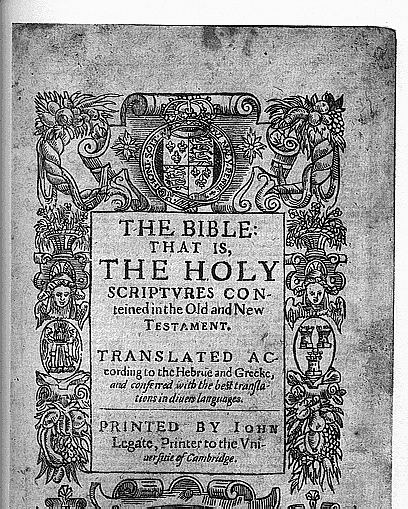
From the Geneva Bible it has been estimated that 19 percent of the KJV text comes, such phrases as:
"his word was with authority" (Lk.4.32); "in all these things we are more than conquerors through him that loved us" (Rom. 8.37); "we have the mind of Christ" (1 Cor. 2.16); "all the fulness of God" (Eph.3.19); "the eyes of him with whom we have to do" (Heb.4.13); "so great a cloud of witnesses" (Heb.12.1).
From the Bishops' Bible comes:
"persecuted for rigeousness' sake" (Mt.5.10); "faithless and p verse generation" (Mt.17.17); "overcome e with good" (Rom.12.21); "was made in 1 likeness of men" (Phil.2.7); "the power of 1 resurrection" (Phil.3.10).
The KJV owe's to the Catholic Rheims Version such expressions as:
| This is the title page of the1582 Rheims New Testament | 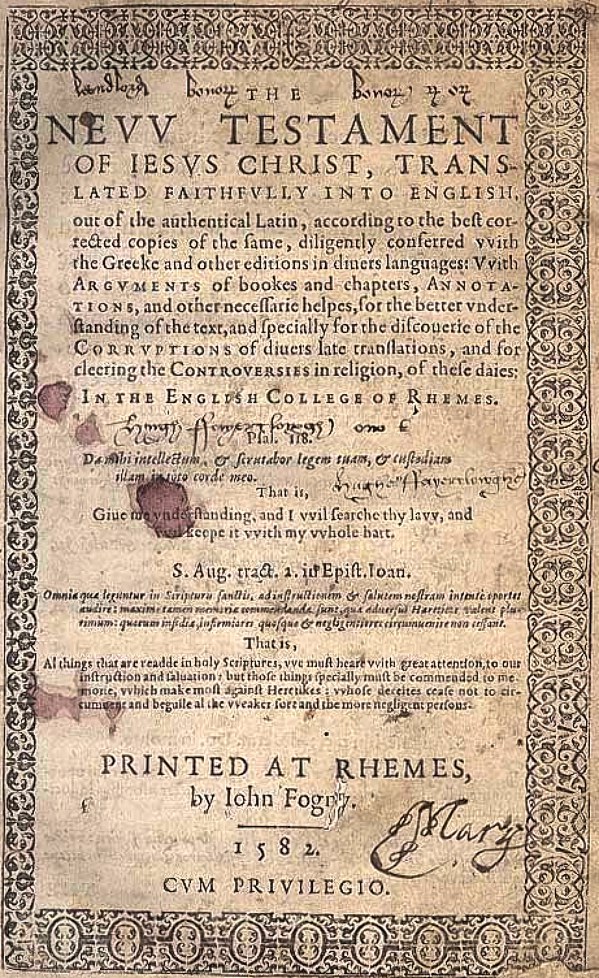 |
"Why, what evil has he done (Mt.27.23); "owe no one anything" (Ro 13.8); "the ministry of reconciliation" (2 Ci 5.18); "to me to live is Christ, and to die gain" (Phil.1.21). Many of the proper names of the New Testament, now so familier, were derived from the Catholic Rheims instead of the Greek. "Elias" instead of "Elijah" (Mat. 11:14 and 17:3-12); and "Jesus" instead of "Joshua" (Heb. 4:8) even though Tyndale, Cranmer, and Geneva Bibles all had "Joshua".
HOME TO: TRADITIONAL CATHOLIC APOLOGETICS
Please sign our Guest book!
This page has helped
People find the truth since November 1999