
A Look at the The "Ælfric Bible".
A Tenth century Catholic English translation of the of the first seven books of the bible.
EZCODE CENTER START
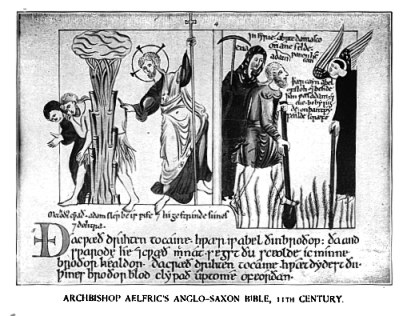 |
| This is a photograph of
Archbishop Aeifric's Anglo-Saxon Bible. It is taken from a beautiful copy
in the Cottonian Library It contains many curious miniatures as for
example the Creation of Eve who is represented as being drawn out of an
opening amongst Adam's ribs. The miniature which we reproduce represents
the expulsion of Adam and Eve from Paradise and their being taught by an
angel to till the ground. Below it is photographed a verse from a later
page (Gen. iv. 9, io). It is interesting to notice in this passage that
almost every word of its Anglo-Saxon is still represented in our present
English:
Tha cwayth Drihten to Caine hwaer is Abel Then quoth the Lord to Cain where is Abel thin brothor: tha andswarode he & cwa'th thy brother: the answered he & quoth is nat,segst thu sceolde is minne brothor &c. I know not, sayest thou should I my brother &c. |
Achbishop Ælfric was a English writer and Benedictine monk. He was one of the the greatest English scholar during the revival of learning fostered by the Benedictine monasteries in the second half of the 10th cent. His aim was to educate the laity as well as the clergy. He wrote in English a series of saints’ lives and homilies—designed for use as sermons by the preachers who were generally unable to read Latin. Ælfric was also the author of a grammar, a glossary, and a colloquy, which were for many years the standard texts for Latin study in English monasteries.
Among his other writings are the Heptateuch, a free English version (Anglo-Saxon) of the first seven books of the Bible. As far as we can judge from the existing manuscripts, most of these early Bible translations were intended for reading in the churches to the people, and their simple expressive terms made them very easily understood. For example, a centurion was a "hundred man" a disciple a " leorning cnight" (learning youth), the man with the dropsy, is translated as "the water-seoc-man" the Sabbath as "the reste daeg " (rest day), and the woman who put her mites in the treasury, is said to have cast them into the "gold hoard."
Ælfric is considered the chief prose stylist of the period. His later writings were strongly influenced by the balance, alliteration, and rhythm of Latin prose. This Catholic English translation was made almost four hundred years before Wycliffe produced his English translation.
The great care that went in to the many ornate hand done illustrations found among its ancient pages clearly show the great love of the scriptures held by the Catholics of that time period.
CLICK
HERE: To read a HTML Transcript of the Old English Version of the THE
BOOK OF GENESIS, from the eleventh century translation by Archbishop
Ælfric.