
Did The Catholic Church "Borrowed Many Items From the Pagans"?
EZCODE CENTER START
Protestant Objection "Many things used by Catholics such as votive offerings, holy water, holydays, and seasons of devotion, processions, Wedding rings, blessing of fields, sacerdotal vestments, the tonsure (of priests, monks and nuns), are of pagan origin, and were barrowed from them"
A Pagan Egyptian Priest using Incense. Incense was condemned by certain prophets because of its association with idolatrous rites (11 Chron. :34:25; let,. Ii:20, 48:35), and yet scholars tell us that, about two pounds of incense per day were consumed in the Temple of Solomon.
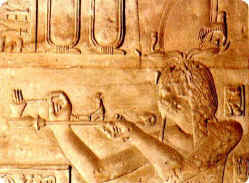
To begin with, Just because Pagans had previously used a item does not mean that, the it was borrowed from them. We ask our selves is, so what if the pagans used them in a sense foreign to Christianity? We can adopt them, give them a new meaning, and so "reclaim" them for God and the Church. In other words can’t these items be sanctified by their adoption into the true Church of God?
The answer is yes, if we were to study the scriptures we would find that many of the familiar objects used in Jewish Worship, were used first by the Pagans. This did not prevent God from ordaining their use among the Jews.
For example we find the Egyptians were the first use Oils, Oil Lamps, Priests, Incense, Ritualistic Anointing, Temples, Religious Processions and Tabernacles in their ancient Pagan worship. The Egyptians were also the first to have Holydays, Holy Seasons, and used Calendars. It should be noted that practice of Circumcision was also common in pre-Moses Egypt. Does this mean that the Jews "Barrowed" these items from the Pagans? does this mean that the Jews should not have used these items? the answer to both of these questions is "NO". For God sanctioned and Sanctified the Jewish use of the items:
- Oils: Oils were were used in the temple, not just for the lamps and menorah, but as part of the sacrifices, for example the meat offerings were mingled with oil. (Lev. 7:10-12)
- Oil Lamps: The seven branched oil lamp called the "menorah" is an ancient symbol of Judaism. Its design was dictated by God when He instructed the Israelites to build the tabernacle in the wilderness. (Ex 25:31-40)
- Anointing: In that section of the Pentateuch known as the Priestly Code the Jewish high priest is anointed (Ex. 29:7; Lev. 6:13, 8:12), The other Jewish priests were anointed as well (Ex. xxx. 30, xl. 13-15). From the earliest times Jewish Kings anointed from the earliest times (Judges, ix. 8, 15; I Sam. 9:16, 10:1; II Sam. 19:10; I Kings, 1:39, 45; II Kings, 9:3, 6, 11:12).
- Priests: God set the tribe of Levi apart for the priestly service, Aaron was anointed and consecrated to the priesthood, arrayed in the robes of his office, and instructed in its manifold duties (Ex. 28. and 29.).
- Incense: Every morning the Hebrew high priest burned incense when he dressed the lamps (Ex. 30:1_9). A special altar of incense was located iv front of the most Holy Place in the Tabernacle and the Temple (Ex. 38:1 f.). On the Day of Atonement the priest carried a censer of burning incense when he entered the Holy of Holies (Lev. 16: 12 f.). In later times Sadducees held that the priest should light the Incense before entering the Most Holy Place, lest lie see the glory of God; Pharisees maintained this to be superstition, and contended that the priest might light the incense after lie had entered. Incense was also burned with meat offerings (Lev. 2:1, 2, 15, 16)
- The Temple: In 2 Chronicles 7: 12-18 God blesses the Jewish Temple indicating His divine pleasure. In the scriptures it is called "the temple of the Lord" (2 Kings 11:10); "thy holy temple" (Ps. 79:1); "the house of the Lord" (2 Chr. 23:5, 12); "the house of the God of Jacob" (Isa. 2:3); "the house of my glory" (60:7); an "house of prayer" (56:7; Matt. 21:13); "an house of sacrifice" (2 Chr. 7:12); "the house of their sanctuary" (2 Chr. 36:17); "the mountain of the Lord's house" (Isa. 2:2); "our holy and our beautiful house" (64:11); "the holy mount" (27:13); "the palace for the Lord God" (1 Chr. 29:1); "the tabernacle of witness" (2 Chr. 24:6); "Zion" (Ps. 74:2; 84:7). Christ calls it "my Father's house" (John 2:16).
- Religious Processions: 2 Samuel chapter 5 Tells us about the Jewish procession to bring the Ark of the Covenant from Obededom back to the City of David. David was joyful in heart and danced with all his might before the Ark of the Covenant .
- Tabernacles: at Mount Sinai, Moses was given instructions from God for a portable tent-like sanctuary that was to be the center of Israel's worship until the Temple of Solomon was built (Ex. 25-30). The sanctuary was called both the "Tabernacle" ("dwelling") and the "Tent of Meeting." The Jews even had a special religious feast day, each year, in honor of the Tabernacle (described in Leviticus 23).
- Holydays, Holy Seasons: The Jews had many Holy Days that were ordained by God, such as the Passover, feast of Unleavened bread, feast of the first fruits, The Day of Atonement, feast of Tabernacle (all of these feasts are described in Leviticus 23) which was observed in both Old and New Testaments.
- Circumcision: Circumcision was enjoined upon Abraham and his descendants as "a token of the covenant" concluded with him by God for all generations, the penalty of non-observance being "karet," excision from the people (Gen. 27:10-14, 21:4; Lev. 12:3)