
The Question of the Church "Chaining Bibles" in the Middle ages.
EZCODE CENTER START
Protestants some times ask:
"Why did the Church in the Middle Ages chain the Bible in their libraries and churches?"
The Bible and other books were chained in the libraries and churches of the
Middle Ages to preserve them from theft, and especially to make them accessible
to students. We must understand that during the Middle Ages (before the
invention of the printing press) a new Bible would cost a community about as
much as a new church building, and the finished book was easily worth a manor.
Books in the Middle Ages were done on parchment or on vellum (made from the
skins of young sheep or cattle) and lettered, gilded, and illuminated by hand. A
whole Bible took maybe four hundred animals and years of work by a score of
scribes and artists. Then as now, there were plenty of unscrupulous collectors,
so a stolen Bible could always be converted into an immense sum of cash. Plus
there were the customary "garnitures", the covers and bindings that
could some times run up to twenty pounds of gold, decorated with jewels and
enamels (when Henry VIII burned all of the Bibles in England, He was careful to
keep the bindings for himself).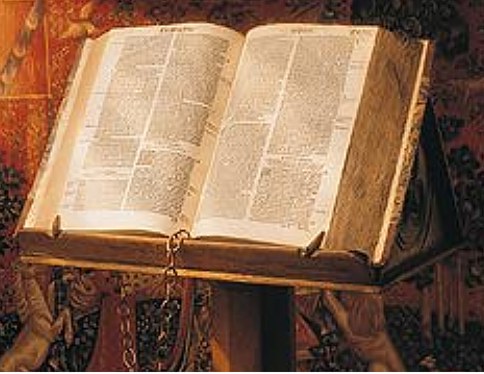
The first mention of chained Bibles occurs in the catalogue of St. Peter's Monastery of Wiessenburg, Alsace, in 1040, which mentions four Psalters chained in the monastery church. Most medieval libraries stored their books in locked chests and presses, for we do not come across any other mention of chained libraries until the fifteenth century. All the books of St. Mark's Library in Florence (1441) and of the Malatesta Library in Cesena (1452) were chained.
Throughout the Middle Ages it was deemed a pious work to bequeath Bibles, Psalters and Books of Hours to be chained in church for common use. Count Frederick of Heidelberg bequeathed his Book of Hours to the Holy Ghost Church in 1474; a Catholic of Leyden, Holland, his Bible to St. Peter's Church; and the Earl of Ormond his Psalter to be chained to his tomb at St. Thomas Acon.
The Reformers adopted this custom of having chained Bibles in their churches, and the practice lasted for over three hundred years. There were chained libraries at Grantham (1598), Bolton (1651) and Wimborne (1686), England, and chained Bibles in most of the English churches (Chelsea, East Winch, Evesham, Minehead, Milton, Shorwell, Stratford). The Oxford Colleges of Eton, Brasenose and Merton did not remove the chains until the eighteenth century, while some libraries removed them only in the nineteenth (Manchester, Cirencester, Llanbadarn).
At the present time we have records of over five thousand chained books in eleven Protestant and two Catholic libraries. A list of chained books in England has been compiled by William Blades in his Books in Chains, and by Charles Cox and Alfred Harvey in English Church Furniture.