
THEM BONES, THEM BONES, THEM DRY BONES
This is a refutation of a deceitful Protestant article by the same name written by Baptist named David Cloud. This article is typical of the trash was found at the militant Anti-Catholic BibleBelievers.net and the Way of Life websites.
EZCODE CENTER START
[Mr. Cloud] "Catholic leaders cited in the article protest that the relics are not worshipped but are simply ‘venerated’ as ‘a piece of memory.’ There is very little difference between venerate and worship."
While it is true that the terms "venerate" and "worship" are similar, in that the are both levels of respect and reverence, there is one glaring difference. "Worship" a is a far higher level of reverence which is only offered to a deity, and contrary to Mr. Cloud’s unfair insinuation, Catholics do not offer this special level of respect and reverence to the bone of saints.
Mr. Cloud’s sly insinuation, is not only unfair but wreaks with dishonesty. By purposely connecting the two words together, he wishes the reader to believe that Catholic leaders sanction the worship of relics, this is far from true.
In the fourth century the great Catholic biblical scholar, Jerome, declared, "We do not worship, we do not adore, for fear that we should bow down to the creature rather than to the creator, but we venerate the relics of the martyrs in order the better to adore him whose martyrs they are" (Ad Riparium, i, P.L., XXII, 907). `
[Mr. Cloud] "I’ve seen Catholics lighting candles and incense and bowing before relics in many parts of the world--at the Vatican in Rome, at St. Joseph’s Cathedral in Montreal, at shrines in Slovakia and Ireland and India and England. This, my friends, is idolatry."
To Start with It should be noted the examples given above, occurred in Church, during prayer services, I’m willing to farther and say they were probably during Mass (which is a ceremony solely focused on the worship of God).
But lest say, for arguments sake that Mr. Cloud did see Catholics using candles and incense while praying to a saint. There are two questions we must ask ourselves
First
, is the use of candles and incense while praying wrong or idolatry? The answer is no, through out the Old and New Testaments we find many examples of God’s people using candles (oil lamps) and incense during prayer. We also find in the scriptures the reoccurring symbolic correlation between the rising smoke and the rising prayers of the faithful. So clearly the use of candles and incense are sanctioned by God and the sacred scriptures.Second,
is praying to the Saints wrong? The answer is also No, for the Scriptures support this Christian practice as well. We shall I shall deal with more thoroughly further down in this refutation[Mr. Cloud] "Those who visit these places hope that the holiness of the relics will somehow make their prayers more efficacious."
Many Protestants regularly visit the graves of deceased friends and family, for they feel a special connection, and closer bond, with their departed loved ones at the grave site. This is similar to how Catholics look at the relics of the saints. Catholics do not feel that use of relics add any "special power" to our prayers, but we do feel they help us form a closer bond to the saints we are praying to.
[Mr. Cloud] "and they are taught to pray directly to the ‘saints’ represented by the relics. All of this is forbidden by the Word of God. Nowhere are we taught to pray to anyone other than Almighty God. To do so is blasphemy and idolatry."
Here Mr. Clouds shows a sever ignorance of both the meaning of the word "pray" and of the sacred text itself. If he had taken the time to study the subject, he would have seen just how wrong he was. Through out the Hebrew and Greek Texts of the Old and New Testament we find several ancient words were used for "pray":
| HEBREW WORDS | GREEK WORDS |
| Na: to beg or to ask for earnestly as a kindness or favor | Deomai: to beg or to ask for earnestly as a kindness or favor. |
| Palal: to intercede or to plead or make a request in behalf of another | Erotao: the act of asking, or expressing a desire, for something. |
| Shaal: to ask | Proseuchomai: to ask for humbly. |
When we examine these words we see a common meaning, prayer is simply to "ask for something". A simple Check of the Webster’s dictionary would show that in the English Language the word "pray" has a similar meaning. So we see that anytime that we "ask" for something, even from humans, we are in fact "praying". Through out the text of the KJV we see that the term "pray" is not just limited to requests made to God, it is repeatedly used in the context of asking fellow humans for something:
Gen. 18:4; 19:2,7,8; 34:8; 37:6; 40:8; 45:4; 50:4; Num. 16:8,26; 22:19; Josh. 2:12; Judges 8:5; 9:2; 19:9; 19:23; Ruth 2:7; 1 Sam. 14:29; 23:22; 2 Sam. 20:16; 1 Kings 20:7; 2 Kings 5:7; Neh. 5:10,11; Job 6:29; 32:21; Is. 5:3 Lam. 1:18 Ez. 33:30; Mic. 3:1,9; Hag. 2:15; Mal. 1:9; Luke 14:18,19; 16:27; Acts 8:34; 24:4; 27:34; 2 Cor. 5:20; (These are just a few examples)
So we see that Linguistically and scripturally, prayer is not limited Just to God.
[Mr. Cloud] "There are no prayers to Mary or to saints in the Bible. The Lord Jesus Christ taught us to pray to God the Father."
Above is detailed chart Showing St. Paul's Prayers to the saints in in the scriptures.
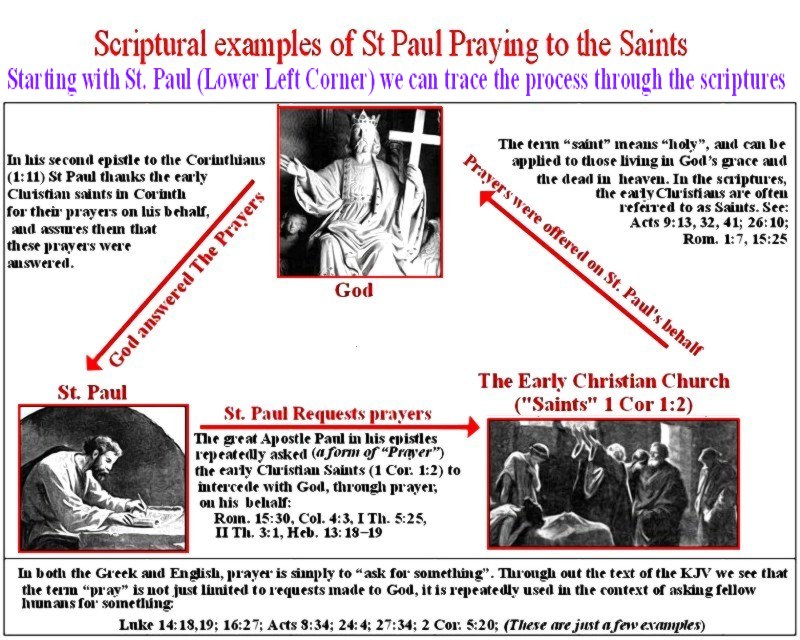
Actually, here again we see Mr. Clouds ignorance of the scriptures, there are many instances of prayers to Saints. For example We find the great Apostle Paul in his epistles repeatedly asking (a form of "Prayer") the early Christian saints (1 Cor. 1:2) to intercede with God, through prayer, on his behalf:
Rom. 15:30, Col. 4:3, I Th. 5:25, II Th. 3:1, Heb. 13:18-19
In his second epistle to the Corinthians (1:11) St Paul thanks the early Christian saints in Corinth for their prayers on his behalf, and assures them that these prayers were answered.
[Mr. Cloud] "We don’t come to God through bones; we come through the shed blood of Jesus Christ."
On this point, I agree With Mr. Cloud, it is not through relics that we come to God or are saved, and the Church has never taught to the contrary.
[Mr. Cloud] "There is not one hint in the Bible that Christians are to save the bones of the dead and make keepsakes of them for any purpose whatsoever. This is pagan and occultic."
"And God did extraordinary miracles by the hands of Paul, so that handkerchiefs or aprons were carried away from his body to the sick, and diseases left them and the evil spirits came out of them" (Acts 19:11-12).
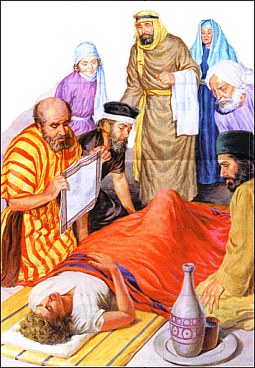
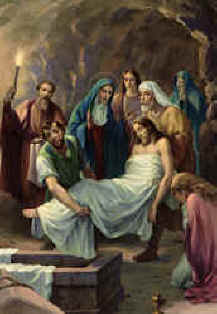 One
of the most moving accounts of the veneration of relics is that of the very body
of Christ itself. Rather than leaving his body on the cross, to be taken down
and disposed of by the Romans (as was the customary practice), Joseph of
Arimathea courageously interceded with Pilate for Christ’s body (Mark 15:43,
John 19:38). He donated his own, newly hewn tomb as Christ’s resting place
(Matt. 27:60). Nicodemus came and donated over a hundred pounds of spices to
wrap inside Jesus’’ grave clothes (John 19:39), that amount of spices being
used only for the most honored dead. And after he was buried, the women went to
reverently visit the tomb (Matt. 28:1) and to further anoint Christ’s body
with spices even though it had already been sealed inside the tomb (Mark 16:1,
Luke 24:1). These acts of reverence were more than just the usual courtesy shown
to the remains of the dead; they were special respect shown to the body of a
most holy man——in this case, the holiest man who has ever lived, for he was
God Incarnate.
In the scriptures there are many examples of where relics have been the occasion of God’s miracles. The use of the bones of Elisha brought a dead man to life: "So Elisha died, and they buried him. Now bands of Moabites used to invade the land in the spring of the year. And as a man was being buried, lo, a marauding band was seen and the man was cast into the grave of Elisha; and as soon as the man touched the bones of Elisha, he revived, and stood on his feet" (2 Kgs. 13:20-21). This is an unequivocal biblical example of a miracle being performed by God through contact with the relics of a saint! Similar are the cases of the woman cured of a hemorrhage by touching the hem of Christ’s cloak (Matt. 9:20-22) and the sick who were healed when Peter’s shadow passed over them (Acts 5:14-16). "And God did extraordinary miracles by the hands of Paul, so that handkerchiefs or aprons were carried away from his body to the sick, and diseases left them and the evil spirits came out of them" (Acts 19:11-12). If these aren’t examples of the use of relics, what are? In the case of Elisha, a Lazarus-like return from the dead was brought about through the prophet’s bones. In the New Testament cases, physical things (the cloak, the shadow, handkerchiefs and aprons) were used to effect cures. There is a perfect congruity between present-day Catholic practice and ancient practice. If Mr. Cloud rejects the Catholic use of relics today as " pagan and occultic", logically he should also reject these biblical accounts as "pagan and occultic".
[Mr. Cloud] "When the first martyr Stephen died, the church at Jerusalem did not keep his bones. They did not hack off a few pieces and distribute them to the other churches. They buried the man (Acts 7:2). All of him!"
To start with the burial first martyr St. Stephen is found in Acts 8:2 (not Acts 7:2 as Mr. Cloud stated). Second the scripture does not say they buried "All of him", it simply states:
"And devout men carried Stephen to his burial, and made great lamentation over him."
The scriptures are very vague as to the topic of how his burial took place. So we see that Mr. Cloud has taken it upon himself to add to the text of the sacred scriptures. For argument sake lets say that no relics were taken from Stephen, does this one instance prove that the early Christians did not practice this reverent custom? The answer must be a simple "No". Few points of faith can be more satisfactorily traced back to the earliest ages of Christianity than the veneration of relics. The classical instance is to be found in the letter written by the inhabitants of Smyrna, about 156, describing the death of St. Polycarp. After he had been burnt at the stake, the Smyrnaeans say, "we took up his bones, which are more valuable than precious stones and finer than refined gold, and laid them in a suitable place, where the Lord will permit us to gather ourselves together, as we are able, in gladness and joy, and to celebrate the birthday of his martyrdom." This is the keynote which is echoed in a multitude of similar passages found a little later in the patristic writers of both East and West.
[Mr. Cloud] "Even in Old Testament times the bones of the saints (every child of God through faith in Christ is a saint--1 Cor. 1:2) were not kept and incorporated into their worship. The body of Joseph was kept, not to use in worship but to carry to the Promised Land to give him a proper burial there (Gen. 50:25; Exodus 13:19; Joshua 24:32)."
Of course the bones of Joseph were not
worshiped, just as Catholics today do not worship relics.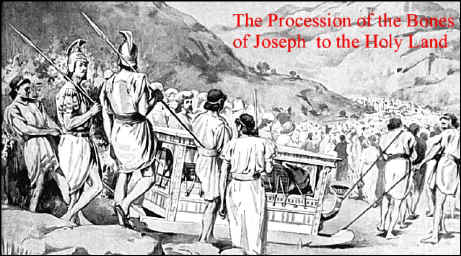
The Story of the body of Joseph is far more than simple story transportation and reburial, as Mr. Cloud would have the reader believe. The body of Joseph was afforded a great deal of respect and reverence (veneration), just as Catholics venerate the relics of the saints. The body of Joseph was reverently and carefully mummified (Gen. 50:25_26). Four hundreds of years passed. Joseph’s body lay in the coffin, and his tomb must have been well identified and looked after by the Jews, because when the Exodus occurred, and Moses led the people of Israel out of Egypt, he was able to locate Joseph’s coffin and take it with them to the Promised Land:. Moses himself had the bones removed from their original burial spot, and personally "took the bones of Joseph with him"(Ex. 13:19) to the Promised Land. Not only were the bones of Joseph taken out of Egypt, but they were carefully guarded all during the wilderness journey for forty years, the transition from Moses to Joshua, and the turbulent conquest of Canaan. The scriptures tell us that bones of Joseph "became the inheritance of the children of Joseph" (Jos. 24:32 ASV). Today, over three thousands of years later Joseph’s grave (a large tomb in the cave of Machpelah in Hebron ) is still a venerated and revered spot among Christians and Jews.
[Mr. Cloud] "God buried the body of Moses to prevent any possibility that his bones would be used as holy relics (Deut. 32:5-6)."
We should start by noting that the scriptures do not say that God buried the body of Moses, it merely states that no man knew were it was buried. Nor does the Sacred text give any reason for the secrecy of the burial site (Deut. 34:6). What Mr. Cloud has done in order to make this argument, is leave the text of the scriptures and draw from ancient Jewish and early Christian tradition (which Mr. Cloud holds as fallible, and not inspired). The first century Jewish Historian Josephus (Ant. iv. 8) wrote of this nonbiblical Jewish tradition, and was mimicked by many early Christian writers.
I see nothing wrong with the unscriptural concept that God (or his angles) hide the location of Moses tomb, considering the Jewish attraction to Pagan Idolatry (Ex. 32:3-4), and their affection to Moses, this would have a reasonable precaution on God’s part. For the Jews probably would have reverted to paganism and worshiped the remains, but since Catholics do not worship relics, this example is not relevant. The comparison of Catholic relics, and Judaism’s attraction to Paganism is very unfair, and not even remotely the same.
Please sign our Guest book!
This page has helped Refuted
People find the truth since November 1999