
The New World Translation, Is It Really a Scholarly Translation?

Is It Really a Scholarly Translation?
To this question the Watchtower has led its followers to believe that although the backgrounds of its translators are not made known, the translation will stand on its own. It does not.
The translation committee is guilty of inventing non-existent Greek grammar (and then follows these made up rules only when necessary to support the theology of the Watchtower) and inserting words into Scripture that change the meaning of God's Word.
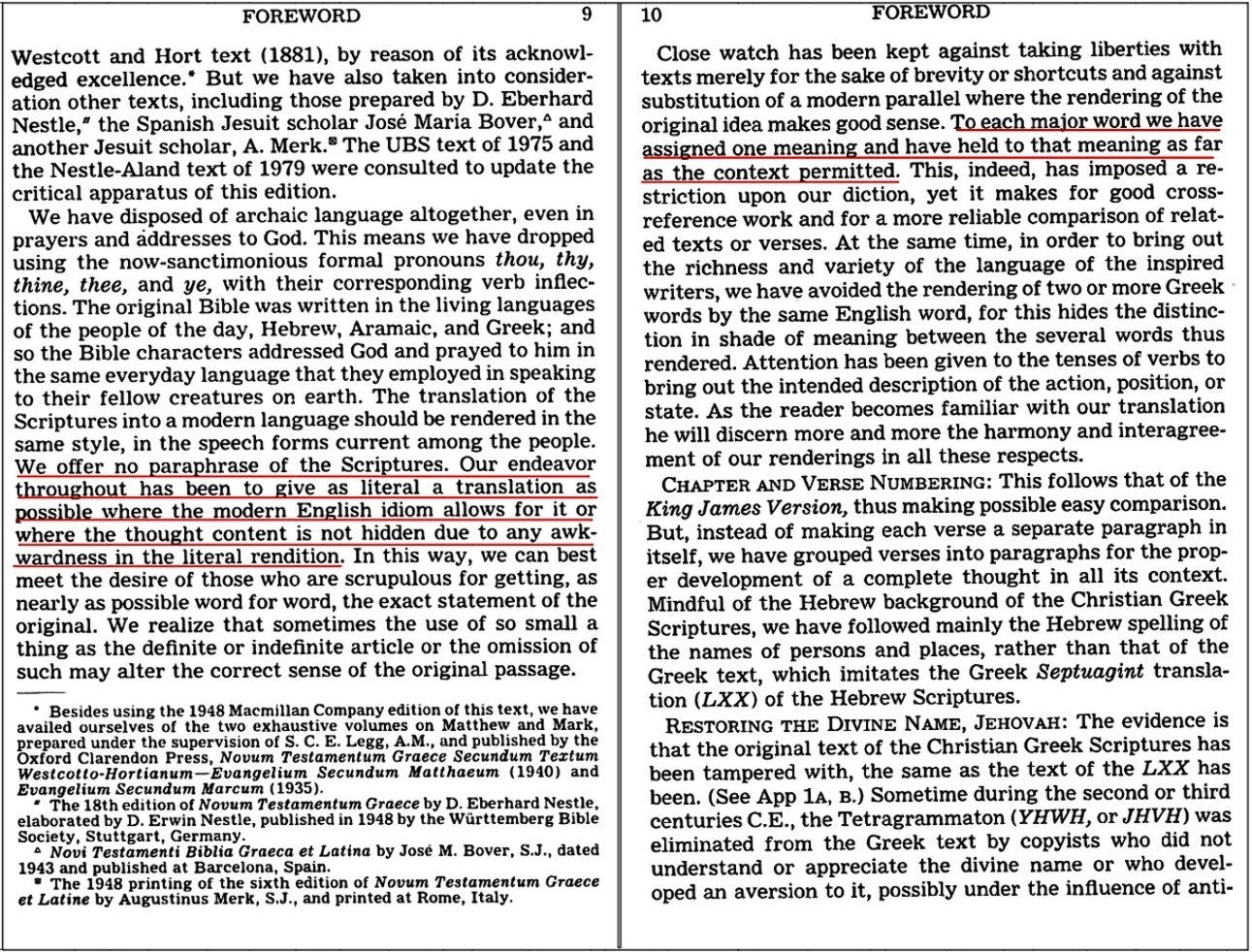 |
| Above are scans of the 1985 edition of the Kingdom Interlinear Translation, pages 9-10. |
The 1985 edition of the Kingdom Interlinear Translation of the Greek Scriptures states for its readers the guidelines and goals endorsed by the translation committee. The Society claims that, "We offer no paraphrase of Scripture. Our endeavor throughout has been to as literal a translation as possible where the modern English idiom allows for it or where the thought content is not hidden due to awkwardness in the literal rendition" and that" To each major word we have assigned one meaning and have held to that meaning as far as context permitted" (pp. 9-10, 1985 ed.; pg. 9,10, 1969 ed.).
However, based on these claims for its translation of the Bible, the committee has failed miserably.
Considering the Watchtower's first point, "We offer no paraphrase of Scripture," one need only examine the NWT renderings of John 15:4,5; John 17:26; Galatians 1:16; Romans 8:10; Colossians 1:27 and 2 Corinthians 13:5 to find that the translation committee has paraphrased Scripture to deny the indwelling of Christ in the believer.
Each of the aforementioned verses speaks of Christ living within the Christian ("in him" or "in you"), yet these verses found in the NWT have been paraphrased to read in union with you (him)" (emphasis added).
Regarding the second point," Our endeavor throughout has been to give as literal a translation as possible...," this criterion likewise misses the mark of honest scholarship.
An examination of Colossians 1:16, 17 and Philippians 2:9 demonstrates through the addition of words that the committee has not presented "as literal a translation as possible. "
In both verses cited one finds the word "other" added. (Christ created all "other" things, meaning he is also a creature, a created being.) Thus we find divine attributes of the Lord Jesus Christ removed, namely that He is the creator of all things and that He possesses the name that is above every name.
Finally, the third point, "To each major word we have assigned one meaning and have held to that meaning as far as context permitted," fairs no better than the previous statements. The translation committee has again let their theological bias bend their rules for translating.
In Matthew 25:46, 2 Peter 2:9 and Acts 4:21 we find the Greek word kolaoontai that refers to punishment.
However, since the Watchtower denies the teaching of eternal punishment we find the committee rendering two of the passages, those in Matthew and 2 Peter (which refer to eternal punishment) as "cutting off" and the Scripture found in Acts (which refers to physical punishment) as "punish."
Since the Kingdom Interlinear Translation provides a between the lines literal Greek-English Translation and the text of the New World Translation (located in the right hand column), we recommend its use for the documentation of the above Scriptural citations.
Why is the Name "]ehovah " Used in the Christian Greek Scriptures?
The Watchtower Society leads its followers to believe that its translation is also superior on the basis that it has restored the divine name ]ehovah (Yahweh) to the pages of the Bible. The Watchtower's publication, "The Divine Name That Will Endure Forever" announces that it was a "apostate" Christian church that removed the divine name and has substituted " Lord" in its place.
However, they have based, in part, this erroneous idea on some guesswork published by Professor George Howard in an article in the March 1978 issue of Biblical Archaeological Review. Howard's evidence was slim and in a more detailed article published the previous year in The Journal of Biblical Literature he sets forth what he proposes as "a theory." The question that the Watchtower leaders never considered is whether Howard's guesses are supported by the evidence.
This question was addressed by Dr. Albert Pietersma of the University of Toronto. Writing in De Sepuaginta, a collection of scholarly articles, by experts in Septuagint studies, Piertersma carefully reviews Howard's use of the three Old Testament manuscript fragments. He finds that a careful examination does not support Howard's theory.
Further the Watchtower's Reasoning book announces, "The divine name appears in translations of the Christian Greek Scriptures into Hebrew, in passages where quotations are made directly from the inspired Hebrew Scriptures. This is merely a rephrasing of the "Restoring the Divine Name" concept found in the Forward of the Kingdom Interlinear Translation (pp. 10ff).
The translation committee has set forth the proposition that a modern translator may render the Greek words Kyrios and Theos as the divine name Jehovah (Yahweh) when the inspired Christian writers have quoted from the Hebrew Scriptures where the divine name appears.
Regrettably, once again the translation committee has followed this rule only when it does not contradicttheir theology. Philippians 2:10,11 serves as a perfect example. Scripture is clear that one day every knee will bow and every tongue confess that "Jesus Christ is Lord." However the Philippians passage is quoted from Isaiah 45:23 and here we are told that to Jehovah every knee will bow.
Therefore based on the Watchtower's own translation rule, the Lord spoken of in Philippians is none other than Jehovah. Further it is of interest to note that the 1950 edition of the New World Translation of the Christian Scriptures, which contained marginal cross references, cited Isaiah 45:23 as a cross reference to the Philippians 2:11 passage.
Numerous scholars with true credentials in the Biblical languages have condemned the Watchtower's New World Translation as a fatal distortion of God's written Word. For example, see The Bible Collector (luly-December, 1971) issue which devotes three articles evaluating the Watchtower scripture.
Thus it has been demonstrated above that the Watchtower Society has, by its own standards, proven its Bible translation to be unreliable and untrustworthy. Those desiring a modern translation would do well to invest in either the New American Standard Version or the New international Version of Scripture to escape the theological prejudice and Biblical untruths found in the New World Translation.
Please sign our Guest book!
This page has helped
People find the truth since November 1999