
THE SHAPE OF THE CROSSES USED IN THE FIRST CENTURY.
[The citations bellow are taken from some of the most scholarly and respected Greek Lexicons, Greek Dictionaries, New Testament word studies, Bible Dictionaries, Bible Encyclopedias.]
|
|
In the years before
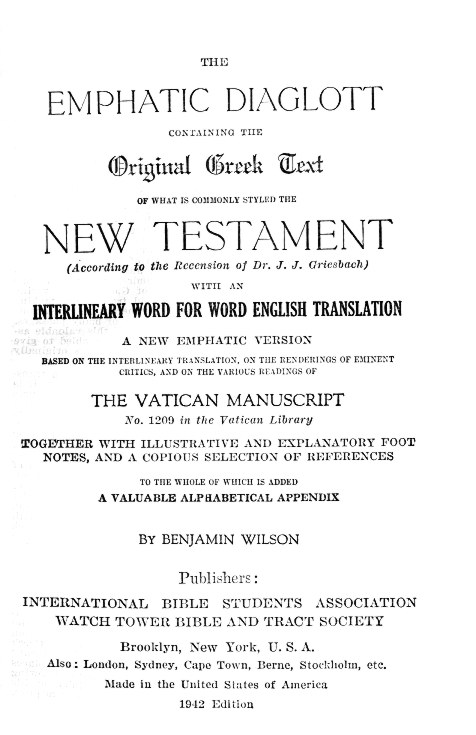
1969 the Interlinear of choice for the Jehovah's
Witnesses was the Emphatic Diaglott. The Emphatic Diaglott was
printed by the Watchtower Society.
This scan is of the definition of the word "Cross" found in the "dictionary" in the back of the Emphatic Diaglott. We note that it describes a Cross as a "T", "t", or a "X" |
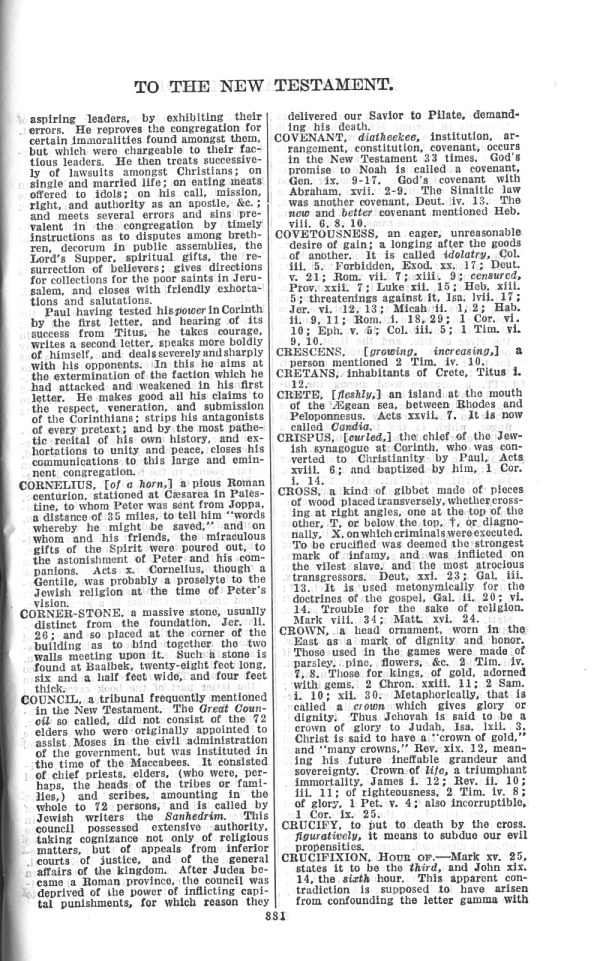
"CROSS, a kind of gibbet made of pieces of wood placed transversely, whether crossing at right angles, one at the lop of the other, T, or below the top, t, or diagonally, X, on which criminals were executed." (The Emphatic Diaglott, printed by the Watchtower Society, p. 881 )
"Stauros,. . . The Cross, N.T. : its form was represented by the Greek letter T, Luc." (An Intermediate Greek - English Lexicon, by Liddell and Scott, Oxford, impression of 1991, p. 743)
"Stauros, ov, o the cross. . . a stake sunk into the earth in a upright position; a cross-piece was oft. (Artem. 2, 53) attached to its upper part, so that is was shaped like a T or thus t." (A Greek-English Lexicon of The New Testament and Other Early Christian Literature, by Frederick W. Danker, Walter Bauer, William Arndt, 1979, p. 764)
"Crucifixion was not the only means of execution at the time, but it was perhaps the most brutal and painful. The ordeal began with a flogging, after which the victim carried the crossbeam to the place of crucifixion, often along a crowded road, where the upright post was already implanted into the ground. There soldiers tied or nailed the outstretched arms of the prisoner to the crossbeam, which was then raised up and fastened to the post. A small wooden peg in the middle of the post provided some support for the suspended body." (The Bible Knowledge Key Word Study, Editor Darrell L. Bock, 2002, P.169)
"4716. Stauros; from histemi (2476) or stag, to stand. A cross, a stake for execution, an instrument of torture. It was not abolished until the time of Constantine, who put an end to it out of regard for Christianity. Crucifixion was at the same time an execution, a pillory, and an instrument of torture. In the NT it means: (1) A Roman cross consisting of a straight piece of wood fixed in the earth with a transverse beam fastened across its top to which the person's hands were nailed, and a small piece of wood projecting from the vertical piece, to which the crucified person's feet were nailed. This is the type of cross on which the Lord Jesus suffered (Matt. 27:32, 40, 42)." (Lexical Aides To the New Testament, compiled and edited by Spiros Zodhiates, Th. D., 1992 P. 956)
"Cross Greek expression: stauros... Three types of crosses seem to have been used: a cross with the crossbar below the head of the upright bar (Latin cross); a T-shaped cross (St. Anthony", cross); and an X-shaped cross (St. Andrew's cross). At Jesus' crucifixion, Matthew records that the inscription, "This is Jesus the King of the Jews," was placed ov Jesus' head (Matt. 27:37). This indicates that for Jesus' crucifixion a Latin cross was used, as artists have traditionally depicted." (Holman Treasury of Key Bible Words, by Eugene E. Carpenter, 2000, p.260)
"Cross, and ancient instrument of execution. Originally the "cross" was an upright stake to which the corpse of an executed criminal was bound for public display or on which the living body of a condemned person was affixed to await death. During Roman times a crossbar was sometimes added across the top of the stake forming a T (later known as St. Anthony’s cross) or intersecting it to form the familiar Christian shape. Later and X-shaped form (St. Andrew’s cross) was also employed." (Harper’s Bible Dictionary, General Editor Paul J. Achtemeier, 1971, P. 194)
|
ANTI-CHRISTIAN GRAFFITI |
|
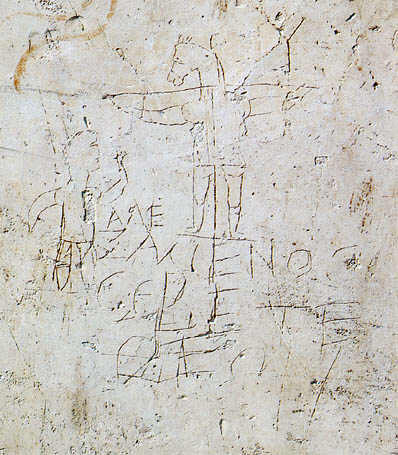 A
picture of the first
century Alexamenos Graffito |
One of the earliest images referring to Jesus on the cross, dates first century (AD). It is a piece of Anti-Christian graffiti known as the "Alexamenos Graffito " . It was found near the Palatine hill in Rome. It was apparently drawn by a Roman soldier to mock another soldier who had converted to Christianity. The caption reads, in Greek, "Alexamenos worships God", while the image shows a man raising his hand toward a crucified figure with a donkey's head. |
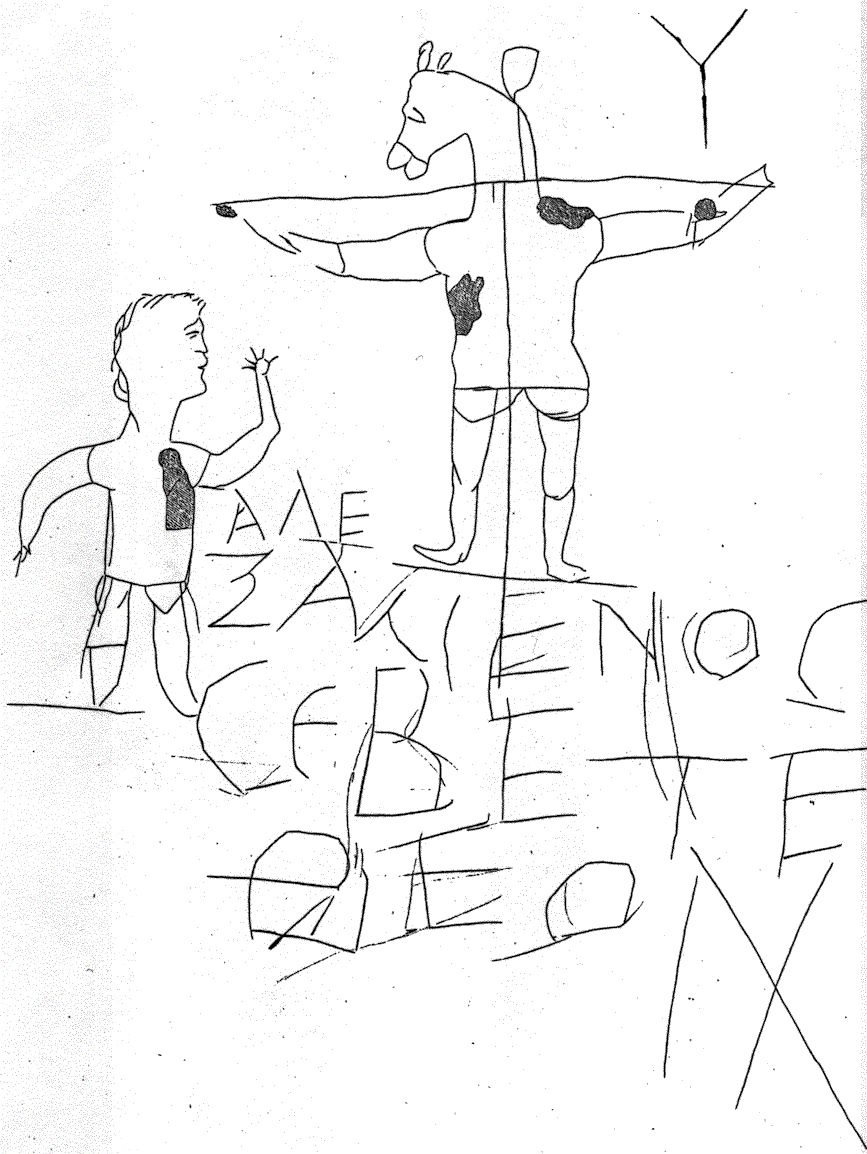 To
the left is a artist rendition of the graffiti. Note the extended arms
forming a 't' shape |
|
"The basic procedures of a typical Roman crucifixion were certainly well known in ancient times, but there was considerable room for variation in practice. The condemned was scourged and usually forced to carry the cross-beam of his cross to the place where the upright part was fixed in the ground. He was stripped to his undergarments and nailed to the cross-beam with a four- or five-inch spike through the wrists. The cross-beam was hoisted up and attached to the top of the gibbet, usually forming a "T" shape. The weight of the body usually rested on a short crosspiece beneath the buttocks. This support helped prolong the torture, so that the condemned would not die quickly. The feet were nailed to the cross by a spike that was driven through both feet together. If the executioners wished to hasten death, the victim's legs could be broken, so that the body would slump down and constrict breathing. The reality of this procedure has become particularly vivid through the recent discovery of a tomb near Jerusalem. Dating from the first century of our era, the tomb contained a partial skeleton of a man crucified perhaps during the census revolt of A.D. 6. The remains include the heel bones, still fastened together by a spike more than four inches long, and the lower leg bones, which showed that both legs had been broken." (Mysteries of the Bible, Edited by Alma E. Guinness, 1988, p. 333)
"Stauros; (I) A Roman cross consisting of a straight piece of wood erected in the earth, often with a transverse beam fastened across its top and another piece nearer the bottom on which the crucified person’s feet were nailed, as was the cross on which the Lord Jesus suffered." (The Complete Word Study Dictionary New Testament, Edited by Spiros Zodhiates Th. D., 1992, P.1309)
"Stauros; the upright (staticulum) was of strong wood and, after implanting in the ground, did not stand more then 9 ft. high. This was left permanently erected outside the walls of the city, only the crossbar (patibulum) being carried by the criminal to the place of execution, were it was affixed to the upright." (New Standard Bible Dictionary, Edited by Melancthon W. Jacobus D.D., 1936, p. 160)
"The two Greek words used for the cross are xylon ('wood') and Stauros ('stake,' or 'cross'). In the Roman world the cross was used to execute only slaves and foreigners. Those with Roman citizenship were protected from shame and the pain associated with crucifixion. As practiced by the Romans, crucifixion involved either tying or nailing the convicted person to a crossbeam which was attached to the Stauros ('pole'). The cross might be in the form of a T or, as it is more traditionally represented, as a t." (New International Encyclopedia of Bible Words, by Lawrence O. Richards Th.M. Ph.D. , 1991, p. 204)
"By the time of Christ’s Crucifixion a crossbar, patibulum, had been added – sometimes carried by the condemned man and fastened to the upright." (Harper’s Bible Dictionary, by Madeleine S. Miller, 1961, p.118)
"A particularly horrible mode of punishment by which a person (some times the corpse of an executed victim) was or bound to a cross (Gk. Stauros, t ; also in the form of an X - or T- shaped structure), or to a stake or tree." (Eerdmans Dictionary of the Bible, Edited by David Noel Freedman, 2000, P.298)
"Stauros; a cross (crux), strictly the transverse beam (patibulum), which was placed at the top of the vertical part, thus forming a capital T. it was this transverse beam that was carried by the criminal " (A Pocket Lexicon To The Greek New Testament, by Alexander Souter M.A., 1946, P. 240)
|
|
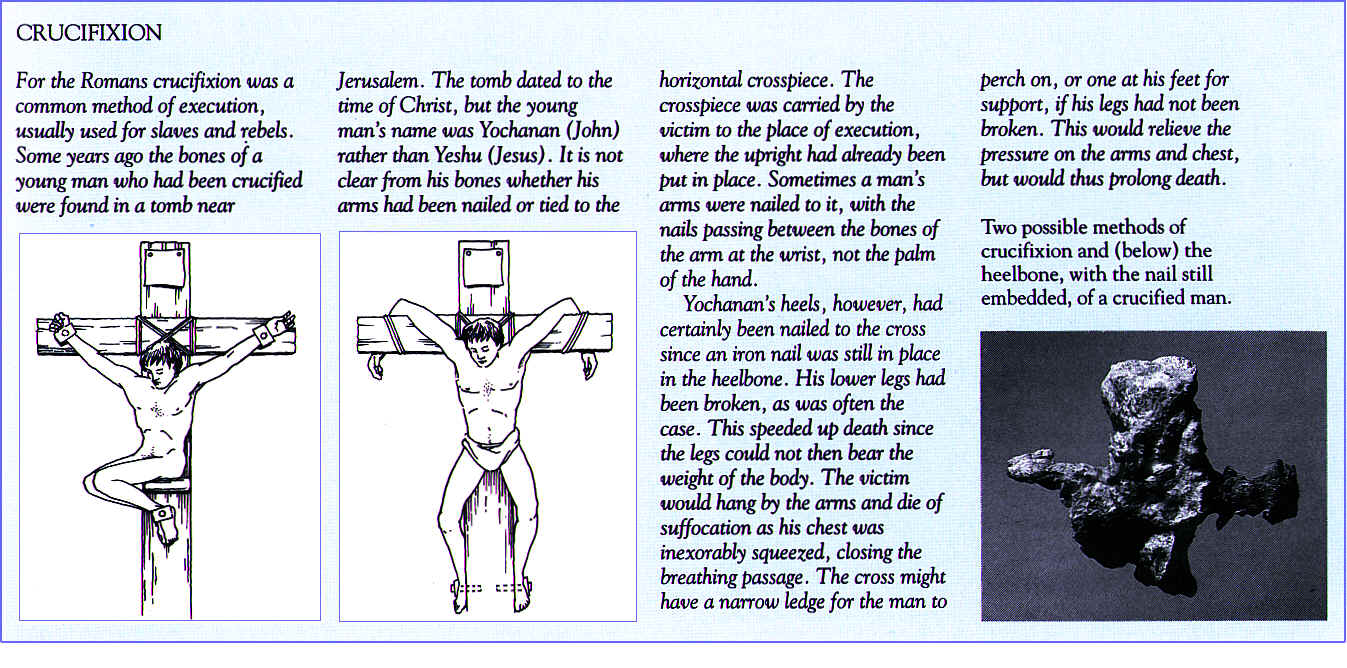
| Archeological finds also verify the shape of Roman "crosses" used in first century Jerusalem. |
"4716. Stauros; from histemi (2476) or stag, to stand. A cross, a stake for execution, an instrument of torture. It was not abolished until the time of Constantine, who put an end to it out of regard for Christianity. Crucifixion was at the same time an execution, a pillory, and an instrument of torture. In the NT it means: (1) A Roman cross consisting of a straight piece of wood fixed in the earth with a transverse beam fastened across its top to which the person's hands were nailed, and a small piece of wood projecting from the vertical piece, to which the crucified person's feet were nailed. This is the type of cross on which the Lord Jesus suffered (Matt. 27:32, 40, 42)." (Lexical Aides To the New Testament, compiled and edited by Spiros Zodhiates, Th. D., 1992 P. 956)
In June of 1968 1st century tombs were accidentally unearthed by bulldozers working north of Jerusalem. Archaeologist, Vasilius Tzaferis excavated the tombs and unearthed the skeletal remains of a young man who had been crucified. Mr Tzaferis, who is not a Christian, wrote an article on his findings in the Biblical Archaeological Review. Writing of what he discovered, part of the Review states: "At the end of the first century BC, the Romans adopted crucifixion as an official punishment for non-Romans for certain limited transgressions. Initially, it was employed not as a method of execution, but only of punishment. Moreover, only slaves convicted of certain crimes were punished by crucifixion. During this early period, a wooden beam known as a 'furca' or 'patibulum' was placed on the slave's neck and bound his arms. The slave was then required to march through the neighborhood proclaiming his offence. This march was intended as an expiation and humiliation. Later, the slave was also stripped and scourged. increasing both the punishment and the humiliation. Still later, instead of walking with the arms tied to the wooden beam, the slave was tied to a vertical stake...Following the beating, the horizontal beam was placed upon the condemned man's shoulders, and he began the long, grueling march to the execution site, usually outside the city walls...When the procession arrived at the execution site, a vertical stake was fixed into the ground...If the victim was attached by nails, he was laid on the ground, with his shoulders on the cross-beam. His arms were held out and nailed to the two ends of the cross-beam, which was then raised and fixed on top of the vertical beam. The victim's feet were then nailed down against this vertical stake...In order to prolong the agony, Roman executioners devised two instruments that would keep the victim alive on the cross for extended periods of time. One known as the 'sedile', was a small seat attached to the front of the cross, about half way down. This device provided some support for the victim's body and may explain the phrase used by the Romans, 'to sit upon the cross'. Both Erenaeus and Justin Martyr describe the cross as having five extremities rather than four; the fifth was probably the 'sedile'." (Biblical Archaeological Review, January/February, 1988, pp. 48-49, as quoted by Doug Harris in Awake to the Watchtower, pp. 309-310.).
"Cross. The cross existed in 4 different forms: 1. The Latin, with the cross beam near the upper part of the up-right beam. 2. St. Andrew's, in the shape of an "X." 3. St Anthony's, in the form of the letter "T." 4. The Greek, with the cross beams of equal length." (Zondervan Compact Bible Dictionary, 1993, p. 119)
"Shape of the Cross. In time the simple pointed stake first used for execution was modified. The four most important of the resulting crosses are: (1) the Latin cross (shaped like a lower case "t"), on which it seems likely that Jesus died for our sins, because of the notice above His head (Matt. 27:37)" (Nelson’s New Illustrated Bible Dictionary, General Editor Ronald F. Youngblood, 1995, p. 315)
"By NT times there seem to have been several different forms of 'crosses' commonly used by the Romans. . . ., most involved the use of at least two separate pieces of wood to construct a frame. However, crucifixion gave executioners opportunity to use their most cruel and sadistic creativity; victims were occasionally hung in grotesque positions by a variety of means. The two cross forms most likely used for the execution of Jesus are the St. Anthony's cross (crux commissa), shaped like a 'T,' or the Latin cross (crux immissa), on which the vertical piece rises above both the horizontal cross-bar (patibulum) and the head of the victim; the statement in Matt. 27:37 (cf. Luke 23:38) that the inscription was placed "over his head" and most ancient tradition favor the latter." (Elwell’s Evangelical Dictionary, by Walter A. Elwell, from CD ROM)
"Cross (Gr. Stauros). . .Our English word is derived from the Latin Crux. The cross existed in four different forms: 1, the crux immissa, the type usually presented in art in which the upright beam extends above the cross beam, traditionally held to be the cross upon which the Redeemer suffered and died." (The Zondervan Pictorial Bible Dictionary, General Editor Merril C. Tenney, 1967, P.189)
"A person crucified in Jesus’ day was first of all scourged (beaten with a whip consisting of thongs with pieces of metal or bone attached to the end) or at least flogged until the blood flowed. This was not just done out of cruelty but was designed to hasten death and lessen the terrible ordeal. After the beating, the victim was forced to bear the crossbeam to the execution site in order to signify that life was already over and to break the will to live. A tablet detailing the crime (s) was often placed around the criminal’s neck and then fastened to the cross. At the site the prisoner was often tied (the normal method) or nailed (if a quicker death was desired) to the crossbeam. The nail would be driven through the wrist rather than the palm, since the smaller bones of hand could not support the wight of the body. The beam with body was them lifted and tied to the already affixed upright pole. Pins or a small wooden block were placed halfway up to provide a seat for the body lest the nails tear open the wounds or the ropes force the arms from their sockets. Finally the feet were tied or nailed to the post. Death was caused by the loss of blood circulation and coronary failure. Especially if the victims were tied, it could take days of hideous pain as the extremities turned slowly gangrenous; so often the soldiers would break the victims legs with a club, causing massive shock and a quick death. Such deaths were usually done in public places, and the body was left to rot for days with carrion birds allowed to degrade the corpse further. Four types of crosses were used: 1) The Latin cross has the crossbeam about two-thirds of the way up the upright pole; 2) St. Anthony’s cross (probably due to its similarity to his famous crutch) had the beam at the top of the upright pole like a T. 3) St. Andrew’s cross (supposedly the form used to crucify Andrew) had the shape of the letter X; 4) the Greek cross has both beams equal in the shape of a plus sign." (Holman Bible Dictionary, General Editor Trent C. Butler, Ph. D., 1991, P. 319--320)
"Cross, a structure for death by crucifixion. it consisted of two beams attached to one another a right angles. to the upper part of the cross, over the victim’s head, appeared his name (Matt. 27:37). (The New Combined Bible Dictionary and Concordance, by Charles F. Pfeiffer, 1965, p.116)
"The forms in which the cross is represented are these:_ 1. The crux simplex (I), a "single piece without transom." 2. The crux decussata (X), or St. Andrew's cross. 3. The crux commissa (T), or St. Anthony's cross. 4. The crux immissa (t), or Latin cross, which was the kind of cross on which our Savior died. " (Easton’s Bible Dictionary, by Matthew George Easton, 1897, from CD ROM)
"There were 3 types of cross: the T St. Anthony's cross; the X St. Andrew's cross; and the dagger-shaped Cross which is likely to have been the one Jesus was crucified on, because of the inscription nailed above His head (Matt. 27:37)" ( The New Concise Bible Dictionary, Edited by Derek Williams, p. 112)
"Cross, Stauros (Mark 15.21, ect) ... It consisted of two beams of wood, one nailed to the other in the form of X, or T, or t. The last which is most familiar to us in art, was in all probability the shape of Christ’s cross." (The Illustrated Bible Treasury, Edited by William Wright, D.D. 1896, p. 320 )
"CRUCIFIXION. 1. Its nature. Crucifixion denotes a form of execution in which the condemned person was affixed in one way or another to a cross (Lat. crux) and there left to die. The Gr. term rendered 'cross' in the Eng. NT is Stauros (staurob='crucify'), which has a wider application than we ordinarily give to 'cross,' being composed of two beams.... Forms of the cross. The primitive form was the crux simplex a single post set upright in the earth, to which the victim was fastened; or a sharp stake on which he was impaled. The Roman cross was more elaborate, consisting of two beams, which, however, might be put together in different ways. Three shapes are distinguished: (1) The crux commissa (T), shaped like a capital T, and commonly known as St. Anthony's cross; (2) the crux immissa (t), the form with which we are most familiar; (3) the crux decussaia (X), shaped like the letter X, and known as St. Andrew's cross. Early Christian tradition affirms that it was on (2) that Jesus died (e.g. Iren. Haer. ii. 24, § 4; Justin, Trypho, 91); and this is confirmed by the statements of the Gospels as to the 'title' that was set above His head (Mt 27:37, Mk 15:26, Lk 23:38, Jn 19:19.)." (Hastings, Dictionary of the Bible, Editor James Hastings, 2001, p. 171 )
"Crosses are of three leading types: one, generally called the St. Andrew's cross, like the letter X; another like the letter T; and the third of the dagger form, known as the Latin cross. The cross of Christ was, probably, of the last named type, which more easily than the others allowed the name, title, or crime of the victim to be affixed to the upper part (Matt. 27: 37; Mark 15: 26; Luke 23: 38; John 19:19). " (New Illustrated Davis Dictionary of the Bible, By John D. Davies, 1973 p. 159)
"Cross, An instrument for execution consisting of an upright beam left permanently in the ground surmounted by a crossbeam or patibulum, which might also be attached a little below the top of the upright. The condemned prisoner himself carried the patibulum to the place of execution, where he was stripped naked. His arms were bound to the crossbeam and his legs to the upright with either nails or rope or both. He was left suspended until he died of thirst or starvation." (The New World Dictionary- Concordance, 1970, p. 108)
"Cross, in the New Testament the instrument of crucifixion, and hence used for the crucifixion of Christ itself (1 Cor. 1:17; Gal. 5:11; 6:12, 14; Eph. 2:16; Phil. 3:18; Heb, 12:2). The word is also used to denote any severe affliction or trial (Matt. 10:38; 16:24; Mark 8:34; 10:21). The forms in which the cross is represented are these: (1.) The crux decussata (X), or St. An_drew's cross. (2.) The crux commissa (T), or St. Anthony's cross. (3.) The crux immissa (t), or Latin cross, which was the kind of cross on which our Savior died. Above our Lord's head, on the projecting beam, was placed the title." (Today’s Dictionary of the Bible, Complied by T.A. Bryant, 1982, p.152)
"CROSS. An upright stake, with one or more cross pieces, on which persons were suspended for Punishment." (Smith’s Bible Dictionary, Compiled by Dr. William Smith, p. 66)
"Four types of crosses were used: 1) The Latin cross has the crossbeam about two-thirds of the way up the upright pole; 2) St. Anthony’s cross (probably due to its similarity to his famous crutch) had the beam at the top of the upright pole like a T. 3) St. Andrew’s cross (supposedly the form used to crucify Andrew) had the shape of the letter X; 4) the Greek cross has both beams equal in the shape of a plus sign." (Holman Concise Bible Dictionary, General Editor Trent C. Butler, Ph. D., 1997, P. 153)
"The Latin cross, on which out Lord suffered, was in the form of the letter T, and had an upright above the crossbar, on which the "title" was placed. There was a projection from the central stem, on which the body of the sufferer rested." (The Peloubet- Smith Bible Dictionary, 1966, P. 129)
"Crosses are of three leading types: one, generally called the St. Andrew's cross, like the letter X; another like the letter T; and the third of the dagger form, known as the Latin cross. The cross of Christ was, probably, of the last named type, which more easily than the others allowed the name, title, or crime of the victim to be affixed to the upper part (Matt. 27: 37; Mark 15: 26; Luke 23: 38; John 19:19). " (The New Westminster Dictionary of the Bible, Edited by Henry Snyder Gehman, 1970, p. 194)
"CROSS (Gr. Stauros; Lat. crux)... The Roman cross consisted of two beams which were put together in three different forms: (1) the crux immissa, the most familiar and the type JESUS CHRIST was crucified on, is usually represented with the upright beam extending above the cross beam; (2) the crux commissa, or "Saint Anthony's Cross," is shaped like a capital T; (3) the crux decussata, or "Saint Andrew's Cross," is shaped like the letter X. Another type of cross, the Greek or "Saint George's Cross," is one in which the cross beam is centered on the upright beam, both beams usually of equal length." (The Family Bible Encyclopedia, 1972, Vol. 4 p. 676 )
"Cross, an ancient instrument used for capital punishment. After the crucifixion of Christ it became the Christian symbol of redemption. The New Testament gives no indication of the form of the cross on which Christ died. Tradition uniformly refers to the Roman cross. Other varieties were used. Crucifixion was regarded by the Romans as the basest and most ignominious death. It was an accursed death. Deut. 21:23; Gal. 3:13. As a Christian symbol the cross is in various forms, namely the Roman Or Latin cross (+), the Saint Andres's cross (X), the Greek cross (+). A double cross is used by the Pope, and a triple cross is used by the Raskolniks, a Russian sect." (The Pocket Bible Dictionary, Revised and Edited by Phillip Schaff D,D. LL.D., 1996, p.51)
"Crosses are of three leading types: one, generally called the St. Andrew's cross, like the letter X; another like the letter T; and the third of the dagger form, known as the Latin cross. The cross of Christ was, probably, of the last named type, which more easily than the others allowed the name, title, or crime of the victim to be affixed to the upper part (Matt. 27: 37; Mark 15: 26; Luke 23: 38; John 19:19). " (The Bible Dictionary, By Baker Book House, Copyright 1954, Page 154)
"In the time of Christ there were three types of crosses: (1) the type usually pictured in Christian art; (2) a cross shaped like a T; and (3) a cross shaped like an X. As an instrument of death, the cross was abhorred by both Jews and Romans; although the Romans administered execution by crucifixion, no Roman citizen could be crucified. Among the Romans, crucifixion was preceded by scourging, probably to hasten death. The victim was then either tied to the cross beams or fastened with nails or stakes." (The Layman's Bible Encyclopedia, by William C. Martin M.A. B.D., 1964, p.161)
"Cross. The cross existed in 4 different forms: 1. The Latin, with the cross beam near the upper part of the up-right beam. 2. St. Andrew's, in the shape of an "X." 3. St Anthony's, in the form of the letter "T." 4. The Greek, with the cross beams of equal length." (Handy Dictionary of the Bible Dictionary, edited by Marrill C. Tenney, 1980, p. 39)
Each prisoner was then placed on his cross. Jesus suffered in silence as the soldiers nailed his wrists to the crosspiece with large iron spikes and drove another spike through both ankles. As they lifted his cross upright, his weight was supported by a peg jutting out from the cross between his legs. The soldiers placed a sign on the cross, pro-claiming, "This is Jesus the King of the Jews." As was customary, they then offered him some wine mixed with gall to dull the pain." (Great People of the Bible and How They Lived, by G. Ernest Wright,1974, p.381)
"CROSS, a kind of gibbet made of 2 pieces of wood placed transversely." (The Dictionary of the Holy Bible 1896, p. 118)
BACK TO THE MAIN SECTION ON THE CROSS
Please sign our Guest book!
This page has helped
People find the truth since November 1999