
The Jehovah's Witnesses, The Crosses, and "Idolatry"
EZCODE CENTER START
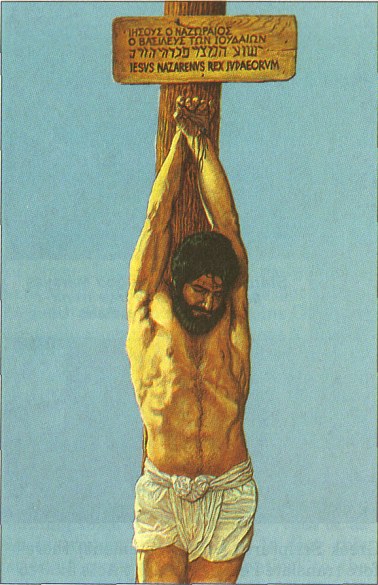 |
| This rendition of Christ's death is taken from "The Watchtower" magazine. The Jehovah's Witnesses hold that Christ died on a "torture stake" |
The Jehovah's Witnesses deny the fact that Christ died on a cross (with two beams), they hold that is was a stake (a single beam) that Jesus was crucified on. The Watchtower Bible and Tract Society goes to great pains throughout many of it's publications, to show the diligent bible student that it's translation to torture stake is the correct one. The Watchtower (Feb. 1 1968) Says:
"True Christians NEVER REVERED THE CROSS OR REGARDED IT AS A SYMBOL OF TRUE CHRISTIANITY. Many persons contend that the cross is used by the churches because Christ died on one. That is what the churches say, BUT IT IS NO THE TRUTH." (emphasize mine)
The Witnesses will argue that the cross his a "Pagan history" and is a "Pagan symbol", they will say that because of this possessing, honoring and wearing crosses are acts of "idolatry" The Watchtower (Aug. 15, 1987 pg. 23-24) says:
"Bear in mind, how the cross has been used down through history as a object of pagan worship and of superstitious awe, could wearing a cross, even as a ornament, be harmonized with the admonition of the apostle Paul at 1 Corinthians 10:14 ‘Therefore, my beloved ones, flee from idolatry’?"
Has the Watchtower Bible and Tract Society always held the position that simply because a item was at one time in the past used in pagan worship it is still to be considered a "idol" and not to be used by true followers of "Jehovah" even as a ornament. Apparently not!! This position has been refuted in the past in the Witnesses own publications, for example The Watchtower (May 15, 1972, pg. 295) tells us:
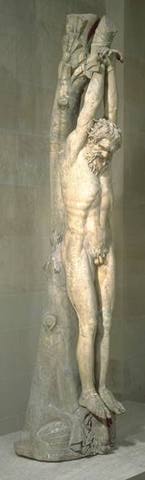 |
| The Death Greek god Marsyas This Pagan statue depicting the death of the Greek god Marsyas's is from a third century [B.C.]. It is currently housed in the Louvre in Paris France. If we apply the "similarity make relationship" argument, it could be claimed, the Watchtower's images of Christ dieing on a "torture stake" have a Pagan origin. |
"The Holy Scriptures make it plain that not all pictures, statues and other representations are idols. Whether an object is an idol or not primarily depends on how it is viewed. This might be illustrated by ancient representations of bulls.
In the courtyard of the temple built by Solomon stood the "molten sea.’ This large vessel rested upon the figures of twelve bulls. These representations thus served both a utilitarian and an ornamental purpose. But they were never worshiped. Supporting as they did a vessel that normally held around 11, 600 gallons of water, the bulls were a fitting symbol of strength or power. (1 Ki. 7:26) They called attention to the truth enunciated at Psalm 62:11; "Strength belongs to God."
On the other hand, the golden calves set up by King Jeroboam at Dan and Bethel were idols. They received actual worship in the Northern Kingdom of Israel. Even thought the claim was made that the golden calves represented Jehovah, this did not make the relative worship given to them acceptable. (1 Ki. 12:28; 14: 7-9) Declared Jehovah through his prophet Isaiah: "I am Jehovah. That is my name; and to no one else shall I give my own glory, neither my praise to graven images." (Isa. 42:8) By making the golden calves (evidently your bulls) and using them in worship, the Israelites made themselves guilty of exchanging God’s glory for something that misrepresented him. How of the universe to be represented as a bull, "an eater of vegetation!"—Ps. 106:20.
The fact that the bull was an object of worship in the Northern Kingdom of Israel did not make the bulls at Solomon’s temple idols... Similarly, the fact that various creatures, plants and heavenly bodies—all parts of God’s creative works—have been and still are being given veneration would not in itself make them unacceptable for decorative or ornamental purposes. MANY THINGS THAT WERE AT ONE TIME WORSHIPED BY ANCIENTS HAVE LOST THEIR IDOLATROUS SIGNIFICANCE AND ARE GENERALLY REGARDED AS BEING MERELY ORNAMENTAL." (emphasize mine)
Please sign our Guest book!
This page has helped
People find the truth since November 1999