
LUKE 1:34 AND MARY'S VOW OF VIRGINITY
EZCODE CENTER START
| "And the
angel said to her: Fear not, Mary, for thou hast found grace with God.
Behold thou shalt
conceive in thy womb, and shalt
bring forth a son; and thou shalt
call his name Jesus. He shall be great, and shall be called the Son of
the most High; and the Lord God shall give unto him the throne of David
his father; and he shall reign in the house of Jacob for ever. And of
his kingdom there shall be no end.
And Mary said to the angel: How shall this be done, because I know not man?" (Luke 1: 30-34 from the KJV) |
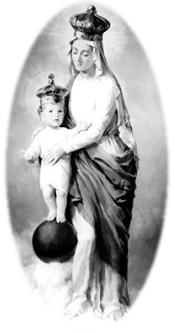 When we
read Luke's account of the At the Annunciation, and we examine Mary's question
to the angle ("How can this be"
[Lk 1:34] ), We are forced to draw one conclusion. Mary's had a lifelong vow of virginity. This
is the understanding of the passage held by many of the early Christians. The
Early Church Father S. Augustine
explains:
"Surely, she would not say, 'HOW shall this be?' unless she had already vowed herself to God as a virgin...If she intended to have intercourse, she wouldn't have asked this question!
In being born of a Virgin who CHOSE to REMAIN a Virgin even BEFORE she KNEW who was to be born of her, Christ wanted to approve virginity rather than to impose it. And He wanted virginity to be of FREE CHOICE even in that woman in whom He took upon Himself the form of a slave." (Holy Virginity 4:4 c. 401 A.D.)
Remember, Mary was ALREADY "betrothed" to Joseph (Mt 1:18; Lk 1:27). Mary was questioning how this pregnancy was to happen. Every new bride , under normal circumstances, would be anticipating at least the possibility of children. Now either Mary had made a vow of virginity or she did not. If she had not then this question of hers to the angel of how she was to become pregnant does not make sense since there had, up until this moment, only one way to get pregnant. Therefore, this questioning by Mary only makes sense if she had made a vow of virginity. Therefore, the text suggests that Mary was asking if God had wanted her to forgo a vow of virginity that she had already made to God.
In considering Mary's question about how she would become pregnant, it is important to note that the archangel said that Mary "Shalt" - the future tense - conceive a child. Mary would have assumed that the child would be conceived the only way any child had ever been conceived until then.
Therefore, since we can arrive at the reasonable conclusion that Mary had taken a vow of virginity, it follows that she would have discussed this with Joseph and that he would have consented to this before their marriage.
Scholarly reference in Support of this position
Early Christian Support for the Perpetual Virginity of Mary
NOTES
SCHOLARLY REFERENCES IN SUPPORT OF THIS POSITION:
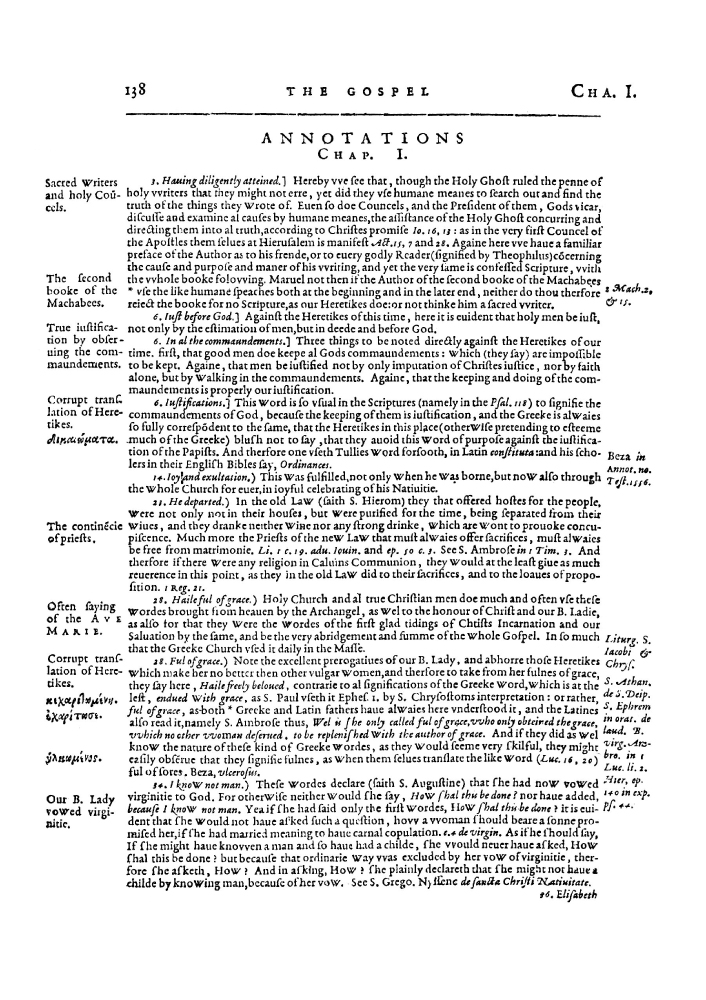
| "34. I know not man.) These Words declare (faith S. Augustine) that she had now vowed virginity to God. For otherwise neither Would she say, How shall be done? Nor have added, because I know not man. Yea if she had said only the first words, How shall this be done? It is evident that she would not have asked such a question, how a woman should bear a son promised her, if she had married meaning to have carnal copulation 6.4 de virgin. As if he should say, If she might have known a man and so have had a child, she would never have asked, How shall this be done? But because that ordinary Way was excluded by her vow of virginity, therefore she asketh, How? And in asking, How? She plainly declareth that she might nor have a child by knowing man, because of her vow." (Annotation for Luke 1:34, from the1582 Catholic Rheims New Testament, printed in Rheims France, by John Fogny) |
|
| The Above scan is the Annotations for Luke Chapter I, of the 1582 Rheims New Testament |
"34. This can only mean that she had made a vow of virginity. Mary did not doubt as Zachary did S.T. III. xxx. 4 ad 2. She did not question that fact, but only the mode of its fulfilment." ("The Layman’s New Testament, Father Hugh Pope, O.P., S.T.M., D.S.S., Copyright 1934,Page 189)
"34. According to some commentators Mary understood the words thou shalt conceive as referring to the immediate future; hence, since several months were still to elapse before the final marriage ceremony between her and Joseph, she asks the angel for further instructions. But the traditional interpretation takes her last words in the sense of "since I shall not know man," and argues from this that Mary had a vow or at least a firm resolution to remain a virgin forever. In any case the fact of her perpetual virginity is absolutely certain, whatever might have been the state of her mind at this time." ("A Commentary on The New Testament", The Catholic Biblical Association, Copyright 1942 ,Page 235)
"If she anticipated having children and did not intend to maintain a vow of virginity, she would hardly have to ask 'HOW' she was to have a child, since having a child the normal way would be expected by a newlywed. No, her question makes sense only if there was an apparent, but not a real, conflict between keeping a vow of virginity and acceding to the angel's request." ("Catholicism and Fundamentalism" by Karl Keating ,Page 283-284)
EARLY CHRISTIAN SUPPORT FOR THE PERPETUAL VIRGINITY OF MARY:
All of the following references are from: "The Faith of the Early Fathers" , edited and translated by W. A. Jurgens (The Liturgical Press, Collegeville: Minn, c. 1979), III Vols.
St. Athanasius (358-362) in his Discourse Against the Arians called the Mother of Jesus, "the ever-virgin Mary" #767a, I, p. 330.
Didymus the Blind (381-392 - He was head of the catechetical school at Alexandria) "for neither did Mary. . . marry anyone, nor did she ever become the mother of anyone else, but even after childbirth she remained always and forever an immaculate virgin." #1073, II, p. 62.
St. Epiphanius of Salamis (374) "the holy ever-virgin Mary" and "to Holy Mary is invariably added, for that Holy Woman remains undefiled." #1111, II, p.76.
St. Jerome (383) wrote a whole treatise called: Against Helvidius: The Perpetual Virginity of the Blessed Virgin Mary, II, pp. 190-192.
St. Augustine (391-430) "a virgin conceiving, a virgin bearing, a virgin pregnant, a virgin bringing forth, a virgin perpetual." #1518, III, p.30; also: #1642, III, p. 71; #1974d, p. 166.
Leoporius (426) "the ever-virgin Mary" Document of Amendment, #2048, III, p. 197.
St. Cyril of Alexandria (542) "Therefore he kept His Mother a Virgin even after her childbearing." #2133, III, p. 232.
St. Peter Chrysologus (405-450) "and a virgin she remained." # 2177, III, p. 267.
Leo I (c. 461) "a Virgin conceived, a Virgin bore, and Virgin she remained" III, p. 275, #2194.
Gregory of Tours (575-593) "A virgin both before and after she bore Him" III, p. 306 # 2288 b.
Sophronius of Jerusalem c. 638 "the immaculate virginity which was unblemished before the birth, during the birth, and after the birth" III, p. 307 #2289.
John Damascene c. 743 "The Ever-Virgin remains after birth a Virgin still." III, p. 340 #2372.
Please sign our Guest book!
This page has helped
People find the truth since November 1999