
The "Scripture Alone" Theory, and the Ending of the Gospel of Mark

|
|
| Above is scan of the end of the from the gospel of Mark from the "New World Translation". |
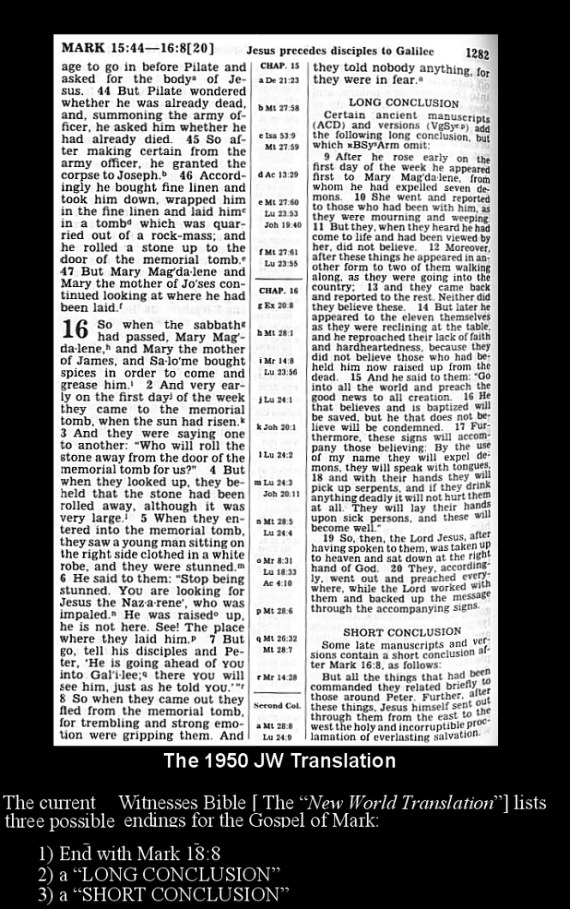
Another example, of the failure of the "Scripture Alone" theory, is the ending of the gospel of Mark. Many modern Protestant translations find it difficult to determine how the apostle intended his gospel to end, for example the seven editions listed below actually provide three possible endings for Mark’s work.
- The Today’s English Version (some times called the "Good News Bible")
- An American Translation
- New Living Bible
- Contemporary English Version
- New World Translation
- A New Translation by James Moffatt
- New American Standard Bible (updated edition)
|
|
| Above is scan of the end of the from the gospel of Mark from the "New International Version". |
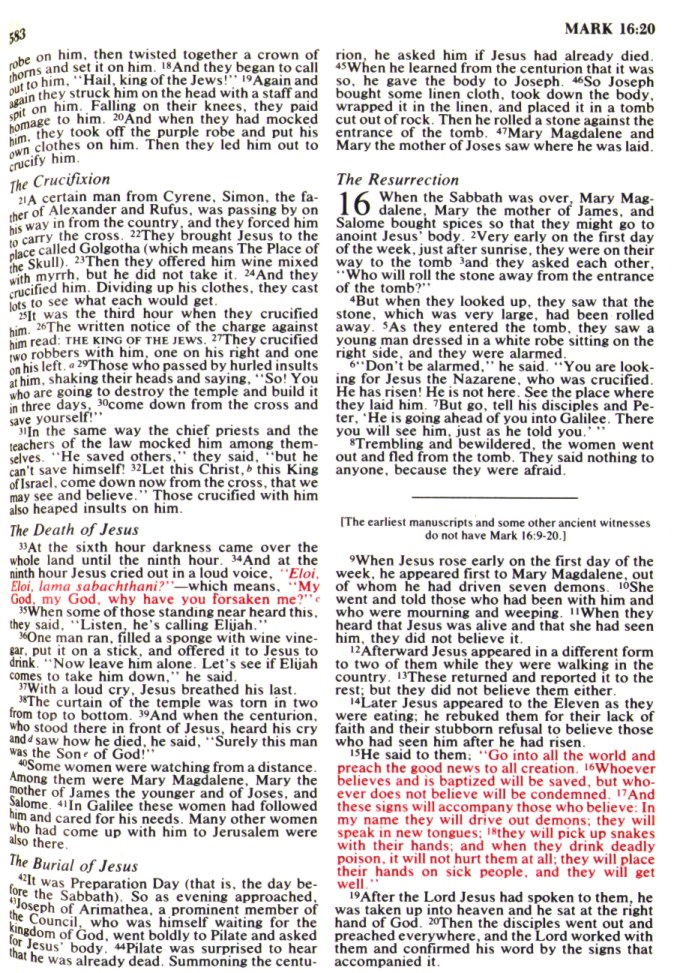
One ending stops with 18:8, then there are to other alternate endings, a long conclusion and a short conclusion. The long conclusion is the traditional verse 18:9-20, found in the King James Version. Then there is a alternate short conclusion, about the size of two verses.
Some protestant versions of the Bible such as the four examples listed below, provide two distinctly separate endings for the book of Mark. One ending stops with 18:8, and the long conclusion (18: 9-20).
- New International Version
- Holman Christian Standard Bible
- The New Testament in Modern English
- The New Testament in Modern Speech English Standard Version
It is hard to hold the "Scripture Alone" theory when there is no physical authority to look to in order determine how the book of Mark ends. So were do Protestants turn to solve this mystery, how do they figure out which ending is scriptural and which is not. The text of Gospel itself does not distinguish which ending is correct, the ancient Greek and Latin manuscripts are divided on the issue. The fallible "scholar" are inconclusive, as the above version prove. How can one be solely dependant on a book for spiritual guidance, when they can not even authoritatively determine what are the physical bounds of the text it self?
Thank God that as Catholics we have a visible Church to guide us with the authority to determine such matters for us.
Please sign our Guest book!
This page has helped
People find the truth since November 1999