
Are the "Apocrypha" books are to be found in the Hebrew language?

I'm sure we have all heard the old argument:
"Not one of the 'Apocrypha' books are to be found in the Hebrew language like the rest of the Old Testament books."
In the above statement, I hope that our Protestant "friends" are acting in good faith and out of ignorance, and that he truly did not know the truth about the books in question. This age old Protestant argument is easily proven to be wrong. As St. Francis de Sales said in his famous book "The Catholic Controversy":
"I say the same to you about Ecclesiasticus, which S. Jerome had and found in Hebrew, as he says in his preface on the books of Solomon. Since, then, you reject these books written in Hebrew or Chaldaic equally with the others which are not written in one of these languages, you will have to find another pretext than that which you have alleged for striking out these books from the canon."
The Book of Ecclesiasticus (The Wisdom of ben Sira) in the Hebrew :
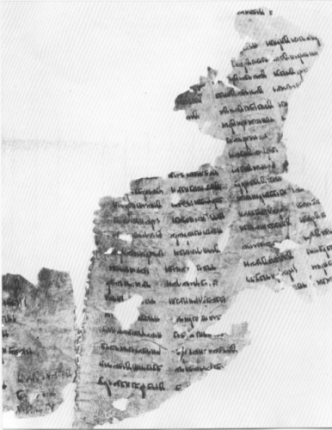 |
| This is a picture is a fragment of the Ecclesiasticus scroll, found in Hebrew language, discovered by Yigael Yadin in the ruins of Masada in the 1960's. |
This point has been born out in the caves of Qumran in 1947 [the "Dead sea scrolls" findings] were found
copy [scroll 2QSir] a of the book of Ecclesiasticus (The Wisdom of ben Sira) in the Hebrew . Another example would be the manuscript Or.1102 perhaps the most famous manuscript of the collection housed at CAMBRIDGE UNIVERSITY, England. It was found in Genizah [Egypt] in 1896. Solomon Schechter, Reader in Talmud at Cambridge (and later president of the Jewish Theological Seminary in New York), identified the Ecclesiasticus text based on the existing Greek translation. Another copy of Ecclesiasticus, in Hebrew, was later discovered by Yigael Yadin in the ruins of Masada in the 1960's.
The Book of I.Esderas in the Hebrew :
If the Protestants had just look at 1611 King James Version they would have found that in the Margin notes to the "apocryphal" book of I.Esderas the Translators often quote from and refer to the Hebrew version of this Book, obviously they found and had I.Esderas in the Language of the Jews. Some examples of these Margin notes are found for verses:
I.Esderas 3:13; 4:14; 7:5, 9; 8:23, 32, 50, 57, 66, 79, 96;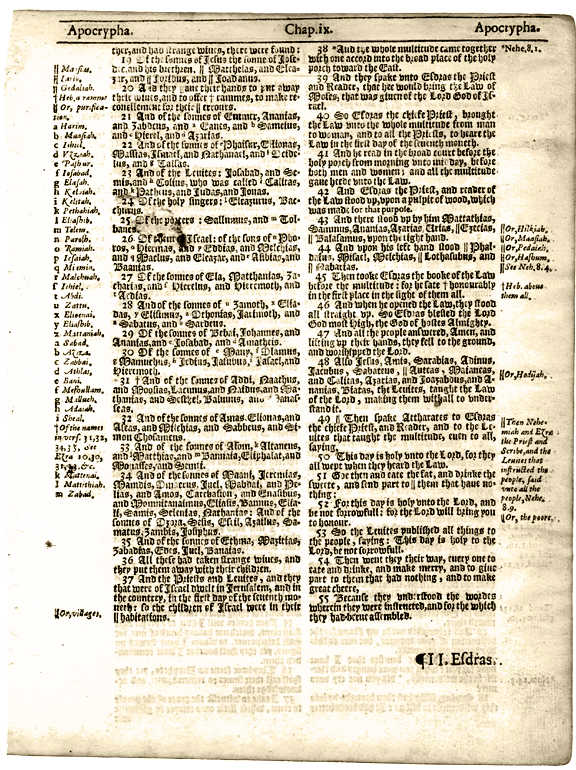 This
Leaf is part of my collection, it is from the 1625 King James Version Printed by Richard
Norton and John Bill The "printers to the Kings moft excellent Majestie". This
printing has become fondly know among collectors a the "Last Edition" because of
the year of its Printing. This was The LAST edition published During the reign of King
James the first of England. This leaf is from the "Apocrypha"
book of fist Esdres chapter ix, we see that verse 45 says in the margin " Heb. aboue
[above] them all"
The Book of Judith in the Hebrew :
We now know that the "Apocryphal" book of Judith was originally composed in Hebrew. Two Hebrew versions are known at present: a long one practically identical with the Greek text, and a short one which is entirely different. However, the book also exists in distinct Greek and Latin versions, of which the former contains at least 84 verses more than the latter. St. Jerome claimed to have made the translation from the Aramaic to the Vulgate, adhering closely to the wording. However, he acknowledged that what he expressed in the Vulgate was only what he could clearly understand from the Aramaic. A comparison of the passages from the LXX with its Vulgate counterpart shows that Jerome was not exaggerating when he said that he made his translation.
That a Hebrew or (less likely) an Aramaic original of Judith once existed is the opinion of almost all modern scholars, and the evidence for this seems conclusive. There are many Hebraisms in the book, e.g. en tais hemerais ("in the days of," Jth 1:7, and 9 t besides); the frequent use of sphodra, in the sense of the Hebrew me'odh, and even its repetition (also a Hebraism, Jth 4:8); compare epi polu sphodra (Jth 5:18) and plethos polu sphodra (Jth 2:17). Note further the following:
"Let not thy eye spare" etc. (Jth 2:11; compare Ezekiel 5:11, etc.); "as I live" (in an oath, Jth 2:12); "God of heaven" (Jth 5:8; 11:17); "son of man," parallel with "man," and in the same sense (Jth 8:16); "and it came to pass when she had ceased crying," etc. (Jth 10:1); "the priests who serve in Jerusalem before the face of our God" (Jth 11:13). In Jth 16:3 we have the words: "For a god that shatters battle is (the) Lord." Now "Lord" without the article can be only the Hebrew "Yahweh," read always 'adhonay, "Lord." But the phrase, "to shatter battle," is not good Greek or good sense. The Hebrew words shabhath ("to rest"; compare shabbath, "Sabbath") and shabhar ("to break") are written much alike, and in the original Hebrew we must have had the causative form of the first vb.: "A God that makes war cease is (the) Lord" (see Psalms 46:9). Moreover, the Hebrew idiom which strengthens a finite verb by placing a cognate (absolute) infinitive before it is represented in the Greek of this book in the usual form in which it occurs in the Septuagint (and in Welsh), namely, a participle followed by a finite verb (see Jth 2:13). The present writer has noted other examples, but is prevented by lack of space from adding them here. That the original book was Hebrew and not Aramaic is made extremely likely by the fact that the above examples of Hebrew idiom are peculiar to this language. Note especially the idiom, "and it came to pass that," etc. (Jth 2:4), with the implied "waw consecutive," and what is said above about Jth 11:13, where the senseless Greek arose through the confusion of two similarly written Hebrew (not Aramaic) words. There are cases also of mistakes in the Greek text due to wrong translation from the Hebrew, as in Jth 1:8 (where for "nations" read "cities" or "mountains"); Jth 2:2 (where for "concluded," Hebrew wa-yekhal, read "revealed," wa-ye-ghal); Jth 3:1,9,10 (see Fritzsche, under the word), etc.
The Book of Bel and the Dragon in the Hebrew :
The opinion has been growing among recent scholars that this work was written first of all either in Hebrew or Aramaic Some of the grounds are the following:
It is known that Theodotion in making his translation of other parts of the Old Testament (Daniel) endeavored to correct the Septuagint with the aid of the Massoretic Text. A comparison of the Septuagint and of Theodotion of Bel and the Dragon reveal differences of a similar character. How can we account for them unless we assume that Theodotion had before him a Semitic original? A very weak argument, however, for the translator might have corrected on a priori principles, using his own Judgment; or there might well have been in his time different recensions of the Septuagint. Westcott (DB, I, 397a; 2nd edition, 714a) holds that some of Theodotion's changes are due to a desire to give consistency to the facts.
Much has been made of the Semiticisms in the work, and it must be admitted that they are numerous and striking. But are these Hebraisms or Aramaisms? The commonest and most undoubted Semiticism is the repeated use of kai and kai egeneto with the force of the waw-consecutive and only to be explained and understood in the light of that construction. But the waw- consecutive exists only in classical Hebrew; Aramaic and post-Biblical. Hebrew, including late parts of the Old Testament (parts of Ecclesiastes, etc.), know nothing of it. It must be assumed then that if the Semiticisms of this work imply a Semitic original, that original was Hebrew, not Aramaic
The following Hebraisms found in the Septuagint and in Theodotion may briefly be noted:
The use of the Greek kai with all the varied meanings of the waw-consecutive. The beginning of a sentence with kai en ("and there was") Bel and the Dragon (verses 1,3 in the Septuagint; 2, etc., in Theodotion) agrees with the Hebrew waw-consecutive construction, but makes poor Greek. In verse 15 kai egeneto can be understood only in the light of the Hebrew for which it stands.
The syntactical feature called parataxy (coordination) presents itself throughout the Greek of this piece, and it has been reproduced in the English translations (the King James Version, the Revised Version (British and American) as any English reader can see. In the classical languages it is hypotaxy that prevails. If, as seems likely, those responsible for Septuagint and Theodotion followed a Hebrew original, they failed to make sufficient allowance for the peculiar force of the waw-consecutive idiom, for this does not involve hypotaxy to an y considerable extent.
(The constant occurrence of Kurios ("Lord") without the article implies the Hebrew Yahweh; and the phrase the "Lord God" is also Hebrew.
There are difficulties and differences best explained by assuming a Hebrew origin. The Greek word sphragisamenos has no sense in verse 14 (Septuagint) for, retaining it, we should read of a sealing of the temple (of Bel) and also of a sealing with signet rings of the doors. The Hebrew word "shut" (catham) is written much like that for "seal" (chatham), and was probably, as Marshal suggests, mistaken for the latter. The temple was "shut" and the doors "sealed." In verse 10 the Septuagint (choris) and Theodotion (ektos) have 2 words of similar sense, which are best explained as independent renderings of one Hebrew word.
Marshall, identifying this dragon story with the Babylonian creation-myth of Marduk and Tiamat, thinks that instead of "pitch" used in making the obolus with which Daniel destroyed the dragon, the original Aramaic document has "storm wind," the two words being in Aramaic written much alike (za`apha' = "storm wind," and zepha' = pitch). But the fact is quite overlooked that the obolus contained not only pitch, but also "fat" and "hair" (see Bel and the Dragon, verse 27). Besides, in the Aramaic version, published by Gaster, to which Marshall attaches great importance as at least a real source, we have four ingredients, namely, pitch (zepetha'), fat, flax (kittan) and hair. Dr. Marshall's suggestion involves therefore not only the confusion of two words spelled differently in Aramaic, but the substitution of 3 or 4 terms for one in the original draft. Moreover, in Bel and the Dragon the several ingredients are made up into a cake with which the dragon was gorged. Dr. Marshall's view assumes also an Aramaic original which is a gainst the evidence.
In favor of a Semitic original many writers have cited the fact that forms of the story have been found in Hebrew and Aramaic in the 13th century. Raymund Martini in his Pugio Fidei (written against the Jews) quotes Bel and the Dragon from a Hebrew Midrash on Genesis which Neubauer discovered and which is almost verbatim identical with the unique manuscript containing Midrash Rabba de Rabba (see Neubauer, Tobit, viii, and Franz Delitzsch, de Habacuci, 82). Still other Hebrew forms of these stories have been found. All the "additions" to Daniel "occur in Hebrew in the remains of Yosippon," the "Hebrew Josephus," as he has been called. He wrote in the 10th century.
But most important of all is the discovery by Dr. M. Gaster of the dragon story in Aramaic, imbedded in the Chronicles of Yerahmeel, a work of the 10th century. Dr. Gaster maintains that in this Aramaic fragment we have a portion of the original Bel and the Dragon (see PSBA, 1894, 280 (Introduction), 312 (Text) and 1895 (for notes and translation).
The Book of Song of the Three Children in the Hebrew
Along with the story of Bel and the Dragon, Dr. M. Gaster found the Song of the Three Children in the Aramaic Language, also in the 10th century document the Chronicles of Yerahmeel, (see also PSBA, 1894, 280 (Introduction), 312 (Text) and 1895 (for notes and translation). Dr. Gaster’s discovery is a strong foundation for the beleif that this book also was originally written in the Jewish tongue.
The Book of The Story of Susanna in the Hebrew
A fragment [scroll 4Q551] The Story of Susanna [ch. 13 of the book of Dan.] was found in the Hebrew in cave four of the Qumran find. [the "Dead sea scrolls" findings]
The Book of Baruch in the Hebrew :
We have found versions of Baruch in Syriac, Ethiopic, Latin and other ancient languages, these are based on the Greek, which most scholars agree was probably derives from a Hebrew original.
The Book of Tobit in the Hebrew :
It must also be noted that the discoveries found in the the caves of Qumran have prodused more than just Ecclesiasticus in the Hebrew, for example fragments of the "apocrypha" book of Tobit were found in Cave four. These fragments of the book of Tobit are in Aramaic[scrolls 4Q196-9] as well as Hebrew [scrolls 4Q200, 4Q478]. How many, other books of the "apocrypha" are hiden out there in Hebrew still waiting to be found? There is no way of knowing.
The First Book of Machabees in the Hebrew:
The text from which all translations have been derived is the Greek of the Septuagint. But there is little doubt that the Septuagint is itself a translation of a Hebrew or Aramaic original, with the probabilities in favour of Hebrew. Not only is the structure of the sentences decidedly Hebrew (or Aramaic); but many words and expressions occur which are literal renderings of Hebrew idioms (e.g., i, 4, 15, 16, 44; ii, 19, 42, 48; v, 37, 40; etc.). These peculiarities can scarcely be explained by assuming that the writer was little versed in Greek, for a number of instances show that he was acquainted with the niceties of the language. Besides, there are inexact expressions and obscurities which can be explained only in the supposition of an imperfect translation or a misreading of a Hebrew original (e.g., i, 16, 28; iv, 19, 24; xi, 28; xiv, 5). The internal evidence is confirmed by the testimony of St. Jerome and of Origen. The former writes that he saw the book in Hebrew: "Machabaeorum primum librum Hebraicum reperi" (Prol. Galeat.). As there is no ground for assuming that St. Jerome refers to a translation, and as he is not likely to have applied the term Hebrew to an Aramaic text, his testimony tells strongly in favour of a Hebrew as against an Aramaic original. Origen states (Eusebius, "Hist. Eccl.", vi, 25) that the title of the book was Sarbeth Sarbane el, or more correctly Sarbeth Sarbanaiel. Though the meaning of this title is uncertain (a number of different explanations have been proposed, especially of the first reading), it is plainly either Hebrew or Aramaic.
The Conclusion:
So do I say to the Protestants, You will have to find another pretext for taking these books out of the Canon, for the one which you have used does not justify the removal of several of the deutero-canonical books.
Furthermore, I would like to ask the Protestants upon what does he base his assumption that any books of the Old Testament that are not written in Hebrew are not canonical? If he presumes to base his assumption upon a Bible verse, then I must ask him to provide this verse (or verses if there be more than one), that says that any book of the Old Testament which was not written in Hebrew is not canonical.
If The Protestants cannot support his position with a verse from the Sacred Scriptures, then he has violated Protestant belief system of "Sola Scriptura" and is relying upon an authority outside the Bible. If he can support his position with a verse from the Sacred Scripture, we must ask him to provide us with proof (extra-biblically) that the book which he cites is Sacred Scripture.