
The Angel Raphael And The Charge Of "Magic" In Book Of Tobias

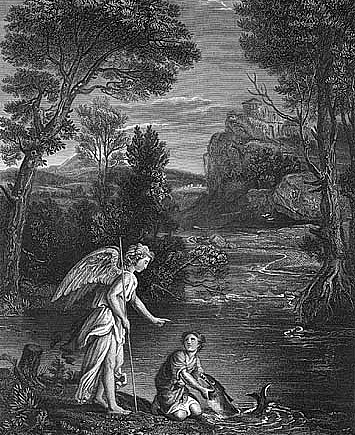
"Then the angel (Raphael [Tobias 6:16]) said to him: Take out the entrails of the fish, and lay up his heart, and his gall, and his liver for thee: for these are necessary for useful medicines... Then Tobias asked the angel, and said to him: I beseech thee, brother Azarias, tell me what remedies are these things good for, which thou hast bid me keep of the fish? And the angel, answering, said to him: If thou put a little piece of its heart upon coals, the smoke there of driveth away all kind of devils, either from man or from woman, so that they come no more to them... And on that night lay the liver of the fish on the fire, and the devil shall be driven away. But the second night thou shalt be admitted into the society of the holy Patriarchs. (Tobias 6:5,7-8,19-20)
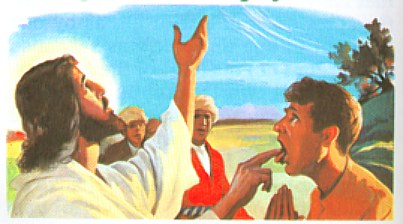 |
| Who has the right to criticize God's actions, or his choice of how he wishes heal? Do we not read in the Gospel of Mark [7:31-37] that while in Galilee Christ used his "spit" to loose the tongue of a inflicted man |
The idea of placing the heart of a fish upon the coals the fire so that the smoke would rise up and drive the demons away from the possessed, at first glance, to the uneducated person this may indeed seem like "magic". Let us closely examine this charge of "Magic". First, I ask if it pleases God to give a piece of its fish heart a power against those proud demonic spirits than who is to criticize this action? God sometimes makes use of things as remedies which have, naturally, a different effect; as when Christ put clay on the eyes of the blind man. (John. ix.) The things which the angel Raphael ordered were salutary, by God’s appointment. They could not act directly upon a spirit: but they might upon the person troubled by one, as Saul was relieved by music. The smoke was a sign of the devil’s expulsion and of the efficacy of prayer; or rather, God subjected the proud spirits to such weak elements.
Second The use of "smoke to fend off evil was not foreign to the Jew's loyal to God. A study of the Old Testament would Jews thought the smoke made from compound of sweet guns and spices [called incense] to have purifying effect in times of plague (Nuns. I6:17, ).
 The inspired word of God is very clear on the subjects of
Divination, magic and witchcraft, we as followers of the true God are firmly admonished to
have no part in such activities (Lev. 19:3, 26; 20:6,27; Deut. 18 9-14; Ezek. 13:23). The
Roman Catholic Church, which is the church of the one true holy living God, founded by
Christ upon the rock, Peter, has always taken the forefront in fighting evil and
condemning such evil actions. Sometimes as humans it is hard for us to distinguish with
our flawed mortal judgment between the miraculous acts of God and the "signs and
wonders" of Satan. This is attested to many times in the new Testament with the
numerous accounts of the Jews inability to distinguish the miracles Christ as of God and
not of Satan.
Scripture shows it is ONLY GOD that has the authority to determine what is condemned "magic", it is only through his approval or disapproval that we can make our judgment . There are many forms of "magic" used in the old Testament in the book of Ezekiel we read how Nebuchadnezzer For the king of Babylon would use a form of "casting lots" to receive "divine" revelation and guidance from his pagan gods
"For the king of Babylon will stop at the fork in the road, at the junction of the two roads, to seek an omen: He will cast lots with arrows" (Ezekiel 21:21)
Yet, we find the practice of "cleromancy" (lot casting) was a divinely approved and a integral activity of the Jewish priests (Num. 27:21). The sacred scriptures refer to this Jewish activity as "Urim" and "Thummin". The function of "Urim" and "Thummin"was to provide a divinely inspired "yes" or "no" answer to questions. It was this form of "casting lots" which determined the divisions of the land (Num. 26:55-56), it is also used to determine divine approval of candidates for such high offices as King (I Sam. 10:20-21), priest (I Chr.24:5), and for the determining of a individuals guilt (Num.5:15-30; Josh.7:14-15 )in certain cases. So we see that although both cases are "casting lots" there is a defining difference between them. The Babylonian form was condemned pagan "magic". The one preformed by the Jewish priests was a divinely approved activity, is essentially this divine approval which makes one good and the other evil. Another good example of this point is in Exodus and the case of Aaron’s staff.
"The LORD said to Moses and Aaron, "When Pharaoh says to you, `Perform a miracle,' then say to Aaron, `Take your staff and throw it down before Pharaoh,' and it will become a snake." So Moses and Aaron went to Pharaoh and did just as the LORD commanded. Aaron threw his staff down in front of Pharaoh and his officials, and it became a snake. Pharaoh then summoned wise men and sorcerers, and the Egyptian magicians also did the same things by their secret arts: Each one threw down his staff and it became a snake. But Aaron's staff swallowed up their staffs. "(Exodus 7:8-12)
Once again we find two distinctly similar yet different "miracles". The first being the miraculous action of God’s messenger Aaron the second being the actions of the pagan Egyptian magicians. Again we find it is divine approval and power which made one into a TRUE miracle and the other one into nothing more than a pagan trick of "magic". When Moses announced the plagues that he was going to bring up on Egypt, the Egyptian magicians had ample time to prepare an imitation. In no case where they able to undo what the Hebrew workers did; for they did not restore the purity of the river Nile water, nor drive away the frogs, lice, and locusts, but they did increase the evil in each case, or appeared to do so. The Pharaoh did not expect anything more of them. When the last plague came they could not imitate, nor dared to increase, and they were forced to acknowledge the "finger of God.". The Egyptian "magicians" counted Moses and Aaron as members of their own profession, possessed a little more of the secret knowledge, and the Pharaoh seems to have thought the same, until the miracle of the boils appeared and attacked the Egyptian "magicians" it was this which seemed to have convinced the Pharaoh.
The Bible teaches us that we are not to put restrictions upon God or his divine will. Scripture calls the practice of "Astrology" or the art of determining the future by studying the stars as "the way of the heathen"(Jer.10:2) and yet we find it is through the position of the stars that God sends the glorious message of his Son’s birth to the three Magi (who were heathen Astrologers)
"... Magi from the east came to Jerusalem and asked, ‘Where is the one who has been born king of the Jews? We saw his star in the east and have come to worship him." (Matthew 2:1-2)