THE EVER CHANGING FACE OF THE 1611.

Which King James Version?
Few people seem conscious of the fact that a currently circulating King James Bible differs in significant details (though not in general content) from the one issued in 1611. They assume that the King James is a fixed phenomenon like "the faith which was once for all delivered unto the saints" (Jude 3; ASV). However, a current KJV differs from the 1611 edition in numerous details. According to modern standards, books produced in the seventeenth century were carelessly printed. The 1611 editions of the KJV had "Then cometh Judas" in Matthew 26:36, which should have been "Then cometh Jesus." The second edition by dittography repeated twenty words of Exodus 14:10. The two editions of the KJV issued in 1611 differ from each other in several other respects. Printers errors in various later printings created oddities like the "Wicked Bible" (which omitted "not" from the seventh of the ten commandments), the "Unrighteous Bible" (in which the unrighteous inherit the Kingdom), the "Vinegar Bible" (with its "Parable of the Vinegar") the Ears to Ear Bible, and many others. Though quite humorous, these examples show that the printing of the Bible is a process subject to human error. The running together of "headstone" (Zech. 4:7) is a printer's error of 1611 which remains uncorrected. Another printing error continued in modern printings and defying explanation is "strain at a gnat" (Matt. 23:24) where the 1611 version correctly had "strain out a gnat."
Apocrypha Omitted in the l9th Century
But there have also been intentional changes since 1611. Some improvements were made as early as 1612; in a 1613 edition another 413 changes were made. In 1616 an edition improved the reading "approved to death" (I Cor.4:9) to "appointed to death." Omission of the Apocrypha, which had been printed between the Testaments in all English Bibles since Coverdale's, is one of the marked ways in which a current King James Bible differs from that of 1611. A 1629 edition was the first to omit the Apocrypha, but the omission did not become general until the nineteenth century. The following four main editions were released: the 1629, 1638, 1762, and 1769 editions. There were others from various printers but I will deal with the main ones that are commonly claimed to be revisions.
- The 1629 edition - This edition was simply put forth in order to correct the printer's errors. Two of the King James Bible translators, Dr. Samuel Ward and John Bois, assisted in this edition.
- The 1638 edition - This edition also dealt with the printers' errors, mainly the whole words and phrases accidentally left out by the printers. Approximately 72% of the around 400 textual corrections made to the King James Bible were completed and included in the 1638 Cambridge edition.
- The 1762 edition - This edition was simply to correct the spelling according to the standardization of spelling. The spelling of 1611 was often different from person to person and there was no set standard of spelling. By 1762 the English spelling of words had been standardized and the 1611 was corrected.
- The 1769 edition - This edition was only 7 years after the 1762 edition's correction of the spelling. This edition was only the final completion of the spelling corrections.
Thousands of Errors Corrected
Additional revisions of the KJV were made in a Cambridge edition which appeared in 1629. In 1638 an edition of the King James Bible prepared by Goad, Ward, Boyse, and Mead (two of whom had served on committees preparing the 1611 KJV) continued other revisions. The most controversial of these revisions was the reading "ye may appoint" for "we may appoint" in Acts 6:3, which some have thought to be a deliberate change under nonconformist influence. William Kilburne, in 1659, claimed to find 20,000 errors
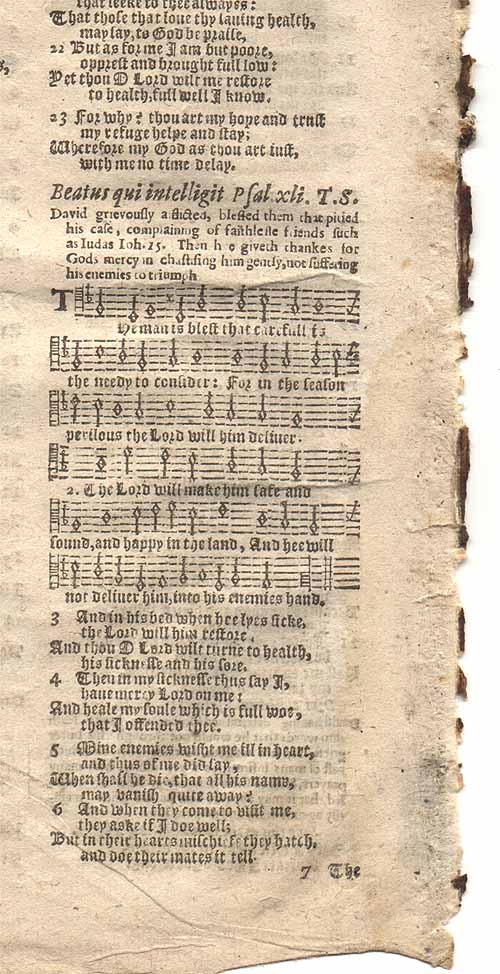
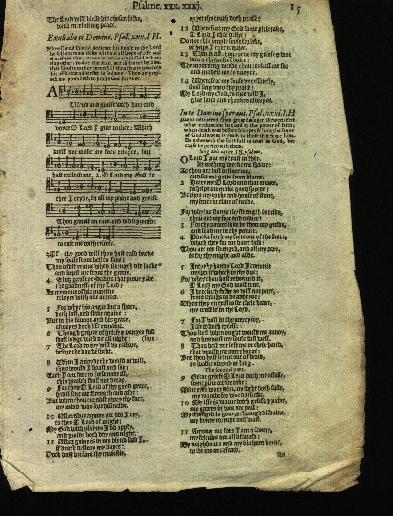
Here is a actual leaf from a 1634 KJB This is Psalm 41.This leaf was part of The Whole Book of Psalms Collected into English Meter By Thomas Sternhold and John Hopkins printed in London in 1634 by Robert Barker who was the official printer for the King. This was leaf was included in the 1634 edition of the KJB. Could anyone tell me, which original Greek Manuscript has the music staff? thal had crept into six different editions printed in the 1650's. New marginal references were introduced into printings in 1660, and still other changes came as Dr. Anthony Scattergood in 1683 added 7,250 references in an edition no longer in existence. In 1727 the King's printer at Edinburgh issued an edition in which several thousand errors in the marginal materials on the Old Testament were amended and corrected.
The 1611 KJV did not have "of silver" (Exod. 21:32), "of God" (1 John 5:12), and "Amen" (Eph. 6:24) that present KJV's have.
The 1611 KJV began Jeremiah 38:16 with the wording "So the king sware" while present KJV's have "So Zedekiah the king sware."
Present KJV's have "the city of the Damascenes" (2 Cor. 11:32) while the 1611 KJV has "the city."The 1611 KJV has "thee" at 2 Timothy 4:13 while current KJV's have "thee and the books."
At Eccl. 8:17, the 1611 KJV has only "seek it out" while current KJV's have "seek it out, yet he shall not find it."
At 2 Kings 11:10, the 1611 KJV only has "the Temple" while current KJV's have "the temple of the LORD."
Errors Continue to be Corrected
In a quite revolutionary step, Bishop Lloyd, in an edition of 1701, inserted a biblical chronology -- taken from Bishop Ussher -- at the head of the reference column at the beginning of numerous Old Testament books. Up to this point, in keeping with rule two of the King's instructions to the translators, the KJV had ordinarily been printed with references and marginal readings but without notes. Though Ussher's dates are no longer thought to be correct they are still being printed. F.S. Paris and H. Therold in 1762 extended the use of italics, modernized the language, and added 360 marginal references. Benjamin Blayney, in 1769 did extensive revision, added 76 notes -- including many on weights, measures, and coins -- and added 34,495 new marginal references. At this time the spelling and punctuation were modernized. "Hierusalem,"' "Marie," "assone," "foorth," "shalbe," "fet," "creeple," "fift," "sixt," "ioy," "middes," "charet," and the like were no longer used. Blayney's edition became the standard edition until the publication of the Cambridge Paragraph Bible, edited by Scrivener in 1873. The American Bible Society in the nineteenth century, after examining six editions of the KJV then circulating and finding 24,000 variants in the text and punctuation, claimed that "of the great number, there is not one which mars the integrity of the text or affects any doctrine or precept of the Bible"; but the Society did a revision in 1860 which was later abandoned because of protests from its supporters. A study of all these matters was made by F.H. A. Scrivener in The Authorized Edition of the English Bible (16l1). Additional revision in punctuation, spelling, and running heads was done by the Bible Society in 1932. In 1962 it was decided to omit the short explanatory statements following certain epistles in the New Testament, to change some spelling, to omit hyphens in some words, and to omit some capitals. Even after all these revision efforts, careful comparison of various current prutings of the KJV will show that there are still minor variations in spelling. For example, the
This is a nice example of what can be found towards the end of a King James Bible of the 17th century. I Here is a actual leaf from a 1634 KJB taken from The Whole Book of Psalms Collected into English Meter by Thomas Sternhold and John Hopkins printed in London in 1634 by Robert Barker and John Bill Measures 8 by 6.5 inches: Again I ask can anyone tell me, which original Greek Manuscript has the music staff? Oxford, Cambridge, and some Nelson printings have "an hungered" (Matt. 4:2); other Nelson and Zondervan printings have "an hungered";and the American Bible Society printing has "ahungered." The marginal readings and chapter headings of the 1611 edition are often not printed in current printings. why do so many variations exist within the various current editions of the KJV printed by different publishers?
At Jeremiah 34:16, the Oxford KJV has "whom he: while the Cambridge KJV has "whom ye."
One Oxford edition of the KJV has "fleeth" at Nahum 3:16 while a Cambridge edition has "flieth."
At 2 Chronicles 33:19, the Oxford KJV has "sins" while the Cambridge KJV has "sin."
At Nahum 3:16, the Oxford edition has "fleeth" while the Cambridge has "flieth."
The Companion Bible edition of the KJV has "LORD" in at least 133 places where most KJV editions have "Lord."
A present edition of the KJV published by the American Bible Society has many variations or differences when compared to other KJV editions. This ABS edition has "sneezings" (Job 41:18), "rearward" (Jos. 6:9), "since" (Ezek. 35:6), "thoroughly" (2 Tim. 3:17), and "hoisted" (Acts 27:40). The ABS edition of the KJV has "Elijah" (Matt. 16:14), "Hosea" (Rom. 9:25), "Beor" (2 Pet. 2:15), "Uzziah" (Matt. 1:9), "Hezekiah" (Matt. 1:10), etc. There are MANY more differences in the ABS edition.
The edition of the KJV in the Open Bible also has some differences with many of them seeming to be the same as those in the ABS edition. In fact, Wally Beebe's 1975 Bus Worker's Edition of the KJV has some differences in its text when compared to other editions. Beebe's Edition has "Joshua" in the text at Acts 7:45 along with other changes. The ABS edition also "Joshua" in the text at Acts 7:45. Was Beebe responsible for having a KJV published that changed the "immutable" KJV?