
The finding of a ancient bone box, called an ossuary and the perpetual virginity of Mary.
Recently a inscription has been found on an ancient bone box, called an ossuary, that reads "James, son of Joseph, brother of Jesus.", does this affect the the Catholic Church's teaching of the perpetual virginity of Mary. The answer is NO.

Recently a inscription has been found on an ancient bone box, called an ossuary, that
reads "James, son of Joseph, brother of Jesus." 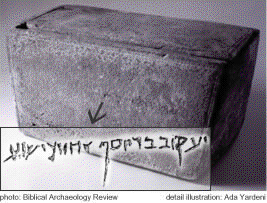
The Aramaic words etched on the box’s side show a cursive form of writing used only from about 10 to 70 A.D., according to noted paleographer André Lemaire [1] of the École Pratique des Hautes Études (popularly known as the Sorbonne University) in Paris, who verified the inscription’s authenticity. The ossuary has been dated to approximately 63 A.D. Lemaire [1]
Time Magazine tells us
"The History of the ossuary is murky. It was probably looted from the burial cave decades ago.... Unofficial excavations br residents and by professional looters, although illegal, have long suppled the antiquities market with pots, lamps and other artifacts. According to the owner, the dealer who sold it to him told him it was found in the Silwan area. The owner says it is highly unlikely that any one will be able to the cave it came from....
As McCarter says, it ‘compromises everything. We don’t know were [the box] came from, so there will always be nagging doubts." [2]
Before we jump to conclusions. It must be shown that the Jesus in this text is Jesus of Nazareth, and nobody can show this by the inscription. The possibility that this refers to Jesus of Nazareth is very slim at best. Archaeologist Zvi Greenhut of the Antiquities Authority, said that among the about 1,000 ossuaries from biblical times unearthed in Jerusalem, six carry the inscription ''Yeshua,'' or Jesus. Of those, two are even engraved with the words ''Jesus, son of Joseph''. The Name Joseph was the second most common man's name of the period.
A Good example of this is the limestone box, catalogue No. 80.503, once contained human bones and is engraved in barely legible Hebrew: ''Jesus, son of Joseph.'' which was found by Israeli archaeologists in a Jewish burial chamber in Jerusalem in 1980 during a salvage dig in the Armon Hanatziv area in southern Jerusalem. It was then packed away in the warehouse hundreds of other caskets.[3]
All three names were commonplace, the Paleographer André Lemaire estimates that there could have been around 20 different men named James in Jerusalem during that era would have had a father named Joseph and a brother named Jesus.[4]
Biblical Archaeology Review explains on the frequency of the names: "The names James (Jacob), Joseph, and Jesus were all fairly common among Jews at the turn of the era. ...Rachel Hachlili has studied names used at this time in all types of inscriptions. Joseph appeared in 14 percent, Jesus in 9 percent, and James/Jacob in 2 percent of the cases. ...in Jerusalem during the two generations before 70 C.E., there were therefore about twenty people who could be called 'Jacob son of Joseph brother of Jesus." [5]P.Kyle McCarter, chair of the Near Eastern studies department at John Hopkins University in Baltimore, Md.., notes that the log of inscription names from which the Sorbonne professor derives his percentages may not reflect their frequency in Jerusalem as a whole, contaminating the calculations. He comments
"It wouldn’t be my inclination to qualify it that way." [6]
The mention of a brother is unusual, but there are other known examples. Some think this uncommon mention of a brother indicates that this Jesus must have been a well-known figure. However, Kyle McCarter, a Johns Hopkins University archaeologist, said:
"it's possible the brother was named because he conducted the burial or owned the tomb." [2]
Dr. Johann Roten, of the University of Dayton, told the The Pittsburgh Post-Gazette[7]:
"This only brings to the fore again the discussion. It doesn't give any solution to it. And we don't know at this point whether it refers to Joshua—Jesus—the Son of God or if it is another Joshua,"
Dr. Ben Witherington [8] explains in a Beliefnet column:
"The Aramaic word used on the ossuary, akhui, certainly means brother. The order of the words in the inscription
does not indicate that Jesus was the son of Joseph. The inscription intends to make clear the two closest male blood relatives of James. It is not commenting on Jesus' relationship with Joseph, but on James' relationship to Joseph and Jesus. There is some evidence, for example in Tobit, that occasionally the word 'brother' might mean something other than full brother."
So we can see that this discovery really does not disprove the Catholic Church's teaching of the perpetual virginity of Mary,. as The Pittsburgh Post-Gazette[7]. explains "Theologians of all stripes agree that the burial box—called an ossuary—doesn't change the argument over whether Jesus' mother, Mary, remained a virgin."
Notes
[1] André Lemaire, is a specialist in ancient inscriptions at France's Practical School of Higher Studies (popularly known as the Sorbonne University) in Paris, published his findings in the November/December issue of Biblical Archaeology Review.
[2]Time magazine, Nov. 4, 20002 p. 71,73
[3] James Tabor Associated Press April 02, 1996; Tuesday 21:30 Eastern Time
[4]Reported By Richard N. Ostling AP Religion Writer, for the The Associated Press, on Monday, October 21, 2002;
[5] Editor's note to the artical in the the November/December issue of Biblical Archaeology Review.
[6] Time magazine, Nov. 4, 20002P. 72
[7] The Pittsburgh Post-Gazette, Wednesday, October 23, 2002 By Ann Rodgers-Melnick, Post-Gazette Staff Writer
[8] Protestant Scripture scholar Ben Witherington III is a professor of New Testament interpretation at Asbury Seminary in Kentucky. He has taught at Ashland Theological Seminary, High Point College, Duke Divinity School and Gordon-Conwell Theological Seminary. He received an M.Div. from Gordon-Conwell and a Ph.D. from University of Durham, England.