
Did the Catholic Religion take out one of God's Ten Commandments?
They shall go to confusion
together that are makers of idols.
Isaiah 45:16

The Ten Commandments are, aside from the Two Great Commandments ("Love thy God..." and "Love thy neighbor..."), the most fundamental biblical expression of Judeo-Christian morality. This article was originally titled Catholic Religion Purposely takes out one of God's Ten Commandments . Our opponent’s comments will appear in red, while ours will remain in normal colored text.
Catholics love images Now we all know how Catholics love to bow down in front of statues and pray.
Answer: Here the author attempts to play clever or game note he says "bow down in front of statues and pray." a quick reference of stricture would reveal God forbids Bowing TO statutes and serving them "Thou shalt not bow down thyself TO THEM, nor serve THEM"(Exodus 20:5) the author by his cleverly worded statement hopes the reader would believe that "Catholics bow TO pieces of plaster and worship THEM." even though this is with the author wishes to the portray he does not do so far as to actually stated he simply hints the idea with confidence that the readers prejudice against the Catholic Church will fill in the rest. To some people this may not seem like a big difference in reality its very fundamental. one is expressly forbidden the other is not.
We know that they like to light candles
Answer
: If the author had bothered to read sacred scripture he would have found that the use of candles in religious worship can be found in Exodus were GOD COMMANDED the construction of a six branch Candlestick for the temple. Obviously this is not part of the Devil’s religion."And thou shalt make A CANDLESTICK of pure gold: of beaten work shall the candlestick be made: his shaft, and his branches, his bowls, his knops, and his flowers, shall be of the same. And six branches shall come out of the sides of it; three branches of the CANDLESTICK out of the one side, and three branches of the CANDLESTICK out of the other side: Three bowls made like unto almonds, with a knop and a flower in one branch; and three bowls made like almonds in the other branch, with a knop and a flower: so in the six branches that come out of the CANDLESTICK. And in the candlestick shall be four bowls made like unto almonds, with their knops and their flowers. And there shall be a knop under two branches of the same, and a knop under two branches of the same, and a knop under two branches of the same, according to the six branches that proceed out of the CANDLESTICK. Their knops and their branches shall be of the same: all it shall be one beaten work of pure gold. And thou shalt make the seven lamps thereof: and they shall light the lamps thereof, that they may give light over against it." (Exodus 25:31-37)
It must be noted that at the time of Exodus candles themselves been invented which is why God commands the construction of lamps. But by the time of the new Testament we see that it is candles that go in to candlesticks no longer lamps
Luke 11:33. No man, when he hath lighted A CANDLE, putteth it in a secret place, neither under a bushel, BUT ON A CANDLESTICK, that they which come in may see the light.
pray for the dead like it does some good.
Answer: this also is a sacred scripture "It is therefore a holy and wholesome thought to pray for the dead that they may be loosed from their sins." (2 Machabees, 12-46:) This is one of the Old Testament books omitted from the Protestant Bible for those who doubt the legitimacy of this book follow this Link: DUTEROCANONICAL.
We also know that they love relics like a dead monk's head.
Answer: Again, If the author had bothered to read sacred scripture he would have found this to. Lets turn to sacred scripture If the clothes, the kerchiefs (Acts, .xix, 12), if the shadow of the saints (Acts, v, 15), before they departed from this life, banished diseases and restored strength, who will have the hardihood to deny that God wonderfully works the same by the sacred ashes, the bones, and other relics of the saints ? This is the lesson we have to learn from that dead body which, having been accidentally let down into the sepulchre of Eliseus, "when it had touched the bones of the Prophet, instantly came to life" (4 Kings xiii, 21, and cf. Ecclus., xlviii, 14). We may add that this miracle as well as the veneration shown to the bones of Moses (See Ex., xiii, 19 and Jos., xxiv, 32)
We also know that they love their other "sacred" images like pictures of a madonna and naked baby Jesus (salvation is a man-sized job by the way.)
Answer: of course this is a derogatory state meant to prejudice the readers opinion on the subject but It is true "salvation is a man-sized job" but every man requires birth, to celebrate the birth of Christ and honor his youth with his family is not to dishonor him. any readers of scripture can tell you that Christ spent 22 years with his mother Mary the "madonna" (toand Joseph) and only three years teaching apostles.
Finally we know that they think that there is some benefit of having a Jesus hanging on the cross in their homes so they can visualize the object of their worship. Maybe they even think the crucifix is a good luck charm.
Answer: It never fails to amaze me how Protestants who show such ignorance of Catholic teaching and scripture come to believe their qualified to tell others what we believe and think. Catholics do not look upon the image of Christ as "a good luck charm". Obviously the author had no intention of properly portraying our beliefs accurately.
They will vehemently tell you they don't worship the images--yeah right. I've seen a great picture of the pope bowing down to Mary.
Answer: this is a beautiful example of the authors viament prejudice against both the Catholic Church in the truth. Even a casual examination of the picture would show the Pope hunched over with his foreign extended towards a statue examining not to or worshipping it.
Does The Bible says "don't even make images"
Well, what doth the Bible say about worshipping images? It says much my friends but today we are looking specifically at the Ten Commandments found in Exodus chapter 20. Most of us know that the Ten Commandments prohibit even making images. This poses a problem for the Catholic religion. How does it get around this?
Answer: First we must note They are found twice recorded in the Pentateuch, in Exodus 20 and Deuteronomy 5. The Truth is this poses no problem for the Catholic Church, if the author had bothered to read the rest of the old Testament he would have noted that got commanded the creation of images on many occasions and some were used in worship, there was the brazen serpent (Num., xxi, 9), not destroyed till Ezechias did so (IV Kings, xviii, 4), there were carved and moulded garlands of fruit and flowers and trees (Num., viii, 4; III Kings, vi, 18; vii, 36); the king's throne rested on carved lions (III Kings, x, 19-20), Iions and bulls supported the basins in the temple (III Kings, vii, 25, 29). Especially there are the cherubim, great carved figures of beasts (Ezech., i, 5; x, 20, where they are called beasts), that stood over the ark of the covenant (Ex., xxv, 18-22; III Kings, vi, 23-8; viii, 6-7, etc.). The ephod was certainly once a statue of human form (Judges, viii, 27; xvii, 5; I Kings, xix, 13, etc.), the human heads of the cherubim (Ezech., xli, 19, Ex., xxv, 20, the references to them when combined seem to point irresistibly to some such figures as the Assyrian winged bulls with human heads), and what were the theraphim (Judges, xvii, 5) Both were used in orthodox worship.
DID THE CATHOLIC RELIGION CHANGES THE TEN COMMANDMENTS?
First, There is a problem because there are actually more than ten imperative statements in the two relevant texts (Exodus 20:1-17, Deuteronomy 5:6-21). Here is a count of them based on Exodus 20:
2 You shall not make for yourself a graven image...
3 You shall not bow down to them or serve them...
4 You shall not take the name of the LORD your God in vain...
5 Remember the sabbath day, to keep it holy.
6 Six days you shall labor...
7 In it [the seventh day] you shall not do any work...
8 Honor your father and your mother...
9 You shall not kill.
10 You shall not commit adultery.
11 You shall not steal.
12 You shall not bear false witness against your neighbor.
13 You shall not covet your neighbor's house
14 You shall not covet your neighbor's wife...The above Chart shows how these fourteen imperative statements are combined by Catholics and Protestants onto ten.
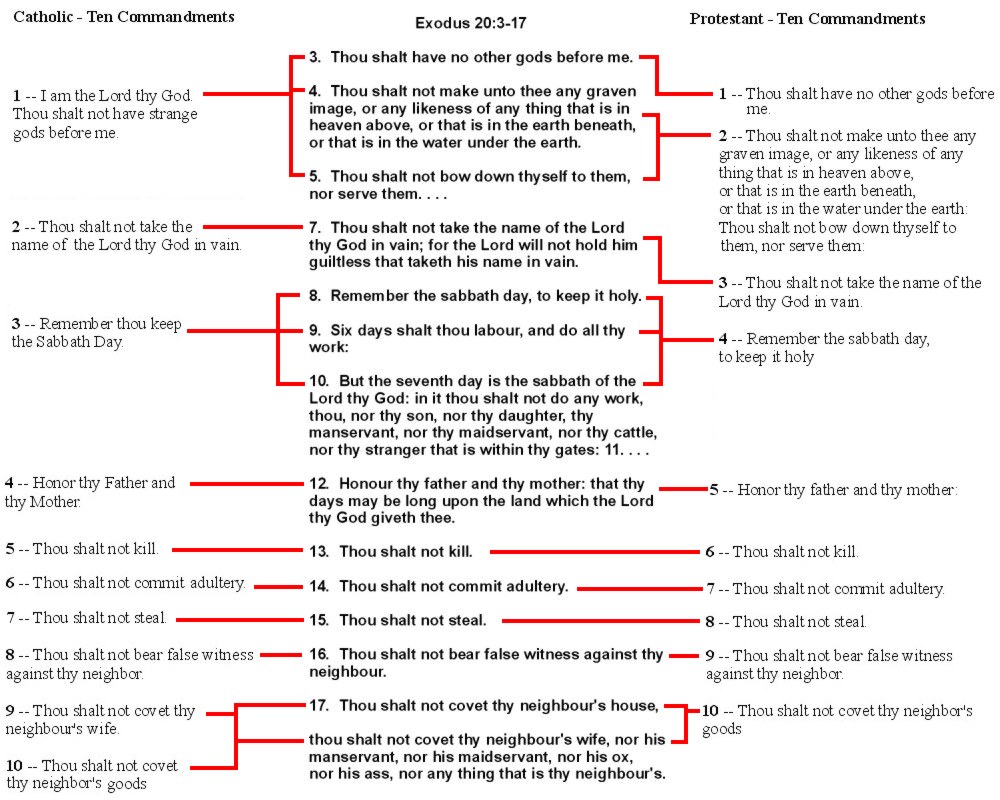
Obviously, in order to get these to total ten commandments, some imperative statements must be grouped together. second, There is no numerical division of the Commandments in the Books of Moses, but the injunctions are distinctly tenfold, and are found almost identical in both sources. The order, too, is the same except for the final prohibitions pronounced against concupiscence, that of Deuteronomy being adopted in preference to Exodus. A confusion, however, exists in the numbering, which is due to a difference of opinion concerning the initial precept on Divine worship.
The difference between the "Catholic and Protestant version of the Commandments" is only in their numerical divisions. The Protestant (Lutherans excepted) divide the first commandment into two, and unite the 9th and 10th Commandments into one. Thus the Catholic 2nd Commandment becomes the Protestant 3rd, and so on until the Catholic 8th becomes the Protestant 9th, and the Catholics 9th and 10th, united, becomes the Protestant 10th.The object of this change was to emphasize the Protestant groundless charge that Catholics are image worshipers.
The system of numeration found in Catholic Bibles is based on the Hebrew text, was made by St. Augustine (fifth century) in his book of "Questions of Exodus" ("Quæstionum in Heptateuchum libri VII", Bk. II, Question lxxi), and was adopted by the Council of Trent. It is followed also by the German Lutherans, except those of the school of Bucer. This arrangement makes the First Commandment relate to false worship and to the worship of false gods as to a single subject and a single class of sins to be guarded against--the reference to idols being regarded as mere application of the precept to adore but one God
Even their own perverted Bibles have something that approximates the commandment to not make images,
Answer: as the point out above the commandment is not against "make images" rather it is against making images and worshipping them even the highly perverted King James version (which could not get "The Lords Paryer" right) is clear on this point.
but since their leaders tell them they are too spiritually dumb to understand the Bible, they don't read it (or read it with muddy eyeballs).
Answer: "And Philip ran thither to him, and heard him read the prophet Esaias, and said, understandest thou what thou readiest? And he said, How can I except some men should guide me? And he desired Philip that he would come up and sit with him." (Acts 8, 30-31) even sacred stricture states that we need a physical human guide in order to understands. The author's numerous strictural screw ups in this article alone show that he (himself) is in great need of a physical human guide and a more accurate Bible. private interpretation does not work.
And so, the wicked deceitfully change the ten commandments
Answer: for over 1000 years before the first Protestant existed all of the Christian world accepted ten commandments them as the Catholic Church still uses. It was the "wicked" Protestants who "deceitfully change the ten commandments"
put them in a book somewhere or post them on a wall and tell the people to memorize them.
Answer: The concept of taking word of God placing it in a book (Isn't this exactly what happened when we created the Bible?) or posting on the wall and requiring people to Memorize sacred scripture is by no means harmful thing.
Of course people are going to trust their almighty priests to tell them the truth (bad move).
Answer: The concept of trusting a human guide for sacred scripture is not a "bad move" rather it is clearly pretrayed in the infallible word God Acts 8, 30-31.In Titus we see the apostles specifically commanded establishment of a leadership of the guide to the early Christians:
"For this cause left I thee in Crete, that thou shouldest set in order the things that are wanting, and ordain presbyters in every city, as I had appointed thee:" (Titus 1:5)
Acts tells us this establishment of a leadership has Divine authority :
"Take heed unto yourselves, and to all the flock, in which the Holy Spirit hath made you bishops, to feed the church of the Lord which he purchased with his own blood."(Acts 20:28)
on the contrary the author has continually proven that private interpretation is a "bad move".
The Catholic religion deletes the second commandment and makes the 10th commandment into two.
Answer: no, The Protestant united Catholic 9th and 10th Commandments into there 10th my making "thou shalt not covet (Deuteronomy says desire) thy neighbor’s wife" equal to the sin of coveting thy neighbor’s goods. Our Lord Jesus Christ did not declare the unlawful desire for a man’s wife to be equal to the sin of coveting thy neighbor’s goods. Our Lord Jesus Christ declared the unlawful desire for a man’s wife, adultery, to be a distinct sin:
"... But I say to you, that whosoever shall look on a woman to lust after her, hath already committed adultery with her in his heart" (St. Matt. V. 28).
If the species of the sin of covetousness is not determined by the object coveted; if there be no difference between coveting, desiring a man’s wife and stealing his goods, then the Protestant 7th Commandment – "Thou shalt not commit adultery" – and its 8th Commandment – "Thou shalt not steal" – ought to be united into one Commandment.
If you follow them all the way down from the second commandment you'll see the Catholic religion is always one ahead of the King James.
Answer: this is VERY true, the Catholic religion is always ahead (way ahead) of the "King James only" Protestants (were any protestants to the matter) on ALL issues including accuracy, morality, understanding of scriptures, doctoral unity and faith. In The original Preface to the King James Version of 1611the translators themselves admitted there were meny Hebrew and Greek words (lexicons) and whole sentences Thay did not understand, Thay were forced to GUESS there meanings.
"REASONS MOVING US TO SET DIVERSITY OF SENSES IN THE MARGIN, WHERE THERE IS GREAT PROBABILITY FOR EACH; Some peradventure would have no variety of senses to be set in the margin, lest the authority of the Scriptures for deciding of controversies by that show of uncertainty should somewhat be shaken. But we hold their judgment not to be so sound in this point....It hath pleased God in His divine providence, here and there to scatter words and sentences of that difficulty and doubtfulness, not in doctrinal points that concern salvation (for in such it hath been vouched that the Scriptures are plain), but in matters of less moment, that fearfulness would better beseem us than confidence, ...There be many words in the Scriptures which be never found there but once (having neither brother nor neighbor [ipax legomena], as the Hebrews speak), so that we cannot be holden by conference of places. Again, there be many rare names of certain birds, beasts and precious stones, etc., concerning which the Hebrews themselves are so divided among themselves for judgment, that they may seem to have defined this or that rather because they would say something than because they were sure of that which they said, as St. Jerome somewhere saith of the Septuagint. Now in such a case, doth not a margin do well to admonish the reader to seek further, and not to conclude or dogmatize upon this or that peremptorily (I.E. Final; absolute)? For as it is a fault of incredulity, to doubt of those things that are evident, so to determine of such things as the Spirit of God hath left (even in the judgment of the judicious) questionable, can be no less than presumption...so diversity of signification and sense in the margin, where the text is not so clear, must needs do good--yea, is necessary, as we are persuaded." [From the "THE TRANSLATORS TO THE READER" The Original Preface to the King James Version of 1611 (The familiar "Epistle Dedicatory" to King James I, printed at the beginning of many current K.J.V. editions, is often mistakenly thought to be the preface of this translation. In actuality, the true preface is a lengthy section entitled "The Translators to the Reader") The above text, modernized as to spelling and punctuation, has been checked and corrected against the reprint of the 1611 edition of the "King James Version of 1611" by Thomas Nelson.]
The editions have of the Authorized King James Version, been innumerable; we need mention but a few. Three distinct editions appeared in 1611; one is known as "The great SHE editions," the nomenclature being too to the fact that whereas Ruth 3:15 should read, "He [Boaz] measured six measures of barley, and laid it on her [Ruth]; and she went," the first folio substituted "he" for "she"; subsequent editions based upon either the "he" or the "she" folio reproduced their respective readings
some other editions noted for their misprints. The edition of 1631 Cambridge, is known as "The Wicked Bible" for printing the commandment, "Thou shalt commit adultery." Another Cambridge edition was guilty of at least four gems in the way of misprints: "sons of Bilial" for "sons of Bilhah (Bala)" (Gen. 37:2); "slew two lions like men," for two lion-like men" (II Sam. 23:20); the Midianites "vex you with their wives" instead of "wiles". Another unfortunate edition was that of 1653, which omitted "or who hath opened his eyes" from John 9:21, and in Rom. 6:13 wrote: "your members as instruments of righteousness," for "unrighteousness"; conversely, in I Cor. 6:9 ii has, "know you not that the righteous [for "unrighteous"] shall not process the kingdom of God?"
One misprint was hard warming, at least for the Puritans. The apostles arranged for the selection by the faithful up seven deacons "whom we may appoint" (Acts 6:3); but the Puritans, binding that "ye" had been printed instead of "we," seized on this misprint as confirmation of their peculiar views on appointment to the ministry. The statement that "the dogs liked ["licked"] Achab’s blood" (III Kings 22:38) may raise a smile ; but "I will never forgive ["forget"] thy precepts" (Ps. 119:93) is distinctly disedifying.
several other editions have received nicknames owing to their misprints. One printed at Oxford, 1717, is called the "vinegar Bible" from the title affixed to Luke chapter 20, which reads, "The Parable of the Vinegar" for "Vineyard"; another 1795, is dubbed the "Murderers Bible" for Mark 7:27 reads, "Let the children first he killed" instead of "filled with"
Finally at the tenth commandment they break it into two and make it the 9th and 10th commandments. What deception! What deceit! What guile!
Answer: What deception? What deceit? What guile? We are told in Scripture that there are ten of them (Exodus 34:28, Deuteronomy 4:13, 10:4), but we are not told exactly how the text should be divided. The author shows his extreme ignorance of Bible history as point above the Catholic list of commitments dates back to before the fith century (1000 years before the existence of the first promised and 1100 years before the King James Bible was produced) the scriptures themselves were not divided into its present verse form until 1551 A.D (by the Catholic Robert Stephens) meaning this section read as continuous sentences with no other divisions. Exodus 20:1-17 was something like this.
"And God spake all these words, saying, I am the Lord thy God, which have brought thee out of the land of Egypt, out of the house of bondage. Thou shalt have no other gods before me. Thou shalt not make unto thee any graven image, or any likeness of any thing that is in heaven above, or that is in the earth beneath, or that is in the water under the earth. Thou shalt not bow down thyself to them, nor serve them: for I the Lord thy God am a jealous God, visiting the iniquity of the fathers upon the children unto the third and fourth generation of them that hate me; And shewing mercy unto thousands of them that love me, and keep my commandments. Thou shalt not take the name of the Lord thy God in vain; for the Lord will not hold him guiltless that taketh his name in vain. Remember the sabbath day, to keep it holy. Six days shalt thou labour, and do all thy work: But the seventh day is the sabbath of the Lord thy God: in it thou shalt not do any work, thou, nor thy son, nor thy daughter, thy manservant, nor thy maidservant, nor thy cattle, nor thy stranger that is within thy gates: For in six days the Lord made heaven and earth, the sea, and all that in them is, and rested the seventh day: wherefore the Lord blessed the sabbath day, and hallowed it. Honour thy father and thy mother: that thy days may be long upon the land which the Lord thy God giveth thee. Thou shalt not kill. Thou shalt not commit adultery. Thou shalt not steal. Thou shalt not bear false witness against thy neighbour. Thou shalt not covet thy neighbour's house, thou shalt not covet thy neighbour's wife, nor his manservant, nor his maidservant, nor his ox, nor his ass, nor any thing that is thy neighbour's."
Deuteronomy 56:-21
"I am the Lord thy God, which brought thee out of the land of Egypt, from the house of bondage. Thou shalt have none other gods before me. Thou shalt not make thee any graven image, or any likeness of any thing that is in heaven above, or that is in the earth beneath, or that is in the waters beneath the earth: Thou shalt not bow down thyself unto them, nor serve them: for I the Lord thy God am a jealous God, visiting the iniquity of the fathers upon the children unto the third and fourth generation of them that hate me, And shewing mercy unto thousands of them that love me and keep my commandments. Thou shalt not take the name of the Lord thy God in vain: for the Lord will not hold him guiltless that taketh his name in vain. Keep the sabbath day to sanctify it, as the Lord thy God hath commanded thee. Six days thou shalt labour, and do all thy work: But the seventh day is the sabbath of the Lord thy God: in it thou shalt not do any work, thou, nor thy son, nor thy daughter, nor thy manservant, nor thy maidservant, nor thine ox, nor thine ass, nor any of thy cattle, nor thy stranger that is within thy gates; that thy manservant and thy maidservant may rest as well as thou. And remember that thou wast a servant in the land of Egypt, and that the Lord thy God brought thee out thence through a mighty hand and by a stretched out arm: therefore the Lord thy God commanded thee to keep the sabbath day. Honour thy father and thy mother, as the Lord thy God hath commanded thee; that thy days may be prolonged, and that it may go well with thee, in the land which the Lord thy God giveth thee. Thou shalt not kill. Neither shalt thou commit adultery. Neither shalt thou steal. Neither shalt thou bear false witness against thy neighbour. Neither shalt thou desire thy neighbour's wife, neither shalt thou covet thy neighbour's house, his field, or his manservant, or his maidservant, his ox, or his ass, or any thing that is thy neighbour's."
I tell no lies here
Answer: on the contrary the author has told a great many lies, and twisted the truth to its breaking point showing a great amount of ignorance on history, sacred scripture, the Catholic Church and the subject at hand. In short, there is simply no basis whatsoever to the charge that the Church is trying to "hide" or "remove" any of the Ten Commandments. Rather, the Church is trying to make them easier to memorize and thus help people learn and internalize them better. One may well ask in which communion an average, catechized person is more likely to know the Ten Commandments by heart. Is a catechized Catholic more likely to be able to name the commandments in order, or is a average, catechized Protestant more likely to be able to name them in order? Which communion really stresses the Ten Commandments more in its catechesis? The group that says it is a mortal sin to violate them or the group that is more prone to say, "That is just Old Testament. Today we have grace"?
just get out the Bible and compare. They even corrupt their own Bible by deleting the 2nd commandment!
Answer: the Catholic Bible most certainly contains Exodus 20:3-5 and I challenge the reader to research this matter. This is another clear example of the authors deceitfully attempt to prejudice the reader against the Catholic Church without just cause. the author is certainly correct when he describes his article as:
Just a little more mumbo-jumbo gumbo...
Please sign our Guest book!
This page has helped
People find the truth since November 1999