Was St. Peter The First Bishop of Rome ?

Do to the vast amount citations from the early church fathers and the archeological evidence readily available on the Internet it has become harder than ever for Protestants to deny the fact that Peter was in Rome. Protestants have had a hard time adjusting to this instant wave of information, they have been forced to change their traditional arguments. Recently it has become more common to here a Protestant say "sure Peter was in Rome, but he was not the Bishop, Linus was the first Bishop of Rome". of course this new revised argument holds the same lack of validity that the original Protestant argument "Peter was not in Rome" as is shown in the writing of the early church fathers:Irenaeus of Lyons
"The blessed apostles [Peter and Paul], having founded and built up the church [of Rome], they handed over the office of the episcopate to Linus. Paul makes mention of this Linus in the letter to Timothy [2 Tim. 4:21]. To him
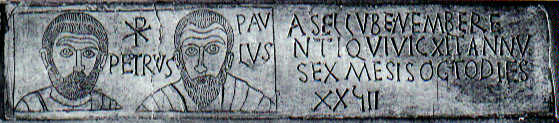
Among the more than 30,000 Greek and Latin inscriptions have been discovered in the catacombs of Rome, is this marble slab above is from about the year 313 A.D. The slab sealed the tomb of a little boy named Asellus and the inscription goes on to tell us that he had lived 5 years, 8 months and 23 days. To the left we see the images of the Saints Peter and Paul, with the monogram of Christ above the name of Peter. The fact that the Gospel of Jesus brought to Rome by St. Peter and St. Paul was clearly professed by the early Christian community there. succeeded Anacletus, and after him, in the third place from the apostles, Clement was chosen for the episcopate. He had seen the blessed apostles and was acquainted with them. It might be said that he still heard the echoes of the preaching of the apostles and had their traditions before his eyes. And not only he, for there were many still remaining who had been instructed by the apostles. In the time of Clement, no small dissension having arisen among the brethren in Corinth, the Church in Rome sent a very strong letter to the Corinthians, exhorting them to peace and renewing their faith . . . To this Clement, Evaristus succeeded . . . and now, in the twelfth place after the apostles, the lot of the episcopate [of Rome] has fallen to Eleutherus. In this order, and by the teaching of the apostles handed down in the Church, the preaching of the truth has come down to us" (ibid., 3:3:3).
Eusebius of Caesarea
"[In the second] year of the two hundredth and fifth Olympiad [A.D. 42]: The Apostle Peter, after he has established the church in Antioch, is sent to Rome, where he remains as a bishop of that city, preaching the gospel for twenty-five years" (The Chronicle [A.D. 303])
The Little Labyrinth
"Victor . . . was the thirteenth bishop of Rome from Peter" (The Little Labyrinth [A.D. 211], in Eusebius, Church History 5:28:3)
Cyprian of Carthage
"Cornelius was made bishop by the decision of God and of his Christ, by the testimony of almost all the clergy, by the applause of the people then present, by the college of venerable priests and good men, at a time when no one had been made [bishop] before him--when the place of [Pope] Fabian, which is the place of Peter, the dignity of the sacerdotal chair, was vacant. Since it has been occupied both at the will of God and with the ratified consent of all of us, whoever now wishes to become bishop must do so outside. For he cannot have ecclesiastical rank who does not hold to the unity of the Church" (Letters 55:[52]):8 [A.D. 253]).
"With a false bishop appointed for themselves by heretics, they dare even to set sail and carry letters from schismatics and blasphemers to the Chair of Peter and to the principal church [at Rome], in which sacerdotal unity has its source" (ibid., 59:14).
Firmilian
"[Pope] Stephen [I] . . . boasts of the place of his episcopate, and contends that he holds the succession from Peter, on whom the foundations of the Church were laid [Matt. 16:18] . . . Stephen . . . announces that he holds by succession the throne of Peter" (collected in Cyprian's Letters 74[75]):17 [A.D. 253]).
The Poem Against the Marcionites
"In this chair in which he himself had sat, Peter in mighty Rome commanded Linus, the first elected, to sit down. After him, Cletus too accepted the flock of the fold. As his successor, Anacletus was elected by lot. Clement follows him, well-known to apostolic men. After him Evaristus ruled the flock without crime. Alexander, sixth in succession, commends the fold to Sixtus. After his illustrious times were completed, he passed it on to Telesphorus. He was excellent, a faithful martyr . . . " (Poem Against the Marcionites 276-284 [A.D. 267]).
Optatus
"You cannot deny that you are aware that in the city of Rome the episcopal chair was given first to Peter; the chair in which Peter sat, the same who was head--that is why he is also called Cephas ["Rock"]--of all the apostles; the one chair in which unity is maintained by all" (The Schism of the Donatists 2:2 [A.D. 367]).
Epiphanius of Salamis
"At Rome the first Apostles and bishops were Peter, then Linus, then Cletus, then Clement, the contemporary of Peter and Paul" (Medicine Chest Against All Heresies 27:6 [A.D. 375]).
Jerome
"[Pope] Stephen . . . was the blessed Peter's twenty-second successor in the See of Rome" (Against the Luciferians 23 [A.D. 383]).
Jerome
"Clement, of whom the apostle Paul writing to the Philippians says 'With Clement and others of my fellow-workers whose names are written in the book of life,' the fourth bishop of Rome after Peter, if indeed the second was Linus and the third Anacletus, although most of the Latins think that Clement was second after the apostle" (Lives of Illustrious Men 15 [A.D. 396]).
Jerome
"Since the East, shattered as it is by the long-standing feuds, subsisting between its peoples, is bit by bit tearing into shreds the seamless vest of the Lord . . . I think it my duty to consult the chair of Peter, and to turn to a church [Rome] whose faith has been praised by Paul [Rom. 1:8]. I appeal for spiritual food to the church whence I have received the garb of Christ. . . . Evil children have squandered their patrimony; you alone keep your heritage intact" (Letters 15:1 [A.D. 396]).
Peter Chrysologus
"We exhort you in every respect, honorable brother, to heed obediently what has been written by the most blessed pope of the city of Rome, for blessed Peter, who lives and presides in his own see, provides the truth of faith to those who seek it. For we, by reason of our pursuit of peace and faith, cannot try cases on the faith without the consent of the bishop of Rome" (Letters 25:2 [A.D. 449]).
Augustine
"If all men throughout the world were such as you most vainly accuse them of having been, what has the chair of the Roman church done to you, in which Peter sat, and in which Anastasius sits today?" (Against the Letters of Petilani 2:118 [A.D. 402]).
Augustine
"If the very order of episcopal succession is to be considered, how much more surely, truly, and safely do we number them from Peter himself, to whom, as to one representing the whole Church, the Lord said, "Upon this rock I will build my church . . . " [Matt. 16:18]. Peter was succeeded by Linus, Linus by Clement, Clement by Anacletus, Anacletus by Evaristus . . . " (Letters 53:1:2 [A.D. 412]).