
By David Goldstein
LL.D, 1943. A Jewish convert to Catholicism.
Named a "Knight of St. Gregory" by Pope Pius XII in 1955.

The thing that rolls the Protestant's is "the exclusive claim" of our Church, that she alone is the Church that Christ established. Well can we understand this, for if the Catholic Church be the one and only Christ-made Church, as the New Testament and history prove her to be, then are Protestant churches functioning without the authority of our Lord and Saviour Jesus Christ.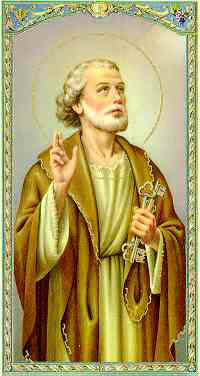
Right reasoning compels the belief, as our Church teaches, that when Christ said to Peter: "Upon this rock I will build My Church;" when Christ said: "hear the Church;" when Christ commissioned His apostles to teach all nations "to observe all things I have commanded you." He referred to one "exclusive," visible, organic Church, and not to a "multiplicity" of churches, that vary as to who Christ is, and what Christ commanded to be observed.
There were dozens of religious groups that professed belief in God during the pre-Christian ages, yet there was but one organic, sacerdotal, God-established spiritual society in the world. That was the Church of the children of Israel, in which supreme authority centered in High Priest Aaron and his successors (popes)' to the exclusion of all other religious denominations.
If Christianity be Judaism full-blossomed; if Christianity be the fulfillment of the prophesies recorded in the Old Testament;' if the Law was brought to perfection in the Gospels, as Christians must believe, then should the Church of the Christian dispensation be more perfect in organization, priesthood, sacrificial worship, authority, and extent of power, than was the Church of the Mosaic dispensation that it displaced. What Church, save the Catholic Church, has these credentials, recorded in the New Testament, to certify as the Church of Christ? Our answer is not the Park Street Church, nor the "multiplicity" of Protestant churches individually or in "unity."
After rejecting the idea of Peter being the rock upon which Christ, the Eternal Rock, built His Church, the Protestants scoffe at the idea that Christ established His Church upon Peter, the man who denied Christ, which is another thousandth time refuted Protestant notion. The Bible, supposed to be this minister's rule of faith, was disregarded in this instance, in order to get a punch in on the Catholic Church. But the blow fell short, as did the other knockout attempt.
It is un-Christian to emphasize Peter's sin in order to deny his selection as the Vicar of Christ, considering that Peter repented, and Christ forgave him. St. Paul says, as we Catholics believe in the case of Peter and everybody else, that repentance blots out sin (Acts, 3:19). Mary Magdalen, who had seven devils in her, came through repentance to be closer to our Lord in affection than any other woman, save His Blessed Mother Mary. David, an adulterer and murderer, became, through repentance, God's beloved, from whose family came Christ, who made Peter the cornerstone of His Church.
No one in history was more repentant than Peter, who for his sinful hour endured thirty years of remorse, ending by being crucified head downwards at his own request, since he believed himself unworthy to die as did the Lord he had denied. Christ knew Peter better than Peter knew himself. He knew Peter to be an impetuous, timid soul in whom there was a magnificent devotion to his Master.
It is un-Biblical to claim that Peter was not the rock upon which Christ built His Church, because he had sinned. Would the Park Street minister deny that Aaron was selected by God to be ti first High Priest of the Old Law because he violated the law God by setting up and worshipping a golden calf? This apparent idolatry caused Moses to wax hot with warranted indignation; break the Tablets of the Law, and to destroy the golden idol. (Exod. 32). But Aaron repented for his sin, and Moses gained for him forgiveness from God. Peter repented, and Christ the GodMan forgave Peter. But there was no blotting out of his sin I the Park Street Church.
The Church of Christ must be an authoritative Church, as was the Church of the Jews, and more so, since greater power an obligations were conferred upon her by Christ. It was to Peter alone that Christ gave His Keys, which signified supreme authority to govern His Church (St. Matt. 16). That authority still abides in the successor of Peter, Pope Pius XII. The significance of key was appreciated by the Jews. The Talmud tells a story of the High Priest who upon seeing the Temple in flames, went up to the roof of the Sanctuary "with a group of the flower of the priest hood." Then holding the keys of the Temple in his hands, he said:"Holy One, Blessed be He, Creator of the Universe, since we are not worthy to be your faithful custodians, we transfer the key of your house to you," and with these words the keys were thrown up. 'Something in the forrn of a hand descended from heaven anc grasped the keys."
Those were keys to the door of the Temple. They were taker from the Jews for a more profound reason than the mere loss Os the building; the authority keys represent; the authority of Juda ism as the religion of God, with its Mosaic priesthood and sacrifices, had ended. They had been replaced by a new, a more perfect priesthood, according to the order of Melchisedech (Ps. 109); anc" a sacrificial worship of a higher order (Mal. 1:10) that were instituted by Christ. A symbolic set of Keys had been given by Christ: the High Priest of the Christian Convenant, to Peter, the Superior of Christ's priesthood, as is Pope Pius XII today.
Our prayerful hope, is that Protestants will give the above matter unbiased consideration. It will, with God's grace, enable you to realize that to question the Catholic Church's infallible interpretation of St. Matthew 16 is to question the Christ you assume to serve.