"EVERY PERSON (OTHER THAN JESUS CHRIST) HAS SINNED "
This is a refutation of a deceitful Protestant article by the same name, found on the The "dokimose" websites.

The "dokimose" websites is for the most part, typical of Anti-Catholic websites in that it is severely lacking in the truth. The site is small, poorly set up, and overly colorful, it hurts the eyes to look at it. One of the interesting points about the site is it has almost no real articles. It one "big" (if you could call it that) item, is the "Fascinating Reading of the Holy Bible for Roman Catholics" section. The refutation bellow is from that section.
When I set out engage a anti-Catholic site I usually try to refute four or five articles from it. This better enables the reader to see the the dishonesty, and ignorance or the protestant site, providing multiple examples. For the ease of the reader, and to prevent confusion, all of "dokimose's" statements will be in "red" the verses they quote will be in "dark blue", and my replies will be in "Black".
[dokimose] Every person (other than Jesus Christ) has sinned:
[Misapplied Verse] As it is written, There is none righteous, no, not one:
- ROMANS 3:10 If we take this verse, by itself, in the strictest sense, it allows NO EXCEPTIONS AT ALL, not even for Jesus Christ. This is why it is important to look at the verse in the context of the verses around it. When we read the Romans Chapter three, we see that St. Paul is Not discussing individuals, but groups (the Jews and Gentiles). St. Paul's is explaining to the Romans that Jew were not better than the Gentile. This is evident when we read Verse nine and Ten together:
"What then? are we better than they? No, in no wise: for we have before proved both Jews and Gentiles, that they are all under sin; As it is written, There is none righteous, no, not one" (Romans 3:9-10)
This is why it is so dangerous to to take scriptures out of context, It also show the blatant dishonesty of the dokimose website. Now on to the next to verses that were listed:
[Misapplied Verse] For all have sinned, and come short of the glory of God;
- ROMANS 3:23 [Misapplied Verse] Wherefore, as by one man sin entered into the world, and death by sin; and so death passed upon all men, for that all have sinned:
- ROMANS 5:12 These verses are good examples of how the original Greek wording is clearer than the English translation of it . Both of these verses use the Greek word "Pas" (i.e "all") in a plural sense, giving it a "in general" or "on the whole" meaning, allowing for many exceptions:
"The emphasis in pas in the plural is not so much on each individual within the group as on the group as a whole." (Mounce's Complete Expository Dictionary of old and New Testament words, Edited by William D. Mounce, copyright 2006, pg. 13)
So we see, the proper understanding of St. Paul's words would be that mankind is sinful. This allows for many possible exceptions, the most obvious ones would Jesus Christ and his mother.
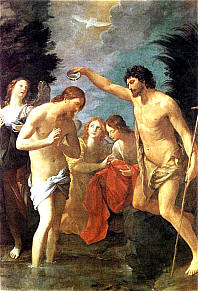
A Artists conception The baptism of Jesus, Christ stands in the shallow water as John pours the water over his head
[dokimose] Although Jesus was not a sinner, he was fully immersed in water baptism to associate himself with us in our sinful nature
[Misapplied Verses] And ye know that he was manifested to take away our sins; and in him is no sin.
- 1 JOHN 3:5 [Misapplied Verses] And Jesus, when he was baptized, went up straightway out of the water: and, lo, the heavens were opened unto him, and he saw the Spirit of God descending like a dove, and lighting upon him:
- MATTHEW 3:16 [Misapplied Verses] And the scripture was fulfilled, which saith, And he was numbered with the transgressors.
- MARK 15:28 Let me start by saying that we agree that Christ was not a sinner. The Problem we have with the dokimose website's application of these verses is the claim that Jesus was "fully immersed in water", there is nothing in the text of the verses that indicates that the baptism was done by immersion. St. Mathew statement that Christ came "out of the water", simply indicates that he was standing in shallow water when John Baptized him, the verse does not say what method (pouring or immersion) of baptism was used.
There is another practical point that needs to be considered, that is the amount physical exertion required to perform a baptism by full immersion . Many Bible scholars (Catholic and Protestants) point out that it is doubtful that St. John the Baptist was capable of physically dunking the huge numbers (estimated in the thousands) of people who came to him daily for baptism. Baptism by Pouring or sprinkling is the more probable method he used.