
A Look at The Gutenberg Bible
This Bible was the first book ever printed, and it was made by a Catholic.

The Gutenberg Bible has often been called the greatest book in the world. There is good and significant reason for the claim. Marking the threshold of a new art, the magnificent work was the first major book in the West to be printed from movable type. The Bible's producers rank high among the handful of men who gave civilization modern printing, an invention to compare with the wheel, the discovery of fire, or the uses of gunpowder.
Printing may have been the supreme achievement of the Northern Renaissance. Because of it, the barbarian dark was pushed back. Advocates of the new humanism or the old theology could count on the presses to send their basic tenets across national borders and into the far places of the earth. Written knowledge, once the province of the cultured few, became available to every literate man.
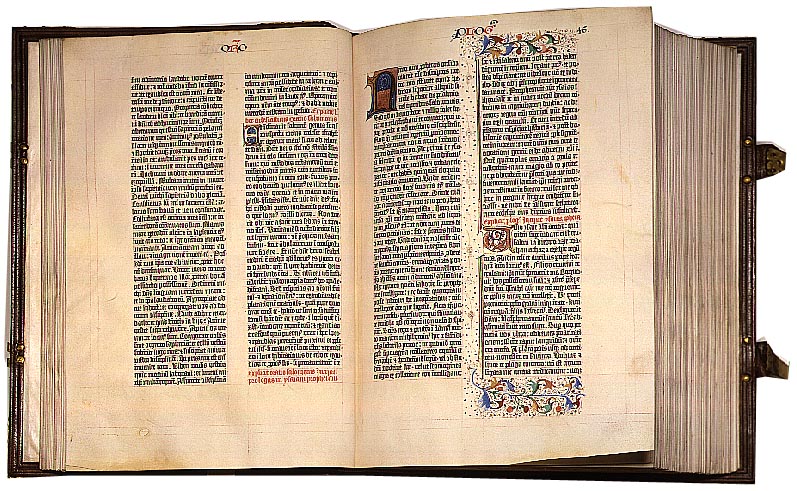 |
| This image is from the Gutenberg Bible kept at the Pierpont Morgan Library, in New York City |
Publication of the great Bible (sometimes called the 42-line Bible from the number of lines per page; sometimes the Mazarin Bible, for the cardinal in whose library a famous copy was found in 1763) released a spate of printing in Europe. From 1457 to 1500, presses appeared at Strasbourg, Cologne, Augsburg, Nuremberg, Ulm, Basle, Rome, Venice, Florence, Paris, Lyons, Westminster and a host of other cities and towns. Along with the proliferation of printing presses came rival claimants, their adherents seeking to displace Gutenberg from his position as first of the master printers. There has never been definite proof relating to a specific inventor of printing in the West. Like most inventions, it must have sprung from many hands. But over the years, the weight of evidence has favored Johann Gutenberg as the foremost pioneer practitioner of the new art. Gutenberg, like Shakespeare, left behind only tantalizing fragments concerning his life and work.
Johann Gensfleisch, born into a well-to-do family Catholic of Mainz about 1400, took the name of Gutenberg from his patrician mother. Some time after his birth, political disturbances forced the family to flee Mainz and settle in Strasbourg. There Gutenberg grew up and entered into a partnership, presumably to carry out some form of experimental printing. Details of this period are hazy and only known through legal proceedings. For several years before mid-century, Gutenberg disappeared from historical records. By 1448, he had become a citizen of Mainz.
In that city, from 1450 to 1455, the pioneer printer worked through a crucial period of his career. About 1450, he borrowed 800 gulden from Johann Fust, a goldsmith and capitalist, and two years later, asked for and received a similar amount. The sum was used to promote the art of printing and Gutenberg's working equipment was put up for security. When payment was not forthcoming, Fust went into court in 1455, suing to recover his money with interest and also requesting possession of Gutenberg's tools. As a witness, the burgher produced Peter Schoeffer of Gernsheim, a technician in Gutenberg's employ. Once again, the mists of time blot out the record; it appears Fust did take over much of the printing equipment. The partnership of Fust and Schoeffer was then established and they became prominent printers of Mainz, producing a magnificent Psalter in 1457, among their other works. Gutenberg apparently was bankrupt but managed to continue printing. In 1465, Archbishop Adolf of Mainz appointed him to a court position for life for services rendered in the past. The great printer died in 1468, but circumstances of his death and burial are unknown.
Among printed pieces attributed to Gutenberg are several editions of a Latin grammar by Donatus, some letters of indulgence from the Pope (dated 1454 and 1455), a rare 36-line Bible, and a Latin dictionary called the Catholicon. But the major question remains: what was Gutenberg's connection with the famed 42-line Bible which carries his name? There are no clean-cut answers. After much sifting of evidence, scholars have concluded that the Bible was conceived and begun by Gutenberg and probably finished and marketed by Fust and Schoeffer.
The Gutenberg Bible was placed in time by Heinrich Cremer, vicar of the Collegiate Church of St. Stephen in Mainz, who rubricated, illuminated and bound a set of the work in 1456, marking the date within the volumes. Allowing several months for Cremer's efforts, it seems apparent the Bible came from the presses some time in 1455. The printers themselves placed no date on their work. Whatever its actual date, the 42-line Bible was a remarkable achievement for its time or any other. Most pioneering works are crude, tentative and fumbling. The Gutenberg Bible is none of these. As a complete and polished entity, it has stood inspection for 500 years.
The medieval printers, practicing an art rather than a craft, lavished infinite care on this first printing of the Book of Books. A large and distinguished format, fine press work, creamy paper and an elaborately beautiful Gothic type face all contribute to this majestic production. After experiments with 40- and 41-line pages, the printers settled on a 42-line page with two columns of type. There are 1,282 printed pages, in black ink. Spaces were left for capital letters and headings, and owners of the book employed artists to illuminate its pages with religious miniatures, dragons, peacocks, falcons and a Gothic riot of medieval flowers.
The number of Gutenberg Bibles printed at Mainz is not known. Estimates say some 200 copies, of which 165 were on paper and 35 on vellum, came from the presses. At present, there are 51 known copies, according to the British Library.