The Honor To The Early Church Fathers
and Tradition
In The Original King James Version.
King James himself said "And I believe them in that sense as the ancient Fathers and Councils that made them did understand them, to which three Creeds all the ministers of England do subscribe at their Ordination. And I also acknowledge for Orthodox all those other forms of Creeds that either were devised by Councils or particular Fathers, against such particular heresies as most reigned in their times." [From A Premonition to All Most Mighty Monarchs, Kings, Free Princes, and States of Christendom Works, ed. James Montague, Bp. of Winchester (1616), pp. 301-308.]

IN THE OFFICIAL PREFACE TO THE ORIGINAL KJV.
Today, most (if not all) Protestants reject what we as Catholic call "tradition" or the writings or the "early church fathers". But this was not always so for the early Protestant "reformers" were not so openly opposed to reading and learning from these early Catholic compositions, a good example of this is the infamous King James Bible.
When reading the original preface to the 1611 King James Version called "To The Reader", we are amazed by the open acceptance of the early church fathers as legitimate authorities and tradition by these Anglican men who translated this Protestant version of the Bible. This should not come as a surprise for did not these same translators in there preface acknowledge the Roman Catholic Church as having been (at one time) the legitimate Church. "The Church of Rome, then a true Church" [page 1] This is the same sentiment that the King himself held "I acknowledge the Romane Church to be our Mother Church." [The truth about King James, Pg 115]
The sheer number of different Church fathers which these Anglican translators cite and quote in there eleven page preface is amazing and quit telling: S. Augustine, S. Chrysostom, S. Cyril, S. Epiphan, Eusebius, S. Jerome, Justin Martyr, S. Ireney, Origen, and Tertullian.
Some of the early Catholic fathers were quoted and cited very extensively in this eleven page preface, such fathers as St. Augustine(28 times) and S. Jerome(26 times). Certain Catholic fathers such as S. Jerome were even singled by the Anglican translators of the KJV of very for special praise. "S. Jerome a most learned father, and the best linguist without controversy, of his age, or of any that went before him, to undertake the translating of the Old Testament, out of the very fountain with that evidence of great learning, judgment, industry, and faithfulness, that he had forever bound the Church unto him, in a debt of special remembrance and thankfulness...S. Jerome maketh no mention of the Greek tongue, wherein yet he did excel" [page 5].
Certain, Fathers writings such as S. Augustine were all but call Divinely inspired themselves "it was said unto S. Augustine by a supernatural voice" [page 2]. King James said of S. Augustine: "I will therefore in that case follow St. Augustine's rule in judging of their opinions as I find them agree with the Scriptures" [From A Premonition to All Most Mighty Monarchs, Kings, Free Princes, and States of Christendom Works, ed. James Montague, Bp. of Winthester (1616), pp. 301-308.]
It is also interesting to note that these translators of the king’s version often quote from many early Christian writings which were written in defense of doctrines that are now considered very Catholic teachings. A good example of this is St. Jerome letter ["Against Helvidius" A.D. 383] written in rebuttal to the theological innovator Helvidius, who asserted, that Mary had other children besides Jesus. Today Many, Protestant reject this doctrine of the Perpetual Virginity of Blessed Mary.
We also notice the over all Great respect in which these fathers were held at point’s being called "Greek
|
|
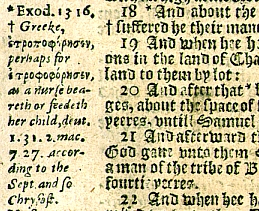
| Acts 13:18 has a marginal note containing the Greek text of an
alternate reading "according to the Sept. [Septuagint] and so
Chrysost." [John Chrystostom, one of the church fathers] This leaf from the King James Version Printed by Bonham Norton and John Bill The "printers to the Kings moft excellent Majestie" at London, England in 1625. |
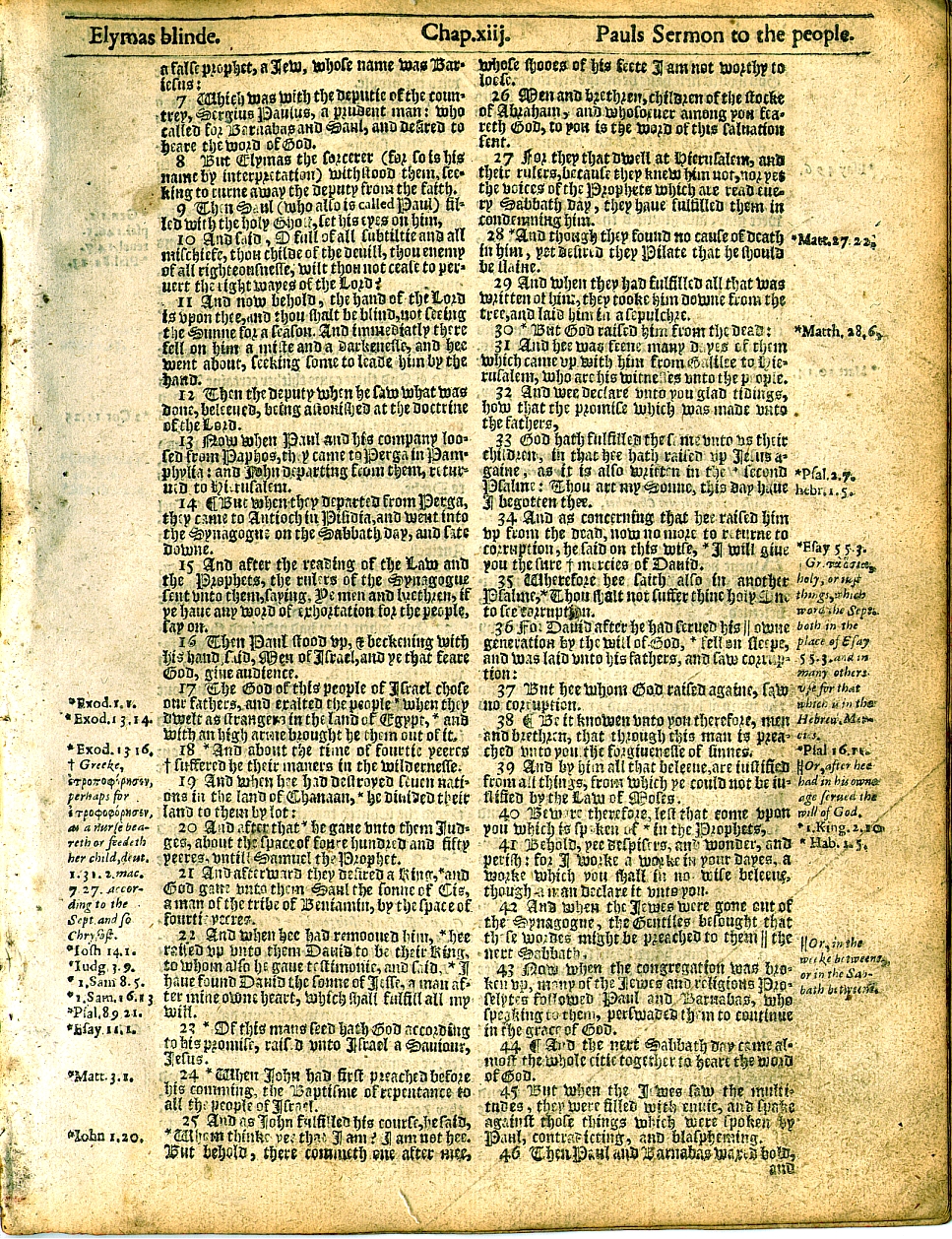
fathers" and "fathers of the Church". At points even going to great effort to Defend and praise these early Catholic Fathers. "since whosoever is worthy the name of a Father, from Christ's time downward, hath likewise written not only of the riches, but also of the perfection of the Scripture" [page 3].
These Anglican translators in there preface also attacked and openly denounced other Protestant translations such as the Puritan "Geneva" Bible, for leaving the traditional Ecclesiastical words "Lastly,
we have on the one side avoided the scrupulosity of the Puritans, who leave the old Ecclesiastical words, and betake them to other, as when they put WASHING for BAPTISM, and CONGREGATION instead of CHURCH:" [page 11]. It is for this resin the pseudo-erudite English King James himself made the assertion that the Geneva version was, to his thinking "the worst that had so far appeared" (English Versions of The Bible, 1952 pg 229)
But did this devotion to the early Catholic Church Fathers stop with the Preface? The answer is NO. Thought the 1611 King James Version the translators placed margin notes often citing these early Catholics fathers as authoritive reference for the translation of the verse (such as Acts 13:20 in the Scan to the right).
IN THE TEXT OF THE KING JAMES VERSION.
Anther example is the fact that in many places the these Anglican translators chose S. Jerome’s Latin Vulgate (the official Bible of the Catholic Church) over the Greek "received Text ". A few of the many possible examples are:
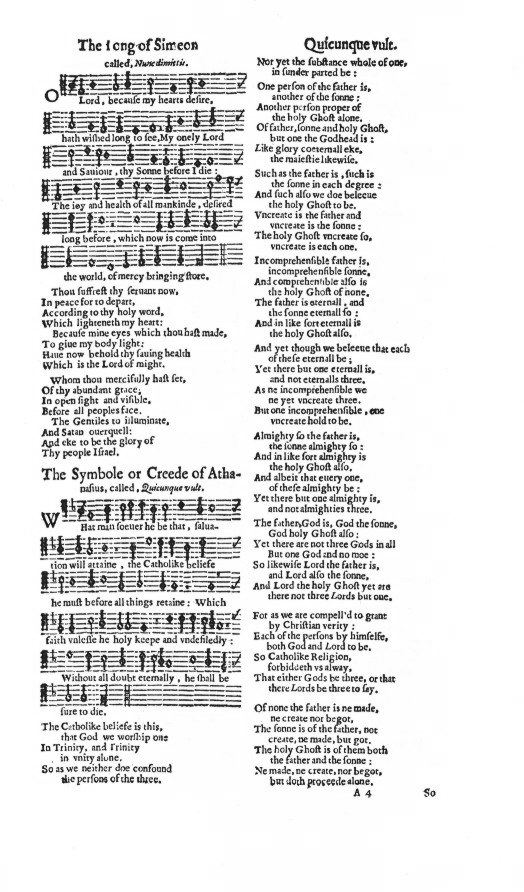
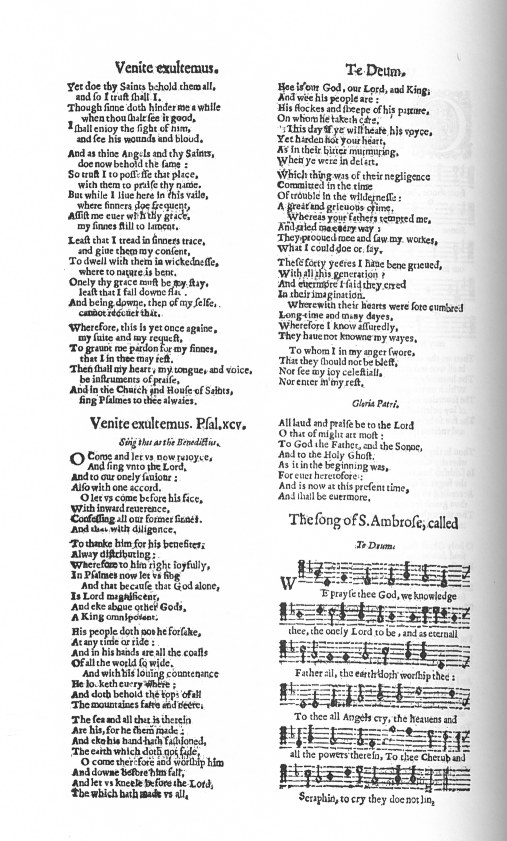
| Also printed within the binding of the 1611 KJV was the the Anglican Psalter or Psalms of David (by Sternhold and Hopkins), "Set forth as they are to be Sung in All Churches." Several of the songs in this Psalter are attributed to the Early Church Fathers, a form of honor. | |
|
|
|
| .The Creed of S. Athanasius. | The Song of S. Ambrose. |
| These scans are from a facsimile of the first impression the original 1611 edition of The King James Bible was produced in 1961 for the World Publishing Company | |
Acts 10:6
"he shall tell thee what thou oughtest to do"
Acts 10:21
"which were sent unto him from Cornelius"
Acts 21:8
"that were of Paul's company"
Romans 13:9
"Thou shalt not bear false witness"
Romans 16:20
"Amen"
Colossians 1:14
"through his blood"
Hebrews 2:7
"and didst set him over the works of thy hands"
Hebrews 11:13
"and were persuaded of them and embraced them"
Hebrews 12:20
"or with a dart shot through"
OTHER EVIDENCE.
It is a certainty that King James himself held the Early Church Fathers in very high regard:
"As for the Fathers, I reverence them as much and more than the Jesuits do, and as much as themselves ever craved. For whatever the Fathers for the first five hundred years did with an unanime consent agree upon, to be believed as a necessary point of salvation, I either will believe it also, or at least will be humbly silent, not taking upon me to condemn the same." [A Premonition to All Most Mighty Monarchs, Kings, Free Princes, and States of Christendom Works, ed. James Montague, Bp. of Wint hester (1616), pp. 301-308.]
Many of the translators themselves had studied the the early Church Fathers, for example Sir Henry Savile who lead the second group from Oxford [who translated the Gospels, Acts, and the Apocalypse] was the editor of the works of St. Chysostom.
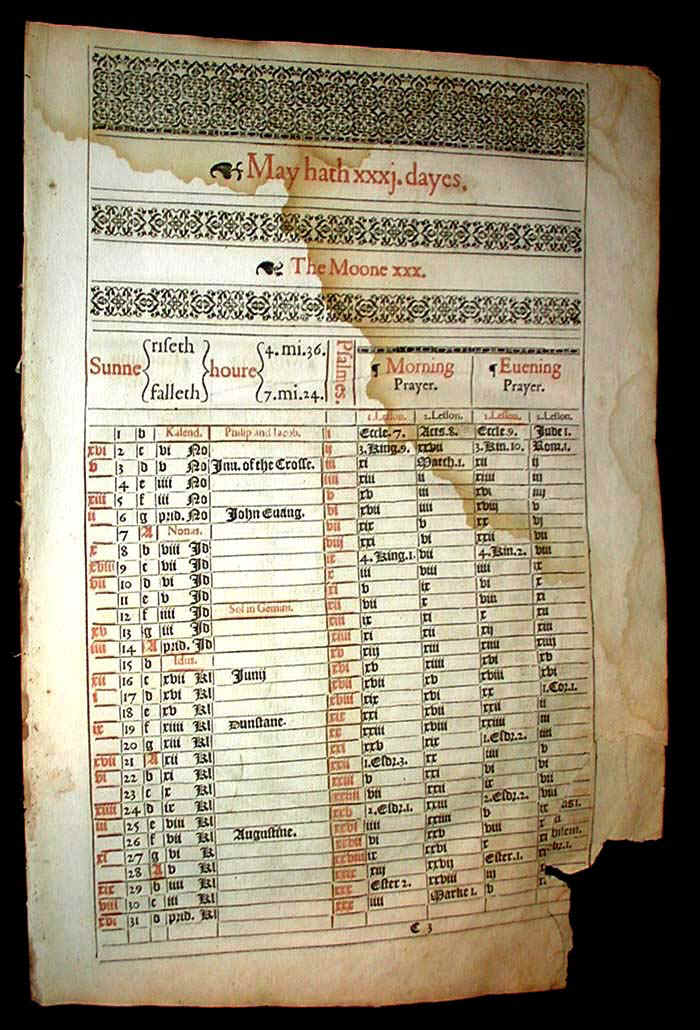
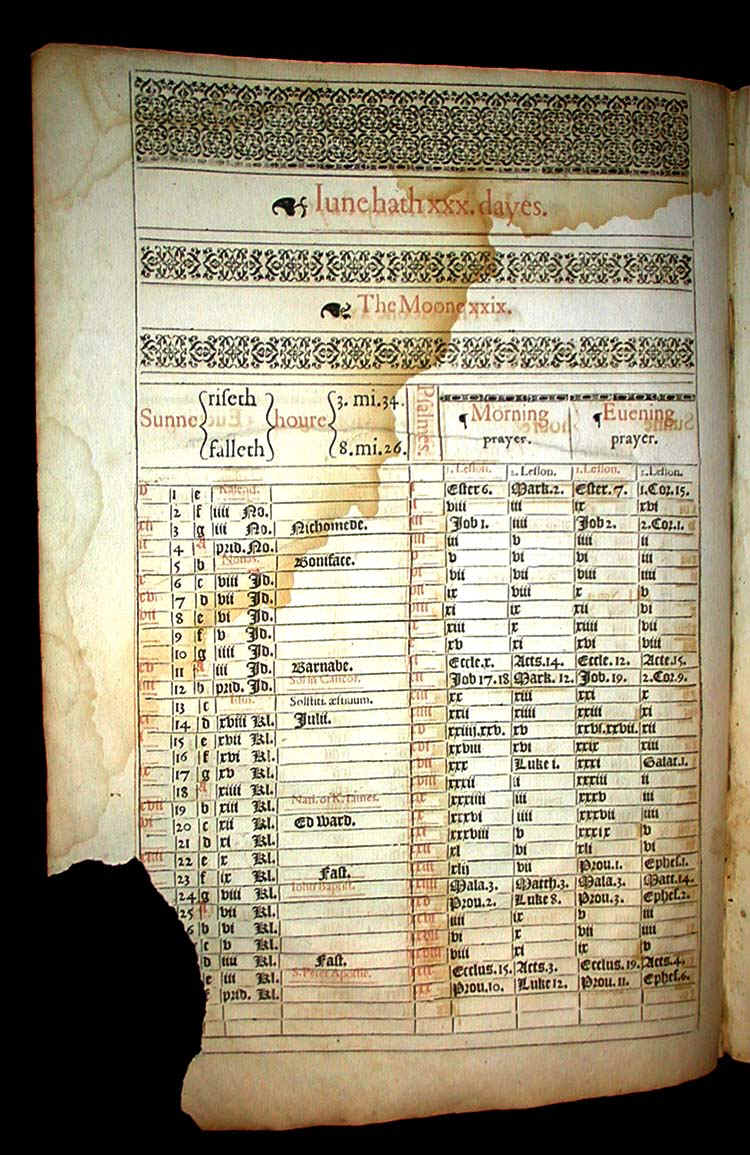
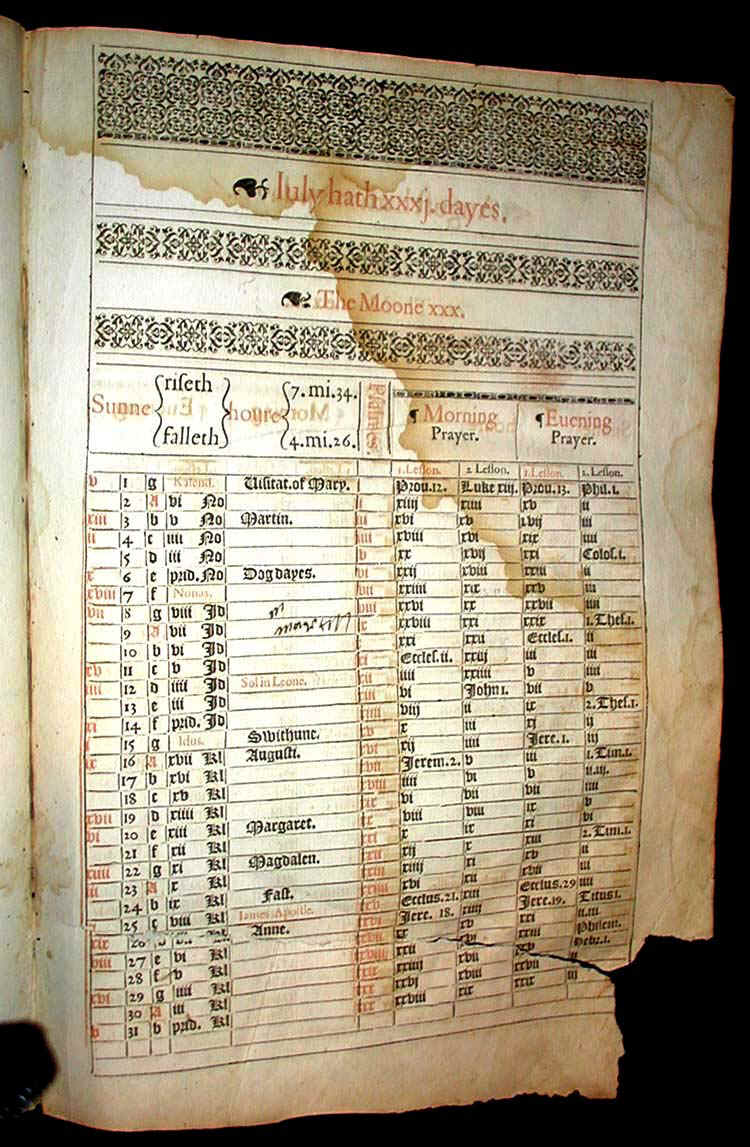
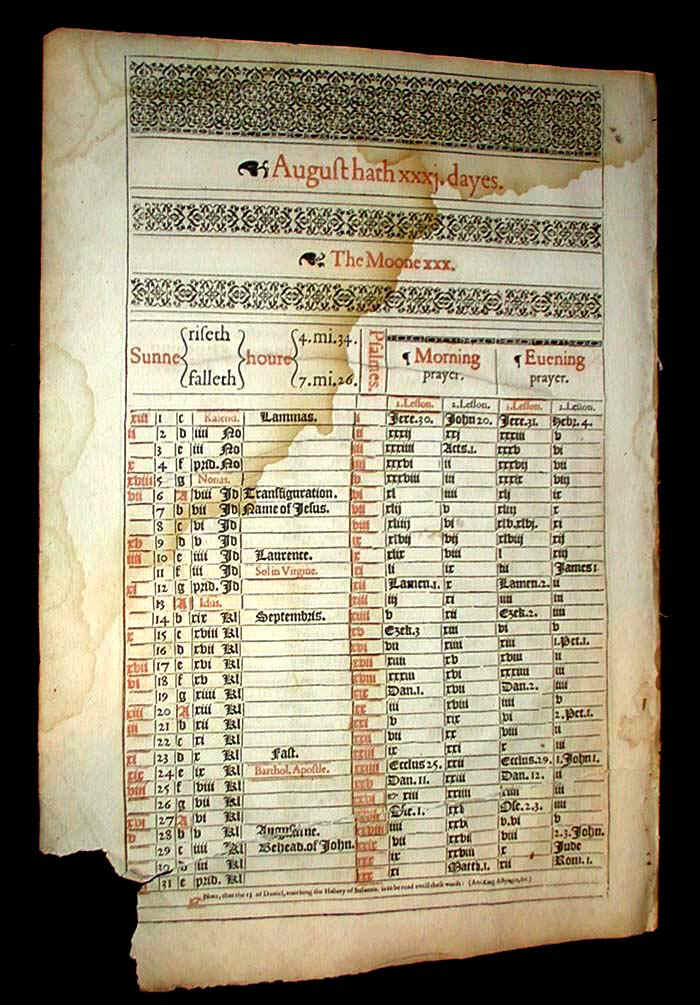
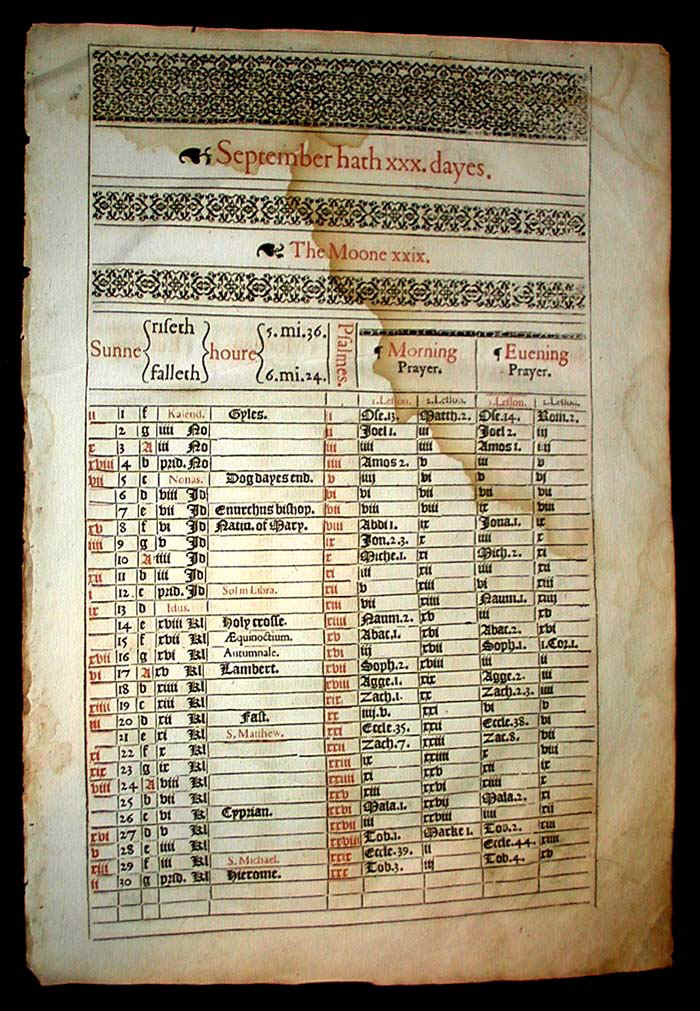
The original 1611 KJV had a calendar/Almanac for each month of the year. Bellow are scans of the 1613 KJV calendars for the months of:
| May | June | July | August | September | October |
 |
 |
 |
 |
 |
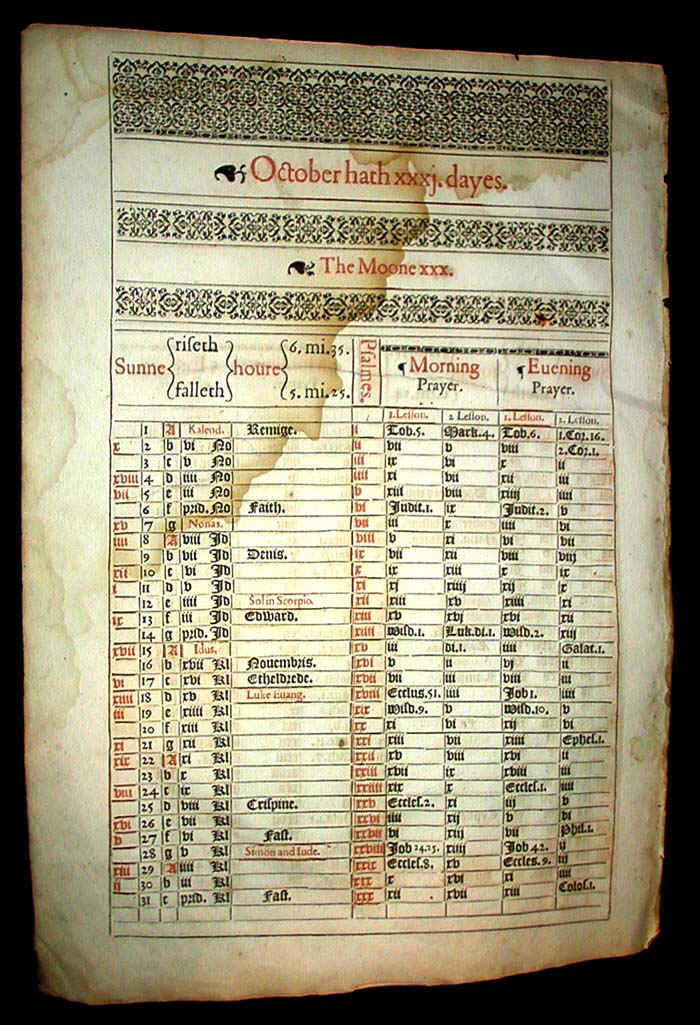 |
All of these leafs were printed by Robert Barker at London, England in 1613. The page size is A HUGE 11" X 16" these are Original leafs from the true Second Folio of the King James Bible. Black and red Letter English language text arraigned in double columns in "Gothic print type". The following links at to scans of the remaining months, these scans are from the Nelson reprint of the KJV: Nov , Dec, Jan, Feb, Mar, Apr.
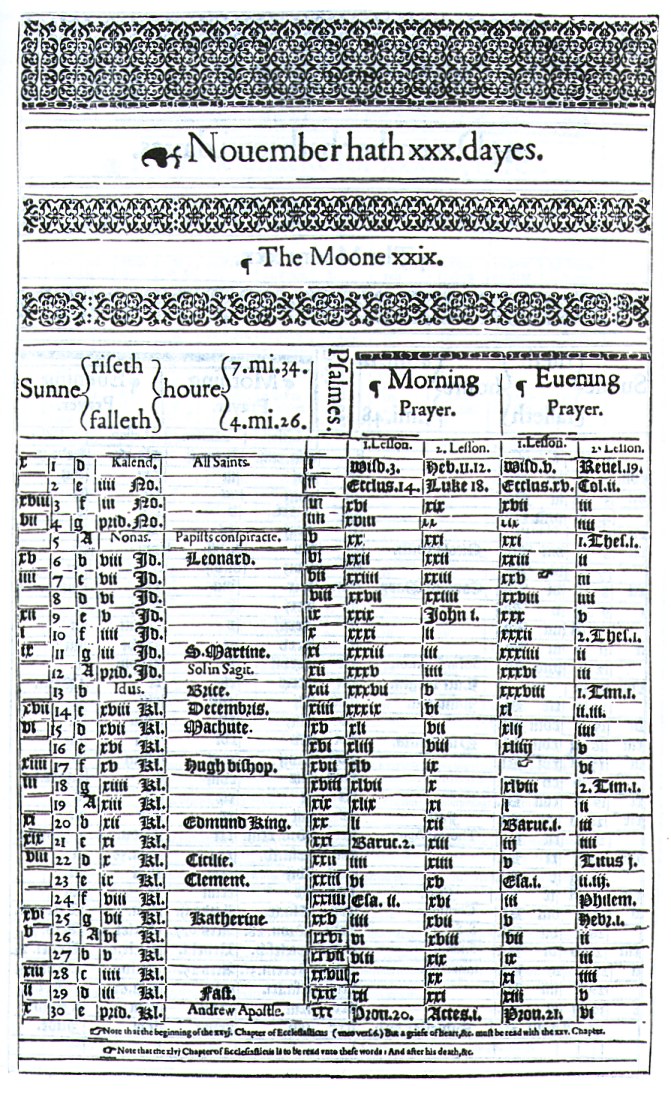
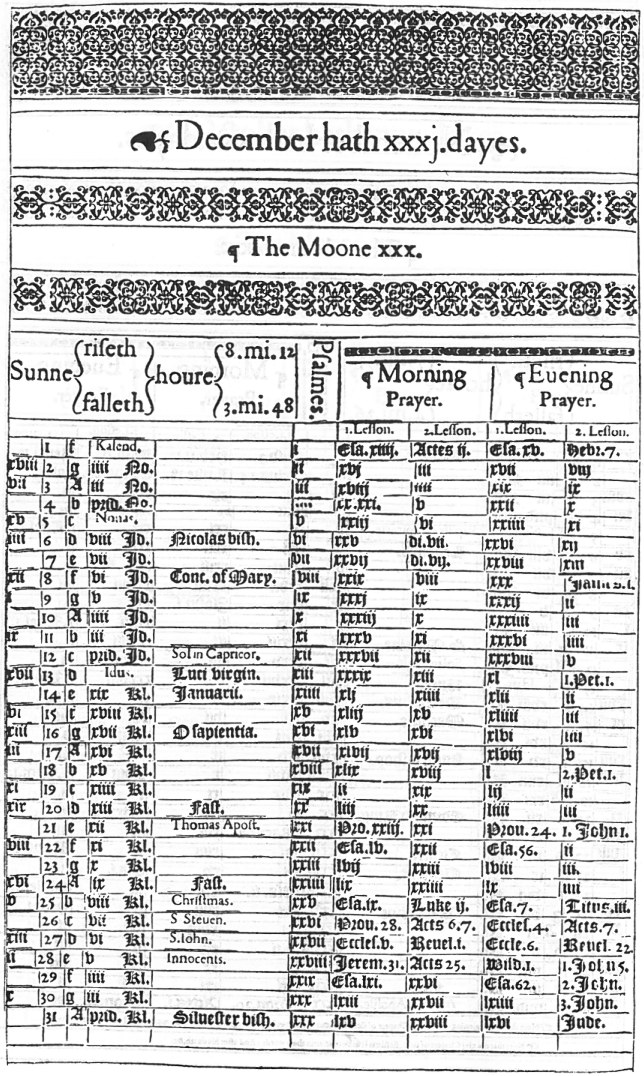
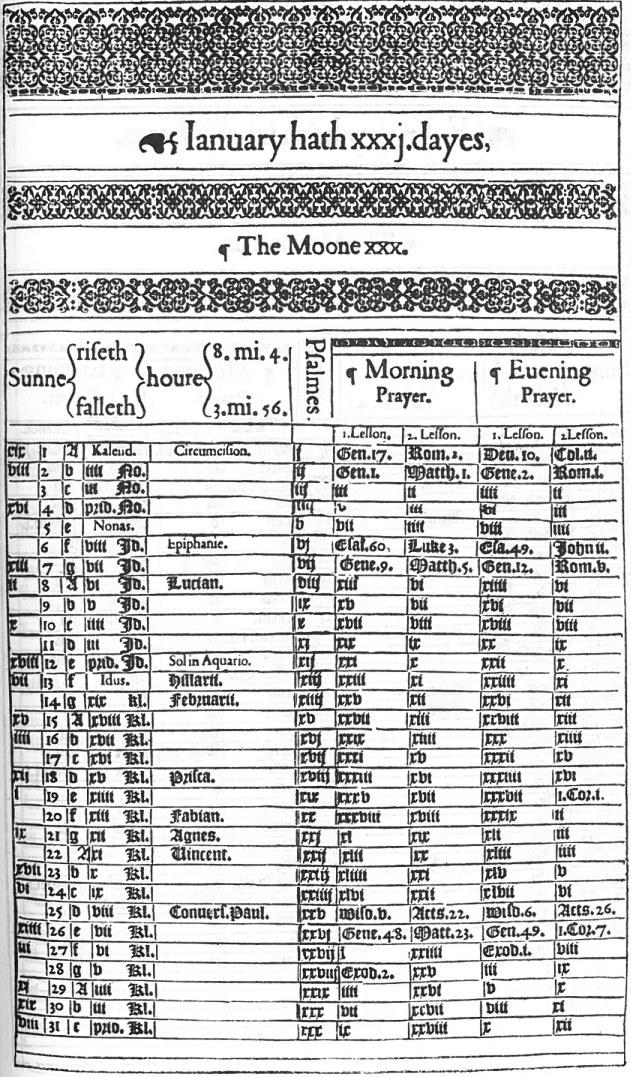
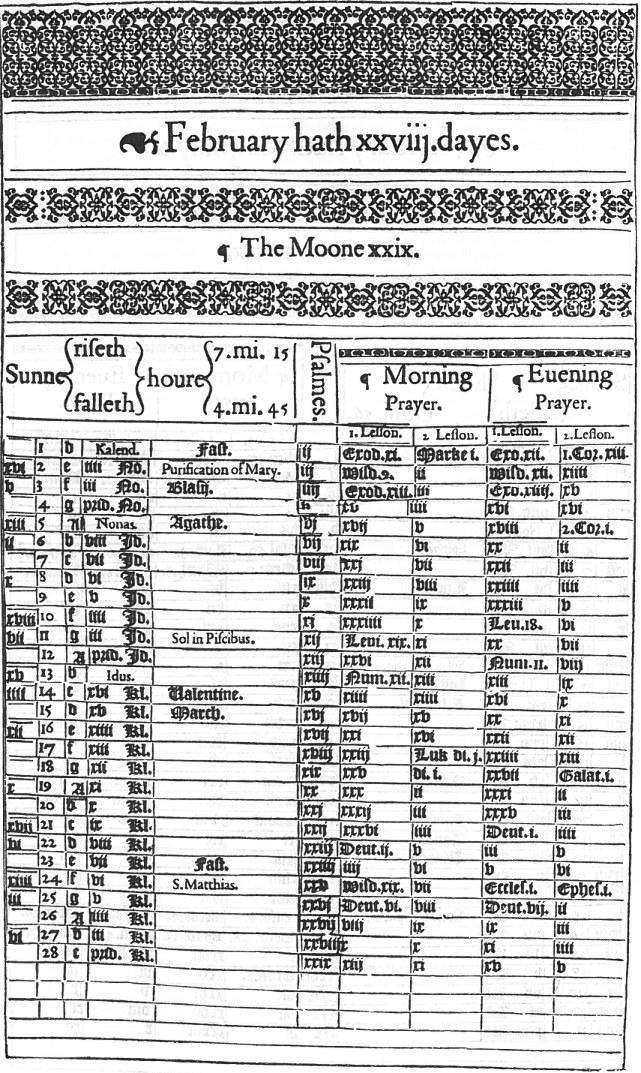
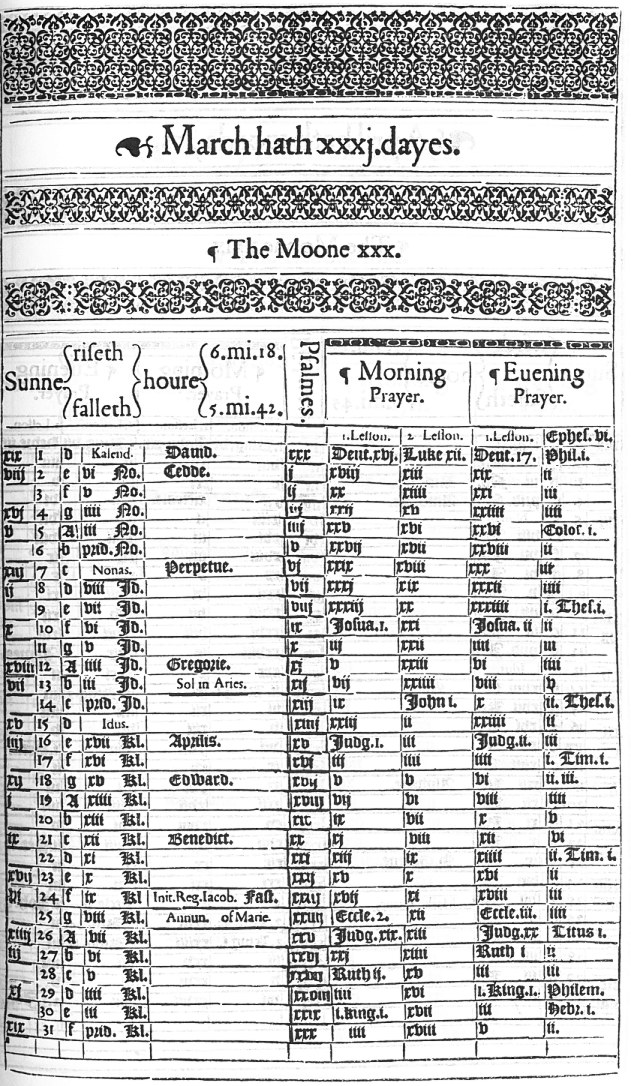
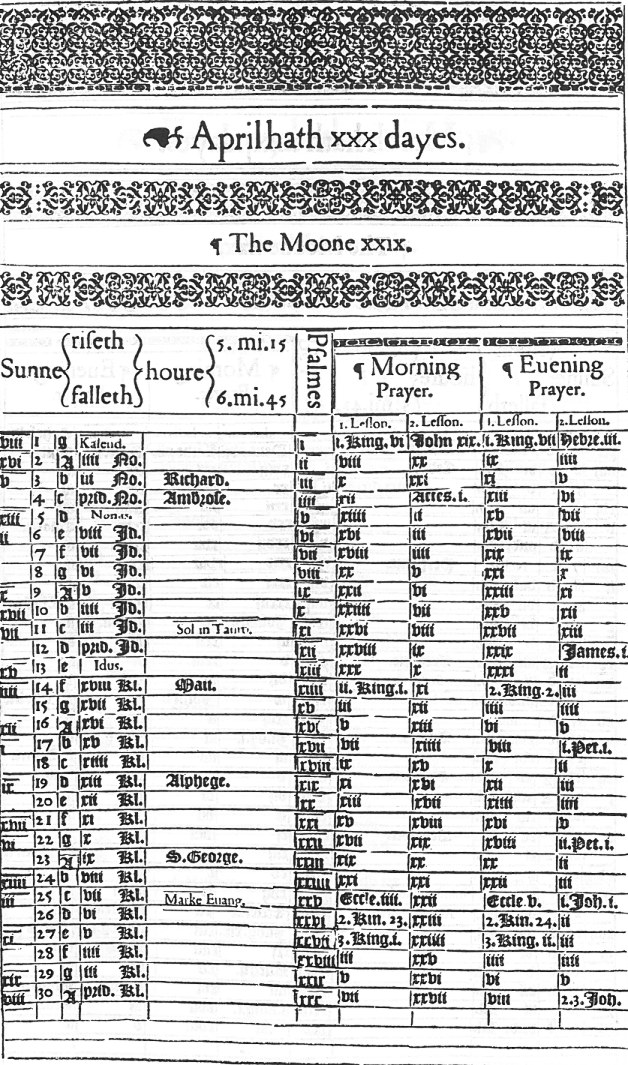
These calendars/Almanacs included many feast paying honor to many early Christians and Church fathers as the fallowing few [and these are just a few of them]:
Mar. 12 St Gregorie [ A Pope of the Catholic Church]
Aug. 28 St Augustine [one of the greatest Catholic writers of all time]
Sept. 26 St. Cyplian, [Catholic of Antioch who suffered martyrdom during the persecution of Diocletian at Nicomedia, 26 September, 304, the date in September being afterwards made the day of his feast]
Sept. 30 St. Jerome, [The creator of the Latin Vulgate, died at Bethlehem, 30 September, 420]
Oct. 9 St. Denis [Bishop of Paris, and martyr. Born in Italy, nothing is definitely known of the time or place, or of his early life. His feast is kept on 9 October. . Denis with his two companions were seized and as they persevered in their faith were beheaded (about 275) after many tortures]
Oct. 26 St. Crispine [beheaded during the reign of Diocletian; the date of their execution is given as 26 October, 285 ]
Nov. 23 St Clement [ A Pope of the Catholic Church]
These calendars were a official sanctioned part of The King James Bible as shown by the King's own open approval of them: "As for the Saints departed, I honour their memory, and in honour of them do we in our Church observe the days of so many of them as the Scripture doth canonize for saints" [From A Premonition to All Most Mighty Monarchs, Kings, Free Princes, and States of Christendom Works, ed. James Montague, Bp. of Wint hester (1616), pp. 301-308.]
It Is a well known fact that Erasmus [Who Derived "Textus Receptus", the Greek text on which the KJV was based] had a special Love for the early Church Fathers, besides the "Textus Receptus" some of the other literary works proceeded from Erasmus' pen, among them critical editions and translations of classical authors and early church fathers. The latter included Jerome, Hilary, Irenaeus, Ambrose, Augustine, Epiphanius, Chrysostom, and Origen, who was Erasmus' favorite church father (Bainton, Erasmus of Christendom, p. 143). ), and of whom Erasmus once wrote, "I have also read a great part of Origen, who opens out new fountains of thought and furnishes a complete key to theology." (Froude, Life and Letters of Erasmus, p. 93). So the next time you run in to a avid KJV lover who rejects the words of these early Catholic Church Fathers, don’t forget to kindly remind them of these facts.
