
"Images" Found in the Old Testament

Throughout the Old Testament there are instances of representations of living things,
not in any way worshiped, but used lawfully, even ordered by the law as ornaments of the
tabernacle and temple. The many cases of idolatry and various deflections from the Law
which the prophets denounce are not, of course, cases in point. It is the statues made and
used with the full approval of the authorities which show that the words, "Thou shalt
not make to thyself any graven image", were not understood absolutely and literally.
It may be that the Hebrew word translated "graven image" had a technical sense
that meant more than a statue, and included the idea of "idol"; though this does
not explain the difficulty of the next phrase. In any case it is certain that there were
"likenesses of that which is in the sky above and on earth below and in the
waters" in the orthodox Jewish cult. 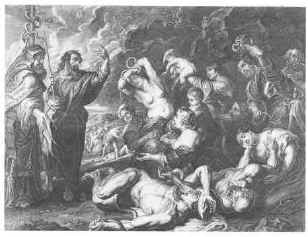
There was the brazen serpent (Num., xxi, 9), not destroyed
till Ezechias did so (IV Kings, xviii, 4), there were carved and moulded garlands of fruit
and flowers and trees (Num., viii, 4; III Kings, vi, 18; vii, 36); the king's throne
rested on carved lions (III Kings, x, 19-20), Iions and bulls supported the basins in the
temple (III Kings, vii, 25, 29). In the first
book of Samuel we read that in order to deceive the guards sent by Saul to seize David, Michal his wife prepared one of the household
teraphim (a graven image), putting on it the goat's, hair cap worn by sleepers and invalids, and laid it in a bed, covering it with a mantle. She pointed it out to the soldiers, and alleged that David was confined to his bed by a sudden illness (1 Sam. 19: 13-16). Thus she gained time for David's escape.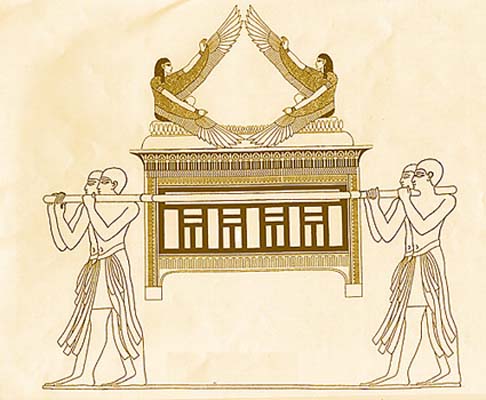
Especially there are the cherubim, great carved figures of beasts (Ezech., i, 5; x, 20, where they are called beasts), that stood over the ark of the covenant (Ex., xxv, 18-22; III Kings, vi, 23-8; viii, 6-7, etc.). The ephod was certainly once a statue of human form (Judges, viii, 27; xvii, 5; I Kings, xix, 13, etc.),
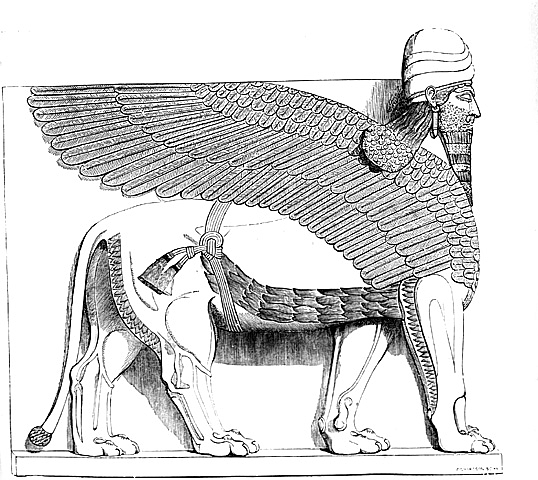
the human heads of the cherubim (Ezech., xli, 19, Ex., xxv, 20, the references to them when combined seem to point irresistibly to some such figures as the Assyrian winged bulls with human heads), and what were the theraphim (Judges, xvii, 5)? Both were used in orthodox worship.