
The King who believed he was a God.
The KJV and the theory "ON THE DIVINE RIGHT OF KINGS."

The Geneva Bible issometimes called the "breeches" Bible because of the quaint translation of Genesis III:7, where it is said that Adam and Eve, realizing their nakedness, "sewed fig leaves together and made themselves breeches."
If the Geneva was so well loved why did the English reading public Need a "new" translation of the scriptures? Because the King of England strongly Disliked this version of the Bible. The Geneva had extensive marginal notes run to approximately 300,000 words, or one third the length of the text of the Bible itself! It was these marginal notes that were also the reason for its eventual demise. These strongly Protestant [Calvinistic] notes so infuriated King James that he considered Them "partial, untrue, seditious, and savouring of dangerous and traitorous conceits." and made its ownership a felony. King James was particularly worried about marginal notes such as the one in Exodus 1:9 indicated that the Hebrew midwives were correct in disobeying the Egyptian king's orders, [King James felt This undermined the theory of divine right of kings] and a note for 2 Chronicles 15:16 said that King Asa should have had his mother executed and not merely deposed for the crime of worshipping an idol."...it is supposed that James's suspicious mind thought that this might react unfavourably upon the memory of his own mother, Mary Queen of Scots." [Bruce, History of the Bible in English, p. 97] Consequently, King James eventually introduced the King James Version, which drew largely from the Geneva Bible (minus the marginal notes that had enraged him). The King James Version of the Bible grew out of the king's distaste for these brief but potent doctrinal commentaries. He considered the marginal notes to be a political threat to his authority and his kingdom.
It was because of there rejection of James's theory of the "Divine right as king", That King came out openly condeming the Puritan Religion and it' s Bible:
"That Bishops ought to be in the Church, I ever maintained it as an Apostolic institution and so the ordinance of God,contrary to the Puritans, ... And as I ever maintained the state of Bishops and the Ecclesiastical Hierarchy for order sake, so was I ever an enemy to the confused anarchy or parity of the Puritans, [From A Premonition to All Most Mighty Monarchs, Kings, Free Princes, and States of Christendom Works, ed. James Montague, Bp. of Wint hester (1616), pp. 301-308.]
It was during the reign of King James I (1566-1625), that England adopted harsh measures against the puritans which forced many of them [the Pilgrims] to flea England (1608), in order to escape religious persecution, they ended up in The Netherlands. The Pilgrims soon left the Netherlands and sailed for the new wold , they avived at Plymouth Rock aboard the Mayflower establishing the colony of Massachusetts in 1620[five years before the death of King James]. The Pilgrims brought with them there Geneva translation.
King James's own words on his theory "ON THE DIVINE RIGHT OF KINGS."
"The state of monarchy is the supremest thing upon earth ... Kings are justly called Gods, for that they exercise a manner or resemblance of divine power upon earth. For if you will consider the attributes to God, you shall see how they agree in the person of a king. God has power to create, or destroy, make, or unmake at his pleasure, to give life, or send death, to judge all, and to be judged nor accountable to none: to raise low things, and to make high things low at his pleasure, and to God are both soul and body due. And the like power have Kings; they make and unmake their subjects: they have power of raising, and casting down: of life, and of death: judges over all their subjects, and in all causes, and yet accountable to none but God only. Now in these our times we are to distinguish between the state of kings in their first original, and between the state of kings and monarchs, that do at this time govern in civil kingdoms ... In the first original of kings, whereof some had their beginning by conquest, and some by election of the people, their wills at that time served for law; Yet how soon kingdoms began to be settled in civility and policy, then did kings set down their minds by laws ... And I am sure to go to my grave with that reputation and comfort, that never king was in all his time more careful to have his laws duly observed, and himself to govern thereafter, than I.... I conclude then this point
1620 King James Version imprinted at London, by Bonham Norton and John Bill, "printers to the Kings moft excellent Majestie". The King James Verion was created to suport the theory of the "divine right of kings"
touching the power of kings, with this axiom of divinity, that as to dispute what God may do, is blasphemy ... so is it sedition in subjects, to dispute what a king may do in the height of his power: But just kings will ever be willing to declare what they will do, if they will not incur the curse of God. I will not be content that my power be disputed upon: but I shall ever be willing to make the reason appear of all my doings, and rule my actions according to my laws ... Therefore all kings that are not tyrants, or perjured, will be glad to bound themselves within the limits of their laws; and they that persuade them the contrary, are vipers, and pests, both against them and the Commonwealth."[Extracts from speech to Parliament, 21 March 1609 ]
"God giues not Kings the style of Gods in vaine, For on his throne his Scepter do they swey: and as their subjects ought them to obey, Kings should feare and serve their god again If then ye would enjoy a happie raigne, Obserue the Statutes of your Heauenly King; and from his lawe, make all your Lawes to spring: Since his Lieutenant heare ye should remaine, Reward the iust, be steadfast, true, and plaine: Represse the proud, maintaining ay the right, Walke alwaies so, as euer in his sight Who guardes the godly, plaging the prophane, And so ye shall in princely vertues shine. Resembling right your mighty King diuine." ["The Argvment of Basilikon Doron" by King James I]
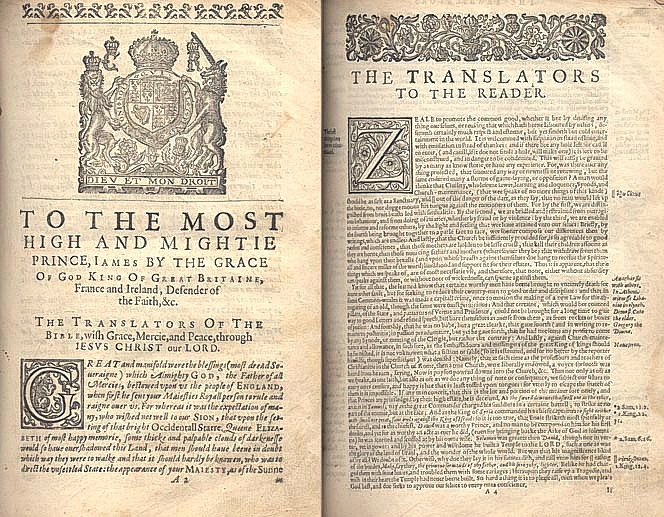
The Translators own words in support of the theory "ON THE DIVINE RIGHT OF KINGS."
"TO THE MOST HIGH AND MIGHTY PRINCE JAMES, BY THE GRACE OF GOD KING OF GREAT BRITAIN, FRANCE, AND IRELAND, DEFENDER OF THE FAITH, GREAT and manifold were the blessings, most dread Sovereign, which Almighty God, the Father of all mercies, bestowed upon us the people of England, when first he sent Your Majesty's Royal Person to rule and reign over us...we hold it our duty to offer it to Your Majesty, not only as to our King and Sovereign, but as to the principal Mover and Author of the work "[Epistle Dedicatory to the Authorized King James of 1611 ]