
Did the Catholic Church Prohibit Bible Reading?

PREFACE:
This is a refutation of a article found on the anti-Catholic "Jesus-is-Lord" [JIL] Website. Here it is found as part of a article called "Catholic Religion Prohibited Bible Reading ".
INTRODUCTION:
The Catholic Church has never attempted to keep the Bible out of the hands of the people. To start with I recomend that the web-Master of the Jesus is Lord Page read:
- Pius XII, Encyclical Letter on: the Promotion of Biblical Studies: Divino Afflante Spiritu
- Encyclical Letter of Pope Leo XIII, On The Promotion Studying of Holy Scripture:
To anyone that has investigated the real facts of the case, are forced to acknowledge the fact that it was the Catholic Church that first gave us the sacred scriptures in the English Language, even before John Wycliff first placed his pen to paper to began his translation. This fact is born out in the statements of many seventeenth century Protestants such as Cranner, Henry VIII's Archbishop of Canterbury, said in the preface of the "Great Bible," that the. Holy Bible:
"was translated and read in the Saxon tongue, which at that time was the mother tongue, whereof there remaineth yet divers copies. ..; and when this language waxed old and out of common use, it was translated into the (English) language, whereof yet also many copies remain and be daily found."
Even Foxe, the famed Protestant martyologist, makes the same acknowledgment:
"If history be well examined we shall find both before the conquest and after, as well before John Wickliffe was born as since, the whole body of the scriptures was by Sundry men translated into our country tongue." ( This was in 1571, in the declaration to Queen Elizabeth, written by Foxe).
To begin far back, we have a copy of the work of Caedmon, a monk of Whitby, in the end of the seventh century, consisting of great portions of the Bible in the common English tongue. In the next century we have the well-known translations of Venerable Bede, a monk of Jarrow, who died whilst busy with the Gospel of St. John. In the same (eighth) century we have the copies of Eadhelm, Bishop of Sherborne; of Guthlac, a hermit near Peterborough; and of Egbert, Bishop of Holy Island; these were all in Saxon, the language understood and spoken by the Christians of that time. Coming down a little later, we have the free translations of King Alfred the Great who was working at the Psalms when he died, and of Aelfric, Archbishop of Canterbury; as well as popular renderings of Holy Scripture like the Book of Durham, and the Rushworth Gloss and others that have survived the wreck of ages. After the Norman conquest in 1066, Anglo-Norman or Middle-English became the language of England, and consequently the next translations of the Bible we meet with are in that tongue. There are several specimens still known, such as the paraphrase of Orm (About 1150) and the Salus Animae (1250), the translations of William Shoreham and Richard Rolle, hermit of Hampole (died 1349). I say advisedly ‘specimens' for those that have come down to us are merely indications of a much greater number that once existed, but afterwards perished.
THE REFUTATION:
[JIL]"The Council of Trent (1545-1564) placed the Bible on its list of prohibited books, and forbade any person to read the Bible without a license from a Roman Catholic bishop or inquisitor. The Council added these words: "That if any one shall dare to read or keep in his possession that book, without such a license, he shall not receive absolution till he has given it up to his ordinary."
Let us look at his assertions. First, did the council of Trent really prohibit the reading and ownership of the bible? The answer is, no. The council fathers decreed on April 8, 1546, ". . . the synod, following the examples of the orthodox Fathers, receives and venerates with an equal affection of piety and reverence all the books both of the Old and New Testament, --seeing that one God is the author of both, . . . ." Oddly, I could not find the quotation as given by the above author; however, I did find decrees regarding UNAPPROVED and or FAULTY translations of the Scrtiptures. Just as with theological works, the Church asserted her role over their legitimate use. To suggest that the council of Trent opposed the authentic Word of God is untrue.
The Catholic Church has always strived to provide the common man with an accurate version of the Sacred Scriptures in the vernacular. Luther himself noted
"It was an effect of God power, that the Papacy should have remained, in the first place, sacred baptism; secondly, the text of the Holy Gospels which it was custom to read from the pulpit in the vernacular tongue of every nation..." (De Missa privata, ed by Jensen, VI, Pg 92)
Nearly all of the books of the Middle Ages were Gospels or complete Bibles (the word itself, after all, is from the medieval Latin Biblia, which means simply "the books"). The fact is every church Christendom during the time of Luther had to have at least one Bible for the Mass readings, and most had an extra or two in the public space of the church, chained down (the way we chain down directories at public telephones now, and for steal it.) We must remember that at that time a new Bible would cost a community about as much as a new church building, and the finished book was easily worth a manor. Books in the Middle Ages were done on parchment or on vellum (made from the skins of young sheep or cattle) and lettered, gilded, and illuminated by hand. A whole Bible took maybe four hundred animals and years of work by a score of scribes and artists. Then as now, there were plenty of unscrupulous collectors, so a stolen Bible could always be converted into an immense sum of cash. Plus there were the customary "garnitures", the covers and bindings that could some times run up to twenty pounds of gold, decorated with jewels and enamels (when Henry VIII burned all of the Bibles in England, He was careful to keep the bindings for himself). The miracle is that so many still survive.
[JIL]"Rome's attempt to keep the Bible from men has continued to recent times. Pope Pius VII (1800-1823) denounced the Bible Society and expressed shock at the
On October 2, 1649, the English Parliament appointed a national Thanksgiving Day in celebration of the dreadful slaughter of over 3000 Catholic Men, woman, and children—and by unanimous vote placed upon the Parliamentary records—"That the House does approve of the execution done at Drogheda as an act of both justice to them [the butchered ones] and mercy to others who may be warned by it." circulation of the Scriptures. Pius VII said, "It is evidence from experience, that the Holy Scriptures, when circulated in the vulgar tongue, have, through the temerity of men, produced more harm than benefit. Second, the prohibition for Catholics in joining Bible Societies was due to the fact that these said groups did not use Scriptures approved by Church sources and were quite anti-Catholic in their approach. Such has been the continued problem with gullible Catholics stolen from Christ's Church by anti-Catholic fundamentalist bible study programs, some which particularly target Catholics. Again, this was no disdain for the holy Scriptures, only for the malicious intent by which some men use them."
The prohibition for Catholics in joining Bible Societies was due to the fact that these said groups did not use Scriptures approved by Church sources and were quite anti-Catholic in their approach. Such has been the continued problem with gullible Catholics stolen from Christ's Church by anti-Catholic fundamentalist bible study programs, some which particularly target Catholics. Again, this was no disdain for the Holy Scriptures, only for the malicious intent by which some men use them. Second, the concern about bible distribution was that Protestant bibles were being circulated which in missing texts and in footnotes often questioned and ridiculed Catholic teaching. Obviously, the Church preferred that Catholics read Bibles, which reflected the orthodox Catholic interpretation of the Word of God. The misuse of the Gospel against the Church established by Christ himself is, as Pope Leo XII noted nothing less than satanic. Cloud's interpretation of Church history, or tradition, is as cloudy as the anti-Catholic's understanding of the Scriptures.
[JIL] "Dear Catholic friend, why do you think Rome prohibited Catholics, and others, from reading the Bible?"
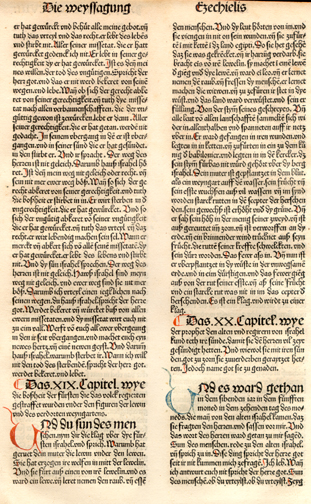 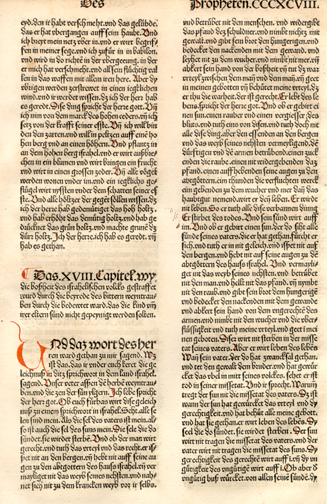 |
| These are incunabula leafs from a Pre-Luther Biblia Germanica or German Bible. Printed by the Catholic Anton Koberger printed it on February 17, 1483 in the city of Nuremberg. |
As I have already shown even before the first Protestant Bible [Luther’s version1522] Bible appeared there were exactly 104 editions of the Bible in Latin; there were 9 before the birth of Luther in the German language, and there were 27 in German before the Lutheran Bible appeared. It was Catholic monk named Ulfilas (In 381 AD) that first translated the Bible into a primitive form of German language (called Gothic). The truth is there was more than a thousand years of manuscript German language Bibles before Luther made his translation.
Before the first Protestant Bible appeared there were already in Italy more than 40 editions and 25 of these were in the Italian language with the express permission of Rome. In France there were 18 editions before 1547. Spain began her editions in 1478. In all, 626 editions of the Bible with 198 in the language of the laity had been edited before the first Protestant Bible was sent forth into the world. With all this evidence why should there be those intellectuals who declare that the Church despised the Bible? This testimony shows that the Church fought to preserve it, translate it, and multiply it. She saved it from utter destruction at the hands of infidels; she saved it from total extinction by guarding it as the
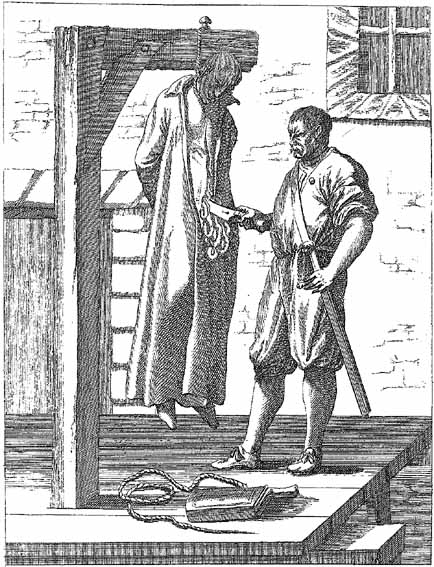 |
| A Catholic Preist Disemboweled
Jesuits like John Ogilvie (Ogilby) (1580-1615) were under constant surveillance and threat from the Protestant governments of England and Scotland. Ogilvie was sentenced to death by a Glasgow court and hanged and mutilated on March 10, 1615. Engraving from Mathias Tanner, Prague: Typis Universitatis Carolo-Ferdinandeae, 1675 |
greatest treasure of all ages.
[JIL] "Why do you think they killed over 50 million people and called them heretics for reading and believing the Holy Scriptures?"
50 Million? I would like to see were the "Jesus is Lord" site came up with this number. The 1994 "Almanac of the Christian World"[Pg, 502] tells us that about 40,725,000 Christian’s have died for their faith since 33 AD. Of these forty million martyrs, 32,900,00 were put to death by non-Christians [Secular governments, Atheists, Muslims, Hindus, Pagans]. According to this Protestant publication, of these forty million Christian martyrs since 33 AD. 16,301,250 were Catholics and Orthodox, only 2,694,700 Protestants.
Here are a number articles which deal with the Bloody persecutions of the Catholic Church by Protestants, under : The Anabaptists, The Anglican, The Calvinists and The Puritans during the reformation. The purpose of these articles set history straight."They have been rebellious to the light, they have not known his ways, neither have they returned by his paths."---Job. xxiv 13
[JIL] "Over hundreds of years, the Catholic religion, headed by the pope, did unimaginable cruelties to Bible-believers. They were burned, tortured, imprisoned, banished, etc. by the pope because they would only believe the Bible."
As we have already seen the "Jesus is Lord" site seems to have a serious problem with telling the truth. If we look at true history, we find it has been the Protestant’s who have attempted to hide and destroy the Bible. The Protestants have even on ocations burned there own KJV.
The Anabaptists In 1534, seized control of Münster Germany calling it The "New Jerusalem" they embarked a reign of terror and indescribable orgies, communism and polygamy. Many Catholic and Lutheran Bibles, treasures of literature and art were burned in great fires held in the town square. The Anabaptists atrocities came to an end on June 24, 1535 with a joint Catholic and Lutherans siege and capture of the town of Münster.
The Anglicans in the English controlled sections of Ireland took the destruction of monasteries,
churches, church libraries and schools to a new level, it became a passion. In 1544 immense amounts of ancient books and Vulgate Bibles were maliciously destroyed in giant bon fires. In an effort to reduce the Catholic Irish to ignorance Henry VIII decreed that in Ireland even the possession of a manuscript any subject whatsoever (including sacred Scripture) incurred the death Penalty. On January 5, 1541 by order of the king an English printer named Grafton was arrested and imprisoned for printing the Matthew and Great Bibles to which he had exclusive printing rights. King Henry VIII held a great official burning of to "heretical" books in 1546, The Protestant Bibles of Tyndale, Coverdale and Matthew and the Catholic Latin Vulgate helped feed the fires
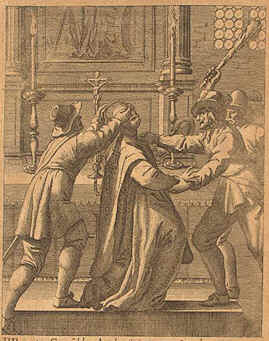 |
| Persecution of Catholic Priests in England In the image above is Brian Cansfield (1581-1643), a Jesuit priest seized while at prayer by English Protestant authorities in Yorkshire. Cansfield was beaten and imprisoned under harsh conditions. He died on August 3, 1643 from the effects of his ordeal. Engraving from Mathias Tanner, Prague: Carlo Ferdinandeischen Universitat Buchdruckeren, 1683 |
The Calvinists in France caused Ten wars between 1562 and 1628 [The Siege and fall of La Rochelle] In one year alone (1561), according to one of THEIR OWN estimates, the French Calvinists "murdered 4,000 priests, monks and nuns, expelled or maltreated 12,000 nuns, sacked 20,000 churches, and destroyed 2,000 monasteries " with their priceless libraries, Bibles and works of art. The rare manuscript collection of the ancient monastery of Cluny was irreparably lost, with many others.
In 1582 The Rheims Catholic New Testament in English was issued Needless to say, the appearance of this New Testament, with its annotations, at once aroused the fiercest opposition. Queen Elizabeth
ordered the searches to seek out and confiscate and destroy every copy they could find. If a priest was found in possession of it, he was forthwith imprisoned. Torture by rack was applied to those who circulated it.
So strong indeed was the feeling--nay, the dread aroused by the Rheims New Testament, that Elizabeth asked Beza to undertake a refutation. Beza, however referred her to a Puritan scholar named Cartwright. Elizabeth accepted Beza's recommendation and Cartwright who was financed by Leicester and Walsingham not to work on this new challenging project. Cartwright got as far as Apoc. chapter 15 when Whitgift resenting Cartwright continuous attacks upon the church in England was forced to stop the publication.
The Protestant English went to many extremes to try to prevent the Catholics from reading the sacred scriptures. We find in the Penal Laws were imposed on the Catholic's of England and Ireland by the Anglican (Protestant) English Government:
 |
 |
|
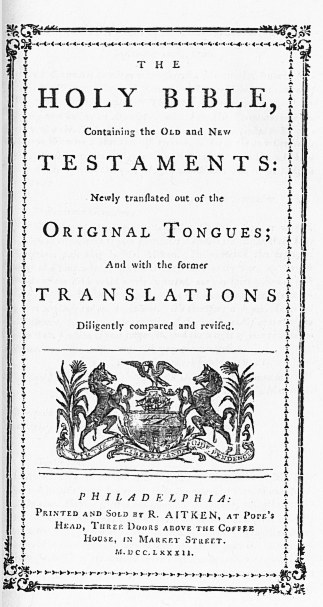
The Title Page of The 1782 Aitken's edition of the Bible. |
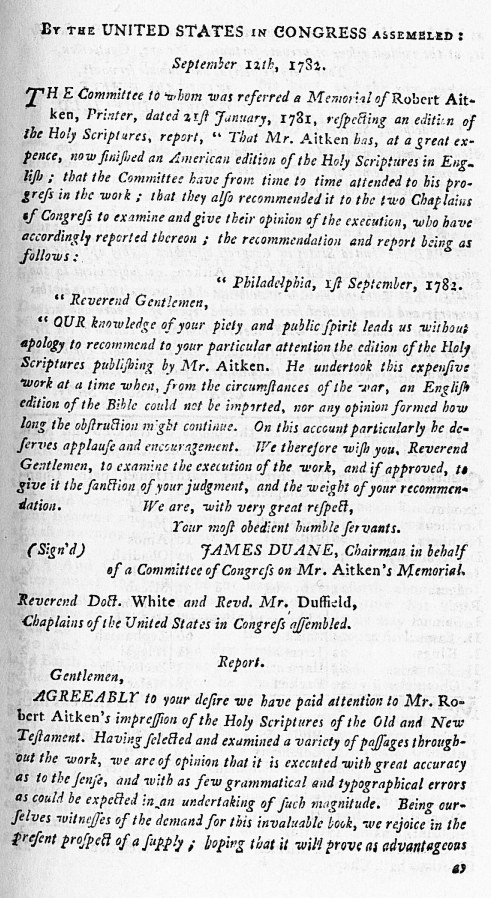
The Congressional Approval Of the 1782 Aitken's edition of the Bible. |
| Due to the restrictions of the English government
against any printing of the Bible in English, by any one other the Royal
printers, it was not until 1782 (at the end of the Revolution) the the
First complete English translation of Bible was printed (by Robert
Aitken) in the Americas. This Protestant edition was officially
approved by the American Congress.
Shortly after its first printing, Robert Aitken got a bill placed before Congress that would have given him the exclusive printing rights of the English Bible in the United States, the bill failed. |
|
Catholics were forbidden to receive education they could not educate their own children. Catholics could not send their children to a Catholic teacher. Catholics could not employ a Catholic teacher to educate their child. He could not send his children abroad to receive education. The Catholic schoolmaster was banned and hunted with bloodhounds. A Catholic schoolmaster, private or public, who ushered to a Protestant, should be deemed guilty of rebellion, that he should be hanged.
The Protestant's even put stipulations on the printing of sacred scripture in English. It was illegal in Anglican England or the American colonies to print the Bible in English. The Crown claimed a copyright on King James Version, and printing of that version was a privilege accorded exclusively to the King's printers and the universities of Oxford in Cambridge. Hence its published in English colonies appeared in languages other than English. As the Protestant scholar Miss Margaret T. Hills (Former Secretary of Research for the American Bible society) explains:
"Prior to the War of the Revolution, there had been no publication of the English Bible in the Colonies. All demands for Scriptures had to be met by importation from England and the Continent. It is true, of course, that there was a scarcity of the type and paper necessary for the successful publication of a book as large as the Bible. Most of the presses were used for the impression of documents, proclamations, pamphlets and papers. But there was a far more serious consideration that kept it from being printed by an American printer. It was, in fact illegal for any printer in the Colonies to produce the English Bible.
Publication of the Scriptures in any lands under the British crown was restricted, in order to insure accuracy in printing, to the Oxford and Cambridge University Presses and to other printer licensed by the king. In Scotland, special license were required." [The First American Bible, Copyright 1968, by Miss Margaret T. Hills]
It has been estimated that there were about about fifty printing presses in the American colonies in 1775 capable of printing the Bible, it was not until after the outbreak of the American Revolution that American presses began to publish the King James Bible. First came Robert Aitken's edition of the New Testament printed in Philadelphia in 1777 against great odds. Not only was the work done on poor equipment, but also on one occasion Aitken had to save his type and printing materials from destruction by the English red coats by sprinting them out-of-town and hiding them under a barn.
Please sign our Guest book!
This page has helped
People find the truth since November 1999