PROTESTANT SUPPORT OF THE NAZI GOVERNMENT
"The first electoral breakthroughs enjoyed by the Nazis came in Protestant rural areas, such as Schleswig-Holstein and Lower Saxony, ...Subsequently the constituencies with the highest proportion of Nazi voters were in Protestant farming communities; and by 1932 the stream of peasant deserters to Hitler's party had become a torrent." (The "History Today" Magazine, October 1998, from the article entitled "WHO VOTED FOR THE NAZIS?)
This map shows the influence of religious conviction on the Nazi vote for the Reichstag election 7/32. Elevation represents the share of catholics / protestants (the higher, the more catholics live in a Kreis) in relation to total population. The Nazi vote share is represented by different colour shadings (dark red: highest NSDAP share; light green: lowest NSDAP share). The map reveals that the NSDAP strongholds are clearly restricted to protestant areas. This becomes very clear e.g. in East Prussia, where in a small catholic enclave the NSDAP performed very poorly in comparison to the surrounding Kreise dominated by protestants.
It is also inportant to note that of the 21 Nazi Germans tried as war criminals at Nuremberg 16 indicated they were "Protestant."
Lets Look at three of the most distinguished German Protestant theologians--Gerhard Kittel, Paul Althaus, and Emanual Hirsch. These men were highly respected, extremely erudite, uncommonly productive, and internationally known professors, each at a different, first-class university.
Professor Robert P. Erickson did an unusually comprehensive investigation of the three theologians' writings, utterances, and activities as they pertain to Nazism and the Jewish Question. He reports his findings in a book, Theologians Under Hitler. If anyone should know whether submission or opposition is demanded of the followers of the living Christ when confronted with a regime as totally reprehensible as that of the Nazis, surely it would be these theologians.
What conclusions did Erickson reach as to the stance of the three men who would be expected to exemplify the ultimate in the embodiment of those noble values that millions of Sunday school children are taught attach to Christian folk? They are grim:
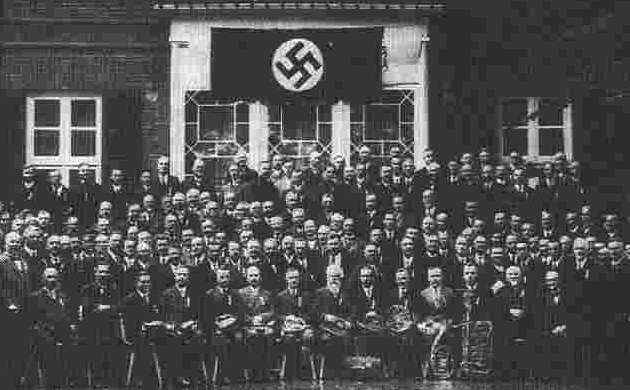
September 1933: German Protestant deacons meet in Hamburg to celebrate the centennial of their association. A Protestant pastor addresses his comrades in a speech entitled Deaconry as attack:" All this is Protestant deaconry: Service and fight. We greet you all as the SA of Jesus Christ and the SS of the Church, you brave ... [fighters] of need, misery, despair and dereliction." [KS57] After the war the swastika was removed from most of the photographs of the meeting. Only a few survived unaltered, such as this one. "They each supported Hitler openly, enthusiastically, and with little restraint." In fact, they deemed it the Christian thing to do. They "saw themselves and were seen by others as genuine Christians acting upon genuine Christian impulses." Furthermore, all three tended "to see God's hand in the elevation of Hitler to power." Hirsch was a member of the Nazi party and of the SS. The Nazi state, he said, should be accepted and supported by Christians as a tool of God's grace. To Althaus, Hitler's coming to power was "a gift and miracle of God." He taught that "we Christians know ourselves bound by God's will to the promotion of National Socialism."
Kittel and a group of twelve leading theologians and pastors issued a proclamation that Nazism is "a call of God," and they thanked God for Adolf Hitler. Kittel was a party member and he himself proudly claimed that he was a good Nazi. He
explains that he did not join it as a result of pressure or for pragmatic reasons but because he concluded that the Nazi phenomenon was "a völkisch renewal movement on a Christian, moral foundation." He accorded Christianity a place of honor in Nazi Germany precisely because of its position on the Jewish Question. He said he was speaking for other theologians too when he maintained that agreement with state and Führer was obedience to the law of God.
These theologians were drenched in anti-Semitism. For example, throughout the whole of the Nazi era, Kittel's writings, Erickson has determined, "correspond to and support Nazi politics, including all of the policies on the Jewish question, with the possible exception of genocide," but one is led to wonder. He never spoke out against extermination. Indeed, he actually propounded what was purported to be a theologically solid Christian justification for the oppression of the Jews, whom he referred to as "refuse."
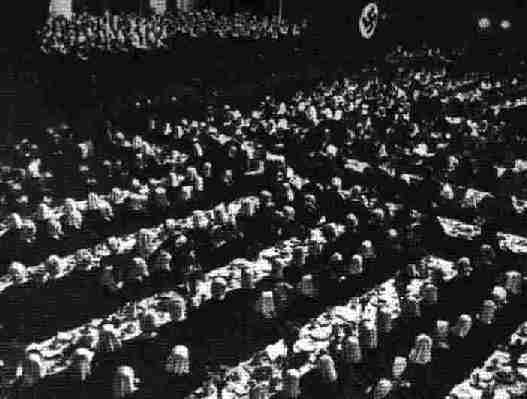
November 15, 1933: More than a thousand Lutheran nuns, meet under the swastika. The Bishop of Berlin in his speech: "Permit me to compare our sisters with the SA!" (a paramilitary Nazi troop). (Though it may be coincidental, even the layout of this meeting, at least on this photograph, seems to resemble a huge swastika. During the Nazi regime, the Protestant Church in general supported Hitler. The Protestant clergymen who wound up as inmates at Dachau were those who were anti-Nazi, such as the Reverend Martin Niemöeller, one of the founders of the Confessional Church. Other Protestant ministers who were incarcerated in the Dachau concentration camp were Ernst Wilm and Kurt Scharf. Although there were far fewer Protestants who were persecuted by the Nazis than there were Catholics and Jews,
Germany's Protestant Church has admitted using slave labour during World War II, and has pledged to pay compensation to Nazi victims. The admission came after revelations that Berlin church parishes set up a forced labour camp during the war, and used workers from mainly central and eastern Europe for tasks such as grave-digging. "This was complicity in a regime based on force and removed from the rule of law. We accept this guilt," said church council president Manfred Kock.
The church and its social services arm, the Diakonisches Werk, said it would pay 10 million marks ($4.9m) into a fund for surviving victims around the world recently set up by the German Government and leading businesses. Along with the Roman Catholic Church, the Evangelical Church is one of the two main denominations in Germany. Both were subject to serious oppression during the Nazi regime. The peak of the forced labour scheme came during the latter years of the war, as thousands of civilians mainly from occupied eastern Europe were forcibly transported to Germany to boost the flagging war effort. Most were housed in extremely poor conditions in labour camps and made to work long hours in munitions factories.
All This Lutheran hatred for the Jews should not be shocking for did not Luther preach this same hatred? Did not on February 15, 1996 [the 450th anniversary of the death of Martin Luther - the father of the Reformation] The Evangelical Lutheran Church in Canada publicly denounced Martin Luther's many "anti-Judaic diatribes" at its biennial national conference in Winnipeg. Prior to that, Lutheran churches in the United States and elsewhere had issued similar declarations.
In the year 2000 the Germany's Evangelical Church, which promised $5 million as it acknowledged that Protestant churches used forced laborers during the Nazi era for such jobs as grave-digging." [CBS News, July 17, 2000]
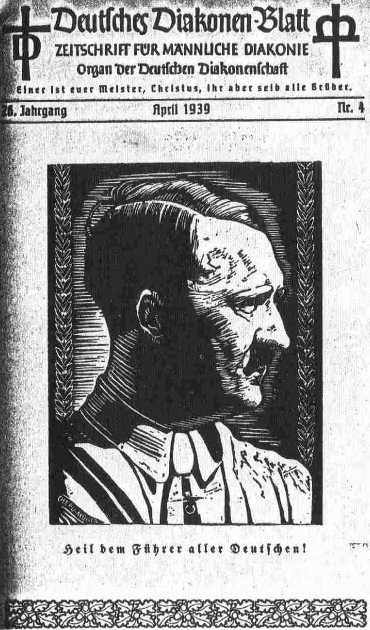
Title Page of theGerman Deacon Press Magazine "
The "German Deacon Press Magazine"
To the right is the cover of the April 1939 edition of the "German Deacon Press Magazine for Male Deaconry Official Organ of the German Deacons" printed for Lutheran Deacons. It should be noted that when this magazine was printed, the majority of the Nazis' crimes had already been committed. Catholic Priest, Communists, democrats, homosexuals, and others had already been carried off into concentration camps, the shameful anti-Jewish race laws of Nuremberg had been introduced 1935. Even those who for a long time had been closing their eyes to the evilness of the Nazis could no longer delude themselves, after the "Kristallnacht" of November 1938, a government-incited public pogrom against the remaining Jews when thousands were killed in the streets, had taken place. The German army had "peacefully" (and to the relief of the major part of its population) annexed Austria in early 1938, and - less peacefully - invaded Czechoslovakia in March 1939.