
PETER VS. THE POPES
This is a refutation of a deceitful Protestant article by the same name written by Baptist named David Cloud. This article is typical of the trash was found at the militant Anti-Catholic BibleBelievers.net and the Way of Life websites.
EZCODE CENTER START
[Mr. Cloud] 1. There is no evidence that Peter was in Rome (Romans 16),
The evidence is so overwhelming that many non-Catholic scholars, Protestants and Rationalists alike, have admitted this fact without question. I mention about twenty in England, France and Germany: Bleck, Cave, Credner, Cludius, De Wette, Grotius, Hales, Hilgenfeld, Lardner, Macknight, Mangold, Meyer, Mynster, Neander, Renan, Steiger, Wieseler, Whiston and Whitby.
Cave writes: "That Peter was at Rome, and held the See there for some time, we fearlessly affirm with the whole multitude of the ancients. We give witnesses above all exception, derived from most remote antiquity." And he proceeds to quote St. Ignatius, Papias, St. Irenxus, Dionysius of Corinth, Clement of Alexandria, Tertullian, Caius of Rome and Origen (Historia Literaria, i.).
Dr. Lardner writes: "It is the general, uncontradicted, dis_interested testimony of ancient writers in the several parts of the world_Greeks, Latins, Syrians" (History of the Apostles, ch. xviii.).
Whiston writes: "That St. Peter was at Rome is so clear in Christian antiquity that it is a shame for any Protestant to confess that any Protestant ever denied it" (Memoirs).
Pearson writes: "Since it has been handed down from almost the beginning that St. Peter preached the Gospel in Rome, and there suffered martyrdom, and since no one has ever affirmed that either Peter or Paul was crowned with martyrdom elsewhere, I think, with full security, faith may be given to this account. For who would believe that so great an Apostle could have died in such obscurity as that no one ever recorded the place of his death?" (Minor Theological Works, iii., 34; Vacandard, Etudes de Critique, iv., 3_12.)
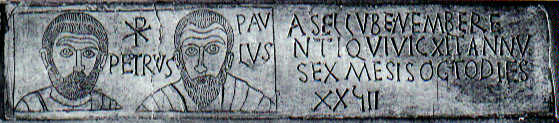 |
| Among the more than 30,000 Greek and Latin inscriptions have been discovered in the catacombs of Rome, is this marble slab above is from about the year 313 A.D. The slab sealed the tomb of a little boy named Asellus and the inscription goes on to tell us that he had lived 5 years, 8 months and 23 days. To the left we see the images of the Saints Peter and Paul, with the monogram of Christ above the name of Peter. The fact that the Gospel of Jesus brought to Rome by St. Peter and St. Paul was clearly professed by the early Christian community there. |
The Fathers of the first four centuries frequently speak of the labors of St. Peter in Rome and his martyrdom there. St, Clement (Ad Con, v.) in 97; St. Ignatius (Ad Rom., iv.) in 107; St. Clement of Alexandria (In Eusebius, Hist. Eccles., vi., 14) in 190; St. Ireneus (Adv. Hcer., iii., 3) in 178; the Roman presbyter Caius (In Eusebius, Hist. Eccles., ii., 25) in 214. Many others can be cited, such as Origen, St. Cyprian, Firmilian, Arnobius, St. Epiphanius and St. Dionysius of Corinth. [For more on this visit this link]
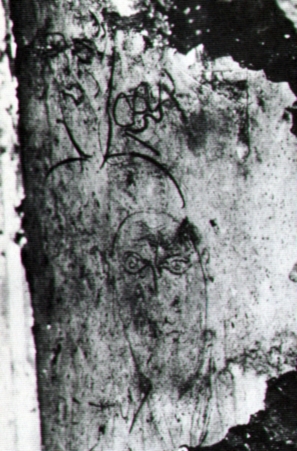 |
| A Crude early Christian sketch of Christ and Peter found by archaeologists In Rome about thirty feet from the tomb of St. Peter. |
Another strong proof of St. Peter's presence in Rome is drawn from the study of archaeology. Professor Lanciani writes: "For the archeologist the presence and execution of St. Peter and St. Paul in Rome are facts established beyond the shadow of a doubt by purely monumental evidence. There is no event of the imperial age which is attested by so many noble structures. . . When Constantine raised the monumental basilicas over their tombs on the Via Cornelia and the Via Ostiensis"
On Wednesday 26th June 1968, Pope Paul VI, conducting an audience in the basilica of Saint Peter in Rome, departed from his normal routine to issue a statement of enormous significance to the Holy See, Roman Catholics and Christians throughout the world: the Pope declared that the mortal remains of Peter, foremost of the Apostles of Jesus Christ, had been found beneaththe great church in which he was speaking. The statement marked the culmination of one of the most famous and important archaeological investigations of recent times; a vast undertaking which had engaged the talents of scientists, historians and linguists for a quarter of a century. [for more on this visit this link]
[Mr. Cloud] and there is no evidence in the New Testament that there was anything special about the congregation at Rome, but the popes rule in Rome and claim that it is the "mother church." Peter's first epistle was written from Babylon, not from Rome, and the popes' claim that "Babylon" stands for Rome is mere conjecture.
It must Be pointed out that Mr. Clouds position here is very week, and his claim that "Babylon" does not stands for Rome can also be classified as "mere conjecture".
The truth is, the first epistle of St. Peter was probably written about the year 64, when the status of Christians in the empire was very uncertain, and when persecution had already begun in Rome. The place of writing is closely connected with the date. "Babylon" (5:13) may refer to the ancient city on the Euphrates, where there was a large Jewish settlement in Peter's day, or to a town in Egypt near Alexandria, where Mark traditionally ministered, or figuratively to Rome as the center of the pagan world (Rev. 17:5; 18:10).
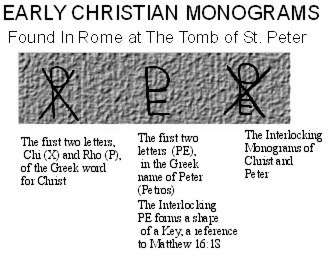 |
| In Rome the Archaeologists found the early Christian Monogram used for the name of St. Peter over two dozen times, on and around the tomb of the Apostle. |
The second alternative need not be considered seriously, for the Egyptian Babylon was only a border fort. Opinion among commentators is divided between the other two opinions. In the absence of any strong tradition that Peter ever visited in the literal Babylon [to the ancient city on the Euphrates], and considering the huge amount of early Christian testimony that Peter was in Rome, it seems more clear that he wrote this epistle from Rome.
Even in the New Testament Scriptures the city of Babylon, [the city of iniquity] was figuratively used for Rome in Apostolic times, as we learn from St. John (Apoc. xiv. 8; xvi. 19; xvii. 5; xviii. 21). In the fourth century we find both Eusebius (Hist. Eccles., 15) and St. Jerome (De Viris 111.) declaring that St. Peter by "Babylon" means Rome.
This is admitted by many fair-minded Protestants. Elliott's, Speaker's Commentary, thus comments on 1 Peter v. 13: "We have to remark that the city of Babylon was certainly not the seat of a Christian community; that no ancient record has the slightest trace of St. Peter's presence or work in Chaldea; that all ancient authorities are unanimous in asserting that the later years of his life were passed in the West of the Roman Empire. On the other hand Babylon was well known in Asia Minor during the lifetime of St. John as the symbolical designation of Rome . . . Accordingly, we find an absolute consensus of ancient interpreters that there Babylon must be understood as equivalent to Rome." He then cites Thiersch, Ewald and Hilgenfeld, who held the same view.
[Mr. Cloud] The biblical evidence that Peter was not a leader in the church at Rome is overwhelming. Paul wrote TO the church at Rome in A.D. 58, but though he mentions 27 people by name, he does not mention Peter. That would have been an inexcusable affront if Peter had been the pope at Rome. Later, Paul writes FROM Rome to the Galatians, the Ephesians, the Philippians, the Colossians, and to Philemon, but not once does he mention that Peter is in Rome. In 2 Timothy 4:16 Paul said that no man stood with him and all forsook him when he answered his charges. Where was Pope Peter? The fact is that Peter was not a pope and he was not in Rome.
This is a old Protestant objection, and the answer to this is obvious. St. Paul’s trip to Rome was not one of a missionary, he was conveyed there as a prisoner, under the care of a centurion, Julius, of the Augustan Cohort. We know that at the time these epistles were written he was billeted under military guard (Acts 28:16; Phil. 1:7) in Private apartment (v. 30) and being watched [although at times rather loosely].
Although the persecution had not yet begun, St. Paul was well aware that anti-Christian were beginning to boil throughout the pagan empire. St, Paul himself had been a victim this growing animosity several times, Damascus (2 Cor. 11:32-33), Iconium (Acts 14:2), Philippi (1 Thes. 2:2), Ephesus ( Acts 19), and Jerusalem (Acts 21: 27-29). St Paul in his writings warns the readers of the coming infractions the ministers if Christ would have to suffer
"But in all things let us exhibit ourselves as the ministers of God, in much patience, in tribulation, in necessities, in distresses, In stripes, in prisons, in seditions,..." (2 Col. 6:4-5)
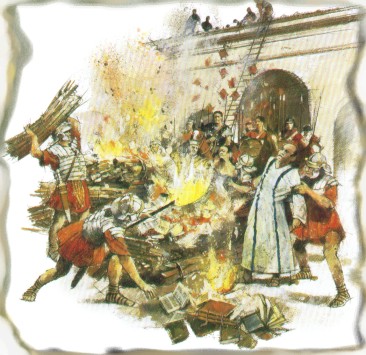 |
| In 64 AD. just three years after Paul's arrival in Rome, the persecution of Emperor Nero began. The Arrests and executions of Christians became common occurrence, and sacred texts of the Christians were often burned. |
The city of Rome was the heart and center of the Pagan empires, the symbol of it's authority. During this time period the status of Christians in the empire was very uncertain, and rumors of a coming persecution had already begun in Rome. It was a potentially dangerous time for Christians, a time when discovery of such a high profile Christian leader as St. Peter, could lead to his arrest and potential death. Is it any wonder that St. Paul in his writings from Rome, was silent on the Apostle Peter's inhabitation in the city? St. Paul would not have carelessly divulged St. Peter's location, nor would St. Paul have just casually Jeopardized the life of his fellow apostles.
While it is true that St. Paul, does not mentions St. Peter presence in Rome, we must also note St. Paul never mentions the location St. Peter at all, he is completely silent on this subject matter. What we must remember is that silence on any subject is neither a "affirmation" nor "denial" of it.
[Mr. Cloud] 2. Peter was married (Matthew 8:14), but the popes cannot marry.
If the ambiguous word "penthera" is correctly translated, St. Peter was certainly married, but he was married before he became an Apostle, and tradition declares that he did not live with his wife after his divine call (Matt. iv. 9) to the Apostleship (St. Jerome, Epis. 48, Ad Pamm). He says himself that he had left all things to follow Christ (Mark ii. 28). In his treatise against Jovinian (viii., 26) St. Jerome judges from the context of Matt. viii. 14, 15, that St. Peter's wife must have been dead at the time of the miracle, for otherwise she would have been mentioned.
Whether St. Peter was married or not is utterly irrelevant, for clerical celibacy is not a divine law, but a Church law, dating only from the fourth century. It does not depend on precedent; it is founded on the Church's estimate of the more perfect following of Christ by her clergy.
[Mr. Cloud] 3. Peter said Holy Scripture is the sure Word of God and to this alone we are to give heed (2 Peter 1:19-21), but the popes say we are also to heed their uninspired traditions.
Where Mr. Cloud got this interpretation of these verse is any ones guess, one thing we know for shore is he did not receive it from the wording of the text. In these Verse St. Peter is discussing the private interpretation of the prophecy found in the scriptures. no were in these verses does he say anything about giving heed to the scriptures alone.
Second, the Popes have never said that Catholics need to heed or accept any uninspired traditions. Catholics are required to accept and follow the inspired sacred traditions handed down to the Church from the apostles, the same sacred traditions St Paul tells us about:
"Therefore, brethren, STAND FAST, and hold the TRADITIONS which ye have been taught, whether BY WORD, or our epistle." (2 Thes. 2:15)
"Now I praise you brethren, that ye remember me in all things, and keep the ORDINANCES (the Greek text says, 'keep the TRADITIONS'), as I delivered them to you." (1Cor 11:2)
"And the things that thou hast HEARD of me among many witnesses, the same commit thou to faithful men, who shall be able to teach others also." (2 Tim. 2:2)
"By which ye are saved, if ye keep in MEMORY what I PREACHED (verbal teaching not written) to you, unless ye have believed in vain." (1Cor 15:2)
[Mr. Cloud] 4. Peter warned of false teachers who would make merchandise of God's people (2 Peter 2:1-3), but the popes have not feared to sell their masses and their prayers and their indulgences.
First in order for this verse to really apply as he wishes it to, Mr. cloud must prove the pope is a "false teacher", so far he has not done so. Second, the Popes have never "sold" prayers or Masses, but it is customary and proper for the recipient [or person who made the request] to give a donation [to help support the Church]. In the case of indulgences, first it would be best if we defined the term. As it is, many protestants and non-denominationalists have a wrong idea of what indulgences are.
"In the Roman Catholic Church (indulgences are) a remission of the punishment still due after the sin has been forgiven." (The World Book Dictionary, 1967)
It does not forgive the sin, but forgives the temporal punishment (temporary punishment in purgatory) for the sin in question. Period. It does nothing more.
[Mr. Cloud] 5. Peter said baptism is a figure, a symbol, and that it is not water which saves us, but the resurrection of Jesus Christ (1 Peter 3:21), but the popes say that baptism itself brings salvation and that it is not merely symbolic.
No this is not at all what St. Peter is saying, If we read the verse in context [with the verse above it] we see that St. Peter say’s the water that saved Noah and his family symbolizes the baptism that now saves us. St. Peter also tells that baptism saves us through the power of the resurrection of Jesus Christ.
1 Peter 3:20-21 " who disobeyed long ago when God waited patiently in the days of Noah while the ark was being built. In it only a few people, eight in all, were saved through water, and this water symbolizes baptism that now saves you also-- not the removal of dirt from the body but the pledge of a good conscience toward God. IT saves you by the resurrection of Jesus Christ."
It’s sad Mr. Cloud feels he must twist, mis-use and all around abuse the scriptures to this extent in order to attack the Catholic Church, and deceive the reader
[Mr. Cloud] 8. Peter refused worship (Acts 10:25-26), but the popes have accepted honor and bowings and kissing's which border on worship and have allowed themselves to be treated almost as gods.
Here Mr. Cloud uses some dishonest twisting of words hoping to deceive the reader in to drawing a false conclusion, with out actually giving one.
First Mr. Cloud Tells us "Peter refused worship (Acts 10:25-26)", than he lists several Catholic practices used in showing respect to the Pope [bowings and kissing's], hoping the reader will assume this is a form of "worship". But does Mr. Cloud really accuse Catholics of worshiping the Pope? The answer is "NO", you will note he uses such terms as " border on" and "almost as".
7. Peter taught that salvation is strictly through the righteousness of Jesus Christ (2 Peter 1:1), but the popes claim that their sacraments are also necessary for salvation.
Sadly, here again we find Mr. Cloud dishonestly misrepresenting the text of the sacred scriptures. When we read the text it becomes obvious that St. Peter [in 2 Peter 1:1] says that he is writing to those who received the precious faith through the righteousness of our God and Savior Jesus Christ:
2 Peter 1:1 Simon Peter, a servant and apostle of Jesus Christ, To those who through the righteousness of our God and Savior Jesus Christ have received a faith as precious as ours:
As we can see St. Peter is not even discussing "salvation", but faith.
[Mr. Cloud] 8. Peter taught against hierarchicalism, warning the pastors against "being lords over God's heritage" (1 Peter 5:1-4), and Peter mentioned no church office other than that of the elder; but the popes have set up a system of ecclesiastical lordship over the churches, and have added many offices which are never mentioned in the New Testament.
St Peter did not oppose hierarchical Church structure, In these very verses St. Peter acts, by strong implication, as the chief bishop/shepherd of the Church (1 Pt 5:1), since he exhorts all the other bishops, or "elders".
When we read the scriptures we find that there are many examples of St Peter exercising his position as as the "chief bishop". We Find that St. Peter was the first traveling missionary, and first exercised what would now be called "visitation of the churches" (Acts 9:32-38,43). Paul preached at Damascus immediately after his conversion (Acts 9:20), but had not traveled there for that purpose (God changed his plans). His missionary journeys begin in Acts 13:2. Paul went to Jerusalem specifically to see Peter for 15 days at the beginning of his ministry (Gal 1:18), and was commissioned by Peter, James and John (Gal 2:9) to preach to the Gentiles.We also know that St. Peter himself presides over and opens the first council of Christian Church, he lays down principles afterward accepted by it (Acts 15:7-11). It is St. Peter's words that settles the dispute (v.7) that was raging among the apostles and elders, when St. Peter was done speaking all the multitude was silent (v.12).
St. Peter again shows his authority by correcting those who would misuse Paul's writings (2 Pt 3:15-16).
The foundation of the hierarchical structure of the Church was first laid in Mark 3:13, it is here that we fined the first clerical ordination of the New Testament. Christ ordained the 12 apostles and sent them forth to preach. The apostles understood that they would not be around forever and THEY needed to establish a leadership to pass along their authority from generation to generation. In St. Paul’s first letter to the Corinthians (3:10-11) he explains he laid a foundation as an expert builder, and someone else is building on it. But each one should be careful how he builds. For no one can lay any foundation other than the one already laid, which is Jesus Christ.
So in the Acts (6:2) the ordination of the seven Deacons of the church of Jerusalem. The implication here is very clear "Wherefore, brethren, look ye out among you seven men of honest report, full of the Holy Ghost and wisdom, whom WE (the apostles) may appoint over this business." in Acts 14:23 we read how Barnabas and Paul ordained presbyter in every church, and had prayed with fasting, they commended them to the Lord, on whom they believed. In St. Paul’s letter to Titus (1:5) St. Paul explains it was For this cause he left Titus in Crete, so Titus could set the church in order, and appoint presbyters in every city, as St. Paul commanded; clearly again an example of authority being derived from above in a hierarchical fashion and not from the congregation.
In St. Paul’s first letter to St. Timothy (who was ordained by St. Paul as a bishop: 1 Timothy 4:14; 2 Timothy 1:6) St. Paul praises this properly ordained leadership is being worthy of double honor "Let the elders that rule well be counted worthy of double honour, especially they who labor in the word and doctrine."(1 Timothy 5:17)
Evidence or a special ordained Priesthood is clearly found in the writings of the early Christians as well, the "Didache", Hermas, Clement of Rome, and Irenææus often use the terms "bishop" and "priest" indiscriminately. In fact, it is really a moot question whether the presbyterate gradually developed as an offshoot of the episcopate--which is in the nature of things more likely and in view of the needs of the growing Church more readily understood--or whether, conversely, the episcopate had its origin in the elevation of the presbyterate to a higher rank (Lightfoot), which is more difficult to admit. On the other hand, even at the beginning of the second century, Ignatius of Antioch (Ep. ad Magnes., vi and passim) brings out with remarkable clearness the hierarchical distinction between the monarchical bishop, the priests, and the deacons. He emphasizes this triad as essential to the constitution of the Church: "Without these [three] it cannot be called the Church" (Ad Trall., iii). But, according to the law of historic continuity, this distinction of the orders must have existed in substance and embryo during the first century; and, as a matter of fact, St. Paul (I Tim., v, 17, 19) mentions "presbyters" who were subordinate to the real bishop Timothy. But in the Latin writers there is no ambiguity. Tertullian (De bapt., xvii) calls the bishop the "summus sacerdos", under whom are the "presbyteri et diaconi"; and Cyprian (Ep. lxi, 3) speaks of the "presbyteri cum episcopo sacerdotali honore conjuncti", i.e. the priests united by sacerdotal dignity with the bishop.
[Mr. Cloud] 9. Peter taught that the only priesthood in the New Testament dispensation is the High priesthood of Jesus Christ and the general priesthood of all believers (1 Peter 2:9), but the popes say that their "church" has a special priesthood which is ordained to distribute sacraments.
As for the "universal priesthood", on which Mr. Cloud relies in its denial of the special priesthood, it may be said that Catholics also believe in a universal priesthood; this, however, by no means excludes a special priesthood but rather presupposes its existence, since the two are related as the general and the particular, the abstract and the concrete, the figurative and the real. The ordinary Christian cannot be a priest in the strict sense, for he can offer, not a real sacrifice, but only the figurative sacrifice of prayer.
[Mr. Cloud] 10. Peter taught that Jesus Christ is the rock upon which the church is founded (1 Peter 2:4-8), but the popes say that Peter was the rock.
We as Catholics readily admit that Christ is the foundation of the Church, and not St. Peter. And yet, Christ Himself, the Foundation of the Church, chose to build His Church upon St. Peter, the Rock, in Matthew 16:18.
[Mr. Cloud] 11. Peter taught that men are born again through the Word of God (1 Peter 1:23), but the popes say that men are born again through baptism.
In this verse St Peter is talking about the Birth of Faith, again we see that Mr. Clouds interpretation falls short of the truth. This verse does not even come close to disproving the scriptural fact that men are indeed "born again" through baptism [John 3: 3-5].
[Mr. Cloud] 12. Peter taught that Christ has "once suffered for sins" (1 Peter 3:18), and "bare our sins in his own body on the tree" (1 Peter 2:24); but the popes say that Christ is sacrificed anew in each mass and that having Jesus Christ and his cross is not enough, that a believer also needs the Roman Catholic Church and its sacraments and priesthood.
St. Paul says: "By one offering He hath perfected forever them that are sanctified" (Heb. x. 14),
and "We are sanctified through the offering of the Body of Jesus Christ once for all' (Heb. x. 10).
The Mass is not derogatory to the Sacrifice of the Cross, as the Council of Trent has defined (Sess. xxi., can. 4). The Catholic Church has always taught the all sufficiency of the one Sacrifice of our redemption. St. Paul says: "By one offering He hath perfected forever them that are sanctified" (Heb. x. 14), and "We are sanctified through the offering of the Body of Jesus Christ once for all' (Heb. x. 10).
The fullness of the price once paid, the Blood of Christ, makes all other payment impossible; the immolation of Calvary renders all repetition useless. But "immolation is only one element of sacrifice, and indeed not the one that has to be performed by the priest, or sacrificer. The priestly element is oblation. The oblation has been performed by Christ, St. Thomas remarks, in such wise, that it may be renewed by us. The immolation has been done once, and need not be repeated, and cannot be repeated. But the offering can, and should be, of daily recurrence, according to Christ's command: "This do for the commemoration of Me" (1 Cor. xi. 24). Now the Sacrifice being not the mactation or immolation, but the offering up of what is either slain or to be slain, it follows that our daily celebration is also a daily Sacrifice" (De la Taille, Catholic Faith in the Eucharist, 113, 114).
[Mr. Cloud] 13. Peter taught that the believer has a living hope, that he has an inheritance reserved in heaven, and that he is kept by the power of God (1 Peter 1:2-5); but the popes say that a believer cannot know for sure that he has a home in heaven.
Here Mr. cloud shows a lack of knowledge in Catholic teaching. The Catholic Church to has always taught that believer has a living hope of salvation, but we must continue to live our life properly in faith, so we do not by our actions [sins] forfeit our inheritance reserved in heaven.
[Mr. Cloud] 14. Peter taught that the believer is not to be a murderer, or a thief, or an evildoer, or a busybody in other men's matters (1 Peter 4:15); but the popes have been all of these things.
The Church remains holy, no matter how many of her leaders prove faithless to the Gospel they preach, for these men are cut off from the Church's life by their sins, which can never be traced to her teachings or laws. Would you call an apple tree bad, because you discovered some rotten apples lying on the ground beneath it? No, you judge the tree by the ripening or ripe apples on its boughs. Wicked churchmen will one day have to render a strict account to Almightily God for their stewardship, for as Christ said: "Unto whomsoever much is given, of him much will be required" (Luke xii. 16).
Out of a long line of worthy Popes, seventy-six of whom are reckoned among the saints, only a few were unworthy of their high office, such as John XII (955-964), Benedict IX (1024-1032), and Alexander VI (1492-1503). But the proportion of unworthy Apostles was one out of twelve. No world dynasty can be compared from the standard of virtue with our illustrious dynasty.
At all periods of Church history there have been unworthy Bishops and priests, but as a rule they either repented of their sins before they died, or proved their utter wickedness by apostatizing in times of trial and persecution, or by lapsing into formal heresy and schism.
Is it fair to be ever citing the evil lives of the minority, when all admit that the majority of clerics have ever been faithful to God and the things of God? Dean Maitland, an honest non-Catholic historian, says: "It appears to be the testimony of history that the monks and clergy were at all times and places better than the people" (The Dark Ages, viii.). Voltaire, the arch enemy of Christianity, makes the same admission.
Christ always speaks of the Church as a
Society composed of the good and the wicked. He compares it to a field in which
cockle grows with the wheat (Matt. xiii. 24_30) ; to a net containing good and
bad fishes (Matt. xiii. 47); to a barn containing chaff as well as wheat (Matt.
iii. 12); to wise and foolish virgins (Matt. xxv. 1_12). St. Paul also speaks of
a "great house having vessels not only of gold and silver, but also of wood
and earth; or honor and dishonor" (2 Tim. ii. 20). And St. John writes to
remind us that we are all sinners: "If we say that we have no sin, we
deceive ourselves, and the truth is not in us" (1 John i. 8).