
ROME DESTROYED BIBLES
This is a refutation of a deceitful Protestant article by the same name written by Baptist named David Cloud. This article is typical of the trash was found at the militant Anti-Catholic BibleBelievers.net and the Way of Life websites.
EZCODE CENTER START
[Mr. Cloud] For 600 years the Roman Catholic Church attempted to keep vernacular translations of the Bible out of the hands of the people.
This is not true, for almost two thousand years the Catholic Church has attempted to keep perverted and inaccurate versiona (vernacular or otherwise) of the Bible out of the hands of the people. The Catholic Church, as the guardian and interpreter of the Scriptures, must needs prevent her people from being led astray by false translations of the Bible, which are often accompanied by glosses and notes destructive of the Catholic faith. But she never has prohibited versions in the vernacular which have been approved by the Bishops of the various countries, and have been edited with explanatory notes by Catholic scholars.
If take a look on the opening pages of the Catholic NAB [New American Bible] you can read a letter from the Pope to the translators in which he states
"Therefore we are gratified to find in this new translation of the Scriptures a new opportunity for men to give themselves to frequent reading of, and meditation on, the living Word of God. In its pages we recognize His voice, we hear a message of deep significance for every one of us....On all who have contributed to this translation, and all who seek in its pages the sacred teaching and the promise of salvation of Jesus Christ our Lord, we gladly bestow our paternal Apostolic Blessing."
From the Vatican, September 18, 1970

Of course the NAB is not the only example, we find in opening pages of the Haydock's Bible [which is currently being printed by Catholic treasures] the letters of the Bishops of the United States, in which they express the hope that this splendid edition would have a wide circulation among their flocks.
Many Catholic editions of the Bible contain in there opening pages The letter Pope Pius VI sent to the Archbishop of Florence in April of 1778, wherein he urges Catholics to read the Bible. He writes:
"At a time when a great many books which grossly attack the Catholic religion are being circulated even among the unlearned, to the great destruction of souls, you judge exceedingly well that the faithful should be urged to read the Holy Scriptures; for they are the most abundant sources which ought to be left open to everyone, to draw from them purity of morals and of doctrine, and to eradicate the errors which are so widely spread in these corrupt times."
Pius VII a few years later wrote in the same strain to the English Vicars_Apostolic, asking them
"to encourage their people to read the Holy Scriptures; for nothing can be more useful, more consoling, and more animating, inasmuch as they serve to confirm the faith, support the hope, and influence the charity of the true Christian."
Leo XIII, in his Encyclical on the Bible (1893), writes:
"The solicitude of the Apostolic office naturally urges, and even compels us, not only to desire that this great source of Catholic revelation should be made safely and abundantly accessible to the flock of Jesus Christ, but also not to suffer any attempt to defile or corrupt it. . . . (By reading the Scriptures) the inelligence will be illuminated and strengthened . and at the same time the heart will grow warm, and will strive with ardent longing to advance in virtue and divine love."
Pope St. Pius X (1903-1914 AD) wrote:
"Nothing would please us more than to see our beloved children form the habit of reading the Gospels - not merely from time to time, but every day."
Pope Benedict XV, in his Encyclical on St. Jerome, quotes St. Jerome's letter to Demetrias for all Catholics: "Love the Bible and wisdom will love you; love it and it will preserve you; honor it and it will embrace you" (Epis., cxxx., 20). The Pope next cites St. Jerome's letters to the Roman matron, Laeta, and to Eustochium, in which he urges his pupils to "read the Bible assiduously," adding:
"No one can fail to see what profit and sweet tranquillity must result in well disposed souls from a devout reading of the Bible. Whoever comes to it in piety, faith and humility, and with a determination to make progress in it, will assuredly find therein and will eat the Bread that cometh down from heaven; he will, in his own person experience the truth of David's words: The hidden and uncertain things of Thy Wisdom Thou hast made manifest to me."
Pope John Paul II in CATECHESI
TRADENDAE, on October 16, 1979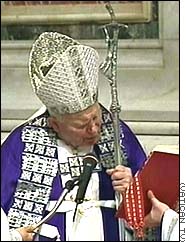
"27. Catechesis will always draw its content from the living source of the Word of God transmitted in Tradition and the Scriptures, for "sacred Tradition and Sacred Scripture make up a single sacred deposit of the Word of God, which is entrusted to the Church," as was recalled by the Second Vatican Council, which desired that 'the ministry of the word-pastoral preaching, catechetics and all forms of Christian instruction . . .-(should be) healthily nourished and (should) thrive in holiness through the word of Scripture.' (57)
"To speak of Tradition and Scripture as the source of catechesis is to draw attention to the fact that catechesis must be impregnated and penetrated by the thought, the spirit and the outlook of the Bible and the Gospels through assiduous contact with the texts themselves …
"The Church's teaching, liturgy and life spring from this source and lead back to it ... "
Another example of the Church’s attempt to foster Bible study among is members is found in the fact that the English speaking Catholic laity of today has many different Bible versions to Chouse from, which have received the "Imprimatur" of approval of the Church.
The Douay-Rheims: This translation was done from the Vulgate by Gregory Martin and William Allen in Douay and Rheims, France in 1582-1908.Challoner Revision: Bishop Challoner revised the Douay-Rheims in 1749-1763 and this remained in almost universal use among English-speaking Catholics for nearly 200 years.
The Haydock's Bible: a edition of the Challoner-Rheims Version with a comprehensive Catholic commentary compiled by Rev. Fr. Geo. Leo Haydock with the approbations of the Archbishops and Bishops of the United States in 1859.The Confraternity Version: a revision of the Challoner-Rheims Version based on the original languages, edited by Catholic Scholars under the patronage of the Bishops Committee of the Confraternity of Christian Doctrine 1944-1950
Kleist & Lilly New Testament: This Bible was translated from the original Greek by Fr. James A Kleist, S.J. and Fr. Josheph L. Lilly, C.M. 1949
Knox Bible: Ronald Knox was commissioned by the English Bishops to make a new translation from the Vulgate. 1952-1970
The New American Bible: translation, from the original languages, was commissioned by the American Bishops, and in 1964The New Jerusalem Bible: The Jerusalem Dominicans edited this French translation. It was then translated into English. 1965
[Mr. Cloud] The Council of Toulouse, in 1229, decreed that "the laity" could not possess the books of the Old and New Testament "in the vulgar tongue.
The Council of Toulouse was a local council with no church wide authority.
[Mr. Cloud] " Waldensian and other Bible-believing people were mercilessly persecuted and their Scriptures destroyed.
The Waldensians were far from being any form of true "Bible-believers", and there Bible was full of errors and inaccuracy. As the great Catholic scholar Thomas Ward stated "The nature of the holy scripture is such, that whosoever do voluntarily corrupt and pervert it, to maintain their own erroneous doctrines, cannot rightly be characterized by any less infamous title than that of heretics; and their false versions, by the title of heretical translations " (Errata of the Protestant Bible 1688 Pg. 22)
[Mr. Cloud] The Council of Trent, in 1546, claimed that the indiscriminate distribution of the Scriptures caused more evil than good and forbade the people to possess the Bible without a written license. Those who possessed Bibles without a license were commanded to deliver them up to the Catholic authorities under threat of inquisition terrors.
Let us look at this assertions. First, did the council of Trent really prohibit the reading and ownership of the bible? The answer is, no. The council fathers decreed on April 8, 1546, ". . . the synod, following the examples of the orthodox Fathers, receives and venerates with an equal affection of piety and reverence all the books both of the Old and New Testament, --seeing that one God is the author of both, . . . ." Oddly, I could not find the quotation as given by the above author; however, I did find decrees regarding UNAPPROVED and or FAULTY translations of the Scriptures. Just as with theological works, the Church asserted her role over their legitimate use. To suggest that the council of Trent opposed the authentic Word of God is untrue.
The Catholic Church has always strived to provide the common man with an accurate version of the Sacred Scriptures in the vernacular. Luther himself noted
"It was an effect of God power, that the Papacy should have remained, in the first place, sacred baptism; secondly, the text of the Holy Gospels which it was custom to read from the pulpit in the vernacular tongue of every nation..." (De Missa privata, ed by Jensen, VI, Pg 92)
Nearly all of the books of the Middle Ages were Gospels or complete Bibles (the word itself, after all, is from the medieval Latin Biblia, which means simply "the books"). The fact is every church Christendom during the time of Luther had to have at least one Bible for the Mass readings, and most had an extra or two in the public space of the church, chained down (the way we chain down directories at public telephones now, and for steal it.) We must remember that at that time a new Bible would cost a community about as much as a new church building, and the finished book was easily worth a manor. Books in the Middle Ages were done on parchment or on vellum (made from the skins of young sheep or cattle) and lettered, gilded, and illuminated by hand. A whole Bible took maybe four hundred animals and years of work by a score of scribes and artists. Then as now, there were plenty of unscrupulous collectors, so a stolen Bible could always be converted into an immense sum of cash. Plus there were the customary "garnitures", the covers and bindings that could some times run up to twenty pounds of gold, decorated with jewels and enamels (when Henry VIII burned all of the Bibles in England, He was careful to keep the bindings for himself). The miracle is that so many still survive
[Mr. Cloud] Pius VII, in 1816, condemned the Bible society in Poland and claimed that the distribution of Scripture was undermining "the very foundations of religion" and was "eminently dangerous to souls." He said, "The Holy Scriptures, when circulated in the vulgar tongue, have, through the temerity of men, produced more harm than benefit." Leo XII, in 1824, said that "if the sacred Scriptures be everywhere indiscriminately published, more evil than advantage will arise." In 1825 Leo mandated that the decrees of the Council of Trent be enforced against distribution of Scriptures. Pius VIII, in 1829, condemned the Bible societies and the free distribution of Scripture. Gregory XVI, in 1836, and again in 1844, affirmed the decrees of his predecessors. In another bull of 1845, this pope repeated his condemnation of Bible society Scriptures and denied that the Scriptures should be freely distributed to all people. Pius IX, in 1850, issued an encyclical letter which condemned the Bible societies. In 1864 this pope issued a Syllabus of Errors, in which he again condemned Bible societies, lumping them together with Communism, secret societies, and other evils, labeling them "pests of this kind."
The prohibition for Catholics in joining Bible Societies was due to the fact that these said groups did not use Scriptures approved by Church sources and were quite anti-Catholic in their approach. Such has been the continued problem with gullible Catholics stolen from Christ's Church by anti-Catholic fundamentalist bible study programs, some which particularly target Catholics. Again, this was no disdain for the Holy Scriptures, only for the malicious intent by which some men use them. Second, the concern about bible distribution was that Protestant bibles were being circulated which in missing texts and in footnotes often questioned and ridiculed Catholic teaching. Obviously, the Church preferred that Catholics read Bibles, which reflected the orthodox Catholic interpretation of the Word of God. The misuse of the Gospel against the Church established by Christ himself is, as Pope Leo XII noted nothing less than satanic. Cloud's interpretation of Church history, or tradition, is as cloudy as the anti-Catholic's understanding of the Scriptures.
[Mr. Cloud] 2. THE ROMAN CATHOLIC CHURCH DID NOT GIVE THE PEOPLE BIBLES. To argue that the Roman Catholic Church forbade only unauthorized vernacular versions is to argue a technicality which has no meaning in reality. Some odd exception which might have existed at some particular place in some point in history does not change this rule. The fact is that the Roman Catholic Church did not labor to give people the Bible, and wherever Rome held power, the people did not have ready access to the Scriptures.
The Catholic Church, far from being opposed to the reading of the Scriptures, does all she can to encourage the Laity to study and know the sacred text of the Bible. Since the first century the Bible has been read to the common people in every church during daily Mass. The priests used it in preparing their sermons, and knew it from their daily reading of the missal and the breviary. When the invention of movable type made the printing of inexpensive Bibles possible, numerous editions were published. In the seventy years before Luther's Bible was published (Luther's Biblical translations, begun in 1522, when he issued his New Testament, and carried on to 1545, when he finished the Deuterocanonical books and the first complete edition of his Bible.) there were 626 editions of the whole or of part of the Bible. Of the 198 in the language of the common people, 104 were complete editions. There were 20 in the Italian, 26 in French, 19 Flemish, 2 in Spanish, 6 in Bohemian, 1 in Slavish, and 30 in German for example the German Strasbourg translation published in 1466. To these editions of the whole Bible, must be added 94 printings of single sections, in the dialects of Europe. Besides these editions in the vernacular, there were 62 editions in Hebrew such as the 1477 Bologna Hebrew translation., 22 in Greek, and 343 in Latin, a language known to all the educated classes. A fitting climax to this period of popularizing the Bible, was the completion of Cardinal Ximenes' Polyglot Edition in 1517
[Mr. Cloud] THIS IS THE BOTTOM LINE. Consider the very important ENGLISH tongue. The Roman Catholic Church did not produce a Bible in English until 1582, fully two centuries after Wycliffe made the first English Bible, and more than a half century after Tyndale made his masterpiece for the English-speaking world.
8th century Vespasian Psalter
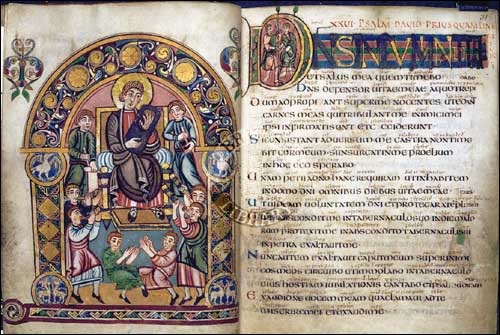
It is interesting to note that among the extensive collection of ancient Biblical manuscripts found at the British Library is the The Vespasian Psalter, a very ancient Catholic translation of the book of Psalms in to a primitive English [Anglo-Saxon]. It is believed that the Vespasian Psalter was produced at St. Augustine's, Canterbury, in the second quarter of the 8th century. This Catholic English translation was made almost six hundred years before Wycliffe produced his English translation. The great care that went in to the many ornate hand done illustrations found among its ancient pages clearly show the great love of the scriptures held by the Catholics of that time period.
The truth is, Long before Wickliffe had made his English translation of the Bible, the Catholic Church had already provided the scriptures to the people of the English isles in there native tong, this fact is born out in the statements of many seventeenth century Protestants such as Cranner, Henry VIII's Archbishop of Canterbury, said in the preface of the "Great Bible," that the. Holy Bible:
"was translated and read in the Saxon tongue, which at that time was the mother tongue, whereof there remaineth yet divers copies. ..; and when this language waxed old and out of common use, it was translated into the (English) language, whereof yet also many copies remain and be daily found."
Even Foxe, the famed Protestant martyologist, makes the same acknowledgment:
"If history be well examined we shall find both before the conquest and after, as well before John Wickliffe was born as since, the whole body of the scriptures was by Sundry men translated into our country tongue." ( This was in 1571, in the declaration to Queen Elizabeth, written by Foxe).
[Mr. Cloud]Rome had done everything in its power to destroy the Wycliffe and Tyndale English Scriptures. Wycliffe's bones were exhumed and burned by Catholic authorities, and Tyndale was burned at the stake.
To Clear up another of Mr. Clouds historical in accuracies we must point out that, William Tyndale was executed for the charge of "heresy" by order of the Protestant King of England Henry VII in October 1536. King Henry VIII held a great official burning of to "heretical" books in 1546, The Protestant Bibles of Tyndale, Coverdale and Matthew and the Catholic Latin Vulgate helped feed the fires
[Mr. Cloud] Even after Rome finally did produce an English Bible (the Rheims-Douay), it was not widely published and made available to the people. The New Testament was reprinted by Catholics ONLY THREE TIMES and the Douay Old Testament, ONLY ONCE, between 1582 and 1750--A PERIOD OF 168 YEARS.
This is not true The Rev. Hugh Pope, O. P. in his book entitled "English Versions of the Bible" [(C)1952] list more than Just three reprints of the Rheims New Testament within this 168 year period:
 |
 |
|
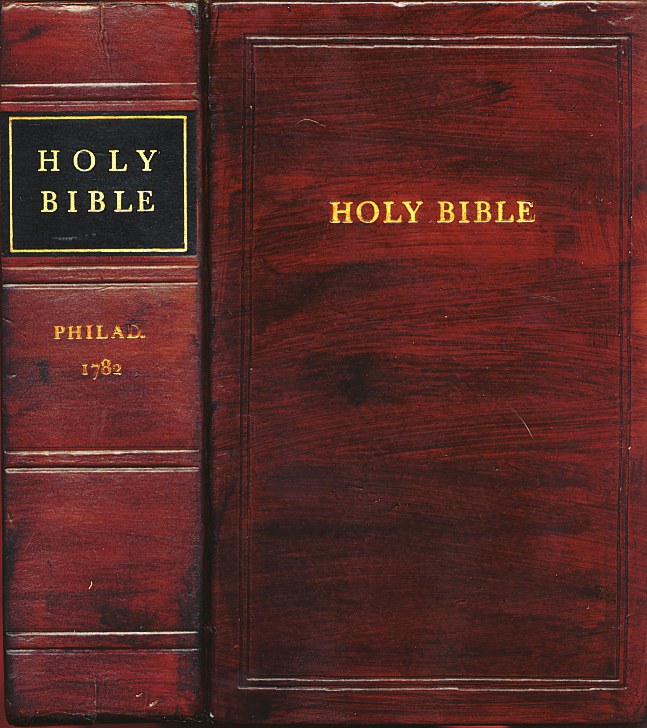
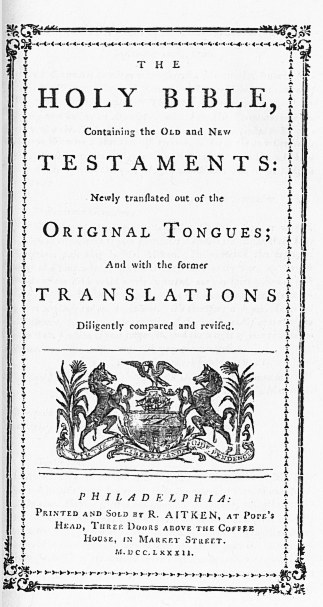
The 1782 Aitken's edition of the Bible . (This Bible is Part of the webmaster's collection.) |
|
|
Shortly after its first printing, Robert Aitken got a bill placed before the U.S. Congress that would have have given him the exclusive printing rights of the English Bible in the United States, the bill failed. |
|
1582, 1600, 1621, 1630, 1633, 1738, 1749, and 1750
We must also keep in mind that editions of Rheims New Testament [in a side by side format, with the "Bishop's" Version] were also printed, in England, by the Protestant William Fulke in years 1589, 1601, 1618, and 1633. This side by side Bible was called "A Confutation".
If Mr. Cloud had bothered to study the history of the printing Scriptures in English, he would know why there were so relatively few Catholic printing of the Bible in English through 168 these years.
In the First place the Penal (Persecution) Laws were imposed Catholics by the Anglican and Puritan (Protestant) English Government prohibited the printing of Catholic books, or even the educating of Catholic Children.
And Second, During the sixteenth, seventeenth, and eighteenth centuries the Protestant English Government had very strict probations and restrictions against the printing of any Bible in the English language, in Great Britain or her colonies, by any one other the Royal printers. As the Protestant scholar Miss Margaret T. Hills (Former Secretary of Research for the American Bible society) explains:
"Prior to the War of the Revolution, there had been no publication of the English Bible in the Colonies. All demands for Scriptures had to be met by importation from England and the Continent. It is true, of course, that there was a scarcity of the type and paper necessary for the successful publication of a book as large as the Bible. Most of the presses were used for the impression of documents, proclamations, pamphlets and papers. But there was a far more serious consideration that kept it from being printed by an American printer. It was, in fact illegal for any printer in the Colonies to produce the English Bible.
Publication of the Scriptures in any lands under the British crown was restricted, in order to insure accuracy in printing, to the Oxford and Cambridge University Presses and to other printer licensed by the king. In Scotland, special license were required." [The First American Bible, Copyright 1968, by Miss Margaret T. Hills]
It has been estimated that there were about about fifty printing presses in the American colonies in 1775 capable of printing the Bible, It was not until 1782 (at the end of the Revolution) the the First complete Protestant English edition of Bible was printed (by Robert Aitken) in North America.
[Mr. Cloud] "Consider the situation in IRELAND, another bastion of Roman Catholicism. In 1907 and 1908 the Irish Church Mission made a diligent search of book shops in Catholic Ireland to determine the availability of Catholic Bibles. Note the result: "In the booksellers’ shops of Athlone, Balbriggan, Drogheda, Mullingar, Wexford, and Clonmel, not a Bible, or New Testament, or scrap of Scripture of the Church’s authorized version, could be found--a shop assistant at Mullingar, saying, ‘I never saw a Catholic Bible.’ … in Cork, with over 76,000 inhabitants, there are twenty-four Roman Catholic booksellers, of whom twenty did not keep the Scriptures, two of them asking the would-be purchaser if the Douay New Testament, of which they knew nothing, was ‘a new monthly publication.’ Lastly, in Dublin itself, out of four large Roman Catholic publishing and bookselling establishments, only one had the Scriptures, whilst the answer given to an inquiry for a New Testament at the depot of The Catholic Truth Society was, ‘We don’t keep it.’ The conclusion arrived at by the commissioners who ransacked the booksellers’ shops in Ireland for Bibles, was ‘that in nine-tenths of the cities, towns, and villages of Ireland a Roman Catholic could not procure a copy of the Roman Catholic Bible or New Testament’" (Alexander Robertson, The Papal Conquest, 1909, pp. 166,167).
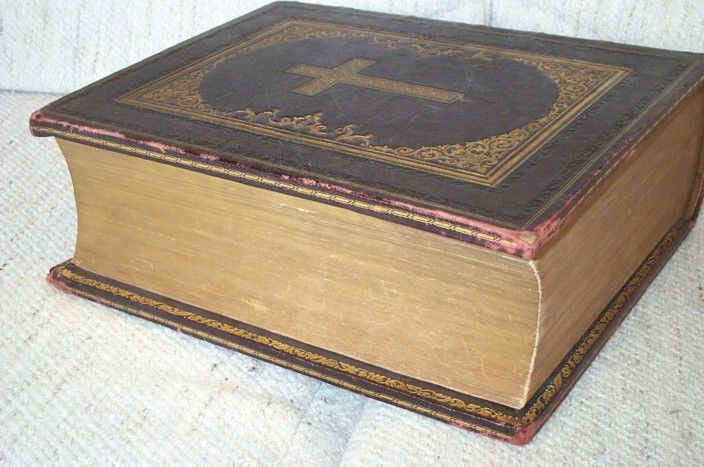
The Title Page of a 1849 printing of the Douay Rheims Bible printed in Dublin Ireland. This Edition Douay Rheims of the is part of the Webmasters Bible collection.
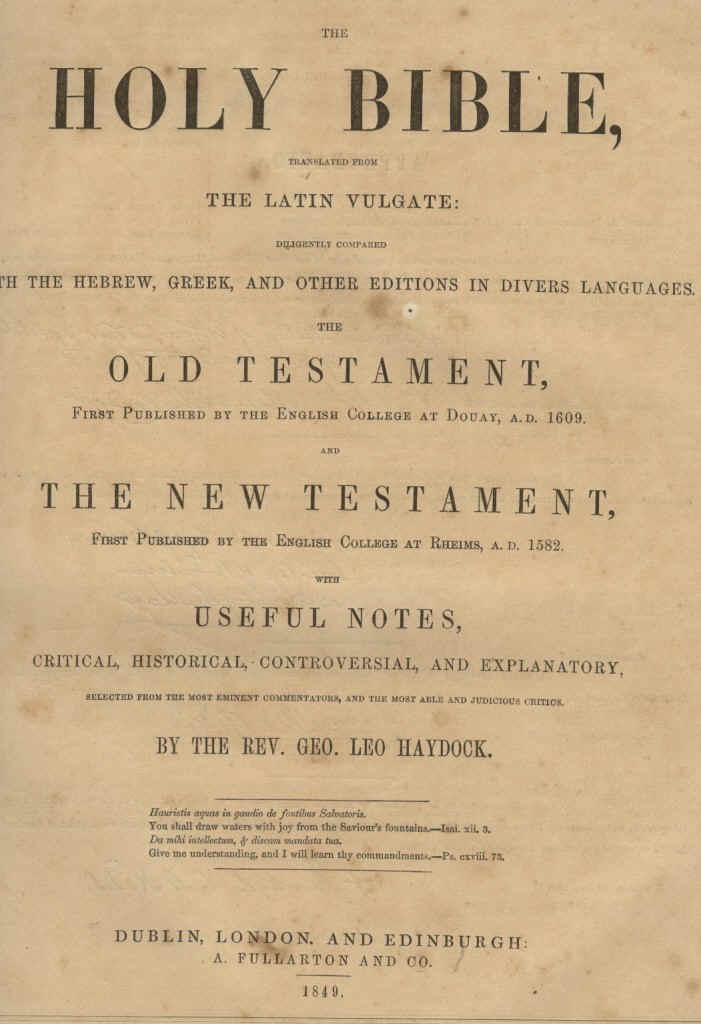
This is typical of the protestant lies that can be found in Mr. Clouds articles, David is so anxious to post any thing anti-Catholic that he does not even pause to verify its accuracy. The Truth is that Catholic Bibles were plentiful in Ireland during this period, they were even being printed in Dublin and Belfast.
Among the many Antiquarian Bibles in my personal collection is a fine example of one printed in 1849 Dublin Ireland by A Fullarton & Co. It Catholic Printing is a Douay Rheims (both New and Old Testament) complete with useful notes expounding the scriptures by The Rev Geo. Leo Haydock.
This wonderful example of a Irish Catholic printing of the sacred scriptures is a huge 11" x 12.5" x 4.5", and it is beautifully gold embossed and deeply tooled leather covers ribbed spine and gold edged pages, AND RICHLY ILLUSTRATED THROUGHOUT WITH BEAUTIFUL ANTIQUE WOODCUTS.
I have recently had the opportunity to examine Three other Irish printings of the Douay Rheims, the first one was published in Dublin, in 1820 it was printed by Richard Coyne. The second was a 1846 edition, It was printed in both New York (Benziger & Co) and Dublin Ireland (Gill & Co). The Third one was published in Belfast Ireland by Robert & Daniel Read in 1854, by the approbation of Most Rev. Dr. Denvir.
[Mr. Cloud] It was 1831 before the first Bible was printed in SPANISH AMERICA, and when the Catholic Church finally did allow the publication of some Scriptures there, they were so outrageously expensive that the common man could not afford a copy. "A traveler across BRAZIL in 1902, who inquired carefully into the subject, found in a thousand miles bishops and priests in plenty, BUT NOT A SINGLE COPY OF THE SCRIPTURES IN ANY LAY HOME; nor had most of the residents ever heard of the Bible, though they were able, willing, and anxious to buy a copy when it was shown to them" (Jacobus, Roman Catholic and Protestant Bibles Compared, 1905, p. 235). These examples could be multiplied exceedingly.
Here again Mr. Cloud did not verify the accuracy of his information. As early as 1478 A.D. we find the Bible being printed in Spanish, In the years before Luther's Bible was published (Luther's Biblical translations, begun in 1522) the Catholics printed 2 different Spanish editions of the Bible. In 1579 A.D. we find the first known Biblical undertaking in Mexico, it was a version of the Gospels and Epistles in 1579 by Didacus de S. Maria, O.P. As we have already stated, is every Catholic Church in Christendom (including South America) had to have at least one Bible for the daily Mass readings, and most had an extra or two in the public space of the church.
Please sign our Guest book!
This page has helped Refuted
People find the truth since November 1999