
The 1611 King James Version was A Copyrighted Bible.
"Cum Privilegio"

One of the Battle cries of the Cultic KJV Onlyist is:
God's Word does not have a Copyright on it. The Scriptures in the King James Bible have no copyright on it. The Scripture belongs to God, and He hasn't felt to profit from man for His Word.
Of course statements like this show the ignorance of these fanatics, and have no grounding in historic fact. The 1911 Encyclopedia Britannica explains that In England, the act of copyrighting books started right after the Reformation:
"In England.... After the Reformation the greater part of the rights of censorship passed to the Crown, which at the same time assumed the power of granting by letters patent the right of printing or selling books as a monopoly. The grant, if made to the author himself, was an equivalent of copyright; if made to a person other than the author, it seems to have always been subject to the authors copyright as it existed at common law...Under Mary printing was confined to members of the Stationers Company, founded by royal charter in 1556. Under Elizabeth the Star Chamber assumed the right to confine printing to London, Oxford and Cambridge, to limit the number of printers and presses, to prohibit all publications issued without proper license, and to enter houses to search for unlicensed presses and publications (Order of 1585, Strypes Whitgift, app. 94). The search for unlicensed presses or publications was entrusted to an officer called the messenger of the press. In 5637 was issued an order of the Star Chamber forbidding the import ation of books printed abroad to the scandal of religion or the" [Read about PRESS LAWS in the 1911 Encyclopdia]
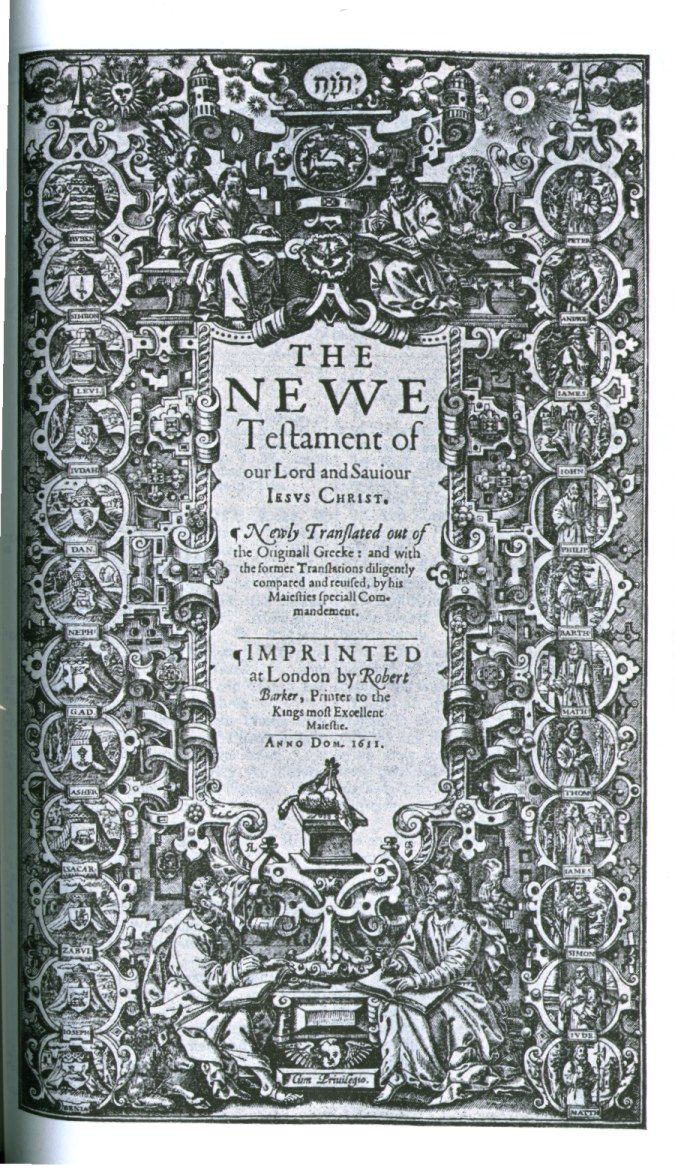
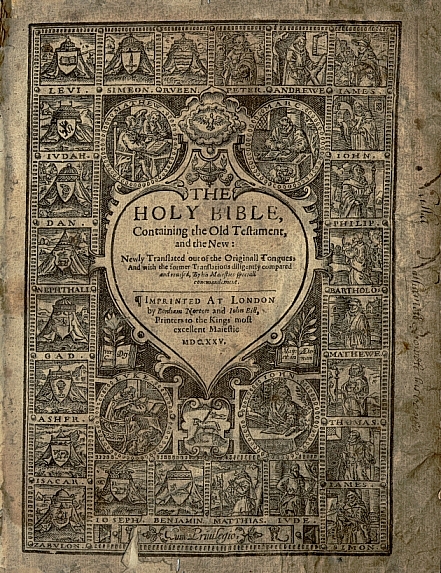
This scans is from the bottom of the opening page of the New Testament in the 1611 King James Version. This scan is from the Oxford University Press (1911) reprint of the 1611 KJV.Click here to see a scan of the full opening page of the New Testament from the Reprint of the 1611 KJV. This scans is from the bottom of the opening page of the 1625 King James Version, Printed by Bonham Norton and John Bill The "printers to the Kings moft excellent Majestie". Click here to see a scan of the very ornately illustrated opening page from the 1625 KJV.
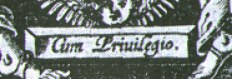
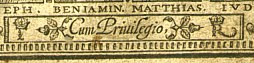
If they ever get the opportunity to examine a original 1611 printing of the King James Version, they would find at the bottom of the title page for the New Testament the phrase, "Cum Privilegio". These Latin words literally mean "with privilege" or "right", that is, with the right of reproduction retained, or, in a word, "copyrighted."
|
|
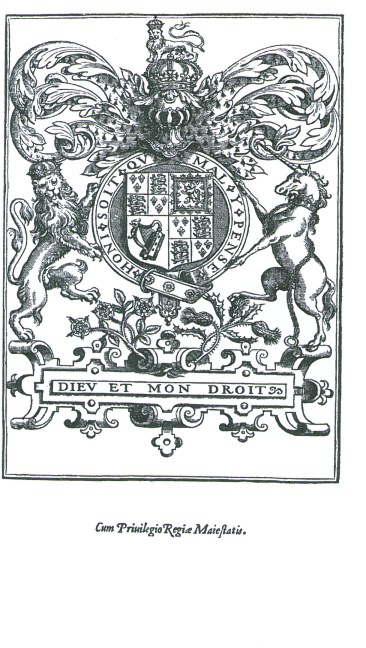
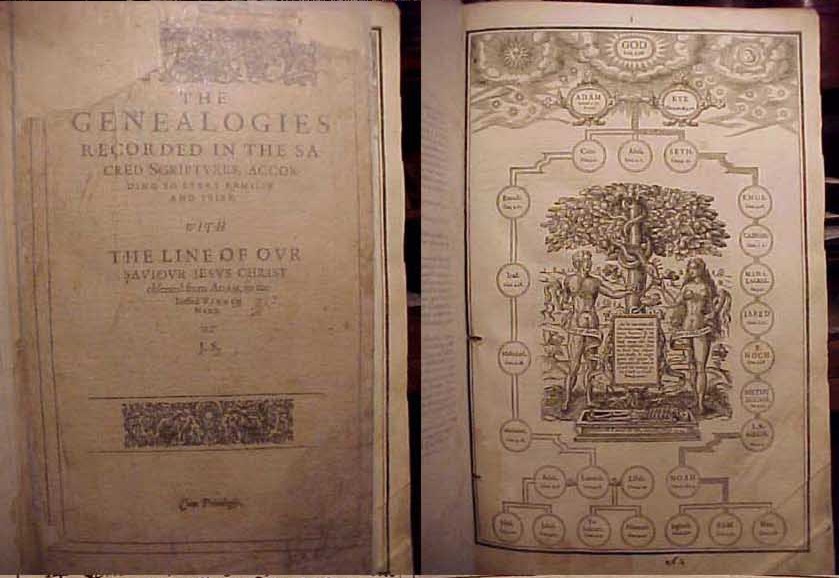
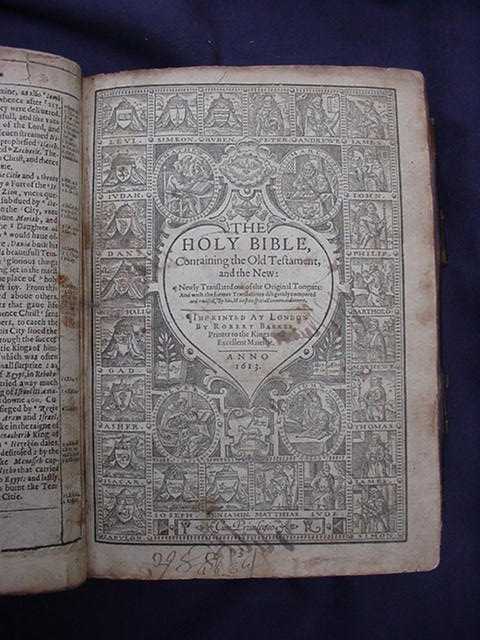
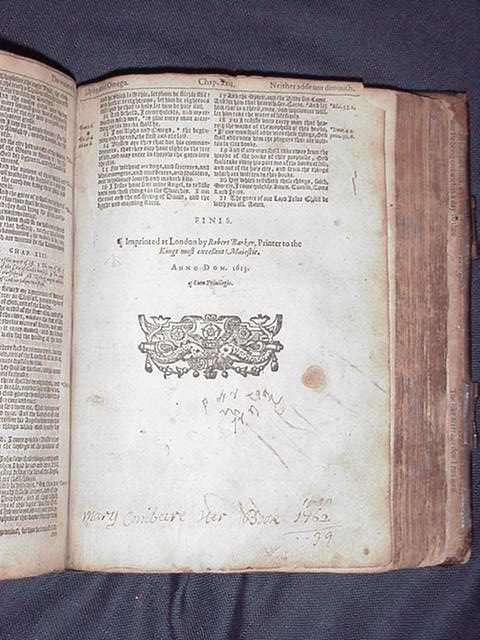
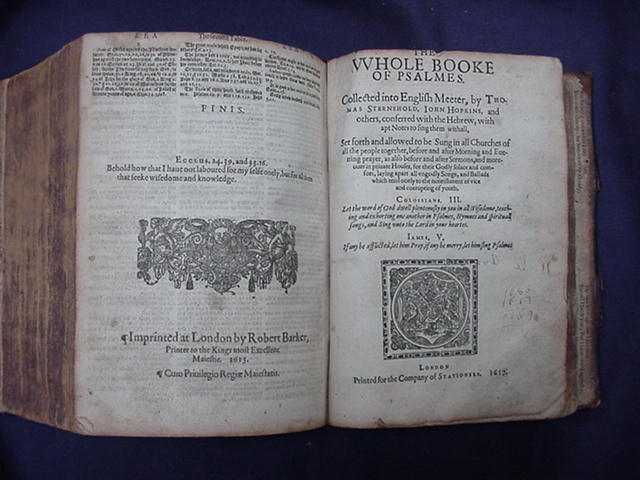
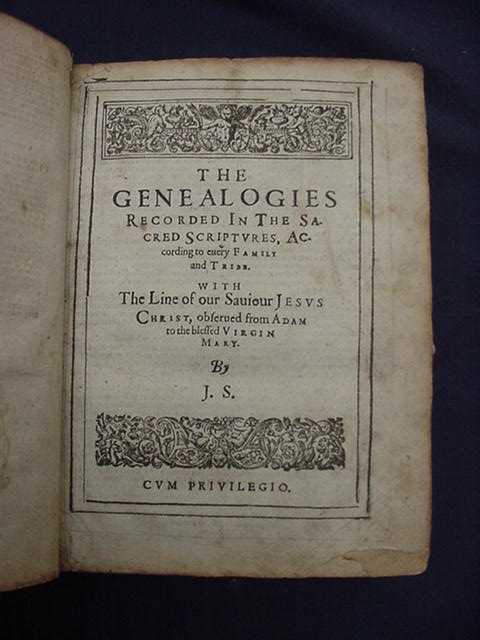
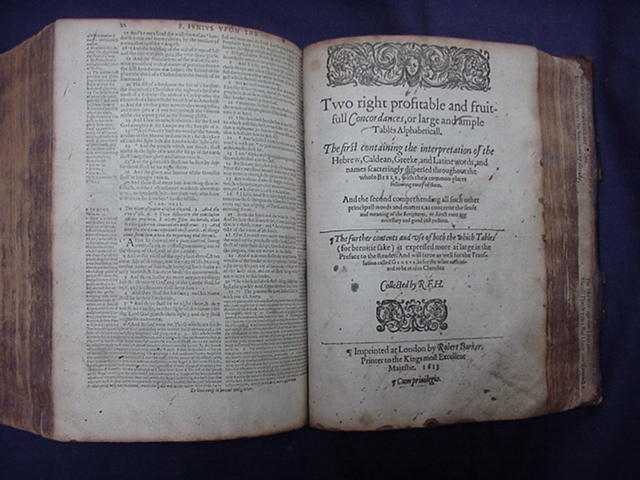
We find the phrase, "Cum Privilegio" also printed at the bottom of the opening page of the genealogies. Also among the opening Pages of the original 1611 King James Version was one that boar the the Royal Seal of James below which is stated "Cum Privilegio Regiae Maieftatis". These Latin words literally mean "with privilege from his royal Majesty " Showing that the writes to print this version of the Bible came from the King of England himself, in other words it was a Royal Copyright enforced by the King. The 1613 Quarto edition of the KJV printed in London by Robert Barker, contains many example of copyrights: |
| The Seal page in the 1611 KJV. It was printed as a frontispiece to the "Epistle Dedicatory". This scan is from a facsimile of the first impression the original 1611 edition of The King James Bible was produced in 1961 for the World Publishing Company |
|
|
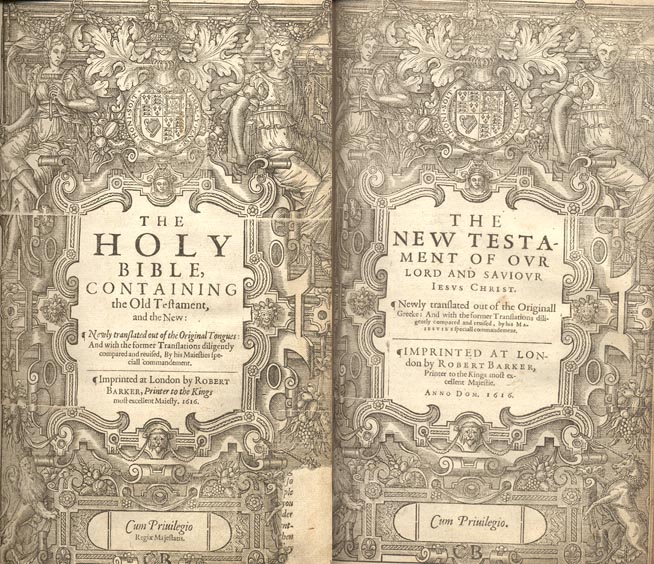
I recently had the opportunity to examine close up a 1616 printing of the KJV, it had Latin phrase "Cum Privilegio Regiae Maieftatis" printed at the bottom of the main title page and "Cum Privilegio" on the bottom of the New Testament title page. (This link is to a digital picture I took of this edition.) Among the books in my collection is a actual 1625 printing of the King James Version, It has the Latin phrase the words "Cum Privilegio" on both the title page to the whole Bible and the title page to the New Testament. Many later editions read the same. |
|
The Protestant author Gustavus Paine, in his book The Men Behind the King James Version, discusses the printing and copyright of the KJV —
"There was no competition for the job of printing the new Bible. It went to Robert Barker, the royal printer who also published it. His father, Christopher Barker, had received from Queen Elizabeth the sole right to print English Bibles, books of common prayer, statutes, and proclamations. On the death of Christopher Barker in 1599 the queen had given to his son, Robert Barker, the office of Queen's Printer for life with the same monopoly. The Barkers and their heirs were to keep their right to publish the King James Bible for a hundred years. The heirs of Robert Barker went on printing [the KJV] as sole owners of the right for a hundred years" (1).
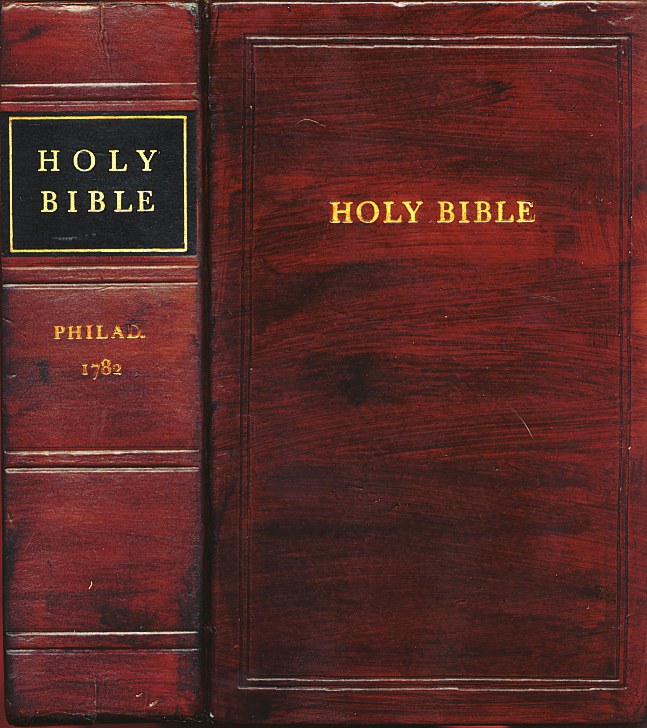
The 1782 Aitken's edition of the Bible . This Bible is Part of the webmaster's collection
The Title Page of The 1782 Aitken's edition of the Bible.
The 1782 U.S. Congressional Approval Of Aitken's Protestant edition of the Bible.
Due to the probations and restrictions of the English government against any printing of the Bible in English, by any one other the Royal printers, it was not until 1782 (at the end of the Revolution) the the First complete English translation of Bible was printed (by Robert Aitken) in the Americas. This Protestant edition was officially approved by the American Congress. Shortly after its first printing, Robert Aitken got a bill placed before Congress that would have given him the exclusive printing rights of the English Bible in the United States, the bill failed.
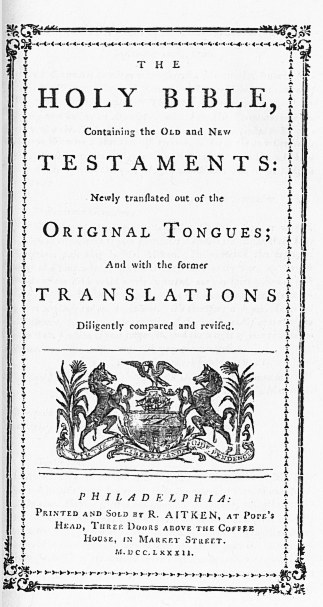
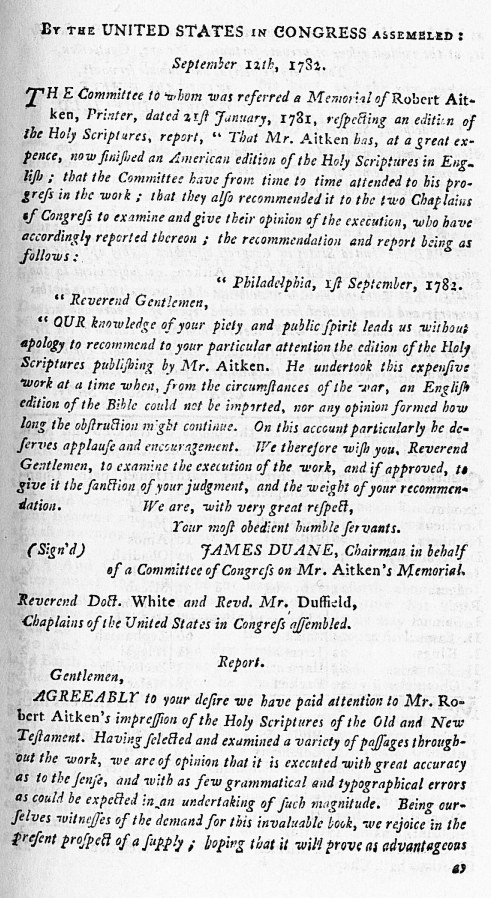
When one examines the history of the KJV since 1611, it becomes evident, that the KJV was under worldwide copyright in all countries ruled by the British Empire from its first publishing in 1611 until 1782, (over one hundred and seventy years). There were very strict restrictions on the printing of King James Version, it was illegal in Anglican England or the American colonies to print the Bible in English, except for the royal printers. The Crown claimed a copyright on King James version, and printing of that version was a privilege accorded exclusively to the King's printers and the universities of Oxford in Cambridge. Hence its published in English colonies appeared in languages other than English. As the Protestant scholar Miss Margaret T. Hills (Former Secretary of Research for the American Bible society) explains:
"Prior to the War of the Revolution, there had been no publication of the English Bible in the Colonies. All demands for Scriptures had to be met by importation from England and the Continent. It is true, of course, that there was a scarcity of the type and paper necessary for the successful publication of a book as large as the Bible. Most of the presses were used for the impression of documents, proclamations, pamphlets and papers. But there was a far more serious consideration that kept it from being printed by an American printer. It was, in fact illegal for any printer in the Colonies to produce the English Bible.
Publication of the Scriptures in any lands under the British crown was restricted, ... to the Oxford and Cambridge University Presses and to other printer licensed by the king. In Scotland, special license were required." ["The First American Bible", Copyright 1968, by Miss Margaret T. Hills]
The Protestant scholar F. F. Bruce also confirmed this fact in
"Before the Declaration of Independence American Christians were debarred by British copyright regulations from printing the English Bible" ("The Canon of Scripture" pg. 111, note 24).
It has been estimated that there were about about fifty printing presses in the American colonies in 1775 capable of printing the Bible, it was not until after the outbreak of the American revolution that American presses began to publish a edition of the King James Bible. First came Robert Aitken's edition of the new Testament printed in Philadelphia in 1777 against great odds. Not only was the work done on poor equipment, but on one occasion Aitken had to save his type and printing materials from destruction by the English red coats by sprinting them out-of-town and hiding them under a barn (2). But the British solders burned the many partially printed copies Robert Aitken was forced to leave behind.
It is of particular interest to find that after the American Revolution had created a new nation there was a effort in these United States to institute a copy restrictions on the King James Version:
"an effort was made in its first Congress to restrict the printing of the [Bible] to licensed houses," but this effort "was cut short by the first amendment to the Constitution, and the book was thrown into the hands of the trade at large, with anything but a beneficial effect on its general integrity" (Cyclopedia of Biblical, Theological, and Ecclesiastical Literature, edited by John M'Clintock and James Strong, Vol. I, pg. 563).
Furthermore, the 1911 Encyclopedia Britannica explains that In England, the Crown still holds a "perpetual" copyright on the text of the KJV.
"A special kind of what amounts to perpetual copyright in various publications has for various reasons been recognized by the laws (I) in the crown, and (2) in the universities and colleges. Crown copyrights are saved by the general principle which exempts crown rights from the operation of statutes unless they are expressly mentioned. Among the books in which the crown has claimed copyright are the English translation of the Bible (I.e. the KJV), the Book of Common Prayer, statutes, orders of privy council, proclamations, almanacs, Lillys Latin Grammar, year books and law reports. The copyright in the Bible is rested by some on the kings position as head of the church; Lord Lyndhurst rested it on his duties as the chief executive officer of the state charged with the publication of authorized manuals of religion. The right of printing the Bible and the Book of Common Prayer is vested in the kings printer and the universities of Oxford and Cambridge." [Read about COPYRIGHT in the 1911 Encyclopdia]
THE "PERPETUAL COPYRIGHT" THE KJV IN ENGLAND IS STILL COPYRIGHTED TODAY
To the present day the KJV is published in England under copyright. In private conversation, Sam Moore, president of Thomas Nelson Publishing of Nashville, Tennessee, the world's largest Bible publisher, informed Robert L. Sumner that there are currently four license holders with legal authority in England to publish the KJV: the Universities of Oxford and Cambridge, as well as William Collins Sons & Co., Ltd, and Eyre & Spottiswoode.
Let us look at the editions of these English license holders of the printed edition of the KJV:
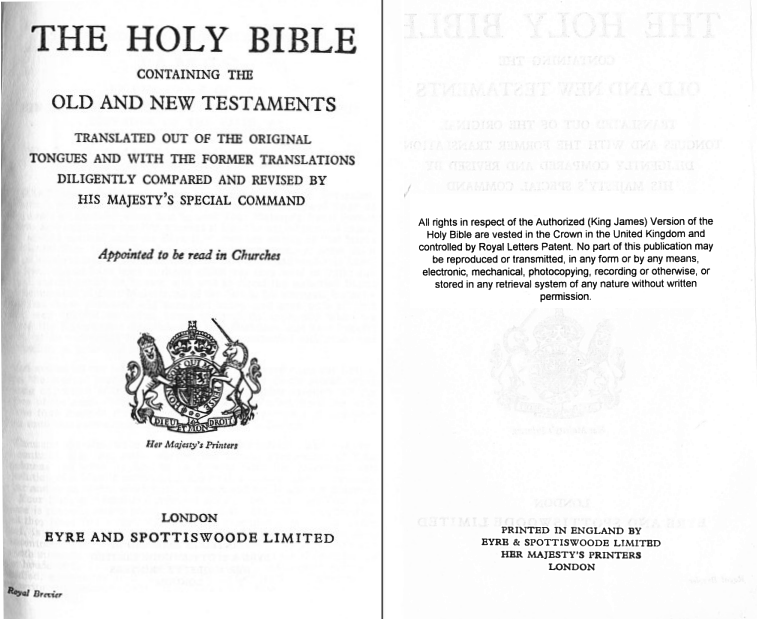 |
A Scan of the front page and the copyright on the current (1986) Eyre & Spottiswoode printing of the KJV |
|
A Scan of the front page and the copyright on the 1975, William Collins Sons & Co., Ltd printing of the KJV | ||
|
Among the authors collection is a 1986 printing of the Eyre & Spottiswoode KJV, it says:
|
Also among the authors collection is a 1975 William Collins Sons edition of the King James Version, inside the front it says:
|
||||
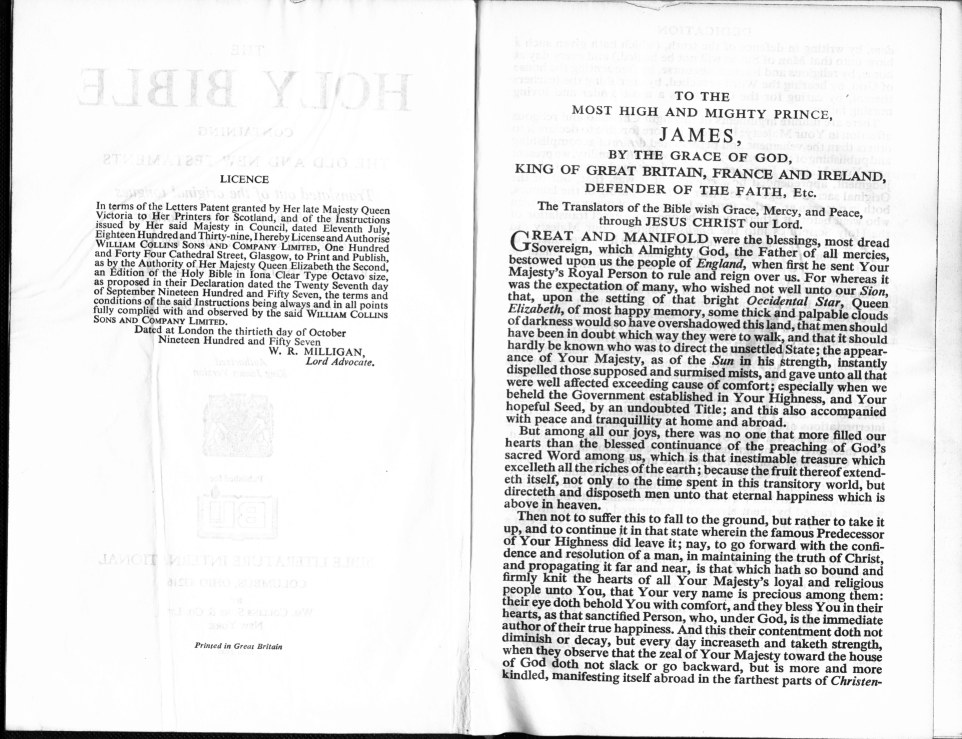
In the front of The Cambridge edition of the KJV, we see still see the words Cum Priveleo. We also see on the opposite page "Rights in the Authorized (King James) Version of the Bible are vested in the crown." Then we see a symbol. then we see "The Bible is published by Cambridge University Press, The Queen's Printer, Under Royal Letters Patent."
The term “Under Royal Letters Patent” does not mean that the particular typeset was copyrighted. It means that Cambridge University Press has the “dignity, office, monopoly, franchise and privilege” to Print the King James Version. 1911 Encyclopedia Britannica explains:
“ Letters patent (litterae pate-ntes) are letters addressed by the sovereign to all to whom these presents shall come, reciting the grant of some dignity, office, monopoly, franchise or other privilege to the patentee. They are not sealed up, but are left open (hence the term patent), and are recorded in the Patent Rolls in the Record Office, or in the case of very recent grants, in the Chancery Enrolment Office, ~o that all subjects of the realm may read and be bound by their contents. In this respect they differ from certain other letters of the sovereign directed to particular persons and for particular purposes, which, riot being proper for public inspection, are closed up and sealed on the outside, and are thereupon called writs close (litterae clausae) and are recorded in the Close Rolls. Letters patent are used to put into commission various powers inherent in the crown-legislative powers, as when the sovereign entrusts to others the duty of opening parliament or assenting to bills ” [1911 Encyclopdia]
The practice of copyrighting of books and translations of the scriptures was a firmly established practice in England long before the first publication of the KJV (in 1611).
Other Early Copyrighted English Bibles,
The Coverdale's Bible: of 1537 printed by Nycolson, of Southwark [a section of London] we read at the foot of the title-page, "Set forth with the Kynges most gracious license" ("The History of the English Bible" by William F. Moulton, 5th edition, copyrighted 1911, pg. 99).
The 1539 Taverner: published his edition of the Bible, the title page of that edition which reads in part, "Printed at London in Flete street at the synge of the sonne by John Byddell, for Thomas Barthlet. Cum privilegio ad imprimendum solum. M.D.XXXIX." ("The History of the English Bible" by William F. Moulton, 5th edition, copyrighted 1911 pg. 133).
The Great Bible: completed in April of 1539, on its title page included the words, "Printed by Rychard Grafton and Edward Whitchurch. Cum privilegio ad imprimendum solum" ("English Versions," The International Standard Bible Encyclopedia, volume II, pg. 949, 1937 revised edition).
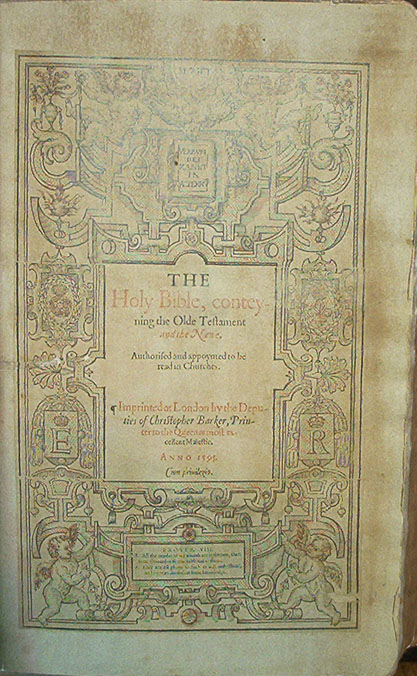
The Bishop's Bible: was copyrighted when it appeared. Its title page read the words "cum gratia et privilegio" —— "with grace and privilege." ("The History of the English Bible" by William F. Moulton, 5th edition, copyrighted 1911, pg. 215). This LINK is to a digital photo of the general title page of the1595 Bishop's Bible, at the bottom it says "Cum privilegio"
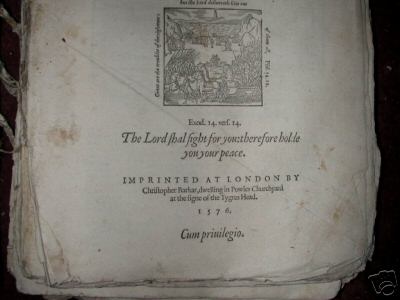
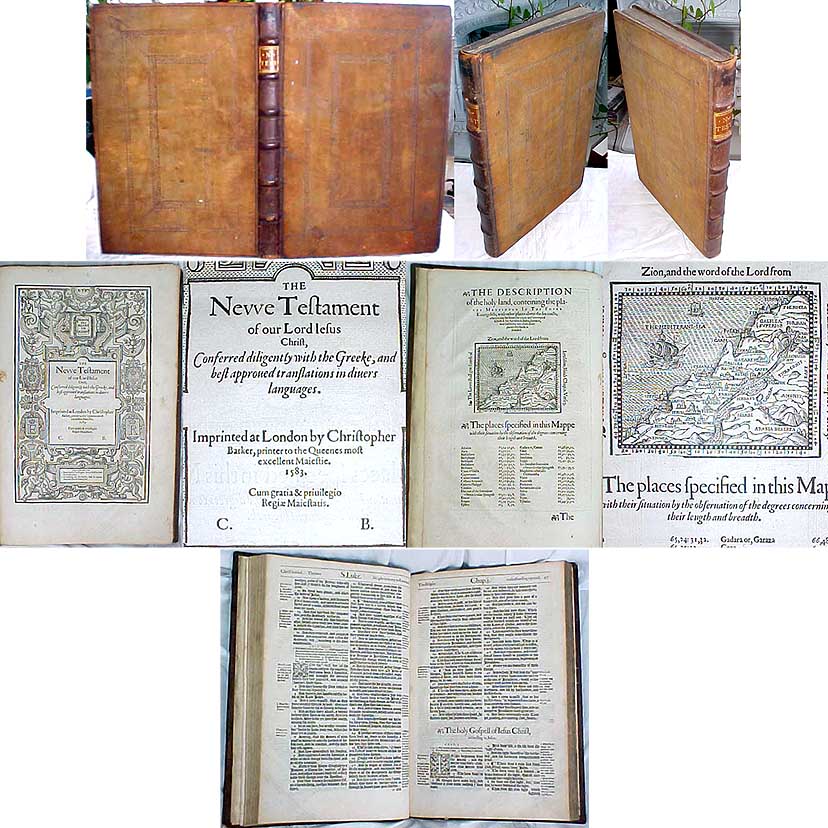
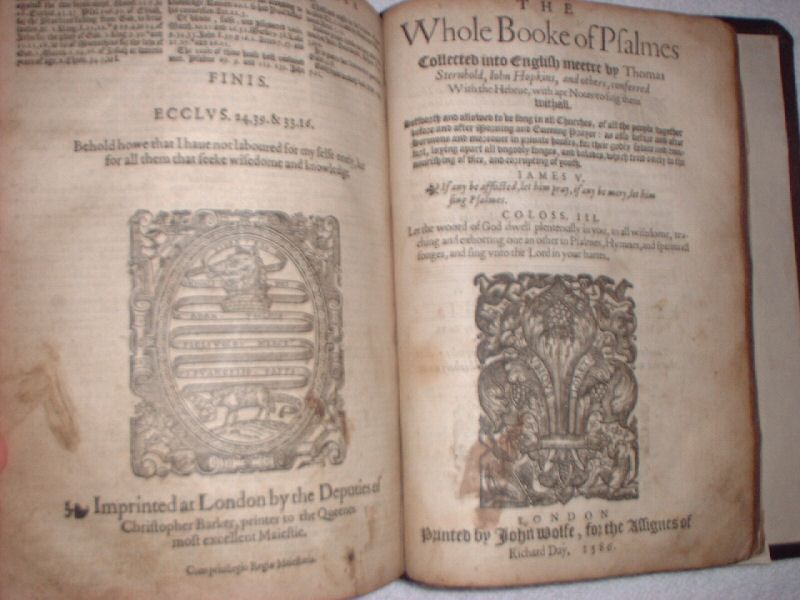
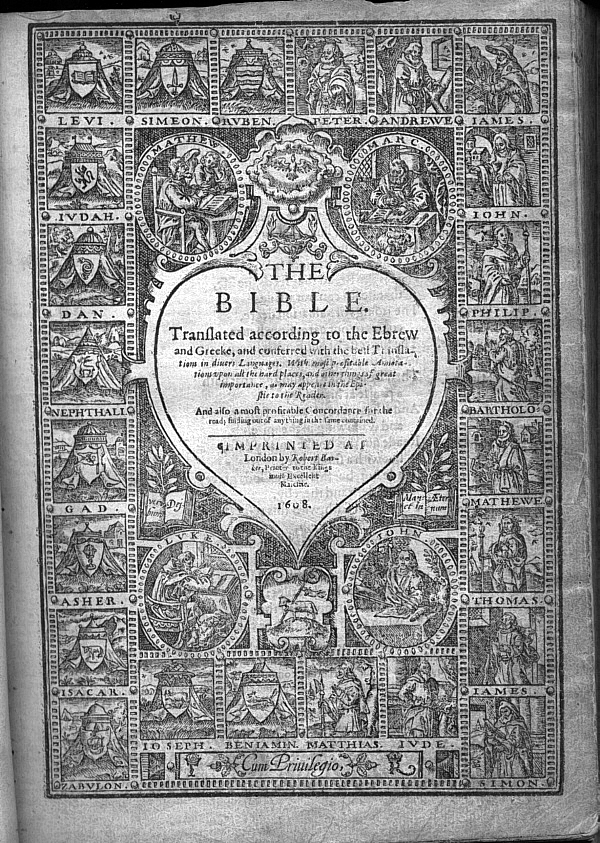
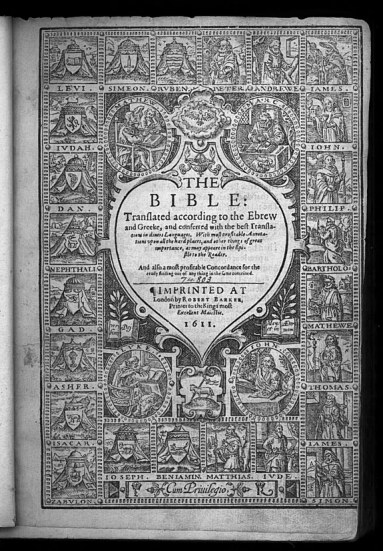
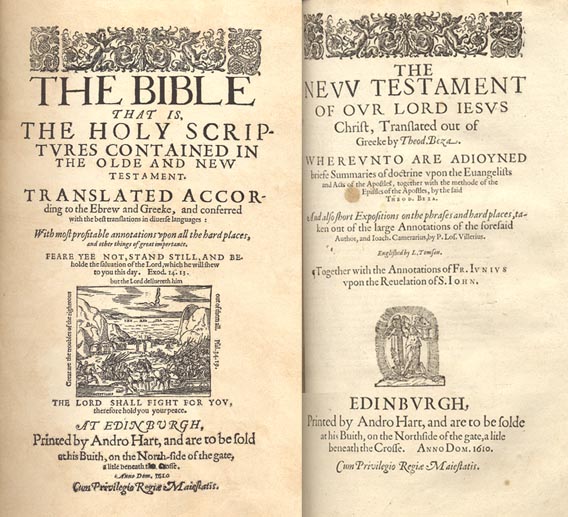
The Geneva Bible: Its title page reads in, "Cum privilegio Regiae Maieftatis". This link is to the title page of the New Testament of the 1576 printing of the Geneva Bible, it says "Cum Privilegio. This link is to the a picture of the 1583 printing of the Geneva Bible, it says "Cum Privilegio Regiae Maieftatis" at the bottom of the title page of the New Testament. This link is to a digital photo of the the final page of revelations in a 1588 printing of the Geneva Bible, although the picture is not very clear you can still read "Cum Privilegio Regiae Maieftatis" at the bottom of the page. The following are links to scans of the title Pages of the New Testament for the 1608 and 1611 printing of the Geneva Bible. Here is a link to a scan of the General and New Testament Title pages from the 1610 edition they both say "Cum Privilegio Regiae Maieftatis"
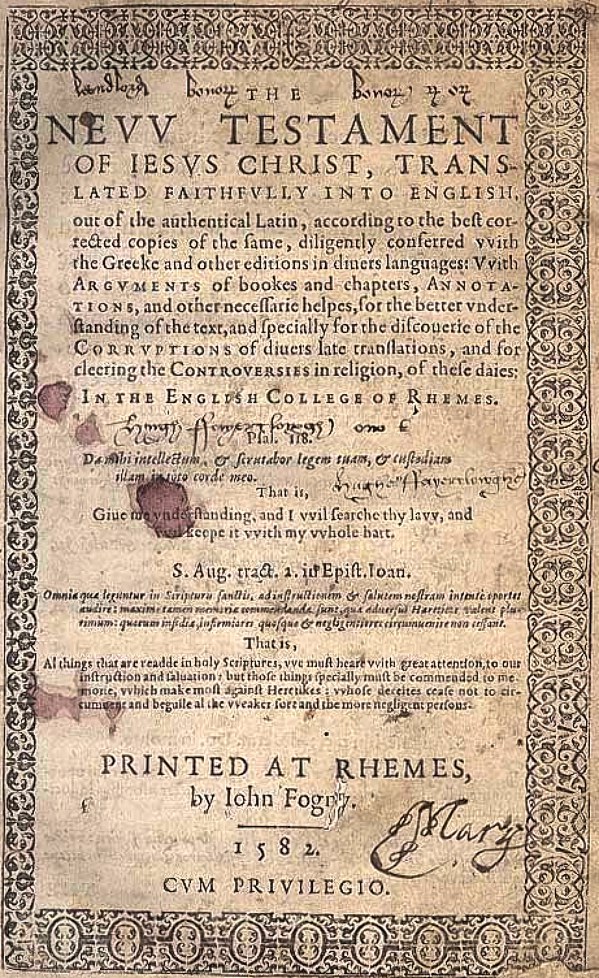
The Catholic Rheims New Testament: was copyrighted when it appeared. Its title page reads in, "Printed at Rhemes by Ioan Fogny. 1582. Cum privilegio" This LINK is to a scan of the title page of the1582 Rheims New Testament
And, we note, though it is not an English Bible, that Erasmus' Greek text in its first edition of 1516 was published under copyright; an exact reproduction of the title page is to be found in Schaff's Companion to the Greek Testament and English Version, pg. 532, where we clearly see "CVM PRIVILEGIO."
FOOT NOTES:
1) The Men Behind the King James Version" pgs. 134, 182
2)"The Bible Through the Ages" © 1996 Pg 337-338

Please sign our Guest book!
This page has helped
People find the truth since November 1999