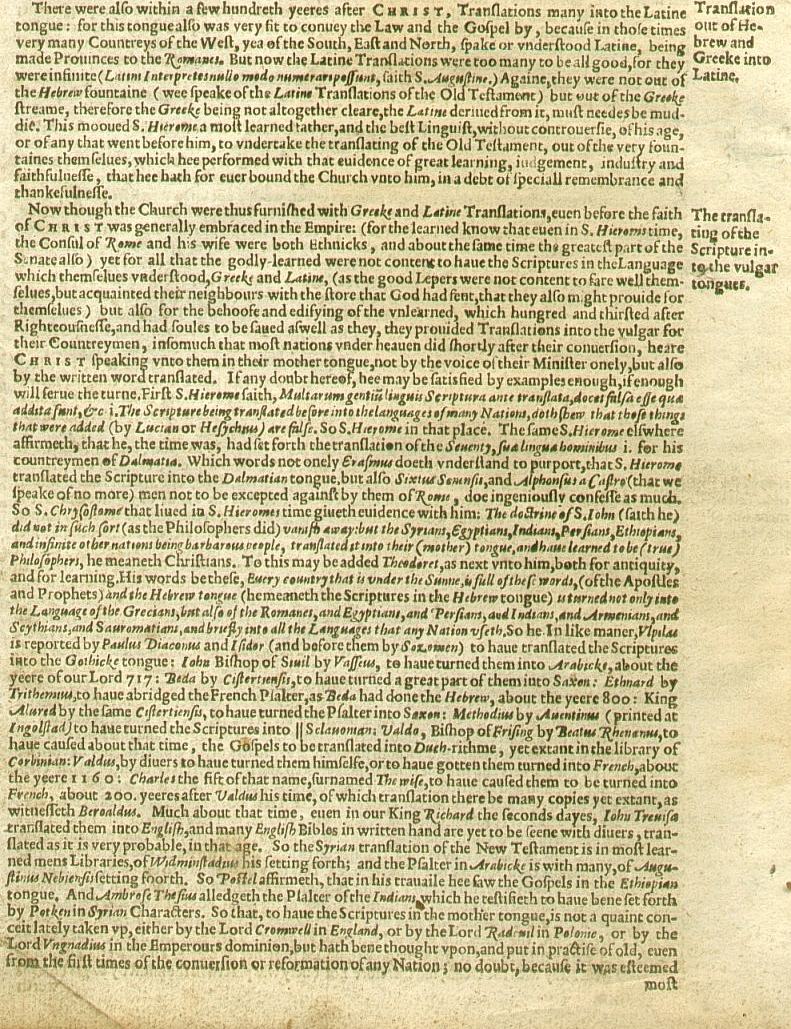
There were also within a few hundred years after CHRIST, translations many into the
Latin tongue: for this tongue also was very fit to convey the Law and the Gospel by,
because in those times very many Countries of the West, yea of the South, East and North,
spake or understood Latin, being made Provinces to the Romans. But now the Latin
Translations were too many to be all good, for they were infinite (Latini Interprets nullo
modo numerari possunt, saith S. Augustine.) [S. Augustin. de doctr. Christ. lib 2 cap II].
Again they were not out of the Hebrew fountain (we speak of the Latin Translations of the
Old Testament) but out of the Greek stream, therefore the Greek being not altogether
clear, the Latin derived from it must needs be muddy. This moved S. Jerome a most learned
father, and the best linguist without controversy, of his age, or of any that went before
him, to undertake the translating of the Old Testament, out of the very fountain with that
evidence of great learning, judgment, industry, and faithfulness, that he had forever
bound the Church unto him, in a debt of special remembrance and thankfulness.
THE TRANSLATING OF THE SCRIPTURE INTO THE VULGAR TONGUES
Now through the Church were thus furnished with Greek and Latin Translations, even
before the faith of CHRIST was generally embraced in the Empire; (for the learned know
that even in S. Jerome's time, the Consul of Rome and his wife were both Ethnics, and
about the same time the greatest part of the Senate also) [S. Jerome. Marcell.Zosim] yet
for all that the godly-learned were not content to have the Scriptures in the Language
which they themselves understood, Greek and Latin, (as the good Lepers were not content to
fare well themselves, but acquainted their neighbors with the store that God had sent,
that they also might provide for themselves) [2 Kings 7:9] but also for the behoof
andedifying of the unlearned which hungered and thirsted after righteousness, and had
souls to be saved as well as they, they provided Translations into the vulgar for their
Countrymen, insomuch that most nations under heaven did shortly after their conversion,
hear CHRIST speaking unto them in their mother tongue, not by the voice of their Minister
only, but also by the written word translated. If any doubt hereof, he may be satisfied by
examples enough, if enough will serve the turn. First S. Jerome saith, Multarum gentium
linguis Scriptura ante translata, docet falsa esse quae addita sunt, etc. i.e. "The
Scripture being translated before in the languages of many Nations, doth show that those
things that were added (by Lucian and Hesychius) are false." [S. Jerome. praef. in
4::Evangel.] So S. Jerome in that place. The same Jerome elsewhere affirmeth that he, the
time was, had set forth the translation of the Seventy suae linguae hominibus, i.e., for
his countrymen of Dalmatia [S. Jerome. Sophronio.] Which words not only Erasmus doth
understand to purport, that S. Jerome translated the Scripture into the Dalmatian tongue,
but also Sixtus Senensis [Six. Sen. lib 4], and Alphonsus a` Castro [Alphon. lb 1 ca 23]
(that we speak of no more) men not to be excepted against by them of Rome, do ingenuously
confess as much. So, S. Chrysostom that lived in S. Jerome's time, giveth evidence with
him: "The doctrine of S. John [saith he] did not in such sort [as the Philosophers'
did] vanish away: but the Syrians, Egyptians, Indians, Persians, Ethiopians, and infinite
other nations being barbarous people translated it into their [mother] tongue, and have
learned to be [true] Philosophers," he meaneth Christians. [S. Chrysost. in Johan.
cap.I. hom.I.] To this may be added Theodoret, as next unto him, both for antiquity, and
for learning. His words be these, "Every Country that is under the Sun, is full of
these words (of the Apostles and Prophets) and the Hebrew tongue [he meaneth the
Scriptures in the Hebrew tongue] is turned not only into the Language of the Grecians, but
also of the Romans, and Egyptians, and Persians, and Indians, and Armenians, and
Scythians, and Sauromatians, and briefly into all the Languages that any Nation useth.
[Theodor. 5. Therapeut.] So he. In like manner, Ulfilas is reported by Paulus Diaconus and
Isidor (and before them by Sozomen) to have translated the Scriptures into the Gothic
tongue: [P. Diacon. li. 12.] John Bishop of Sevil by Vasseus, to have turned them into
Arabic, about the year of our Lord 717; [Vaseus in Chron. Hispan.] Bede by Cistertiensis,
to have turned a great part of them into Saxon: Efnard by Trithemius, to have abridged the
French Psalter, as Beded had done the Hebrew, about the year 800: King Alfred by the said
Cistertiensis, to have turned the Psalter into Saxon: [Polydor. Virg. 5 histor.] Methodius
by Aventinus (printed at Ingolstadt) to have turned the Scriptures into Slavonian:
[Aventin. lib. 4.] Valdo, Bishop of Frising by Beatus Rhenanus, to have caused about that
time, the Gospels to be translated into Dutch rhythm, yet extant in the Library of
Corbinian: [Circa annum 900. B. Rhenan. rerum German. lib 2.] Valdus, by divers to have
turned them himself into French, about the year 1160: Charles the Fifth of that name,
surnamed the Wise, to have caused them to be turned into French, about 200 years after
Valdus his time, of which translation there be many copies yet extant, as witnesseth
Beroaldus. Much about that time, even in our King Richard the second's days, John Trevisa
translated them into English, and many English Bibles in written hand are yet to be seen
with divers, translated as it is very probable, in that age. So the Syrian translation of
the New Testament is in most learned men's Libraries, of Widminstadius his setting forth,
and the Psalter in Arabic is with many, of Augustinus Nebiensis' setting forth. So Postel
affirmeth, that in his travel he saw the Gospels in the Ethiopian tongue; And Ambrose
Thesius allegeth the Pslater of the Indians, which he testifieth to have been set forth by
Potken in Syrian characters.