Is This The Original 1611 King James Version?
The true answer might Surprise you.

The original 1611 King James Version contained the Deuterocanonical books.
"The Apocrypha consists of the books that are found in the Greek version of the Jewish Bible—the Septuagint, the earliest complete version of the Bible was possess—but that were not included in the final, Canonical version of the 90 A.D. Hebrew Bible. For this reason, they were called "Apocrypha," the hidden or secret book, and while they formed part of the original King James Version of 1611." (The Apocrypha, by Edgar J. Goodspeed, copyrights: 1989,1959,1938)
Thus, the Bible that the Protestants use today omits thousands of verses originally contained in the KJV (just over 5,700). It is true that the Deuterocanonical books were widely regarded by Protestants in 1611 with mixed feelings as to there status of there canonicity. However, in the original 1611 edition no disclaimer was included in this regard. Furthermore, if the Apocrypha were to be reintroduced in to the KJV today by all of its printers, the KJV-only advocates would vehemently object to its inclusion – a sure sign that its inclusion in the 1611 edition is a significant difference.
Even excluding the Deuterocanonical books, the KJV of 1611 differed slightly from editions of the KJV in common use today.. We are not referring here to spelling changes and the like, or to misprints in later, single editions. Usually the changes are improvements – for example, Matthew 26:36 now properly reads "Then cometh Jesus," where the original KJV read "Then cometh Judas." Not all the changes are for the better, though – for example, Matthew 23:34 in the KJV originally read "strain out a gnat," which is correct, while subsequent editions of the KJV to this day have "strain at a gnat." These facts prove that the extreme KJV-Only belief that even the slightest deviation from the wording of the KJV results in a false Bible is completely unrealistic. Please note that we are not claiming that the differences are vast or troubling from our perspective. We are simply pointing out that the position that the wording of the 1611 KJV is inviolable logically requires that modern editions of the KJV not be used.
[Note: The following images on these Links is taken from The Holy Bible, King James Version, 1611 Edition (Thomas Nelson Publishers), a reprint of the first edition of the Authorized 1611 Version.]
- Ruth 3:15 - "...and he went into the city." Today's KJVs read "...and she went into the city."
- Psalm 69:32 - "...and your heart shall liue that seeke goode." Today's KJVs read, "...and your heart shall live that seek God."
- Jeremiah 34:16 - "...and euery man his handmaide, whom yee had set at libertie...." Today's KJVs read, "...and every man his handmaid, whom he had set at liberty...."
* Significance: KJV-Only advocates believe that the KJV is the "inerrant, pure, perfect, preserved Word of God." Which KJV are they referring to... the 1611 KJV or the KJV used today?
The original 1611 KJV had a list of Holy Days to be observed throughout the year, including "The Purification of the Blessed Virgin" and "The Annunciation of the Blessed Virgin", as well as a lising of holy days [feastdays] set a side for the honer of many Saints.
This image is a scan from a original leaf (page) from The King James Version The Holy Bible, King James Version, 1612 Edition. This was printed ONLY 1 Year after the first edition King James Bible. It was printed and published by Robert Barker, the King’s Printer, London, 1612.
This leaf is part of Part of my personal collection.
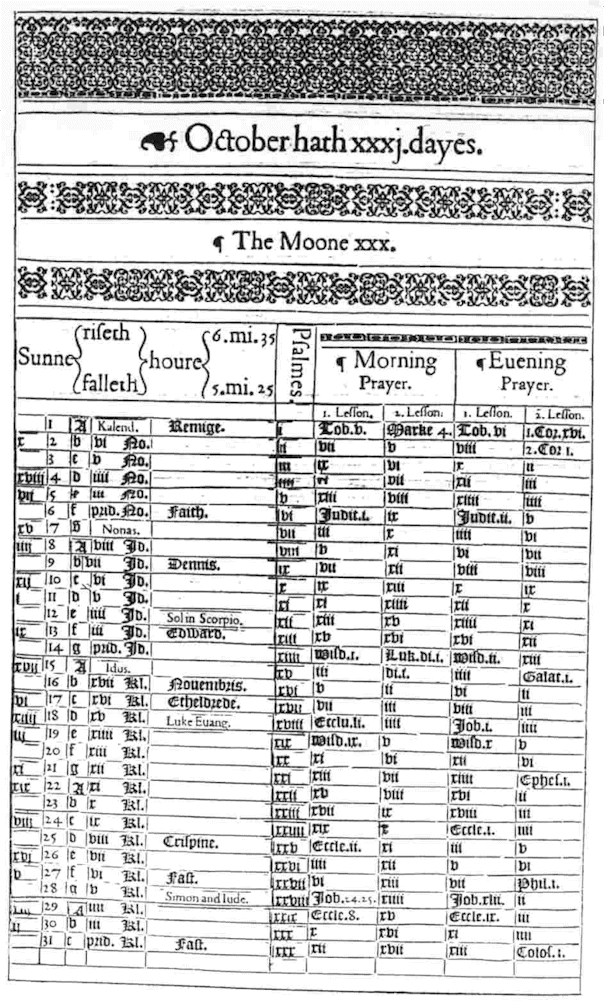
The original 1611 KJV had a calendar for each month of the year. The calendar for the month of October contains such things as [Note: The image on this Link is taken from The Holy Bible, King James Version, 1611 Edition (Thomas Nelson Publishers), a reprint of the first edition of the Authorized 1611 Version.]
- a list of designated saints days' (Oct. 18, Luke the Evangelist; Oct. 28, Simon and Jude);
- a list of designated fast days (Oct. 27 and 31);
- a notation about which sign of the zodiac the sun is in that month (Oct. 12, "Sol in Scorpio");
- a schedule of Scripture readings for morning and evening prayer which includes passages from the Apocrypha (Judith, Oct. 6-13; Wisdom, Oct. 14-17; Ecclesiasticus, Oct. 18)
The significance: saints' days and fast days should be obvious They are considered "popish" and "Romanist" by most KJV advocates, yet They were listed in the 1611 KJV
This leaf is part of Part of my personal collection. (Click here For more on The Special Honor Paid To The Blessed Virgin and The Saints In The Original King James Version)
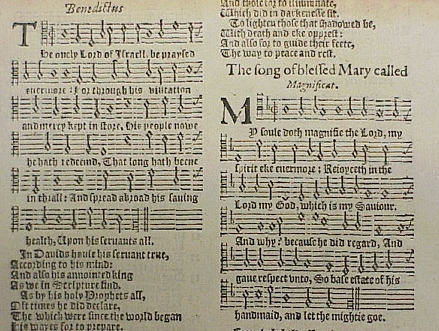
This is an original leaf (page) from The King James Version Collected into English meetre, by Thomas Sternbold, John Hopkins, and others, conferred with apt Notes to sing them withall, printed by John Windet for the Alligues of Richard Daye at London, England in 1613. It also contained the Psalms of David done into English poems, rather than as literal translations from the Hebrew originals. Music is supplied, so they may be sung before the Church of England's prescribed morning and evening prayers. This song shown honors Mary, a very "popish" and "Romanist" thing to do.
These are original leafs (pages) from The King James Version. One of the first Bible printed after the Restoration of King Charles the 2nd in 1660. Showing pictures honoring Mary and S. Joseph. Protestants today would consider these very "popish" and "Romanist".
These leafs are part of Part of my personal collection.
F.H.A. Scrivener, in the appendix of his book, lists the variations between the 1611 edition of the KJV and later printings. A sampling of these corrections is given below. In order to be objective, the samples give the first textual correction on consecutive left-hand pages of Scrivener's book. The 1611 reading is given first; then the present reading; and finally, the date the correction was first made.
1 this thing--this thing also (1638)
2 shalt have remained--ye shall have remained (1762)
3 Achzib, nor Helbath, nor Aphik--of Achzib, nor of Helbath, nor of Aphik (1762)
4 requite good--requite me good (1629)
5 this book of the Covenant--the book of this covenant (1629)
6 chief rulers--chief ruler (1629)
7 And Parbar--At Parbar (1638)
8 For this cause--And for this cause (1638)
9 For the king had appointed--for so the king had appointed (1629)
10 Seek good--seek God (1617)
11 The cormorant--But the cormorant (1629)
12 returned--turned (1769)
13 a fiery furnace--a burning fiery furnace (1638)
14 The crowned--Thy crowned (1629)
15 thy right doeth--thy right hand doeth (1613)
16 the wayes side--the way side (1743)
17 which was a Jew--which was a Jewess (1629)
18 the city--the city of the Damascenes (1629)
19 now and ever--both now and ever (1638)
20 which was of our father's--which was our fathers (1616)
Before your eyes are 5% of the textual changes made in the King James Version in 375 years. Here are some examples from the NT of the MANY differences between the 1611 printing of the KJV and today's printing of the KJV which affect the text and meaning:
"And Simon Peter answered and said, Thou art *Christ*, the Son of the living God." (Mt. 16:16, 1611 KJV)
"And Simon Peter answered and said, Thou art *the Christ*, the Son of the living God." (Mt. 16:16, today's KJV)
Just Christ? Or THE Christ?
"But when he saw Jesus afar off, he *came* and worshipped him" (Mk. 5:6, 1611 KJV)
"But when he saw Jesus afar off, he *ran* and worshipped him" (Mk. 5:6, today's KJV)
Did the man simply come to Jesus, perhaps walking? Or did he run to Jesus?
"It seemed good to me also, having had perfect understanding of *things* from the very first, to write unto thee in order, most excellent Theophilus" (Lk. 1:3, 1611 KJV)
"It seemed good to me also, having had perfect understanding of *all things* from the very first, to write unto thee in order, most excellent Theophilus" (Lk. 1:3, today's KJV)
Did Luke have perfect understanding of only a few things, or of all things?
"Therefore his *sister* sent unto him, saying, Lord, behold, he whom thou lovest is sick." (Jn. 11:3, 1611 KJV)
"Therefore his *sisters* sent unto him, saying, Lord, behold, he whom thou lovest is sick." (Jn. 11:3, today's KJV)
Did only one of the two sisters send word to Jesus about Lazarus, or did they both send word?
"And God hath set some in the church, first apostles, secondarily prophets, thirdly teachers, after that miracles, then gifts of healings, *helps in governments*, diversities of tongues." (1 Cor. 12:28, 1611 KJV)
"And God hath set some in the church, first apostles, secondarily prophets, thirdly teachers, after that miracles, then gifts of healings, *helps, governments*, diversities of tongues." (1 Cor. 12:28, today's KJV)
Is Paul speaking of one administrative gift known as "helps in governments," or is he speaking of two different gifts, a gift of "helps" and a gift of "governments?"
"In Damascus the governor under Aretas the king kept the city with a garrison, desirous to apprehend me:" (2 Cor 11:32, 1611 KJV)
"In Damascus the governor under Aretas the king kept the city *of the Damascenes* with a garrison, desirous to apprehend me:" (2 Cor 11:32, today's KJV)
Just "the city?" Or "the city of the Damascenes?"
"Grace be with all them that love our Lord Jesus Christ in sincerity." (Eph. 6:24, 1611 KJV)
"Grace be with all them that love our Lord Jesus Christ in sincerity. *Amen*. " (Eph. 6:24, today's KJV)
Do I hear an "amen" or not?
"Neither give heed to fables and endless genealogies, which minister questions, rather than *edifying* which is in faith: so do." (1 Tim. 1:4, 1611 KJV)
"Neither give heed to fables and endless genealogies, which minister questions, rather than *godly edifying* which is in faith: so do." (1 Tim. 1:4, today's KJV)
So is it merely edifying, or is it a particluar kind of edifying, namely, godly edifying?
"The cloke that I left at Troas with Carpus, when thou comest, bring with thee, but especially the parchments." (2 Tim. 4:13, 1611 KJV)
"The cloke that I left at Troas with Carpus, when thou comest, bring with thee, *and the books*, but especially the parchments." (2 Tim. 4:13, today's KJV)
Was Timothy to bring the books or not?
"Ye also, as lively stones, are built up a spiritual house, an holy priesthood, to offer up spiritual *sacrifice*, acceptable to God by Jesus Christ." (1 Pet. 2:5, 1611 KJV)
"Ye also, as lively stones, are built up a spiritual house, an holy priesthood, to offer up spiritual *sacrifices*, acceptable to God by Jesus Christ." (1 Pet. 2:5, today's KJV)
Is Peter telling us to offer one single spiritual sacrifice, or many different spiritual sacrifices?
"He that hath the Son hath life; and he that hath not *the Son* hath not life." (1 Jn. 5:12, 1611 KJV)
"He that hath the Son hath life; and he that hath not *the Son of God* hath not life." (1 Jn. 5:12, today's KJV)So is it "the Son" or "the Son of God?"
Which version of the KJV is correct, and which is "corrupt?" (It must be corrupt, because anything that changes the actual words of God is a corruption, right?) And how do you KNOW which version of the KJV is the correct one?The editions have of the Authorized King James Version, been innumerable; we need mention but a few. Three distinct editions appeared in 1611; one is known as "The great SHE editions," the nomenclature being too to the fact that whereas Ruth 3:15 should read, "He [Boaz] measured six measures of barley, and laid it on her [Ruth]; and she went," the first folio substituted "he" for "she"; subsequent editions based upon either the "he" or the "she" folio reproduced their respective readings
some other editions noted for their misprints. The edition of 1631 Cambridge, is known as "The Wicked Bible" for printing the commandment, "Thou shalt commit adultery." Another Cambridge edition was guilty of at least four gems in the way of misprints: "sons of Bilial" for "sons of Bilhah (Bala)" (Gen. 37:2); "slew two lions like men," for two lion-like men" (II Sam. 23:20); the Midianites "vex you with their wives" instead of "wiles". Another unfortunate edition was that of 1653, which omitted "or who hath opened his eyes" from John 9:21, and in Rom. 6:13 wrote: "your members as instruments of righteousness," for "unrighteousness"; conversely, in I Cor. 6:9 ii has, "know you not that the righteous [for "unrighteous"] shall not process the kingdom of God?"
One misprint was hard warming, at least for the Puritans. The apostles arranged for the selection by the faithful up seven deacons "whom we may appoint" (Acts 6:3); but the Puritans, binding that "ye" had been printed instead of "we," seized on this misprint as confirmation of their peculiar views on appointment to the ministry. The statement that "the dogs liked ["licked"] Achab’s blood" (III Kings 22:38) may raise a smile ; but "I will never forgive["forget"] thy precepts" (Ps. 119:93) is distinctly disedifying.
several other editions have received nicknames owing to their misprints. One printed at Oxford, 1717, is called the "vinegar Bible" from the title affixed to Luke chapter 20, which reads, "The Parable of the Vinegar" for "Vineyard"; another 1795, is dubbed the "Murderers Bible" for Mark 7:27 reads, "Let the children first he killed" instead of "filled with"