
WAS PETER THE BISHOP OF ROME?
This is a refutation of a deceitful Protestant article by the same name written by Baptist named David Cloud. This article is typical of the trash was found at the militant Anti-Catholic BibleBelievers.net and the Way of Life websites.
EZCODE CENTER START
[Mr. Cloud] The Roman Catholic Church claims that Peter was the bishop of the church at Rome and that he held the position as the first Pope.
It is important to point out that that St. Peter held the position as the first Pope, and the was the position of Bishop of Rome, disproving one does not disprove the other. For even if Mr. Cloud could disprove [which he does not] that St. Peter was the Bishop of Rome, this does not disprove the scriptural fact that St. Peter was the Chief Apostle.
The biblical Petrine data is quite strong, and is inescapably compelling by virtue of its cumulative weight, even when looking at the King James Bible, the most well known Protestant Bible.
- St. Peter's name occurs first in all lists of apostles (see Mt 10:2; Mk 3:16; Lk 6:14; Acts 1:13). Matthew even calls him "the first" (10:2). (Judas Iscariot is invariably mentioned last.).
- St. Peter is almost without exception named first whenever he appears with anyone else.
- St. Peter is often spoken of as distinct among apostles (Mk 1:36; Lk 9:28,32; Acts 2:37; 5:29; 1 Cor 9:5).
- St. Peter is often spokesman for the other apostles, especially at climactic moments (Mk 8:29; Mt 18:21; Lk 9:5; 12:41; Jn 6:67).
- St. Peter's name is always the first listed of the "inner circle" of the disciples (Peter, James and John - Mt 17:1; 26:37,40; Mk 5:37; 14:37).
- St. Peter's name is mentioned more often than all the other disciples put together: 191 times (162 as Peter or Simon Peter, 23 as Simon and 6 as Cephas). John is next in frequency with only 48 appearances, and Peter is present 50 percent of the time we find John in the Bible. It has been reckoned that all the other disciples combined were mentioned 130 times. If this is correct, Peter is named a remarkable 60 percent of the time any disciple is referred to.
When we read the scriptures we find that there are many examples of St Peter exercising his position as as the "chief bishop". We Find that St. Peter was the first traveling missionary, and first exercised what would now be called "visitation of the churches" (Acts 9:32-38,43). Paul preached at Damascus immediately after his conversion (Acts 9:20), but had not traveled there for that purpose (God changed his plans). His missionary journeys begin in Acts 13:2. Paul went to Jerusalem specifically to see Peter for 15 days at the beginning of his ministry (Gal 1:18), and was commissioned by Peter, James and John (Gal 2:9) to preach to the Gentiles.
We also know that St. Peter himself presides over and opens the first council of Christian Church, he lays down principles afterward accepted by it (Acts 15:7-11). It is St. Peter's words that settles the dispute (v.7) that was raging among the apostles and elders, when St. Peter was done speaking all the multitude was silent (v.12). St. Peter also shows his authority by correcting those who would misuse Paul's writings (2 Pt 3:15-16)
[Mr. Cloud] The Bible record conclusively testifies against this. The following study by Henry Hudson is from his book Papal Power: Its Origins and Development-- "In A.D. 58 Paul wrote to the Romans, but does not mention Peter. In Romans 1:11, he wants to impart special gifts, and in Romans 1:15 he is ready to preach there. He sends greetings to twenty-seven persons, but none to Peter.
This letter was written in 55 AD, St. Paul did not arrive in the city until six years later. Most scholars date St. Peters arrival as being 56-57 AD. So we see that Peter Had not yet arrived in the city.
The early Christians of the first four centuries frequently speak of the labors of St. Peter in Rome and his martyrdom there. St, Clement (Ad Con, v.) in 97; St. Ignatius (Ad Rom., iv.) in 107; St. Clement of Alexandria (In Eusebius, Hist. Eccles., vi., 14) in 190; St. Ireneus (Adv. Hcer., iii., 3) in 178; the Roman presbyter Caius (In Eusebius, Hist. Eccles., ii., 25) in 214. Many others can be cited, such as Origen, St. Cyprian, Firmilian, Arnobius, St. Epiphanius and St. Dionysius of Corinth. [For more on this visit this link]
[Mr. Cloud] "In 61 Paul is conveyed a prisoner to Rome, and certain brethren go to meet him, but not Peter.
I would like to ask Mr. Cloud, were Does the Sacred Scriptures say that St. Peter did not go to meet St. Paul? The answer is, It Doesn't . The most that Mr. Cloud could honestly say [with out adding to the scriptures] is that St. Peter is not listed as being there.
[Mr. Cloud]At Rome Paul writes to the Galatians, and mentions Peter, but not as being there or as having been pontiff . The Epistles to the Ephesians, Philippians, Colossians and Philemon were all written from Rome; but while others are mentioned as sending messages, or as being associated with Paul, Peter is never once mentioned.
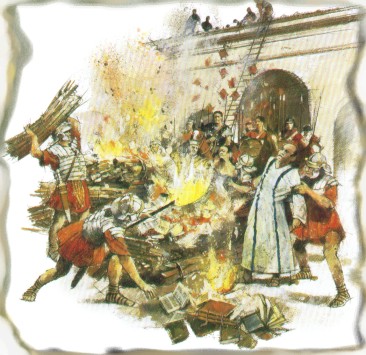
In 64 AD. just three years after Paul's arrival in Rome, the persecution of Emperor Nero began. The Arrests and executions of Christians became common occurrence, and sacred texts of the Christians were often burned.
This is a old Protestant objection, and the answer to this is obvious. St. Paul’s trip to Rome was not one of a missionary, he was conveyed there as a prisoner, under the care of a centurion, Julius, of the Augustan Cohort. We know that at the time these epistles were written he was billeted under military guard (Acts 28:16; Phil. 1:7) in Private apartment (v. 30) and being watched [although at times rather loosely].
Although the persecution had not yet begun, St. Paul was well aware that anti-Christian were beginning to boil throughout the pagan empire. St, Paul himself had been a victim this growing animosity several times, Damascus (2 Cor. 11:32-33), Iconium (Acts 14:2), Philippi (1 Thes. 2:2), Ephesus ( Acts 19), and Jerusalem (Acts 21: 27-29). St Paul in his writings warns the readers of the coming infractions the ministers if Christ would have to suffer
tribulation, in necessities, in distresses, In stripes, in prisons, in seditions,..." (2 Col. 6:4-5)"But in all things let us exhibit ourselves as the ministers of God, in much patience, in
The city of Rome was the heart and center of the Pagan empires, the symbol of it's authority. During this time period the status of Christians in the empire was very uncertain, and rumors of a coming persecution had already begun in Rome. It was a potentially dangerous time for Christians, a time when discovery of such a high profile Christian leader as St. Peter, could lead to his arrest and potential death. Is it any wonder that St. Paul in his writings from Rome, was silent on the Apostle Peter's inhabitation in the city? St. Paul would not have
carelessly divulged St. Peter's location, nor would St. Paul have just casually Jeopardized the life of his fellow apostles.While it is true that St. Paul, does not mentions St. Peter presence in Rome, we must also note St. Paul never mentions the location St. Peter at all, he is completely silent on this subject matter. What we must remember is that
silence on any subject is neither a "affirmation" nor "denial" of it.[Mr. Cloud] "From Rome also Paul's last letter is written (the Second Epistle to Timothy). He says, 'At my first answer no man stood with me, but all men forsook me' (2 Timothy 4:16). So that if Peter were Bishop of Rome he enjoyed an immunity which was not accorded to Paul, and is guilty of having forsaken the great apostle.
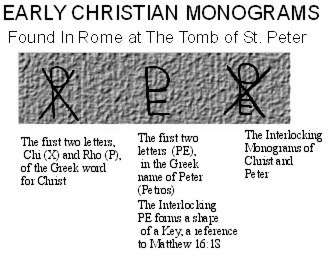
In Rome the Archaeologists found the early Christian Monogram used for the name of St. Peter over two dozen times, on and around the tomb of the Apostle.
Paul's last letter is written (the Second Epistle to Timothy) has been dated at around 68 AD. Most Scholars using the writing of the early Christians have dated St Peter death In Rome as being around 66 AD. If this is true [and we have no reason to doubt it] Than it is clear that St. Peter did not forsake or abandon St. Paul and St. Paul's statement "no man stood with me, but all men forsook me" also does not apply, for St. Peter had already died for his faith two years earlier.
[Mr. Cloud] And, finally, in this very Epistle, written from Rome immediately before his martyrdom, Paul says, 'Only Luke is with me' (2 Timothy 4:11). This is conclusive.
Second, Mr. Cloud has in this case purposely and dishonestly pulled this verse out of context, in order to deceive the reader and to the attack St. Peter. I use the term "purposely and dishonestly" because he only gives the reader a PORTION of the verse ( 2 Tim. 4:11), in order to conceal and hide its true connotation.
In order to show the proper context of St Paul's statements, we must first provide the reader with a little back ground information. When St. Paul was sent to Rome (as a prisoner) he was accompanied by Luke and Aristarchus, a Thessalonian (Acts 27:1-2). When St. Paul got to Rome he gathered a small group of friends around him, who acted as his messengers to the churches and also his co-workers in Rome. This small group of assistants included Timothy (Col. 1:1), Titus (Gal. 2:3 ), Luke (Col. 4:14), Aristarchus (Col. 4:10), Tychicus (Eph. 6:21) Crescens, Demas (Col. 4:14) and John Mark (Col. 4:14).
When we Read in Context we see that it is of this small group of assistants that St. Paul is discussing in his letter to Timothy:
"For Demas hath forsaken me, having loved this present world, and is departed unto Thessalonica; Crescens to Galatia, Titus unto Dalmatia. Only Luke is with me. Take Mark, and bring him with thee: for he is profitable to me for the ministry. And Tychicus have I sent to Ephesus." (2 Timothy 4:10-12)
[Mr. Cloud] While it is possible that Peter visited Rome briefly at some point, the biblical record testifies conclusively that he was not the bishop of the church at Rome.
St. Peter did far more than Just "Visit" Rome, He wrote epistles from there. The first epistle of St. Peter was probably written about the year 64, when the status of Christians in the empire was very uncertain, and when persecution had already begun in Rome. The place of writing is closely connected with the date. "Babylon" (5:13) may refer to the ancient city on the Euphrates, where there was a large Jewish settlement in Peter's day, or to a town in Egypt near Alexandria, where Mark traditionally ministered, or figuratively to Rome as the center of the pagan world (Rev. 17:5; 18:10).
The second alternative need not be considered seriously, for the Egyptian Babylon was only a border fort. Opinion among commentators is divided between the other two opinions. In the absence of any strong tradition that Peter ever visited in the literal Babylon [to the ancient city on the Euphrates], and considering the huge amount of early Christian testimony that Peter was in Rome, it seems more clear that he wrote this epistle from Rome.
Even in the New Testament Scriptures the city of Babylon, [the city of iniquity] was figuratively used for Rome in Apostolic times, as we learn from St. John (Apoc. xiv. 8; xvi. 19; xvii. 5; xviii. 21). In the fourth century we find both Eusebius (Hist. Eccles., 15) and St. Jerome (De Viris 111.) declaring that St. Peter by "Babylon" means Rome.
This is admitted by many fair-minded Protestants. Elliott's, Speaker's Commentary, thus comments on 1 Peter v. 13: "We have to remark that the city of Babylon was certainly not the seat of a Christian community; that no ancient record has the slightest trace of St. Peter's presence or work in Chaldea; that all ancient authorities are unanimous in asserting that the later years of his life were passed in the West of the Roman Empire. On the other hand Babylon was well known in Asia Minor during the lifetime of St. John as the symbolical designation of Rome . . . Accordingly, we find an absolute consensus of ancient interpreters that there Babylon must be understood as equivalent to Rome." He then cites Thiersch, Ewald and Hilgenfeld, who held the same view.
[Mr. Cloud] the biblical record testifies conclusively that he was not the bishop of the church at Rome.
No the biblical record is silent St. Peter's position as Bishop of Rome, but the Early Christians [in there writings] testify conclusively that St. Peter was the bishop of the church at Rome.
Irenaeus of Lyons
 |
| This image is from the
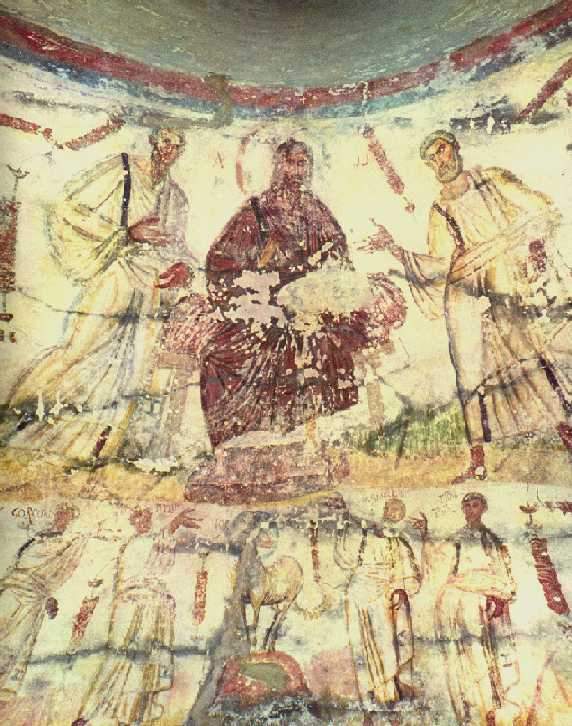
third century roman Catacomb of Saints Marcellinus and Peter on the Via
Labicana
Christ with the book of the Gospels is seated between Peter and Paul. Below, the Lamb is standing in the center on a hill, from which flow out the four symbolic rivers of Scripture. To the sides are the most venerated Roman Martyrs, with their names: Gorgonius, Peter, Marcellinus, Tiburtius, all acclaiming the Lamb." The fact that the Gospel of Jesus brought to Rome by St. Peter and St. Paul was clearly professed by the early Christian community there. |
"The blessed apostles [Peter and Paul], having founded and built up the church [of Rome], they handed over the office of the episcopate to Linus. Paul makes mention of this Linus in the letter to Timothy [2 Tim. 4:21]. To him succeeded Anacletus, and after him, in the third place from the apostles, Clement was chosen for the episcopate. He had seen the blessed apostles and was acquainted with them. It might be said that he still heard the echoes of the preaching of the apostles and had their traditions before his eyes. And not only he, for there were many still remaining who had been instructed by the apostles. In the time of Clement, no small dissension having arisen among the brethren in Corinth, the Church in Rome sent a very strong letter to the Corinthians, exhorting them to peace and renewing their faith . . . To this Clement, Evaristus succeeded . . . and now, in the twelfth place after the apostles, the lot of the episcopate [of Rome] has fallen to Eleutherus. In this order, and by the teaching of the apostles handed down in the Church, the preaching of the truth has come down to us" (ibid., 3:3:3).
Eusebius of Caesarea
"[In the second] year of the two hundredth and fifth Olympiad [A.D. 42]: The Apostle Peter, after he has established the church in Antioch, is sent to Rome, where he remains as a bishop of that city, preaching the gospel for twenty-five years" (The Chronicle [A.D. 303])
The Little Labyrinth
"Victor . . . was the thirteenth bishop of Rome from Peter" (The Little Labyrinth [A.D. 211], in Eusebius, Church History 5:28:3)
Cyprian of Carthage
"Cornelius was made bishop by the decision of God and of his Christ, by the testimony of almost all the clergy, by the applause of the people then present, by the college of venerable priests and good men, at a time when no one had been made [bishop] before him--when the place of [Pope] Fabian, which is the place of Peter, the dignity of the sacerdotal chair, was vacant. Since it has been occupied both at the will of God and with the ratified consent of all of us, whoever now wishes to become bishop must do so outside. For he cannot have ecclesiastical rank who does not hold to the unity of the Church" (Letters 55:[52]):8 [A.D. 253]).
"With a false bishop appointed for themselves by heretics, they dare even to set sail and carry letters from schismatics and blasphemers to the Chair of Peter and to the principal church [at Rome], in which sacerdotal unity has its source" (ibid., 59:14).
Firmilian
"[Pope] Stephen [I] . . . boasts of the place of his episcopate, and contends that he holds the succession from Peter, on whom the foundations of the Church were laid [Matt. 16:18] . . . Stephen . . . announces that he holds by succession the throne of Peter" (collected in Cyprian's Letters 74[75]):17 [A.D. 253]).
The Poem Against the Marcionites
"In this chair in which he himself had sat, Peter in mighty Rome commanded Linus, the first elected, to sit down. After him, Cletus too accepted the flock of the fold. As his successor, Anacletus was elected by lot. Clement follows him, well-known to apostolic men. After him Evaristus ruled the flock without crime. Alexander, sixth in succession, commends the fold to Sixtus. After his illustrious times were completed, he passed it on to Telesphorus. He was excellent, a faithful martyr . . . " (Poem Against the Marcionites 276-284 [A.D. 267]).
Optatus
"You cannot deny that you are aware that in the city of Rome the episcopal chair was given first to Peter; the chair in which Peter sat, the same who was head--that is why he is also called Cephas ["Rock"]--of all the apostles; the one chair in which unity is maintained by all" (The Schism of the Donatists 2:2 [A.D. 367]).
Epiphanius of Salamis
"At Rome the first Apostles and bishops were Peter, then Linus, then Cletus, then Clement, the contemporary of Peter and Paul" (Medicine Chest Against All Heresies 27:6 [A.D. 375]).
Jerome
"[Pope] Stephen . . . was the blessed Peter's twenty-second successor in the See of Rome" (Against the Luciferians 23 [A.D. 383]).
Jerome
"Clement, of whom the apostle Paul writing to the Philippians says 'With Clement and others of my fellow-workers whose names are written in the book of life,' the fourth bishop of Rome after Peter, if indeed the second was Linus and the third Anacletus, although most of the Latins think that Clement was second after the apostle" (Lives of Illustrious Men 15 [A.D. 396]).
Jerome
"Since the East, shattered as it is by the long-standing feuds, subsisting between its peoples, is bit by bit tearing into shreds the seamless vest of the Lord . . . I think it my duty to consult the chair of Peter, and to turn to a church [Rome] whose faith has been praised by Paul [Rom. 1:8]. I appeal for spiritual food to the church whence I have received the garb of Christ. . . . Evil children have squandered their patrimony; you alone keep your heritage intact" (Letters 15:1 [A.D. 396]).
Peter Chrysologus
"We exhort you in every respect, honorable brother, to heed obediently what has been written by the most blessed pope of the city of Rome, for blessed Peter, who lives and presides in his own see, provides the truth of faith to those who seek it. For we, by reason of our pursuit of peace and faith, cannot try cases on the faith without the consent of the bishop of Rome" (Letters 25:2 [A.D. 449]).
Augustine
"If all men throughout the world were such as you most vainly accuse them of having been, what has the chair of the Roman church done to you, in which Peter sat, and in which Anastasius sits today?" (Against the Letters of Petilani 2:118 [A.D. 402]).
Augustine
"If the very order of episcopal succession is to be considered, how much more surely, truly, and safely do we number them from Peter himself, to whom, as to one representing the whole Church, the Lord said, "Upon this rock I will build my church . . . " [Matt. 16:18]. Peter was succeeded by Linus, Linus by Clement, Clement by Anacletus, Anacletus by Evaristus . . . " (Letters 53:1:2 [A.D. 412]).