
The Gallery of The "Apocrypha" books
In The Very Early Protestant English Translations of the Bible
Many Protestants would be Amazed to find that the book they deny as Scripture, were not held as such, by there early rebellious ancestors. Martin Luther's Translation included the books called the "Apocrypha" as did all of the early English Protestant Bibles. These books became associated in Egypt with the translated Old Testament books, and so formed part of the Greek Old Testament, the so-called Septuagint version. And when this became the Bible of the early Church, these books went with it.
So the "Apocrypha", as some call them, appear in all of the ancient Greek LXX Bible (the Septuagint) of the early Church. the "Apocrypha" were also in the ancient Eastern Aramaic translations ancient Eastern Aramaic translation (called the Peshitta Bible) and in the early Latin Bible, before and after Jerome's work of revising it. They passed naturally, as we have seen, into the early German translation of the Latin Bible, made in Bohemia in the fourteenth century, and also into the English translation made by Wyclif and his helpers, in 1382-88.
But Luther translated the Greek New Testament and the Hebrew Old Testament; and when he had finished these, he found a number of books that were in the Latin and German Old Testaments left over. Luther in his edition called them "Apocrypha" and now proceeded to translate them from the Greek text, except one, Second Esdras, of which no Greek but only a Latin version could be found. As we have seen in an earlier chapter, when he finished his translation of the Bible in 1534, he put them in a group by themselves, after the Old Testament. This course was promptly followed by Coverdale, in the first printed English Bible, the next year. And thereafter all the great historic English Bibles followed the same procedure, making these books a separate group, and putting them after the Old Testament-the Thomas Matthew Bible of 1537, the Taverner of 1539, the Great Bible of 1539, the Geneva of 1560, the Bishops' of 1568, and the King James 1611, and the Catholic Old Testament of 1610,
This is a partial list of the early English Protestant Bibles which contained the "Apocrypha".
1541 The "Great" or "Cromwell's" Bible:
1551 The "Tyndale"/ "Matthews" Bible:
1541 The Great Bible : This work is also known as "Cromwell's Bible", as Coverdale worked under his direct patronage, or as "Cranmer's Bible"
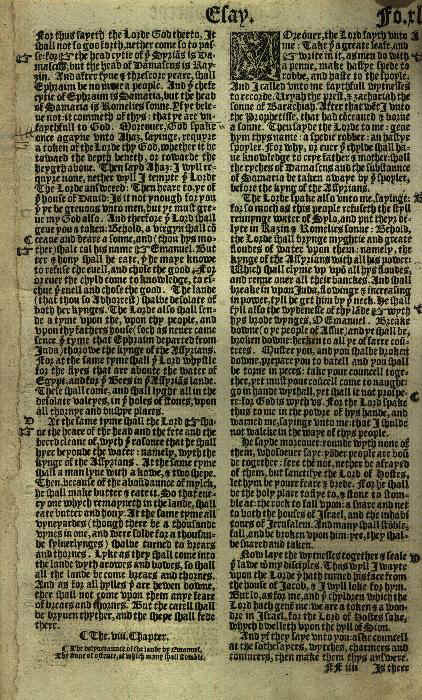 |
This is a Scan from a actual Leaf from a
Apocrypha book found in the English Protestant "GREAT BIBLE" printed at London,
England, by Richard Grafton in 1541 (First Edition was 1539.)" "by
commaundement of oure moost redoubted prynce and soueraygne Lorde, Kynge Henry the viii
supreme head of this his churche and realme of England" , Large folio size, 10"
x 14½", double columns of English language text in large Black Letter type, with
historiated initial letters. This work is also known as "Cromwell's Bible", as Coverdale worked under his direct patronage, or as "Cranmer's Bible" although the Archbishop is thought not to have been involved in the work apart from contributing his Prologue, which first appeared in the April, 1540 edition. Six essentially identical editions of the Great Bible were printed in 1540 - 41, in conformity with Henry VIII's royal order instructing every clergyman in the Kingdom to provide "one boke of the whole Bible of the largest Volume in Englysshe and have the same sett up in summe convenient place within the churche that he hath cure of, wherat his parishoners may most commodiously resort to the same and red yt." |
1551 The Tyndale/Matthews Bible :
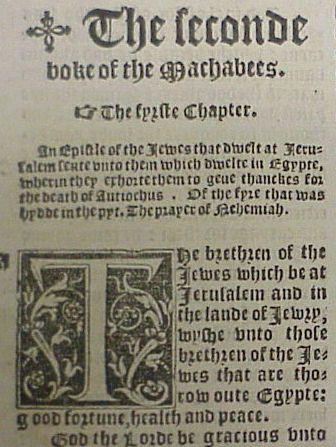
| This is Scan from a actual a leaf from the 1551 (First Edition was 1537.) Protestant "Matthews Bible": Matthew was an alias for John Rogers. A leaf in gothic metal type with woodcut initials. After Tyndale and Coverdale's Bible came the 1537 Matthews Bible the second Bible ever printed in the English language, and the first English Bible ever translated from the original Greek and Hebrew languages! . John Rogers (a close friend of William Tyndale) printed this Bible under the pseudonym "Thomas Matthew". He used this assumed name because the New Testament and the first few books of the Old Testament were taken from Tyndale's translation...and possession or distribution of any Tyndale material was still punishable by death under King Henry the eighth. This leaf is from the 4th and last edition, (12.25 X 8) Printed by Hyll at London in 1551. This is a scan The title page from the "Apocrypha" Book of "Machabees". | 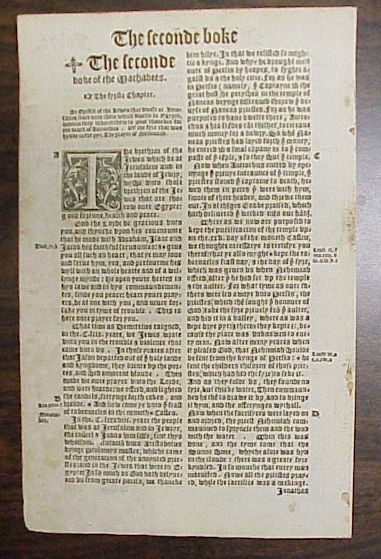 |
 |
|
| This next Image is the highly ornate title page to the "Apocrypha" books from a 1549 Matthew Bible, printed in London by Jhon Daye | 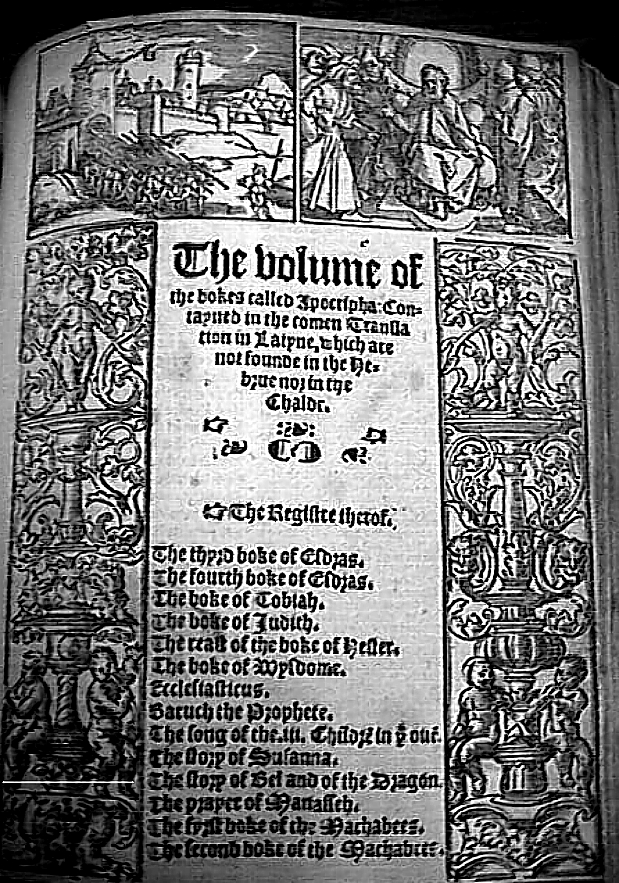 |
||
 |
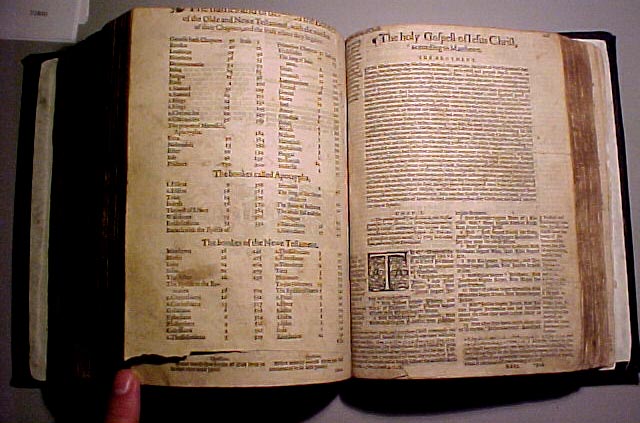 |
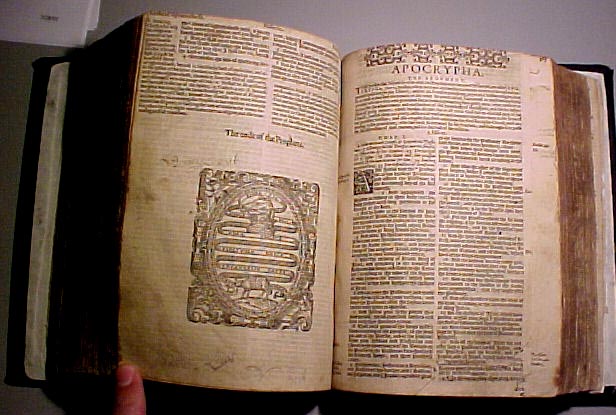
The Geneva Bible was the Bible first brought to America, and the first version to add numbered verses to each chapter. It was the Bible of the Pilgrims and the Puritans, and is the version quoted thousands of times in William Shakespeare's plays. Do to the return of a Catholic monarch to the throne of England many Protestants Church leaders went to Geneva, Switzerland. There, with the support of John Calvin and John Knox, they produced an English "Study Bible" (with extensive marginal notes and study aids) in 1560 so accurate and popular among Christians that it continued to be the best-selling version until SEVERAL DECADES AFTER the introduction of the 1611 King James version! Possession of one of these Bibles in England at the time meant almost certain death. These are Scans from the Protestant, English 1574 "Geneva" bible Translated according to the "Ebrew and Greek.." Contained the entire Old Testament, Apocrypha and New Testament. known at the 'breeches' bible from the passage in Gen 3:7 says that after the fall of Adam and Eve they 'Made themselves breeches". in 1618 the Synod of Dort Directed that the "Apocrypha" should be omitted; they therefore do not appear in the editions published after 1633. The "Geneva" bible was highly influential for a hundred years, the textus receptus for the Puritan England. In fierce competition with the Bishops' Bible (1568) and the later King James Edition (1611) Reference: DMH [Herbert], The English Bible, no. 342. |
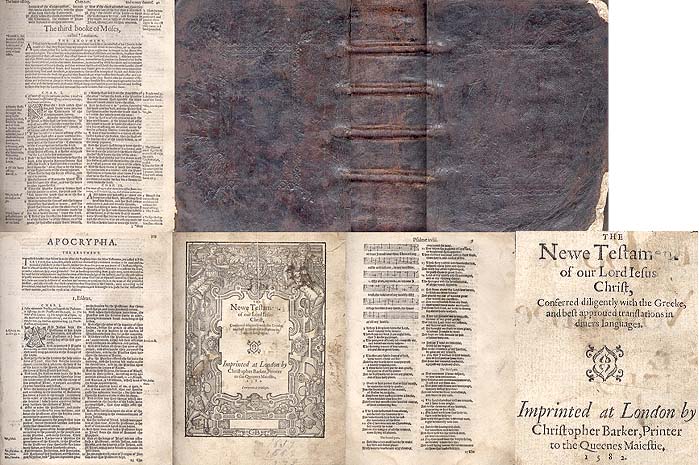 |
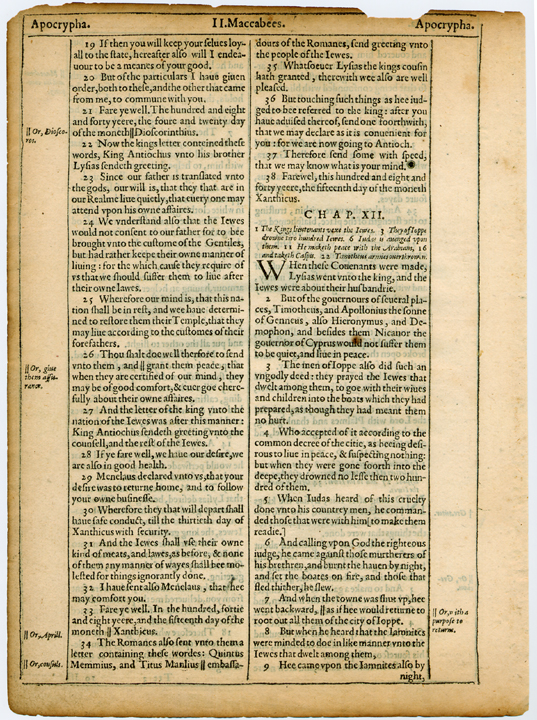
These leafs are from the very rare "Bishop's Bible" published by the Church of England to compete with the popular Geneva translation. The Bishops' Bible was a revision of the Great Bible undertaken by Matthew Parker, Archbishop of Canterbury, with the assistance of many bishops & biblical scholars. It was hoped that this would replace the Great, both in the parish churches and in the hearts of the people. While the former was ordered for cathedrals and recommended for churches, this translation failed to gain popular support. " The Holy Bible. Containing the Old Testament and the New. [Translated by Matthew Parker and others.] Set forth by authority. Imprinted at London by Christopher Barker, Printer to the "Queenes most excellent Maiestie." 1582. (First Edition was 1568.)" |
 |
To the left is a Scan from a actual 1612 printing of
the King James Version, it shows a Leafs out of one of the "Apocrypha"
books, this one is the Book of Baruch. These were printed ONLY
1 Year after the first edition King James Bible. They were printed and published by Robert
Barker, the King’s Printer, London, 1612
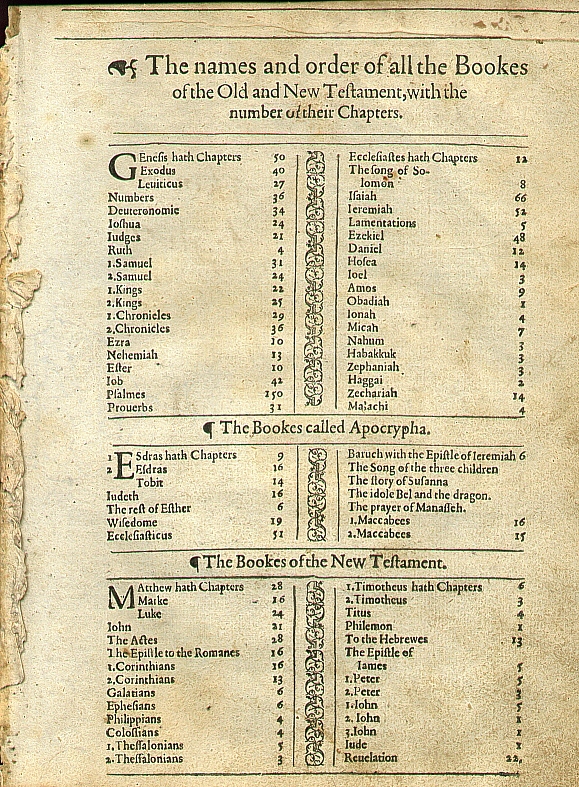
To the right is an original leaf from the Holy Bible, Containing the old Testament, the the Apocrypha and the new Testament (King James translation) printed by Robert Barker at London, England in 1615. Quarto size Black Letter English language text arraigned in double columns with margin-notes in Italic Roman type. For more on the Apocrypha in the KJV. (Click Here) |
 |
Please sign our Guest book!
This page has helped
People find the truth since November 1999