
The influence of the "Apocrypha" Books on Music Art and Literature.
The following is from the preface to the Apocrypha found in "The the New Oxford Announced Bible With the Apocrypha" printed by the Oxford University Press 1977. This is a edition of the Revised Standard Version of the Bible.
EZCODE CENTER START
Most readers will probably be surprised to learn how pervasive the influence of the Apocrypha has been over the centuries. Not only have these books inspired homilies, meditations, and liturgical forms, but poets, dramatists, composers, and artists have drawn freely upon them for subject matter. Common proverbs and familiar names are derived from their pages. Even the discovery of the New World was due in part to the influence of a passage in 2 Esdras upon Christopher Columbus. In what follows the reader will find a representative selection of such examples, most of them chosen from the editor's book, An Introduction to the Apocrypha, and arranged under the headings of
(a) English Literature:
(b) Music:
(c) Art:
(d) Miscellaneous.

(a)
English Literature. Sometime during the ninth or the tenth century an unknown poet, using the West-Saxon dialect, turned the story of Judith into an Old English epic of twelve cantos, transforming at the same time the heroine into a Christian. It is thought that the poem was written to celebrate the prowess of jEthelflaed, "The Lady of the Mercians," who, like the indomitable Judith, delivered her people from the fury of invaders, the heathen Northmen.During the fourteenth and fifteenth centuries a poem called "The Pistill [i.e. Epistle] of Swete Susan" circulated in Scotland. Written in stanzas of thirteen lines and characterized by an unusual combination of alliteration and rhyme, the ancient apocryphal story was adorned with many imaginative details by the author, thought to have been a certain Huchown (Hugh) of Ayrshire in western Scotland.
How conversant Shakespeare was with the contents of the Bible is a question which, like many another concerning the bard of Avon, has been keenly debated In any case, it is a fact that two of the poet's daughters bore the names of two of the chief heroines of the Apocrypha-Susanna and Judith-and, what is of
greater significance, allusions to about eighty passages from eleven books of the Apocrypha have been identified in his plays.
|
How conversant Shakespeare was with the contents of the Bible is a question which, like many another concerning the bard of Avon, has been keenly debated In any case, it is a fact that two of the poet's daughters bore the names of two of the chief heroines of the Apocrypha-Susanna and Judith-and, what is of greater significance, allusions to about eighty passages from eleven books of the Apocrypha have been identified in his plays. Noteworthy among American writers who have drawn upon the Apocrypha for themes as well as subject matter is Henry Wadsworth Longfellow. His New England Tragedies contains references to 1 and 2 Maccabees, and the chief episodes of the courageous Maccabean uprising are included in his poetic dramatization, Judas Maccabaeus. |
The
Protestant 1611 King James Version had printed among its pages one of the
"Apocrypha" books in to song form, to be sung during the
public worship services. We must remember that the original 1611
KJV was a pulpit Bible, it was printed with the intention to be used by
the Church
of England . The 1611 edition (like many subsequent editions that
would follow it) contained the Anglican Psalter or Psalms of David
(by Sternhold and Hopkins), The title page of this Psalter reads:
|
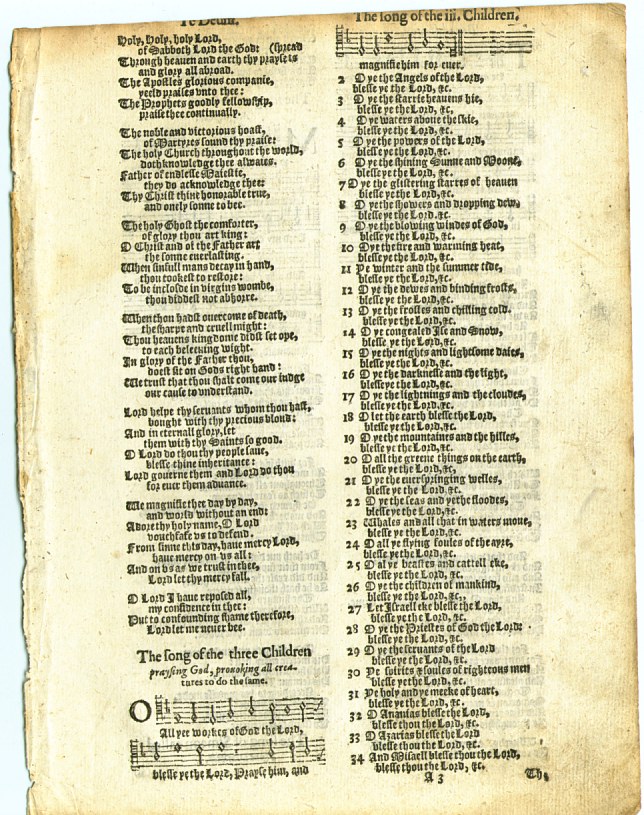 |
| The above scan is "The Song of the iii Children", from a 1615 King James Version. This leaf was printed by Robert Barker at London, England. |
(b)
Music. More than one hymn writer has drawn inspiration, as well as, in some cases, the words themselves, from the Apocrypha. For example, the exalted hymn of thanksgiving, "Nun danket alle Gott," written by Pastor Martin Rinkart about 1636 when the devastating Thirty Years War was nearing its end, is dependent upon Luther's translation of Sir.50.22-24. Two stanzas of the hymn, as translated by Catherine Winkworth, will show the amount of borrowing (here printed in italics):| Now thank we all our God
With heart and hands and voices, Who wondrous things hath done, In whom His world rejoices; Who, from our mother's arms, Hath blessed us on our way With countless gifts of love, And still is ours today. |
0 may this
bounteous God
Through all our life be near us, With ever joyful hearts And blessed peace to cheer us; And keep us in His grace, And guide us when perplexed, And free us from all ills In this world and the next. |
Strange though it may seem, ideas included in the Christmas hymn, "It Came upon the Midnight Clear," are traceable to the Old Testament Apocrypha. In the New Testament accounts of the Nativity, nothing is said of the exact time of Jesus' birth. The subsequent identification of the hour of his birth as midnight is doubtless due to the influence of a remarkable passage in the Wisdom of Solomon. At an early century in the Christian era the imagination of more than one Church Father was caught by the books vivid reference to the time when God's "all-powerful word [the Logos] leaped from heaven, from the royal throne," namely when "night in its swift course was now half gone" (Wis. 18.14-15). Despite the context of the passage, which speaks of the destruction of the first-born Egyptians at the time of the Exodus, the words were interpreted as referring to the Incarnation of the eternal Word of God, Jesus Christ. Thus by a curious twist, a passage which tells of a stern warrior with a sharp sword filling a doomed land with death has had a share in fixing popular traditions concerning the time and circumstances of the birth of the Prince of Peace.
The influence of the Apocrypha can also be traced in many an anthem, cantata, oratorio, and opera. Handel's oratorios Susanna and Judas Maccabaeus, as well as his Alexander Balus, an historical sequel to the latter, will occur at once to music lovers. At an early date in operatic history the stirring story of Judith was found to lend itself admirably to dramatic presentation. Italian and German operas on this theme were written by Andrea Salvadori, Marco da Gangliano, Martin Opitz, and Joachim Beccau. In the nineteenth century the noted Russian pianist and composer, Anton Rubenstein, published The Mac-cabees, an opera of monumental proportions, the libretto of which was written by one of his collaborators, Dr. H. S. von Mosenthal.
(c) Art. During the Renaissance and later, many painters chose subjects from the books of the Apocrypha. Almost every large gallery in Europe and America has one or more works of the old masters depicting Judith, Tobit, or Susanna, who were the three most popular subjects from the Apocrypha.
Besides paintings, down through the ages artists in almost every other medium have chosen themes from the Apocrypha. Were space available here for an inventory, examples could be cited from such divergent types of objets d'art as mosaics, frescoes, gems, ivories, sarcophagi, enameled plaques, terra cottas, stained glass, manuscript illumination, sculpture, and tapestries.
(d)
Miscellaneous. The influence of the Apocrypha in everyday life can be observed in the currency of such names as Edna, Susanna (or one of its many derivatives, such as Susan, Suzanne, and Sue), Judith (or Judy), Raphael, and Tobias (or Toby).The word "macabre," according to the opinion of several lexicographers, may be derived ultimately from "Maccabee," alluding to the grisly-and gruesome tortures inflicted upon the Jewish martyrs.
Some of the most common expressions and proverbs have come from the Apocrypha. The sententious sayings, "A good name endures for ever" and "You can't touch pitch without being defiled," are derived from Sir.41.13 and 13.1. The noble affirmation in I Esd.4.41, "Great is Truth, and mighty above all things" (King James Version), or its Latin form, Magna est veritas, el praevalet, has been used frequently as a motto or maxim in a wide variety of contexts.
A passage from the Apocrypha encouraged Christopher
Columbus in the enterprise that resulted in his discovery of the New World. To
be sure, the verse in 2 Esdras is an erroneous comment upon the Genesis
narrative of creation, and Columbus was mistaken in attributing its authority to
the "prophet Ezra" of the Old Testament, but-for all that-it played a
significant part in pushing back the earth's horizons, both figuratively and
literally. The words of 2 Esd.6.42 concerning God's work of creation ("On
the third day thou didst command the waters to be gathered together in the
seventh part of the earth; six parts thou didst dry up and keep so that some of
them might be planted and cultivated and be of service before thee") led
Columbus to reason that, if only one-seventh of the earth's surface is covered
with water, the ocean between the west coast of Europe and the east coast of
Asia could be no great width and might be navigated in a few days with a fair
wind. It was partly by quoting this verse from what was regarded as an
authoritative book that Columbus managed to persuade Ferdinand and Isabella of
Spain to provide the necessary financial support for his voyage.