
Damaging Margin Notes
Did the 1611 King James Version contain margin notes that condemned the "Apocrypha" as not being scripture? the answer is NO. The arguments refuted in this article were originally found on the "J.S. Bach's Ornament Table" a site set up to support and uphold the KJV.

Many ardent followers of the King James Version today attempt to negate the presence of "Apocrypha" in the original 1611 King James Version. They try to argue that the translators did not hold the "Apocrypha" Books as Scripture to prove this point they They attempt to point to certain margin notes. There argument goes something like this:
"The first edition of the King James Version also have marginal notes that criticize the text of the Apocrypha. The translators of the 1611 Bible did not malign the canonical books the way they did the Apocrypha. At 1 Esdras 5:5 the margin states, " THIS Place is corrupt,"
This is a old argument, (I have seen it several times) and a easy one to explain. The problem here is the lack of understanding of the the special guidelines set forth by the King of England , Marginal notes were only aloud to:
1) Cross reference the verses this is one of the original 14 Guidelines set forth By King James I.
2) No marginal notes at all to be affixed, but only for the explanation of the Hebrew or Greek words, which cannot without some circumlocution, so briefly and fitly be expressed in the text. also one of the 14 Guidelines set forth By King James I.
To put it bluntly, this is nothing more than textual criticism for the faulty manuscripts these translators had to work with, and nothing more. Because of the Kings hatred for the "Geneva" marginal Notes the translators of the 1611 KJV were not allowed to intrepit the verses. The original 1611 edition contained 4,223 marginal notes giving a more literal translation and another 2,738 alternative readings.
The Marginal note for 1 Esdras 5:5 was simply attacking the accuracy of faulty manuscript the translators had to work with, NOT the credibility of the verse or first book of Esdres.The 1611 King James Version In the Heading notes to the book of Esther say, " The rest of the Chapters of the Book of Esther, which are found neither in the Hebrew, nor in the
Calde."
First, we note that the translators refer to these chapters as belonging to the Book of Esther. Secondly, this is Again, a old argument, and just as simple to answer. The translators could not find the last chapters of the Book of Esther, in either the "Hebrew, nor in the Calde", what does this prove? NOTHING, this was noting more than a observation about the manuscripts they had at had to work with, not a judgment on this part of the Book of Esther. Archaeology has in resent years uncovered several of the "apocrypha" books in the original Hebrew.
The Book of Ecclesiasticus in the Hebrew :
In the in the caves of Qumran in 1947 [the "Dead sea scrolls" findings] were found copy a of the "apocrypha" book of Ecclesiasticus (The Wisdom of ben Sira) in the Hebrew. Another example would be the manuscript "Or.1102" perhaps the most famous manuscript of the collection housed at CAMBRIDGE UNIVERSITY, England. It was the identification of this fragment as part of the lost Hebrew original of the book of Ecclesiasticus, It was was found in Genizah [Egypt] in 1896. Solomon Schechter, Reader in Talmud at Cambridge (and later president of the Jewish Theological Seminary in New York), identified the Ecclesiasticus text based on the existing Greek translation and argued that these manuscripts represented parts of the lost Hebrew original. Another copy of Ecclesiasticus, in Hebrew, was later discovered by Yigael Yadin in the ruins of Masada in the 1960's.
The Book of Baruch in the Hebrew :
We have found versions of Baruch in Syriac, Ethiopic, Latin and other ancient languages, these are based on the Greek, which most scholars agree was probably derives from a Hebrew original.
The Book of I.Esderas in the Hebrew :
If we just look at 1611 King James Version we find that in the Margin notes to the "apocryphal" book of I.Esderas the Translators often quote from and refer to the Hebrew version of this Book, obviously they found I.Esderas in the Language of the Jews. Some examples of these Margin notes are found at verses: I.Esderas 3:13; 4:14; 7:5, 9; 8:23, 32, 50, 57, 66, 79, 96;
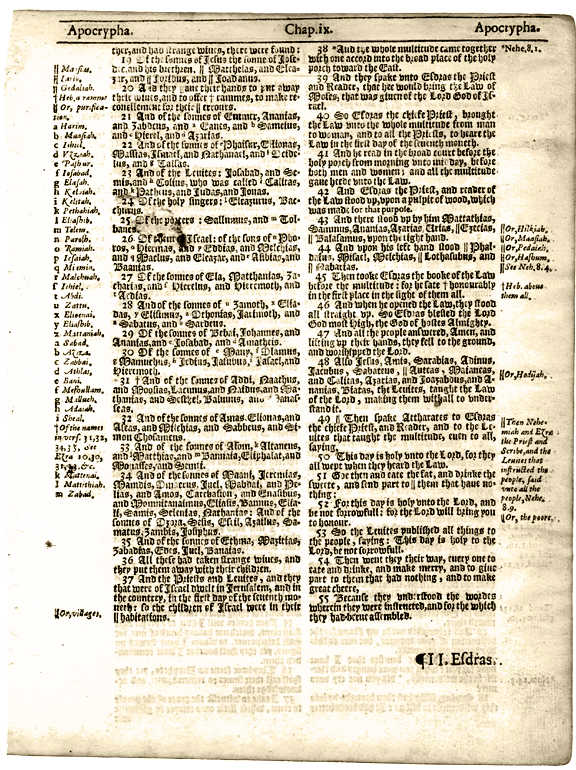
This Leaf is part of my collection, it is from the 1625 King James Version Printed by Richard Norton and John Bill The "printers to the Kings moft excellent Majestie". This printing has become fondly know among collectors a the "Last Edition" because of the year of its Printing. This was The LAST edition published During the reign of King James the first of England. This leaf is from the "Apocrypha" book of fist Esdres chapter ix, we see that verse 45 says in the margin " Heb. aboue [above] them all"
The Book of Judith In the Hebrew :
We now know that the "Apocryphal" book of Judith was originally composed in Hebrew. Two Hebrew versions are known at present: a long one practically identical with the Greek text, and a short one which is entirely different. However, the book also exists in distinct Greek and Latin versions, of which the former contains at least 84 verses more than the latter. St. Jerome claimed to have made the translation from the Aramaic to the Vulgate, adhering closely to the wording. However, he acknowledged that what he expressed in the Vulgate was only what he could clearly understand from the Aramaic. A comparison of the passages from the LXX with its Vulgate counterpart shows that Jerome was not exaggerating when he said that he made his translation.
That a Hebrew or (less likely) an Aramaic original of Judith once existed is the opinion of almost all modern scholars, and the evidence for this seems conclusive. There are many Hebraisms in the book, e.g. en tais hemerais ("in the days of," Jth 1:7, and 9 t besides); the frequent use of sphodra, in the sense of the Hebrew me'odh, and even its repetition (also a Hebraism, Jth 4:8); compare epi polu sphodra (Jth 5:18) and plethos polu sphodra (Jth 2:17). Note further the following:
"Let not thy eye spare" etc. (Jth 2:11; compare Ezekiel 5:11, etc.); "as I live" (in an oath, Jth 2:12); "God of heaven" (Jth 5:8; 11:17); "son of man," parallel with "man," and in the same sense (Jth 8:16); "and it came to pass when she had ceased crying," etc. (Jth 10:1); "the priests who serve in Jerusalem before the face of our God" (Jth 11:13). In Jth 16:3 we have the words: "For a god that shatters battle is (the) Lord." Now "Lord" without the article can be only the Hebrew "Yahweh," read always 'adhonay, "Lord." But the phrase, "to shatter battle," is not good Greek or good sense. The Hebrew words shabhath ("to rest"; compare shabbath, "Sabbath") and shabhar ("to break") are written much alike, and in the original Hebrew we must have had the causative form of the first vb.: "A God that makes war cease is (the) Lord" (see Psalms 46:9). Moreover, the Hebrew idiom which strengthens a finite verb by placing a cognate (absolute) infinitive before it is represented in the Greek of this book in the usual form in which it occurs in the Septuagint (and in Welsh), namely, a participle followed by a finite verb (see Jth 2:13). The present writer has noted other examples, but is prevented by lack of space from adding them here. That the original book was Hebrew and not Aramaic is made extremely likely by the fact that the above examples of Hebrew idiom are peculiar to this language. Note especially the idiom, "and it came to pass that," etc. (Jth 2:4), with the implied "waw consecutive," and what is said above about Jth 11:13, where the senseless Greek arose through the confusion of two similarly written Hebrew (not Aramaic) words. There are cases also of mistakes in the Greek text due to wrong translation from the Hebrew, as in Jth 1:8 (where for "nations" read "cities" or "mountains"); Jth 2:2 (where for "concluded," Hebrew wa-yekhal, read "revealed," wa-ye-ghal); Jth 3:1,9,10 (see Fritzsche, under the word), etc.
The Book of Bel and the Dragon in the Hebrew :
The opinion has been growing among recent scholars that this work was written first of all either in Hebrew or Aramaic Some of the grounds are the following:
It is known that Theodotion in making his translation of other parts of the Old Testament (Daniel) endeavored to correct the Septuagint with the aid of the Massoretic Text. A comparison of the Septuagint and of Theodotion of Bel and the Dragon reveal differences of a similar character. How can we account for them unless we assume that Theodotion had before him a Semitic original? A very weak argument, however, for the translator might have corrected on a priori principles, using his own Judgment; or there might well have been in his time different recessions of the Septuagint. Westcott (DB, I, 397a; 2nd edition, 714a) holds that some of Theodotion's changes are due to a desire to give consistency to the facts.
Much has been made of the Semiticisms in the work, and it must be admitted that they are numerous and striking. But are these Hebraisms or Aramaisms? The commonest and most undoubted Semiticism is the repeated use of kai and kai egeneto with the force of the waw-consecutive and only to be explained and understood in the light of that construction. But the waw- consecutive exists only in classical Hebrew; Aramaic and post-Biblical. Hebrew, including late parts of the Old Testament (parts of Ecclesiastes, etc.), know nothing of it. It must be assumed then that if the Semiticisms of this work imply a Semitic original, that original was Hebrew, not Aramaic
The following Hebraisms found in the Septuagint and in Theodotion may briefly be noted:
The use of the Greek kai with all the varied meanings of the waw-consecutive. (see below, under "VI. Teaching"). The beginning of a sentence with kai en ("and there was") Bel and the Dragon (verses 1,3 in the Septuagint; 2, etc., in Theodotion) agrees with the Hebrew waw-consecutive construction, but makes poor Greek. In verse 15 kai egeneto can be understood only in the light of the Hebrew for which it stands.
The syntactical feature called parataxy (coordination) presents itself throughout the Greek of this piece, and it has been reproduced in the English translations (the King James Version, the Revised Version (British and American) as any English reader can see. In the classical languages it is hypotaxy that prevails. If, as seems likely, those responsible for Septuagint and Theodotion followed a Hebrew original, they failed to make sufficient allowance for the peculiar force of the waw-consecutive idiom, for this does not involve hypotaxy to an y considerable extent.
The constant occurrence of Kurios ("Lord") without the article implies the Hebrew Yahweh; and the phrase the "Lord God" is also Hebrew.
There are difficulties and differences best explained by assuming a Hebrew origin. The Greek word sphragisamenos has no sense in verse 14 (Septuagint) for, retaining it, we should read of a sealing of the temple (of Bel) and also of a sealing with signet rings of the doors. The Hebrew word "shut" (catham) is written much like that for "seal" (chatham), and was probably, as Marshal suggests, mistaken for the latter. The temple was "shut" and the doors "sealed." In verse 10 the Septuagint (choris) and Theodotion (ektos) have 2 words of similar sense, which are best explained as independent renderings of one Hebrew word.
Marshall, identifying this dragon story with the Babylonian creation-myth of Marduk and Tiamat, thinks that instead of "pitch" used in making the obolus with which Daniel destroyed the dragon, the original Aramaic document has "storm wind," the two words being in Aramaic written much alike (za`apha' = "storm wind," and zepha' = pitch). But the fact is quite overlooked that the obolus contained not only pitch, but also "fat" and "hair" (see Bel and the Dragon, verse 27). Besides, in the Aramaic version, published by Gaster, to which Marshall attaches great importance as at least a real source, we have four ingredients, namely, pitch (zepetha'), fat, flax (kittan) and hair. Dr. Marshall's suggestion involves therefore not only the confusion of two words spelled differently in Aramaic, but the substitution of 3 or 4 terms for one in the original draft. Moreover, in Bel and the Dragon the several ingredients are made up into a cake with which the dragon was gorged. Dr. Marshall's view assumes also an Aramaic original which is against the evidence. But the suggestion would not have been made but for a desire to assimilate the dragon story to the Babylonian creation-myth, though in motive and details both differ so essentially.
In favor of a Semitic original many writers have cited the fact that forms of the story have been found in Hebrew and Aramaic in the 13th century. Raymund Martini in his Pugio Fidei (written against the Jews) quotes Bel and the Dragon from a Hebrew Midrash on Genesis which Neubauer discovered and which is almost verbatim identical with the unique manuscript containing Midrash Rabba de Rabba (see Neubauer, Tobit, viii, and Franz Delitzsch, de Habacuci, 82). Still other Hebrew forms of these stories have been found. All the "additions" to Daniel "occur in Hebrew in the remains of Yosippon," the "Hebrew Josephus," as he has been called. He wrote in the 10th century.
But most important of all is the discovery by Dr. M. Gaster of the dragon story in Aramaic, imbedded in the Chronicles of Yerahmeel, a work of the 10th century. Dr. Gaster maintains that in this Aramaic fragment we have a portion of the original Bel and the Dragon (see PSBA, 1894, 280 (Introduction), 312 (Text) and 1895 (for notes and translation)). The present writer does not think Dr. Gaster has made out his case.
The Book of Tobit In the Hebrew :
It must also be noted that the discoveries found in the the caves of Qumran have produced more than just Ecclesiasticus in the Hebrew, for example fragments of the "apocrypha" book of Tobit [scrolls 4Q196- 4Q200] were found in Cave four. these fragments of the book of Tobit are in Aramaic as well as Hebrew. How many, other books of the "apocrypha" are hidden out there in Hebrew still waiting to be found? There is no way of knowing. For more on this subject visit this Link.
We should also note that the book of "The Song of the three Children" [part of the third chapter of Daniel, and considered as one of "the Books called apocrypha"] also has a heading very similar to the one above:
"That which followeth is not in the Hebrew"
Again this is nothing more than a remark about the manuscripts they
had at had at hand to work with, this is not a statement of opinion as to the validity of this part of the Book of Daniel.
Along with the story of Bel and the Dragon, Dr. M. Gaster found the Song of the Three Children in the Aramaic Language, also in the 10th century document the Chronicles of Yerahmeel, (see also PSBA, 1894, 280 (Introduction), 312 (Text) and 1895 (for notes and translation). Dr. Gaster’s discovery is a strong foundation for the belief that this book also was originally written in the Jewish tongue.
The Translators of the KJV themselves did not believed the Greek [Septuagint] version as invalid or inferior to the Hebrew.
The Translators of the KJV believe that God caused the Greek Version of the Old Testament [LXX] to be created, accepted the fact that the Apostles used the Greek Old Testament [the Septuagint], and that the LXX, despite its few variations from the Hebrew, was the very word of God.
"The translation of the Seventie dissenteth from the Originall in many places, neither doeth it come neere it, for perspicuitie, gratvitie, majestie; yet which of the Apostles did condemne it? Condemne it? Nay, they used it, (as it is apparent, and as Saint Jerome and most learned men doe confesse) which they would not have done, nor by their example of using it, so grace and commend it to the Church, if it had bene unworthy the appellation and name of the word of God." (from the Translators' Preface to the 1611 KJV)
It is also true, that even in the Old Testament the KJV translators themselves abandon the reading of the Hebrew Masoretic Text in favor of the reading of the Greek in numerous places? Here are five specific examples:
Let me add another to This list, this change is VERY important to Christianity.* Jud. 16:26, where the Hebrew MT reads "touch the pillars," while the KJV/LXX read "feel the pillars."
* 1 Kg. 22:48, where the Hebrew MT reads "Jehoshaphat had ten ships of Tharshish to go to Ophir," while the KJV/LXX reads, "Jehoshaphat made ships of Tharshish to go to Ophir."
* 2 Kg. 20:4, where the Hebrew MT reads "the city," while the KJV/LXX read "the middle court."
* Isa. 10:32, where the Hebrew MT reads "the mount of the house of Zion," while the KJV/LXX reads "the mount of the daughter of Zion."
* Isa. 65:4, where the Hebrew MT reads "pieces of," while the KJV/LXX reads "broth of."Old Testament/Masoretic Text (Isaiah 7:14 ) "Behold, a young woman shall conceive"
LXX (Isaiah 7:14 ) "Behold, a virgin shall conceive"
KJV (Isaiah 7:14 ) "Behold, a virgin shall conceive"
KJV New Testament (Matthew 1.23) "Behold, a virgin shall conceiveIf we are to believe that the translators felt the Greek [Septuagint] version is invalid or inferior, then it is up to Protestants to explain why they give Greek names instead of Hebrew names, or their English equivalent names to the books of Moses. Why call those books the Pentateuch instead of the Torah or its English designation, Instruction? Why Genesis, Exodus, Leviticus, Numbers (translation of the Greek Arithmoi), and Deuteronomy? Instead of the Palestinian Hebrew names, Bereshith, Shemoth, Vayikra, Bemidbar, and Debarim? Or their English equivalents, The Beginning, Names, And He Called, In the Wilderness, and Words? Why call the Book "The Bible," which is the Greek (Anglicized) name the Catholic Church gave the Septuagint in union with the New Testament?
One more notable feature of the KJV's Apocrypha is the somewhat careless hand with which it appears to have been completed...The inconsistencies are frequent enough and substantive enough to be indicative of the relative unconcern the translators had for the Apocrypha.
It is true that the "Apocryphal" books were badly translated, but to point to this poor scholarship of the translators to argue that they held these books a inferior to the rest is self defeating, for the "Apocryphal" books are not the only example there poor language translational skills.
"It is generally agreed that the Pentateuch, historical books, and prophets were well done, Job and the Psalms were not so well done, the epistles were also poorly done." (English Versions of the Bible, 1952, pg 319)
If we are to follow the circular logic of this attempted Protestant "argument", it would mean that the translators of the 1611 King James Version also held the books of Job, Psalms and the epistles as inferior to scripture, and yet no Protestant would make this claim. The quality of the translation of "Apocrypha" books is simple just another example of the poor quality of men who were doing the translation, nothing more.
In 1884, Dr. F. H. A. Scrivener, perhaps the greatest authority on the history of the "Authorized Version" (1611 KJV), aptly said concerning these changes the following —
"Most readers will be aware that numberless and not inconsiderable departures from the original or standard edition of the Authorized Translation as published in 1611, are to be found in the modern [KJV] Bibles which issue from the press by thousands every year. Some of these differences must be imputed to oversight and negligence, from which no work of man can be entirely free; but much the greater part of them are deliberate changes, introduced silently and without authority by men whose very names are often unknown."
The bare-bones presentation and the occasional marginal comment, show beyond any reasonable doubt that these books were not held as sacred by the king's men.
This is the weakest argument yet, First allow me to point out that the number of Margin notes proves nothing. Secondly, the number of margin notes found in the "Apocryphal" books of 1611 KJV were far from "bare-bones" of "occasional", rather, the truth be told they were just as extensive as any other books found in the New or Old Testament. Last but not least, a quick study of the changes made to the KJV through years, would show that the total number of margin notes and there location varied from one year to the next. By 1762 they had increased to almost double that of the 1611, to almost 65,000, over half of which were cross-reference. The fact is the original 1611 King James Version we find over 840 marginal cross-references books in the "Apocrypha" (the Deuterocanonical books) to the "ligament" Books of the New and Old Testament.
King James own Position on the "Apocrypha" Books:
To start with we Know King James own Position on the "Apocrypha" Books: "As for the Scriptures, no man doubteth, I will believe them; but even for the Apocrypha, I hold them in the same account that the ancients did: they are still printed and bound with our Bibles, and publicly read in our Churches; I reverence them as the writings of holy and good men: but since they are not found in the cannon, we account them to be secundae lectionis, or ordinis," ["The Church History Of Britain" by Thomas Fuller, Oxford, M.DCCC.XLV]. We Know That King James intended to have the "Apocrypha" in his Bible, he set up the "Translation" Committee in a very specific structure it was composed of six panels of translators (47 men in all). Three panels were responsible for the Old Testament, two for the New Testament, and one specifically for the "Apocrypha".
Please sign our Guest book!
This page has helped
People find the truth since November 1999