
The KJV Mistranslation of Psalms

I’m sure to some it will come as a surprise to find the translators and printers of the King James Version willfully, purposely printed a altered text Sacred Book of psalms as a official part of there 1611 translation. They Did this on the very poor theological grounds as that it made them rhyme. As we examine a few of these altered verse you can see that many times they:
1)Completely rewrote the entire verse, they no longer even match the original or the verse that are NOW being printed in the King James Version.
2)Changed the meaning of these sacred verses, they no longer mean the same as the the original or the verse that are NOW being printed in the King James Version.
Two men named Thomas Sternhold and John Hopkins took it as there task to change the sacred poems of King David (Psalms) into English Meter. There purpose was to make these to make these psalms more acceptable as English songs, for official use in the Anglican Church services.
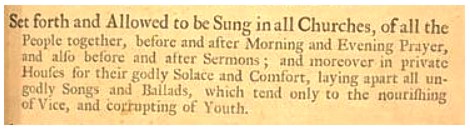
Click to Here see a complete Scan of this page from a later edition of the KJV.
We also know that as late as 1873 King James Version (Printed by John E. Potter & Company, Phild.) Contained this Book of Psalms in English Meter.
The Puritans preferred the Henry Ainsworth’s The book of psalms: Englished in both prose and metre, (Amsterdam 1612) Because they felt that the Sternhold and Hopkins Psalter (found in the 1611 KJV) contained to many alteration from the connotation and wording of the Psalms
Some may ask how important is Psalm’s any way. It may be pointed out that 23% of all of the 320 New Testament quotations of Old Testament passage come from Psalm, this is the biggest group of citations from any of the old testament Books.
we are going to examine some of these fabricated psalms from a leaf of a 1634 KJV (which is part of my personal collection) to those printed in to days present printing we are going to start with Psal. xxx.l .
When David should dedicate his house to the Lord he fell extreme sick without all hope of life and therefore after recovery he thanketh God exhorting others to do the like, and to learn by him, that God is rather merciful than severe towards his, also that adversity is sodaine. Then he prayeth and promiseth to praise God forever.
1634 KJV Psalter 30:1. All laud and praise with heart and voice O Lord I give to thee: which didst not make my foes rejoice, but hast exalted me.
Current KJV Psalm 30:1. I Will extol thee, O Lord; for thou hast lifted me up, and hast not made my foes to rejoice over me.
As can be seen in the above verses, the translators of the 1634 (or possibly it would be more proper to call them "authors"?) not only expanded the wording (such as taking "extol" and turning it into "laud and praise with heart and voice"), but also have reordered the verse - by taking the "lifted me up" and placing it at the end. In other words, the authors of the 1634 KJV added to the Word of God - at the whim of the music writers.
1634 KJV Psalter 30:2. O Lord my God to thee I cry, in all my pain and grief Thou gavest an ear, and didst provide to ease me with relief.
Current KJV Psalm 30:2 O Lord my God, I cried unto thee, and thou hast healed me.
In the first place, it is of interest to note that in the Hebrew the word used is "Yahweh" - which was the
|
|
| This one of the of the leafs we quote in this article this is a actual leaf from a 1634 KJB taken from The Whole Book of Psalms Collected into English Meter by Thomas Sternhold and John Hopkins printed in London in 1634 by Robert Barker and John Bill Measures 8 by 6.5 inches: |
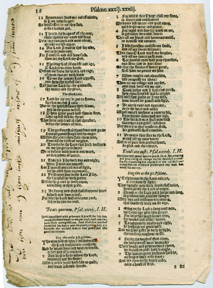
Hebrew Name for God.... not "Lord." The Hebrew, when literally translated, reads: "O Yahweh, my God..." Not "O Lord my God." The Hebrew word for Lord is "Adonai" (Strongs #33) - and this usage is found in verse number eight of this self-same Psalm. Hence, we see even the original translators too liberties with the text.
In the second place, there’s quite a difference between relieving "pain and grief," and healing. An aspirin can relieve pain, but it does not heal the malady. In the Hebrew, the word used for "healing" is "raphaw’," which means, literally, to mend, and to cure (Strong’s #7495). In other words, while the current KJV has the proper translation of this word, the 1634 KJV was highly inaccurate.
1634 KJV Psalter 30:3. Of thy good will thou hast called back my soul from hell to save; thou didst receive when strength did lack and kept me from the grave.
Current KJV Psalm 30:3 O Lord, thou hast brought up my soul from the grave: thou hast kept me alive, that I should not go down to the pit.
In the first place, we see a complete change of meaning here - the 1634 refers to a soul which had already gone to hell, and had been recalled. While the current KJV refers to a soul which had died, and yet had not gone to hell at all - as was stated at the end of the verse where it states "that I should not go down to the pit." In other words, we see here, in addition to a reordering, and the addition of various words, the addition of a completely different meaning. The 1634 has King David in hell.
In the second place, where did the authors of the 1634 get the phrase "thou didst receive when strength did lack" from? Where is this in the Hebrew?
1634 KJV Psalter 30:4. Sing praise ye Saints that prove see the goodness of the Lord; In memory of his majesty rejoice with one accord.
Current KJV Psalm 30:4. Sing unto the Lord, O ye saints of his, and give thanks at the remembrance of his holiness.
Here, yet again, we see a change in meaning - in order to provide rhyme. Please note that in the 1634, the saints rejoiced at the memory "of his majesty" - whereas the current KJV has them giving thanks at the "remember of his holiness." There is quite a large difference between "majesty" and "holiness" - to quote the dictionary:
MAJESTY: a) the dignity or power of a sovereign b) sovereign power
HOLINESS: the quality or state of being holy
1634 KJV Psalter 30:5. For why his anger but a space, both last, and flake [flare?] again: but in his favor and his grace, always doth life remain.
1634 KJV Psalter 30:6. Though gripes of grief and panges full shall lodge with us all night
1634 KJV Psalter 30:7. The Lord to joy will us restore, before the day be light.
Current KJV Psalm 30:5: For his anger endureth but a moment; in his favour is life: weeping may endure for a night, but joy cometh in the morning.
What happened to the weeping? And where did the joy coming in the morning go to? They were divided into separate verses - yet again, the authors of the 1634 were adding to the Word of God.
There is very very very little of the 1634 verse to be found in the current KJV..... though, I must confess, if we are going to look at similarities, we must restrict our examination to the punctuation at the end of the verse - they both end with a period.
1634 KJV Psalter 30:8. When I enjoyed the world at will, thus would I boast and say: Truth I am sure to feel none ill, this wealth shall not decay.
Current KJV Psalm 30:6. And in my prosperity I said, I shall never be moved.
Where did "when I enjoyed the world at will" come from? Or "thus would I boast"? Or "truth I am sure to feel none ill, this wealth shall not decay"? We either have a case of two completely different verses, or just two verses with completely different content.
Permit me to note that there is a world of difference between "prosperity" and "enjoyed the world at will." Prosperity could mean an increase of material wealth, while "enjoyed the world at will" could (and usually does) mean a life of sin. Was David saying that he was wealthy? Or that he was enjoying the vices of the world? There is a difference of meaning here to be sure.
1634 KJV Psalter 30:9. For thou O Lord of thy good grace, hadst sent me strength and aid; But when thou turndst away thy face, my mind was lonely made.
Current KJV Psalm 30:7. Lord, by thy favour thou hast made my mountain to stand strong: thou didst hide thy face, and I was troubled.
These two verses pretty much mean the same thing - though here, again, we see a major difference in a) structure, b) wording.
1634 KJV Psalter 30:10. Wherefore again yet did I cry, to thee O Lord of might: My God with plaints I did applly, and prayed both day and night.
Current KJV Psalm 30:8. I cried to thee, O Lord; and unto the Lord I made supplication.
Yet again, the Hebrew word used here was "Yahweh," which was the Title given by the Hebrews to God - which Title both editions of the KJV translated as "Lord," which would have been "Adonai" in the Hebrew. Both mistranslate the original Hebrew text.
Where did "day and night" come from? Where is it in the present edition? Further, in the present printing it says merely "I cried to thee," whereas in the 1634 edition it says "*again* did I cry." The KJV 1634 has King David praying to the "Lord of might," while present edition just says "O Lord." We are not arguing that God is not mighty, but, rather, the translations.... which is correct?
1634 KJV Psalter 30:11. What gain is in my blend [blood?] said I, if death destroy my days: Doth but declare thy majesty, as yet thy truth does praise?
Current KJV: Psalm 30:9. What profit is there in my blood, when I go down to the pit? Shall the dust praise thee? shall it declare thy truth?
The 1634 completely eliminated the reference to Hell in this verse, and makes it refer to mere death. In other words, it is suffocating all reference to Hell - which the present printing has clearly.
Furthermore, we see the 1634 KJV stated that the truth praises God’s Majesty, while the current printing refers to declaring the truth. How shall we declare God’s truth should we be in Hell? Here we have a change in meaning.
1634 KJV Psalter 30:12. Wherefore my God some pity take, O Lord I thee desire: Do not this simple fool foresake, of help I thee require.
Current KJV Psalm 30:10. Hear, O Lord, and have mercy upon me: Lord, be thou my helper.
Where did the "simple fool" of the 1634 come in? Or "O Lord I thee desire"? Or "my God some pity take" (there’s a difference between pity, and mercy)? Are these two even the same verse?
1634 KJV Psalter 30:13. Then didst thou turn my grief & woe into a cheerful voice: The mourning weed thou tokest me fro and made it me to rejoice.
Current KJV: Psalm 30:11. Thou hast turned for me my mourning into dancing: thou hast put off my sackcloth, and girded me with gladness;
Yet again, we see a difference here. The 1634 refers to "a cheerful voice," while the current KJV refers to "dancing"? I would like to here interject the fact that in the early 1630's, when this Bible was printed, the Puritans were in power in England - and dancing was outlawed. Were the translators translating according to the original languages, or according to the politics of the time? Were they God-fearing individuals searching for the truth, or were they merely crown-fearing individuals searching for wealth, at the expense of the truth?
Further, the present edition said "thou hast put off my sackcloth" - the wearing of sackcloth was a well-known sign of penance. While the 1634 completely eliminates any reference to "sackcloth." Again do we see the translators tailoring the Word of God to match the political trends of the time.
1634 KJV Psalter 30:14. Wherefore my soule uncessantly, shall cling unto thy praise: My Lord my God, to thee will I, give laud and thanks always.
Current KJV: Psalm 30:12. To the end that my glory may sing praise to thee, and not be silent. O Lord my God, I will give thanks unto thee for ever.
The 1634 completely eliminates the act of humility made by King David in verse 12 of the current KJV. Please note, King David states "to the end that my glory may sing praise to thee, and not be silent" - in other words, David makes it plain that he is referring all the glory and honors due to his kingship to God.... and it is for this reason that he thanks God. He thanks God, for God has seen fit to bestow on him the honor of the kingship. Whereas, the 1634 completely eliminates the reason why King David humbly gave thanks to God.
1634 KJV: Inte Domine Speravi. Psal. xxxi.l. H
1634 KJV Psalter 31:1. O Lord I put my trust in thee, let nothing work me shame: As thou art just deliver me, and let me quit from blame.
Current KJV: Psalm 31:1. In thee, O Lord, do I put my trust; let me never be ashamed: deliver me in thy righteousness.
|
|
| This the second of the of the leafs we quote in this article this is a actual leaf from a 1634 KJB taken from The Whole Book of Psalms Collected into English Meter by Thomas Sternhold and John Hopkins printed in London in 1634 by Robert Barker and John Bill Measures 8 by 6.5 inches: |
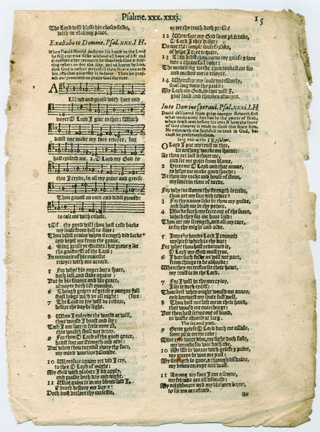
It is of interest here to emphasize the ending words in the 1634 KJV "let me quit from blame." Yet again, we see humility suffering in the 1634 edition of the KJV.... King David, in the current KJV, does not dispute that he is to blame for his faults - and merely asks to be delivered from them.... whereas the 1634 not only has King David asking for deliverance from his faults, but also for the blame. The responsibility.
1634 KJV Psalter 31:2. Hear me O Lord and that anone, to help me make good speed: Be thou my rock and house of stone, my fence in time of need. For why has stones thy strenth is tried, thou art my fort and tower:
Current KJV: Psalm 31:2. Bow down thine ear to me; deliver me speedily: be thou my strong rock, for an house of defence to save me. 3. For thou art my rock and my fortress;
Interesting.... God’s strength is tried? Tested? Further, I wish to draw the reader’s attention to the first portion of the verse in the 1634 KJV. "Hear me O Lord and that anon [immediately], to help me make good speed." Please note the subtle change... no more is Kind David humbly asking God to "bow down [His] ear to" him, but he is now practically demanding of God to be heard, and at once. And what is King David asking for? In the current KJV he is asking for deliverance.... in the 1634 KJV he is asking to be helped along "speedily." To make good time. There is quite a difference here between the two.
Where did the "fence in time of need," and "tower" come from? And how is it that a "house of stone" was put in place, instead of "house of defence"? Which translation is correct? Which one is accurate?
I would also like to point out that the 1634 KJV completely rearranged the verses here.... they have clapped half of verse 3 to the end of verse two.
1634 KJV Psalter 31:3. For thy names sake be thou my guide, and lead me in thy power.
Current KJV: Psalm 31:3 therefore for thy name's sake lead me, and guide me.
Where did "in thy power" come from? This is a curious question. Again we also have to note the structural alteration here. For what is verse 3 in the 1634, is only half of verse 3 in the present printing.
1634 KJV Psalter 31:4. Pluck forth my feet out of the snare, which they for me have laid: Thou art my strength, and all my care, is for thy might and aid.
Current KJV: Psalm 31:4. Pull me out of the net that they have laid privily for me: for thou art my strength.
Interesting... the current KJV says "for thou art my strength" period. The 1634 edition has added "and all my care, is for thy might and aid" to the end of this. In other words, the translators of the 1634 were adding to the Word of God. Or have we seen the current translators subtracting from the Word of God? This is about one third of the 1634 verse... quite a large subtraction/addition.
|
|
| The Book of Psalms (The Whole Book of Psalms Collected into English Meter By Thomas Sternhold and John Hopkins ) as found in the 1641 King James Version |
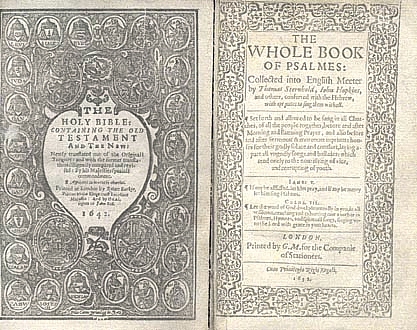
1634 KJV Psalter 31:5. Into thy hands Lord I commit my spirit which is thy due: For why thou hast redeemed it, O Lord my God most true.
Current KJV: Psalm 31:5. Into thine hand I commit my spirit: thou hast redeemed me, O Lord God of truth.
Yet again the virtue of humility suffers... in the 1634, King David only commits his soul to God because it is God’s due. Because he owes it to God. Whereas in the current KJV, King David gives his soul freely to the Lord, out of love.
1634 KJV Psalter 31:6. I hate such folk as will not part, from things to be abhored: When they on trifles let their heart, my trust is in the Lord.
Current KJV: Psalm 31:6. I have hated them that regard lying vanities: but I trust in the Lord.
I ask the reader to keep in mind the structural changes in the above verse, and the watered down language. The 1634 has milder language than the current KJV, in addition to some structural changes. They took the words "lying vanities" and changed them into twelve separate words.
1634 KJV Psalter 31:7. For I will in thy mercy joy, I see it doth excell: Thou seest when ought would me annoy, and knowest my soul full well.
Current KJV: Psalm 31:7 I will be glad and rejoice in thy mercy: for thou hast considered my trouble; thou hast known my soul in adversities;
The additions to the 1634 are obvious to even the most casual reader. Where did "I see it doth excell" come from? The current KJV, and the ancient Hebrew, does not have this portion of this verse. How did "thou hast known my soul in adversities," replace "and knowest my soul full well," as was found in the 1634 KJV? Where did the word "adversities" go to?
1634 KJV Psalter 31:8. Thou hast not left me in their hand, that would me overcharge: But thou hast let me out of bond, to walk abroad at large.
Current KJV: Psalm 31:8 And hast not shut me up into the hand of the enemy: thou hast set my feet in a large room.
Interesting... yet again we see an addition (subtraction?) from the Word of God, and a change in meaning. Please note, in the 1634 KJV it states "Thou hast not left me in their hand" (implying that David was in "their" hand), while the current KJV states "And hast not shut me up into the hand of the enemy" - in other words, God has not permitted the enemy to capture David.
In addition to the above is the addition of the words "that would me overcharge," and "But thou hast let me out of bond, to walk abroad at large." How did "thou hast set my feet in a large room" become "but thou hast let me out of bond, to walk abroad at large"? What does that have to do with a large room? There is quite a difference here.
1634 KJV Psalter 31:9. Great grief O Lord doth me assail, some pity on me take: Mine eyes were dim, my light doth fail, my womb for woe do take.
Current KJV: Psalm 31:9. Have mercy upon me, O Lord, for I am in trouble: mine eye is consumed with grief, yea, my soul and my belly.
|
|
| The Book of Psalms (The Whole Book of Psalms Collected into English Meter By Thomas Sternhold and John Hopkins ) as found in the 1678 King James Version. was printed at London by John Bill, Christopher Barker, Thomas Newcomb and Henry Hills Printers to the Kings moft excellent Majefty, 1678. |
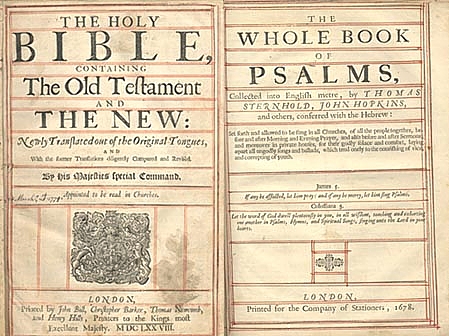
How does "my soul and my belly" turn into "my womb for woe do take"? Although this is not a major theological difference, it is still quite telling that the translators would purposefully tamper with Scripture, for the sole purpose of rhyme - which is certainly not acceptable to any God-fearing Christian.
1634 KJV Psalter 31:10. My life is worn with grief & pain, my years in woe are past: My strength is gone, & through disdaine, my bones corrupt and waste.
Current KJV: Psalm 31:10. For my life is spent with grief, and my years with sighing: my strength faileth because of mine iniquity, and my bones are consumed.
Well, for one thing, they did a really bad job on this verse - it doesn’t even rhyme in the end. If one is going to corrupt Scripture for the purpose of rhyme, the least they could do is accomplish what they set out to do.
But aside from this, they completely changed the reason for the dissolution of King David’s strength - no longer is it because of his iniquity that he strength failed, nor is it because of his iniquity that his bones were consumed..... as a matter of fact, this verse does not give the reason at all.
Secondly, they added in the 1634 the words "grief & pain." Pain is added, and does not exist in the present KJV. Granted, it may possibly fit in - but "pain" does not exist in the present printing. There is also a fundamental difference between "faileth" and "gone." Whereas his strength being "gone" means it is completely non-existent, whereas "faileth" means his strength is weak, and he stumbles in his iniquity.
1634 KJV Psalter 31:11. Among my foes I am alone, my friends are all dismayed: My neighbors and my kinsmen home, to see me are afraid.
Current KJV: Psalm 31:11. I was a reproach among all mine enemies, but especially among my neighbours, and a fear to mine acquaintance: they that did see me without fled from me.
As it is, "reproach" does not translate into "afraid." According to the current KJV King David was a reproach, not only to his enemies, but "especially among [his] neighbours." Further, how is it that "acquaintance" turns into "neighbors and kinsmen"? Yet again, we see changes made to the Word of God, solely for the purpose of rhyme.
1634 KJV Psalter 31:12. As men once dead are out of mind, so I am now forgot: As in all effect in me they find, as in a broken pot.
Current KJV: Psalm 31:12. I am forgotten as a dead man out of mind: I am like a broken vessel.
Essentially the meaning in the above verses are the same, although, yet again, the wording is entirely different - and the translators of the 1634 took this opportunity to add words to the Word of God.
1634 KJV Psalter 31:13. I heard the brags of all the rout, their threats my mind did fray: how they conspired and went about, to take my life away.
Current KJV: Psalm 31:13. For I have heard the slander of many: fear was on every side: while they took counsel together against me, they devised to take away my life.
How did "slander" turn into "brag"? Where did King David say that "their threats [his] mind did fray"? And whatever happened to "fear was on every side"?
1634 KJV Psalter 31:14. But Lord I trust in thee for aid, not to be overtrod: For I confess and will have said, thou art my Lord my God.
Current KJV: Psalm 31:14. But I trusted in thee, O Lord: I said, Thou art my God.
Ummmm.... where did "not to be overtrod" & "For I confess and will have said" come from? Where are these words to be found in the Hebrew? And where are they in the present printing?
1634 KJV Psalter 31:15. The length of all my life and age, O Lord is in thine hand: Defend me from the wrath and rage, of them that me withstand.
Current KJV: Psalm 31:15. My times are in thy hand: deliver me from the hand of mine enemies, and from them that persecute me.
Yet again, these verses are essentially the same - I don’t see much of a difference here. Other than one is nineteenth words, and the other is twenty six - the verses are both rearranged for the purpose of rhyme.... and a very poor rhyme at that. But I guess turning 150 Psalms into metre is a monotonous job, so I guess we’ll have to make some allowances in this case....
1634 KJV Psalter 31:16. To me thy servant Lord express, and show thy joyful face: And save me Lord for thy goodness, thy mercy and thy grace.
Current KJV: Psalm 31:16. Make thy face to shine upon thy servant: save me for thy mercies' sake.
Yet again, we see additions to the Word of God for the sake of rhyme. For example, "save me for thy mercies’ sake" turns into "and save me Lord for thy goodness, thy mercy and thy grace." Where did the "goodness... and... grace" come from? For they are not found in the Hebrew... nor are they found in the present printing.
1634 KJV Psalter 31:17. Lord let me not be put to shame, for that on thee I call: But let the wicked bear their blame, and in the grave to fall.
Current KJV: Psalm 31:17. Let me not be ashamed, O Lord; for I have called upon thee: let the wicked be ashamed, and let them be silent in the grave.
How is it that "let them be silent in the grave" ends up being "in the grave to fall"? The second is a request for vengeance - wishing evil upon his enemies. Secondly, the 1634 wishes the wicked to "bear their blame," while the current KJV wants them to "be ashamed." One wants them to take the blame for what they’ve done, while the other wishes them to be ashamed for what they’ve done - one wants them to take responsibility, while the other wants them to be sorry.
Here we have a completely altered verse... solely so it would sound good, when one puts it to a musical bar/pipe organ and choir.
1634 KJV Psalter 31:18. O how great good hast thou in store, laid up full safe for them: that fear and trust in thee therefore, before the sons of men.
Current KJV Psalm 31:19. Oh how great is thy goodness, which thou hast laid up for them that fear thee; which thou hast wrought for them that trust in thee before the sons of men!
At the present point, the 1634 completely deletes verse 18 as it appears in the current KJV. To provide this verse:
Current KJV: Psalms 31:18. Let the lying lips be put to silence; which speak grievous things proudly and contemptuously against the righteous.
In other words, the Word of God has, yet again, been altered - this time with the complete elimination of a particular verse.
1634 KJV Psalter 31:19. Thy presence shall them fence and guide from all proud brags and wrongs: Within thy place thou shalt them hide, from all the strife of tongues.
Current KJV: Psalm 31:20. Thou shalt hide them in the secret of thy presence from the pride of man: thou shalt keep them secretly in a pavilion from the strife of tongues.
Yet again, the addition of various words to the 1634 can be seen - where did "brags and wrongs" come in? Where are they to be found in the Hebrew? Yet again, the translators have taken the liberty of "expounding" upon various verses, by adding words to it.
1634 KJV Psalter 31:20. Thanks to the Lord that hath declared on me His grace to fare: Me to defend with watch and ward, as in a tone of war.
Current KJV: Psalm 31:21. Blessed be the Lord: for he hath shewed me his marvellous kindness in a strong city.
How in the world did "watch and ward, as in a tone of war" come out of "in a strong city"? For one can certainly be in a strong city, and not in a tone of war, or in a warlike situation. How absurd! But the rhyme must go on! David’s inadequacy to author a proper song not-withstanding - it must be corrected by the translators. Certainly not a printing/spelling error here - but one of many obvious examples of a wilful change in God’s Sacred Scriptures.
1634 KJV Psalter 31:21. This did I say both day and night, when I was sore opprest: Loe I was clean cast out of sight, yet heard it thou my request,
Current KJV: Psalm 31:22. For I said in my haste, I am cut off from before thine eyes: nevertheless thou heardest the voice of my supplications when I cried unto thee.
Yet again, we see a verse mutilated and changed by the translators of this book - almost to the point where it is unrecognizable. But, as it is, this is starting to become quite common.
1634 KJV Psalter 31:22. Ye Saints love ye the Lord I say, the faithful he doth guide: And to the proud he doth repay, according to their pride.
Current KJV: Psalm 31:23. O love the Lord, all ye his saints: for the Lord preserveth the faithful, and plentifully rewardeth the proud doer.
Yet again, we see them adding words, and changing the entire structure of the verse. For example "plentifully rewardeth the proud doer," and "the proud he doth repay, according to their pride."
|
|
| The Book of Psalms (The Whole Book of Psalms Collected into English Meter By Thomas Sternhold and John Hopkins ) as found in the 1706 King James Version |
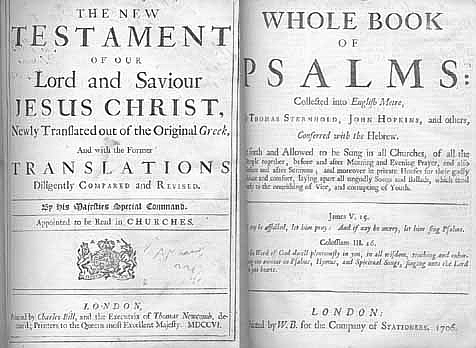
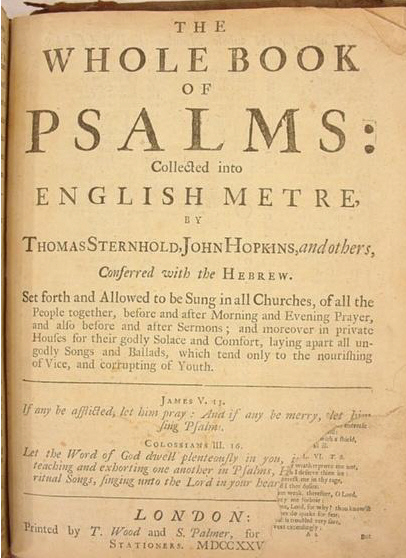
The translation given by the 1634 is very interesting when one considers the fact that most protestants nowadays consider all sins to be equal - no distinction such as "mortal" and "venial" sins. The 1634 states "the proud he doth repay, according to their pride" - which, in turn, implies various levels of pride, which, in turn, indicates a difference in punishment for these various levels of pride.
1634 KJV Psalter 31:23. Be strong and God shall stay your heart behold and have a lust, For sure the Lord will take your part, fith [if?] ye in him do trust.
Current KJV: Psalm 31:24. Be of good courage, and he shall strengthen your heart, all ye that hope in the Lord.
The addition of various words to the above verses is plain to even the novice reader. For example, the substitution of the word "trust" for "hope." This does not necessarily imply a different meaning, but one definitely could be derived from it. The 1634 can be interpreted in support of the protestant presumption that they are to be saved, while the current KJV can be interpreted as meaning that we hope that we are saved, but we still must work out our salvation in fear and trembling. There are some protestants who believe that salvation is not guaranteed, and that we must strive to obtain it - while there are some who believe that we are virtually owed our salvation, regardless of how we live, or what we do...