
Was the 1611 KJV's English a "purest form" of the language?
EZCODE CENTER START
As funny as it may sound, one of the many Laughable "battle cries" of the fanatical KJV Onlyists is that:
"In the time of the KJB, the English language was at its purest form."
First, in order for the English language to be at its “purest form” at the time of the 1610 translation of the KJV, it would have needed to have been a stable language, this was not the case. In the 1600's much of the English language was not even standardized. for example In the 1600s spelling was according to whim. There was no such thing as correct spelling. No standards had been established. The printers of the early KJV’s often spelled the same word several different ways, often in the same book and sometimes on the same page.
|
|
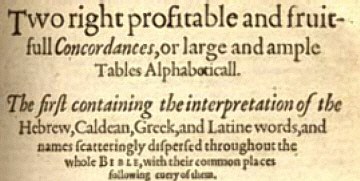
| The 1611 King James Version had a Table or "glossary" of the Hebrew, Chaldean, Greek and Latin words it . To see a scan of the complete leaf CLICK HERE: |
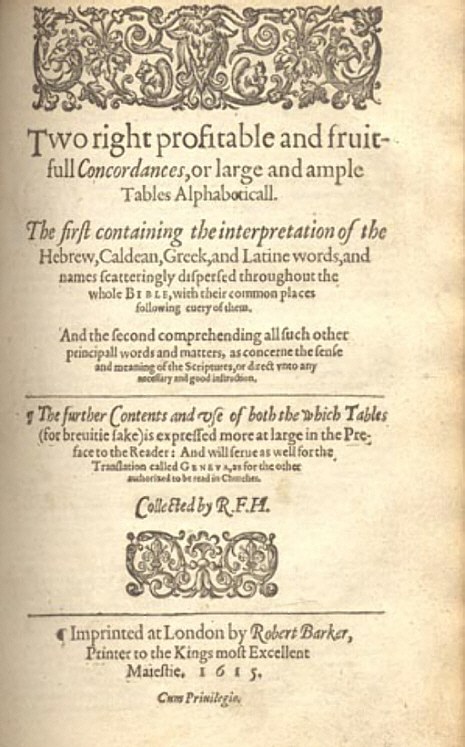
For example the in the 1611 KJV the word sin is spelled three ways “sinne”, “sinn”, and “sine”. Another example is the word “he” in the early editions of the KJV it was spelled “hee” and “he” some times in the same verse. We must also regard lack of standardized punctuation in the early KJV’s.
Another example of the fact that he English language in 1610 was still evolving, are words such as “Jesus” (ie. Iesus in the 1610 KJV) and “Judge” (ie. iudge in the 1610 KJV). The simple fact that they begin with the letter J in the current editions of the KJV, shows this change. The letter J because it did not exist when when the 1610 KJV was translated! All good dictionaries and encyclopedias show that the letter J and its sound are of late origin. The "Funk and Wagnall’s Encyclopedia" (1979 edition), volume 14, page 94 under “J,” states:
“J, the tenth letter and seventh consonant in the English alphabet. It is the latest addition to the English script and has been inserted in the alphabet after I, from which it was developed, just as V and W follow U, the letter from which they arose. In form, J was originally merely a variation of I; J appeared first in Roman times, when it was used sometimes to indicate the long i vowel sound, but was often used interchangeably with I. The Romans pronounced I as a vowel in some words, such as iter, and as a semi-vowel in others, for example, iuvenis, spelled presently juvenis. The only difference in spelling, however, was the occasional use of double i for the y sound for example, in maiior, spelled presently major. In the Middle Ages the elongated form (j) was used as an ornamental device, most often initially and in numeral series; many old French manuscripts indicate the numeral 4 by the letter sequence iiij. The use of j as an initial led ultimately to its specialized use to indicate both the old semi-vowel sound y, found in German, and the new palatal consonant sounds (z) and (dz), found in French, Spanish and English. Not until the middle of the 17th century did this usage become universal in English books; in the King James Bible of 1611, for example, the words Jesus and judge are invariably Iesus and iudge. Long after the invention of printing, j thus became more than a mere calligraphic variation of i (which in Latin could be either vowel or semi-vowel), and, j became restricted to a consonantal function."
Last but not least, the text 1611 KJV could not [even in its time] be considered a truly “pure English” translation, for it borrowed many Foreign words. As a mater of fact it borrowed so many Greek Hebrew and Latin words that The translators of the 1611 King James Version had a Table or "glossary" of Foreign names and words they used printed as part of the edition.
Please sign our Guest book!
This page has helped
People find the truth since November 1999