
Quotes found in the KJV New Testament that were taken from the
Septuagint
|
|
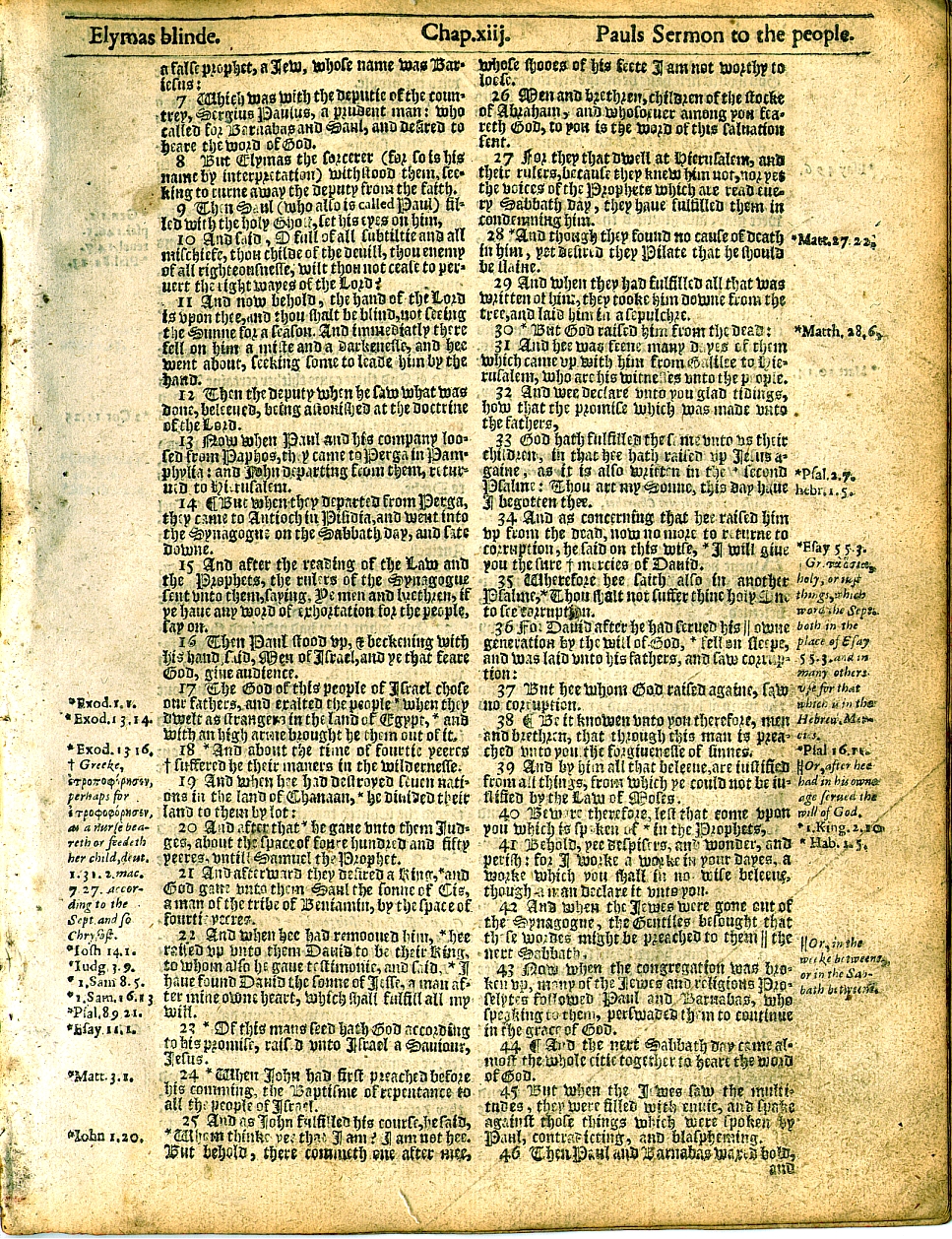
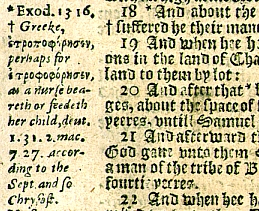
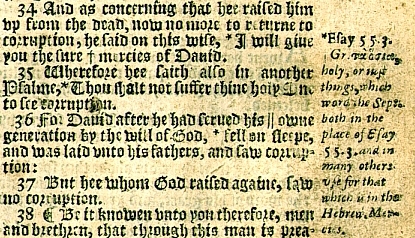
| Acts 13:18, 34 -
Have marginal notes containing the Greek text of an
alternate reading "according to the Sept. [Septuagint]. This leaf from the King James Version Printed by Bonham Norton and John Bill The "printers to the Kings moft excellent Majestie" at London, England in 1625. |
There are many possible examples of the influence of the Septuagint on the creation of the King James Version, one that stands out is "The Prayer of Manasses" [or Manassesh] which found its way into the 1611 among the Deuterocanonical [apocryphal] books. This "Prayer" was never accepted by the Catholic Church and is only found is some [not the majority] of the early LXX manuscripts."But when the fulnesse of time drew neere, that the Sunne of righteousnesse, the Sonne of God should come into the world, whom God ordeined to be a reconciliation through faith in his blood, not of the Jew onely, but also of the Greeke, yea, of all them that were scattered abroad; then loe, it pleased the Lord to stirre up the spirit of a Greeke Prince (Greeke for descent and language) even of Ptolome Philadelph King of Egypt, to procure the translating of the Booke of God out of Hebrew into Greeke. This is the translation of the Seventie Interpreters, commonly so called, which prepared the way for our Saviour among the Gentiles by written preaching, as Saint John Baptist did among the Jewes by vocall." (from the Translators' Preface to the 1611 KJV)
"The translation of the Seventie dissenteth from the Originall in many places, neither doeth it come neere it, for perspicuitie, gratvitie, majestie; yet which of the Apostles did condemne it? Condemne it? Nay, they used it, (as it is apparent, and as Saint Jerome and most learned men doe confesse) which they would not have done, nor by their example of using it, so grace and commend it to the Church, if it had bene unworthy the appellation and name of the word of God." (from the Translators' Preface to the 1611 KJV)
The translators of the King James Version chose to use the Greek [Septuagint] names instead of Hebrew names, [or their English equivalent names] for the books of Moses. They called those books Genesis, Exodus, Leviticus, Numbers (translation of the Greek Arithmoi), and Deuteronomy, Instead of the Palestinian Hebrew names, Bereshith, Shemoth, Vayikra, Bemidbar, and Debarim, and not their English equivalents, The Beginning, Names, And He Called, In the Wilderness, and Words. The translators of the 1611 KJV also chose to use the order and structure of the Sacred books found in the Greek [Septuagint], instead of the order found in the Hebrew Text.
In The Old Testament, we find several margin notes were the translators placed alternate spellings of the names of people and places based on the Greek (LXX) text, some examples of this are found in Genesis 5:12, 21, 29 and 10:10
It is also true, that even in the old testament the KJV translators themselves abandon the reading of the Hebrew Masoretic Text in favor of the reading of the LXX in numerous places? Here are five specific examples:
Let me add another to This list, this change is VERY important to Christianity.* Jud. 16:26, where the Hebrew MT reads "touch the pillars," while the KJV/LXX read "feel the pillars."
* 1 Kg. 22:48, where the Hebrew MT reads "Jehoshaphat had ten ships of Tharshish to go to Ophir," while the KJV/LXX reads, "Jehoshaphat made ships of Tharshish to go to Ophir."
* 2 Kg. 20:4, where the Hebrew MT reads "the city," while the KJV/LXX read "the middle court."
* Isa. 10:32, where the Hebrew MT reads "the mount of the house of Zion," while the KJV/LXX reads "the mount of the daughter of Zion."
* Isa. 65:4, where the Hebrew MT reads "pieces of," while the KJV/LXX reads "broth of."
Old Testament/Masoretic Text (Isaiah 7:14 ) "Behold, a young woman shall conceive"
LXX (Isaiah 7:14 ) "Behold, a virgin shall conceive"
KJV (Isaiah 7:14 ) "Behold, a virgin shall conceive"
KJV New Testament (Matthew 1.23) "Behold, a virgin shall conceive
We allso must note that Christ himself acculy read from the LXX (Greek) version of the book of "Isaiah" in his hometown (Nazareth) synagogue:
"The Spirit of the Lord GOD is upon me; because the LORD hath anointed me to preach the gospel to the meek; he hath sent me to bind up the brokenhearted, to preach deliverance to the captives, and the opening of the prison to them that are bound" (Isa. 61:1-2, Hebrew MT)
"The Spirit of the Lord is upon me, because he hath anointed me to preach the gospel to the poor; he hath sent me to heal the brokenhearted, to preach deliverance to the captives, and recovering of sight to the blind" (Isa. 61:1-2 LXX)
"The Spirit of the Lord is upon me, because he hath anointed me to preach the gospel to the poor; he hath sent me to heal the brokenhearted, to preach deliverance to the captives, and recovering of sight to the blind" (Lk. 4:18-19, where Jesus reads Isa. 61:1-2 in the LXX form).
We also know that at the First Council of Jerusalem [in the book of Acts] St. James quotes the LXX when addressing the Apostles and Elders of the Christian Church.
"In that day will I set up again the booth of David that is fallen, and I will mend its breaches and set up its ruins anew, I will build it firm as in the days of old: so that they may possess the remnant of Edom, and of all the nations once attached to My name declares the Lord who will bring this to pass."[MT Amos 9:11-12]
" In that day will I raise up again the tabernacle of David that is fallen down; and I will build again the ruins thereof, and I will set it up...That the residue of men might seek after the Lord, and all the Gentiles, upon whom my name is called, saith the Lord, who does all these things." [LXX Amos 9:11-12]
"And to this agree the words of the prophets; as it is written, After this I will return, and will build again the tabernacle of David, which is fallen down; and I will build again the ruins thereof, and I will set it up: That the residue of men might seek after the Lord, and all the Gentiles, upon whom my name is called, saith the Lord, who doeth all these things." [Acts 15:15-17 (As found in the KJV)]
Christ and his Apostles quoted the LXX many times, now on to our comparison of some of these New Testament verse (The similarities are in CAPITAL letters.)
Compare Hebrews 10:5-7 with Psalm 40:6-8
New Testament (As found in the KJV) - "Wherefore when he cometh into the world, he
saith, Sacrifice and offering thou wouldest not, BUT A BODY HAST THOU PREPARED ME: In
burnt offerings and sacrifices for sin thou hast had no pleasure. Then said I, Lo, I come
(in the volume of the book it is written of me,) to do thy will, O Eloheem."
Hebrew Old Testament (As found in the KJV) - "Sacrifice and offering thou didst not desire; mine ears hast thou opened: burnt offering and sin offering hast thou not required. Then said I, Lo, I come: in the volume of the book it is written of me, I delight to do thy will, O my Eloheem: yea, thy law is within my heart."
The Septuagint Greek Old Testament - "Sacrifice and offerings Thou didst not desire, BUT PREPARDEST FOR ME A BODY; whole burnt offerings and offerings for sin Thou didst not require. Then I said, Behold I come; (in the volume of a book it is written respecting me) to perform, O my Eloheem, Thy will, I was determined, even that law of thine, within my heart."
Compare Romans 11:26 with Isaiah 59:20
New Testament (As found in the KJV) - "And so all Israel shall be saved: as it is
written, There shall come out of Sion the Deliverer, AND SHALL TURN AWAY UNGODLINESS AWAY
FROM JACOB:"
Hebrew Old Testament (As found in the KJV) - "And the Redeemer shall come to Zion, and unto them that turn from transgression in Jacob, saith YHWH."
The Septuagint Greek Old Testament - "For the sake of Sion the deliverer will come, and TURN AWAY UNGODLINESS FROM JACOB." (Isaiah 59:20)
Compare Matthew 12:18-21 with Isaiah 42:1-4 (Notice that theThe Septuagint Greek Old
Testament identifies Jacob as being YHWH's servant in these verses).
New Testament (As found in the KJV) - "Behold my servant, whom I have chosen; my
beloved, in whom my soul is well pleased: I will put my spirit upon him, and he shall shew
judgment to the Gentiles. He shall not strive, nor cry; neither shall any man hear his
voice in the streets. A bruised reed shall he not break, and smoking flax shall he not
quench, till he send forth judgment unto victory. AND IN HIS NAME SHALL THE GENTILES
TRUST."
Hebrew Old Testament (As found in the KJV) - "Behold my servant, whom I uphold; mine elect, in whom my soul delighteth; I have put my spirit upon him: he shall bring forth judgment to the Gentiles. He shall not cry, nor lift up, nor cause his voice to be heard in the street. A bruised reed shall he not break, and the smoking flax shall he not quench: he shall bring forth judgment unto truth. He shall not fail nor be discouraged, till he have set judgment in the earth: and the isles shall wait for his law."
The Septuagint Greek Old Testament - "Jacob is My servant, I will uphold him, Israel is My chosen one, My soul hath embrased him; I have put my spirit upon him; he will publish judgement to the nations. He will not scream, nor urge with vehememce: nor will his voice be heard abroad in the streets. A bruised reed will he not break, nor extinguish a dimly burning taper, but will publish judgment to establish truth. He will shine out, and shall not be broken until he hath established judgment in the earth. IN HIS NAME, THEREFORE, LET THE NATIONS TRUST."
Compare Matthew 21:16 with Psalms 8:2
New Testament (As found in the KJV) - "And said unto him, Hearest thou what these
say? And Yahshua saith unto them, Yea; have ye never read, OUT OF THE MOUTH OF BABES AND
SUCKLINGS THOU AST PERFECTED PRAISE?"
Hebrew Old Testament (As found in the KJV) - "Out of the mouth of babes and sucklings hast thou ordained strength because of thine enemies, that thou mightest still the enemy and the avenger."
The Septuagint Greek Old Testament - "FROM THE MOUTH OF BABES AND SUCKLINGS THOU AST PERFECTED PRAISE, on account of Thine enemies - [on account] of destroying an enemy and a revenger."
Compare Hebrews 10:37,38 with Habakkuk 2:3, 4 .
New Testament (As found in the KJV) - "For yet a little while, and he that shall come will come, and will not tarry. NOW THE JUST SALL LIVE BY FAITH: BUT IF ANY MAN DRAW BACK, MY SOUL SHALL HAVE NO PLEASURE IN HIM.
Hebrew Old Testament (As found in the KJV) - "For the vision is yet for an appointed time, but at the end it shall speak, and not lie: though it tarry, wait for it; because it will surely come, it will not tarry. Behold, his soul which is lifted up is not upright in him: but the just shall live by his faith."
The Septuagint Greek Old Testament - "For the vision is for a time yet to come. But it will spring up at last and will not be in vain. Thoug he may tarry, wait for him, for he will assuredly come and will not fail. IF ANYONE DRAW BACK, MY SOUL HATH NO PLEASURE IN HIM, BUT THE JUST SALL LIVE BY FAITH IN ME. "
Compare Acts 7:14 with Genesis 26:47 The New Testament says that 75 souls went with Jacob into Egypt.
The Hebrew Old Testament (As found in the KJV) says 70 went down with him. (See alsoExodus 1:5 and Deuteronomy 10:22.)
The Septuagint Greek Old Testament says 75 went with him, (See Genesis 26:47 and Exodus 1:5.)
Compare Hebrews 11:21 with Genesis 47:31 The New Testament says he leaned his head on
his STAFF.
Hebrew Old Testament (As found in the KJV) says he leaned his head on the head of his bed.
The Septuagint Greek Old Testament says he leaned his head on his STAFF.
Compare Hebrews 1: 6 with Deuteronomy 32:43 In Hebrews 1: 6 it says "And again,
when he bringeth in the firstbegotten into the world, he saith, AND LET ALL THE ANGELS OF
ELOHEEM WORSHIP HIM."
"Let all the angels of Eloheem worship him" was quoted in the song of Moshe
(Deuteronomy 32:43) in the Septuagint Greek Old Testament but not in the Hebrew Old
Testament (As found in the KJV)
Hebrew Old Testament (As found in the KJV) - "Rejoice, O ye nations, with his people: for he will avenge the blood of his servants, and will render vengeance to his adversaries, and will be merciful unto his land, and to his people."
The Septuagint Greek Old Testament - "From the head of enemy chiefs. Rejoice, O heavens, with Him, AND LET ALL THE ANGELS OF ELOHEEM WORSHIP HIM: Rejoice, O nations, with His people, And let all the children of Eloheem rely on Him: For he avengeht the blood of His children, And will judge, and execute vengeance on His enemies, To tem who hate Him He will render retribution, And YHWH will purify the land of his people."
This is not an exhaustive comparison list. There are many other quotes in the KJV New Testament that are closer to The Septuagint Greek Old Testament than they are to the Hebrew Old Testament.