
Alexander McClure's seven reasons or not accepting the "Apocrypha" as Scripture
Even today These are still the Seven most common reasons Protestants give for not accepting the "Apocrypha" as Scripture. This listing can be found on many Protestant WebPages such as the anti-Catholic "Jesus is lord" site. The list comes from the book "Translators Revived", written in 1858 by Alexander McClure [Pg. 185-186 of]. To Begin with, this listing did not come from the translators of the 1611 KJV (as some would speculate), for there is no document from them that makes such a list. The seven reasons were derived by Alexander McClure’s based on his speculations. The Protestant scholar Edward Nelson Explains:
"The above reasons were provided by McClure’s were his own reflections on the mater, for no writing from the 1611 translators contain these thoughts." (The Introduction to the Apocrypha, 1984 p. 36)
Mr. McClure was, on his own, attempting to explain why he though the original translators of the 1611 King James Version [which contained the "Apocrypha" ] would not have accept these books as equal to scripture. We will review his "seven reasons" and show the faulty reasoning behind each of them, They basically are as follows:

1.Not one of them is in the Hebrew language like the rest of the Old Testament books.
In the above statement, I hope that our Alexander McClure was acting in good faith and out of ignorance, and that he truly did not know the truth about the books in question. If Mr. Alexander McClure had just look at 1611 King James Version he would have found that in the Margin notes to the "apocryphal" book of I. Esderas the Translators often quote from and refer to the Hebrew version of this Book, obviously they found and had I. Esderas in the Language of the Jews. Some examples of these Margin notes are found for verses:
I.Esderas 3:13; 4:14; 7:5, 9; 8:23, 32, 50, 57, 66, 79, 96;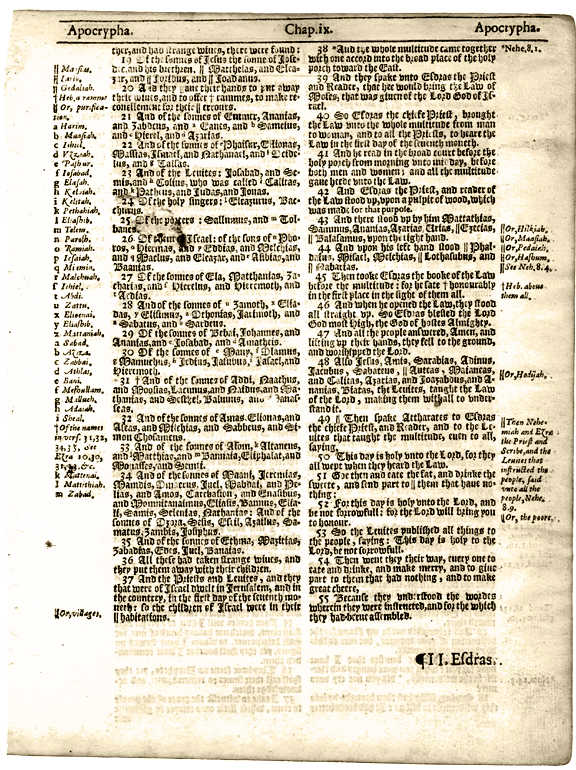 This
Leaf is part of my collection, it is from the 1625 King James Version Printed by Richard
Norton and John Bill The "printers to the Kings moft excellent Majestie". This
printing has become fondly know among collectors a the "Last Edition" because of
the year of its Printing. This was The LAST edition published During the reign of King
James the first of England. This leaf is from the "Apocrypha"
book of fist Esdres chapter ix, we see that verse 45 says in the margin " Heb. aboue
[above] them all"
 |
|
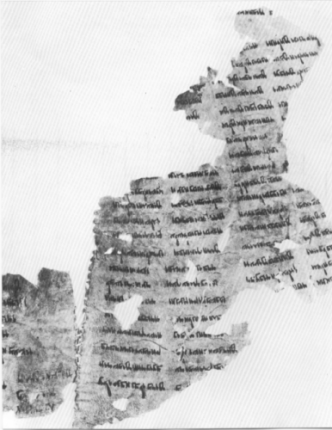
This is a picture is a fragment of the Ecclesiasticus scroll, found in Hebrew language, discovered by Yigael Yadin in the ruins of Masada in the 1960's. |
So do I say to Alexander McClure, You will have to find another pretext for taking these books out of the Canon, for the one which you have used does not justify the removal of several of the Deuterocanonical books.
Furthermore, I would like to ask Mr. McClure upon what does he base his assumption that any books of the Old Testament that are not written in Hebrew are not canonical? If he presumes to base his assumption upon a Bible verse, then I must ask him to provide this verse (or verses if there be more than one), that says that any book of the Old Testament which was not written in Hebrew is not canonical.
If Mr. McClure cannot support his position with a verse from the Sacred Scriptures, then he has violated Protestant belief system of "Sola Scriptura" and is relying upon an authority outside the Bible. If he can support his position with a verse from the Sacred Scripture, we must ask him to provide us with proof (extra-biblically) that the book which he cites is Sacred Scripture. For more on this subject visit this Link.
2.Not one of the writers lays any claim to inspiration.
Is it necessary for the author of a book to lay a claim to inspiration in order for the book to be inspired? If this is so, then let our opponent prove this point through the Sacred Scriptures - which he claims to hold as his sole written doctrinal authority. Furthermore, a claim of inspiration is not proof of anything for or against the book. For even the Koran claims to be inspired -- and I don’t know of any Christian who would want to include that in the Bible on that claim.
Mr. McClure can't show us where the authors of many of the books of the Old Testament claimed inspiration. A good example is the book of Esther which does not even mention God, let alone any claim of his inspiration.
3.These books were never acknowledged as sacred Scriptures by the Jewish church, and therefore were never sanctioned by our Lord.
As to the Question of the books being "acknowledged as sacred Scriptures by the Jewish church", this is gone in to in depth at the following link: "The Acceptance LXX and the Apocrypha in First Century Judea":
The above link does a very good job showing that the Septuagint and the 'Apocrypha' were accepted and used by the first century Jews in Judea.
In the above statement as to these books being "sanctioned by our Lord", I again hope that our Alexander McClure was acting in good faith and out of ignorance. If Mr. Alexander McClure had just look at 1611 King James Version (the book he was defending) he would have found eleven New Testament verses that the Protestant translators felt were quotes from "Apocrypha" books, and in the margin notes they cross-referenced them as such.
| Mat 6:7 | Ecclesiasticus 7:14 |
| Mat 23:37 | 2 Esdras 1:30 |
| Mat 27:43 | Wisdom 2:15-16 |
| Luke 6:31 | Tobit 4:15 |
| Luke 14:13 | Tobit 4:7 |
| John 10:22 | 1 Maccabees 4:59 |
| Rom 9:21 | Wisdom 15:7 |
| Rom 11:34 | Wisdom 9:13 |
| 2 Cor 9:7 | Ecclesiasticus 35:9 |
| Heb 1:3 | Wisdom 7:26 |
| Heb 11:35 | 2 Maccabees 7:7 |
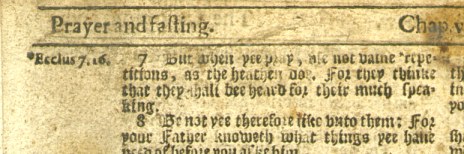
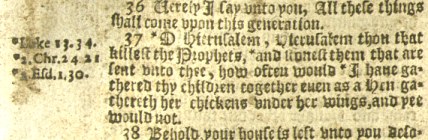
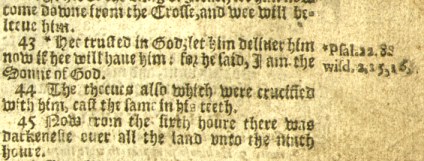
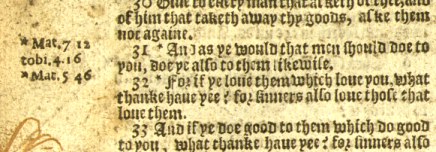
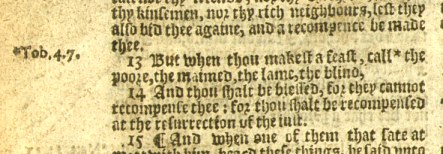
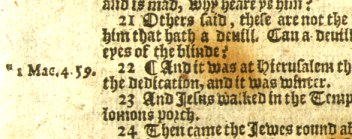
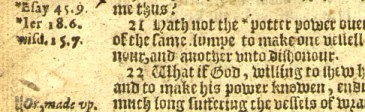

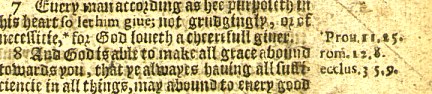
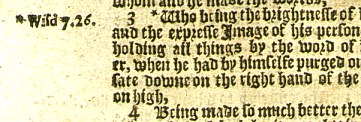
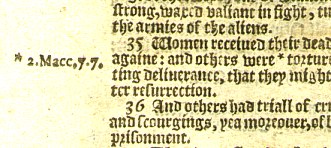
The above links are to images taken from the 1625 King James Version, Printed by Bonham Norton and John Bill The "printers to the Kings moft excellent Majestie". This Bible is part of my collection.
4.They were not allowed a place among the sacred books, during the first four centuries of the Christian church.
This statement is utterly and completely ridiculous! The fact that they were "allowed a place among the sacred books" is sufficiently shown by the following citations from the Councils of Rome, Carthage, and Hippo:
(Council of Rome [A.D. 382])
"Now indeed we must treat of the divine Scriptures, what the universal Catholic Church accepts and what she ought to shun. The order of the Old Testament begins here: Genesis, one book; Exodus, one book; Leviticus, one book; Numbers, one book; Deuteronomy, one book; Joshua [Son of] Nave, one book; Judges, one book; Ruth, one book; Kings, four books [that is, 1 and 2 Samuel and 1 and 2 Kings]; Paralipomenon [Chronicles], two books; Psalms, one book; Solomon, three books: Proverbs, one book; Ecclesiastes, one book; Canticle of Canticles, one book; likewise Wisdom, one book; Ecclesiasticus, one book . . . . Likewise the order of the historical [books]: Job, one book; Tobit, one book; Esdras, two books [Ezra and Nehemiah]; Esther, one book; Judith, one book; Maccabees, two books" (Decree of Pope Damasus).(Council of Hippo [A.D. 393])"[It has been decided] that besides the canonical Scriptures nothing be read in church under the name of divine Scripture. But the Canonical Scriptures are as follows: Genesis, Exodus, Leviticus, Numbers, Deuteronomy, Joshua the Son of Nun, Judges, Ruth, the Kings, four books, the Chronicles, two books, Job, the Psalter, the five books of Solomon, the twelve books of the Prophets, Isaiah, Jeremiah, Daniel, Ezekiel, Tobit, Judith, Esther, Ezra, two books, Maccabees, two books . . ." (canon 36).
(Council of Carthage III [A.D. 397])"[It has been decided] that nothing except the canonical Scriptures should be read in the Church under the name of the divine Scriptures. But the Canonical Scriptures are: Genesis, Exodus, Leviticus, Numbers, Deuteronomy, Joshua, Judges, Ruth, four books of Kings, Paralipomenon, two books, Job, the Psalter of David, five books of Solomon [Proverbs, Ecclesiastes, Song of Songs, Wisdom, Sirach], twelve books of the Prophets, Isaiah, Jeremiah, Daniel, Ezekiel, Tobit, Judith, Esther, two books of Esdras, two books of the Maccabees . . ." (canon 47).
All the above Councils occurred before the end of the fourth century. After one reads the above decrees, the ridiculousness of the fourth reason given by my opponent for the rejection of the Deuterocanonical books is simply and utterly ridiculousness. Now it is up to my opponent to show that the above Councils did not have authority equal to that of the Jews when it comes to the question as to which books are a part of the Canon of the Bible.
St. Clement of Alexandria in the year 202 A.D., cites the book of "Sirach" (21:6) as "Scripture" (11), as well as the book of Tobit (12). While Hippolytus cites the book of Baruch as Scripture (13). Origen defended the canonicity of Susanna [Daniel 13], Bel and the Dragon [Daniel 14], the prayers of Azarias [Daniel 3] and the hymn of praise of the three youths in the fiery furnace [Daniel 3] in his Epistle to Julius Africanus around the year 254. While in the year 248 A.D., Origen cited the book of Sirach 21:28 as Scripture. (14) The following citation from Origen citing the Book of Maccabees as Scripture shows that it was accepted at that time (230 A.D.):
"But that we may believe on the authority of holy Scripture that such is the case, hear how in the book of Maccabees, where the mother of seven martyrs exhorts her son to endure torture, this truth is confirmed; for she says, ' ask of thee, my son, to look at the heaven and the earth, and at all things which are in them, and beholding these, to know that God made all these things when they did not exist.'[2 Maccabees 7:28]", (15)
St. Cyprian in 252-258 A.D., cites the books of Tobit (16), Sirach (17), and the story of the three youths in Daniel 3:37-43 (18), as Scripture several times in his writings. I could easily double or even triple this list of Early Christians who considered the Deuterocanonical books to be Scriptural, but I believe that this, the fourth reason given by the anonymous author of the article in question for rejecting the Deuterocanonical books, is sufficiently refuted by the information given above - and cannot be his real reason for rejecting them. Hence, we are forced to believe one of two things, either 1) he’s completely ignorant of the subject at hand, 2) he is attempting to deceive the readers of his book.
Secondly, This argument provided by Mr. McClure is self defeating, for there are many canonical books, which Protestants holds as "inspired Scripture", which were disputed in the church during the first four centuries after Christ, some examples are:
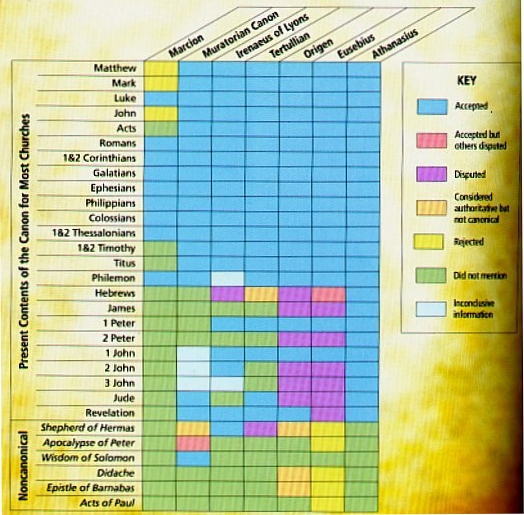
: Irenaeus of Lyons lists it as disputed. Tertullian this epistle as not canonical . Both Origen and the forth century historian Eusebius puts this epistle among the Antilegomena or contested writings. (Hist. eccl., III, 25, 3)Hebrews
The Epistle of James:
In the first centuries of the Church the authenticity of the Epistle was doubted by some, It is wanting in the Muratorian Canon, and because of the silence of several of the Western Churches regarding it, the forth century Christian historian Eusebius classes it amongst the Antilegomena or contested writings (Hist. eccl., III, 25, 3); St. Jerome gives the like information (De vir. ill., ii), but adds that with time its authenticity became universally admitted.Second Peter
: In the first two centuries there is not in the Apostolic Fathers and other ecclesiastical writers, if we except Theophilus of Antioch (180), a single quotation properly so called from this Epistle. In the Western Church there is not explicit testimony in favour of the canonicity and Apostolicity of this Epistle until the middle of the fourth century. Tertullian and Cyprian do not mention it. The forth century Christian historian Eusebius classes it amongst the Antilegomena or contested writings (Hist. eccl., III, 25, 3)Second John
: Tertullian does not list this epistle in the sacred canon. Both Origen and the forth century Christian historian Eusebius puts this epistle among the Antilegomena or contested writings.(Hist. eccl., III, 25, 3)Third John:
Tertullian does not list this epistle in the sacred canon. Both Origen and the forth century historian Eusebius puts this epistle among the Antilegomena or contested writings. (Hist. eccl., III, 25, 3)The Epistle of Jude
: Tertullian does not list this epistle in the sacred canon. Both Origen and the forth century historian Eusebius puts this epistle among the Antilegomena or contested writings. (Hist. eccl., III, 25, 3)The Apocalypse
[or the book of Revelations]: the forth century historian Eusebius the tells us "The Apocalypse is by some accepted among the canonical books but by others rejected" (Hist. Eccl., III, 25, 4). St. Cyril of Jerusalem does not name it among the canonical books (Catech. IV, 33-36); nor does it occur on the list of the Synod of Laodicea, or on that of Gregory of Nazianzus.So we see that if we use Mr. Cloud’s standard for qualifying the canon of the scriptures, we will have to reject far more than Just the the books he calls "Apocrypha".
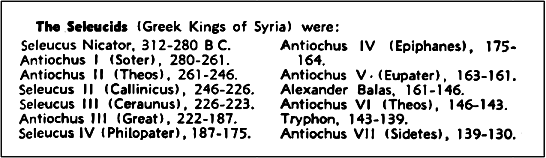
5.They contain fabulous statements, and statements which contradict not only the canonical Scriptures, but themselves. For example, in the Books of Maccabees alone, Antiochus Epiphanes dies three times in three places!
I’ve checked both books, and have only been able to locate one time that Antiochus Epiphanes died . But, as it is, there were several Kings in the Maccabees with the title of "Antiochus." Epiphanes was the fourth one to take the name of Antiochus. Hence, we see another misinterpretation of Sacred Scripture.
But even if this were true (which it is not) does it necessarily follow that we must reject the books of the Maccabees? If so than by this same Protestant logic we must reject the First and Second books of Samuel and First Chronicles as well, for in them we find four very different accounts of how King Saul Died. First Samuel (31:4) says that Saul "Took a Sword, and Fell upon it". Were as Second Samuel (1:2-10) says Saul, at his own request, was slain by an Amalekite. Later in Second Samuel (21:12) we read that Saul was killed by the Philistines on Gilboa. then we read in First Chronicles (10:13-14) that Saul was slain by God.
6.It inculcates doctrines at variance with the Bible, such as prayers for the dead and sinless perfection.
Once again Alexander McClure is resorting to circular logic in his "arguments." He says, basically, in order for a book to be Canonical and Biblical, all the doctrines that it teaches must be reconcilable with what is taught elsewhere in the Bible... but how does he know that the books he is referring to are canonical? How does he know that any of the books in the Bible are canonical? Especially if he uses his above-given "reason" as a determining factor.
The danger of circular logic, is that it is not founded on the pillar of evidence or truth. The same arguments are to be made against the other books of the Bible. "No, the other books of the Bible are not true because they do not match what Maccabees says." The point is, where is the starting point? There is no pillar of truth to sit on. The same argument can be used against the other books of the Bible. For example, in Joshua 2:4-6 the woman lied in order to save the lives of some scouts which Joshua sent out to find out the "lay of the land." And when Joshua’s army took over the city, all the houses of everyone but the woman were burned. The woman was rewarded for her actions! Whereas we see in Exodus 20:16 that lying is forbidden! Does that mean that we should discard Exodus? Or Joshua? According to the circular logic of the anonymous author, we must discard one or the other. Which one is it to be?
The point is, when an ignorant person (with no exterior source of truth to appeal to) attempts to build up his own religion through reading a book, there are bound to be misunderstandings. For example, in the above-given case concerning the book of Joshua. At first glance, they look contradictory. But upon further though/reading, it becomes apparent that the woman was not being rewarded for lying, but for saving the life of the two scouts. Period. Hence, it wasn’t contradicting the book of Exodus at all. The same applies to the book of Maccabees. The anonymous authors’ alleged "contradictions" are nothing more than the products of - already blatant (19) - ignorance and circular logic.
Furthermore, I ask the reader to note that the anonymous author is rejecting the Deuterocanonical books on his own private interpretation of the remainder of Scripture. In his opinion, the Deuterocanonical books contradict the rest of the Bible. In his opinion, the Deuterocanonical books are apocryphal, and non-canonical. In his opinion, what they teach is false. What we have here, is not fact... it is merely fallible human opinion. Which one is not obligated to accept and abide by - despite the opinion of the anonymous author to the contrary -, and which are not guaranteed to be without error.
7.It teaches immoral practices, such as lying, suicide, assassination and magical incantation.
In 1 Samuel, chapter 28, Saul has recourse to a witch for help, this witch actually brings back the spirit of the prophet Samuel. through the witch, Samuel prophases the death of Saul's two sons, and his defeat hand of the Philistines. Does that mean that the book was teaching "immoral practices," such as as the use of witchcraft and magical incantation? Or how about where Saul killed himself with his own sword in 1 Samuel, chapter 31? The point is, that throughout the Old Testament, immoral practices are to be found. They aren’t to be found in the Deuterocanonical books alone. But, of course, this does not mean that simply because they are in the Bible the books are promoting such practices as suicide, recourse to witches, adultery, and so forth.
1. No, private "inspirations" of the "spirit" are not consider evidence.
2. For to attempt to do the opposite would be to fall back upon circular logic.
3. The Catholic Controversy, p. 97.
4. The Catholic Controversy, p. 99.
5. Though I would like to point out that it is practically impossible to speak of any "Jewish church" as whole because it is split up into various denominations - as protestantism is.
6. Encyclopedia Judaica, vol. 6, p. 1147
7. Encyclopedia Judaica, vol. 6, p. 1147
8. New York Times, Dec. 10, 1928
9. Cf. Imperial Encyclopedia and Dictionary, Vol. 34. The Pocket Bible Dictionary, 1996. The Century Dictionary and Cyclopedia, 1904. A Dictionary of the Bible, 1954 p.799.
10. What Say You? p. 256-257.
11. The Instructor, I:8
12. The Stromata, 6:12
13. Against the Noetus, 2
14. Against Celsus,7:12
15. Fundamental Principles,2:2
16. Treatise 4,32
17. Treatise 7,9
18. Testimonies, 20. See also Treatise 4,8.
19. As it is, I believe that I have already proven the ignorance of my opponent on the subject at hand, not to mention his own circular logic.
20. Unlike my anonymous opponent, who has subtracted seven books from the Old Testament on the basis of seven reasons that he doesn’t even really believe himself.
21. My opponent has committed a serious error here... he shows 1) his lack of research, 2) his dishonesty, 3) though it is usual for an author to read his own article before publishing it on the net, it would seem that our opponent takes joy at being very "unusual" in his articles.
22. I ask the reader to note that this is the very self-same reason that he claims we have for defending the Deuterocanonical books.
23. As was stated earlier, our emphasis should be on facts and evidence, and on the Truth, rather than on our own personal fallible human opinion.