Additions to the KJV Derived From Latin Vulgate, Not in Greek Textus Receptus.

Most KJV advocates today often label the Latin Vulgate by Jerome a corrupt translation. They put the Vulgate on their tree or line of corrupt Bibles. Bob Steward, a KJV-only advocate, stated: "One of the grandest names behind the King James Bible is that of Erasmus" (Biography of Erasmus, p. 1). When we read about Erasmus [Who Derivid "Textus Receptus", the Greek text on which the KJV was based] we find he was known for his strong admiration for Jerome. This admiration is clearly evident in his book on the Life of Saint Jerome. Jerome, the translator of the Latin Vulgate, was the favorite church father of Erasmus (Who's Who in Christian History, p. 235). B. Hall commented: "For Erasmus, Jerome was the ideal of the true theologian" (Dorey, Erasmus, p. 84).
Edward F. Hills, a KJV defender, noted: "Erasmus, influenced by the usage of the Latin-speaking Church in which he was reared, sometimes followed the Latin Vulgate rather than the Traditional Greek text" (The KJV Defended, p. 200). In another book that defends the traditional text, Peter Johnston commented: "It should be mentioned that the Textus Receptus deriving from Erasmus has a considerable number of readings similar, not to the Majority Text, but to the Egyptian text, most importantly in the Gospels" (Unholy Hands, Vol. II, p. 578). Jay Green, another defender of the TR, acknowledged: "There are a few places where he [Erasmus] emended the text with poor evidence at hand" (Interlinear Greek-English N.T., p. xii). Since Erasmus admired Jerome, is it good for believers today to follow Jeromes views like he did?
The original printings of the King James Version also contained a Calender / Almanac for each individual month of the year. These included many feast paying honor to many early Christians and Catholic Saints on Sept. 30 we find St. Jerome, [He died at Bethlehem, 30 September, 420].
The Latin Vulgate was translated By St Jerome " a most learned father, and the best linguist without controversy, of his age, or of any that went before him,".(From the Translators' Preface to the 1611 KJV)
St Jerome undertook "the translating of the Old Testament, out of the very fountain with that evidence of great learning, judgment, industry, and faithfulness, that he had forever bound the Church unto him, in a debt of special remembrance and thankfulness." (From the Translators' Preface to the 1611 KJV)
The following are some fine examples of were the translators or the King James Version chose to follow the Catholic Latin Vulgate rather than the Greek texts:
- Matthew 27:35
- "that it might be fulfilled which was spoken by the prophet, They parted my garments among them, and upon my vesture did they cast lots." This verse appears properly in John 19:24.
- John 8:9-10
- Delete: "being convicted by their own conscience . . . unto the last . . . alone .
. . and saw none but the woman . . . those thine accusers."
The Greek properly reads: "But when they heard it, they went away, one by one, beginning with the eldest, and Jesus was left with the woman being before him. Jesus lifted himself up and said to her, 'Woman, where are they? Has no one condemned you?'"
- Acts 9:5-6
- "it is hard for thee to kick against the pricks. And he trembling and astonished said, Lord, what wilt thou have me to do? And the Lord said unto him . . . ."
- Acts 10:6
- "he shall tell thee what thou oughtest to do"
- Acts 10:21
- "which were sent unto him from Cornelius"
- Acts 21:8
- "that were of Paul's company"
- Romans 13:9
- "Thou shalt not bear false witness"
- Romans 16:20
- "Amen"
- Colossians 1:14
- "through his blood"
- Hebrews 2:7
- "and didst set him over the works of thy hands"
- Hebrews 11:13
- "and were persuaded of them and embraced them"
- Hebrews 12:20
- "or with a dart shot through"
- I John 2:23
- "(but) he that acknowledgeth the Son hath the Father also" is placed in italics in the KJV. The Greek Text omits this portion entirely.
- I John 5:7-8
- "in heaven, the Father, the Word, and the Holy Spirit: and these thee are one. And there are three that bear witness in earth" As previously explained, this is not part of the original Greek text.
- Revelation 1:8
- "the beginning and the ending"
- Revelation 1:11
- "I am Alpha and Omega, the first and the last: and . . . which are in Asia"
- Revelation 1:20
- "which thou sawest"
- Revelation 2:17
- "to eat of"
- Revelation 5:4
- "and to read"
- Revelation 5:14
- "four and twenty . . . him that lives forever and ever"
- Revelation 11:1
- "and the angel stood"
- Revelation 12:12
- "the inhabiters of"
- Revelation 14:5
- "before the throne of God"
- Revelation 15:2
- "over his mark"
- Revelation 16:7
- "another out of"
- Revelation 16:14
- "of the earth and"
- Revelation 21:3
- "and be their God"
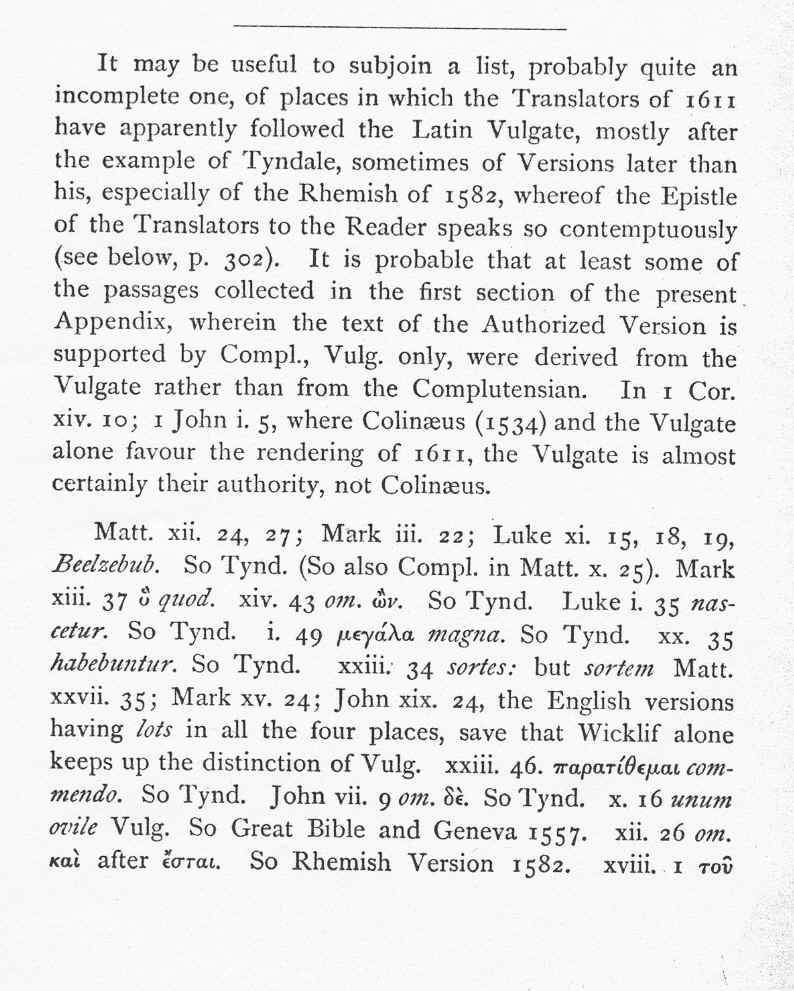
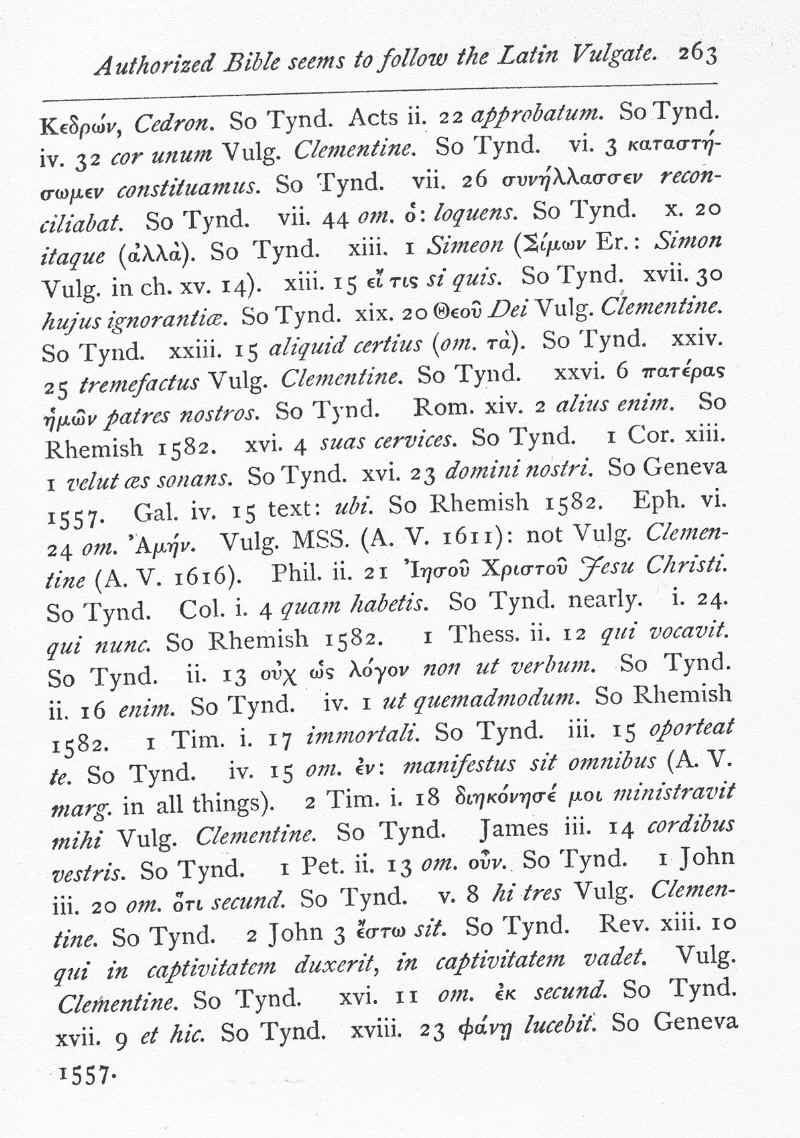
And then there is the fact of strong and repeated influence of Jerome’s Latin Vulgate translation on the King James Version, besides the influence of the Rheims NT. F. H. A. Scrivener, in his extensive study of the KJV (and Scrivener was universally recognized as the greatest 19th century expert on the KJV in its various editions) determined that in the NT, the KJV most closely follows the 1598 Beza Greek text. In about 190 places, though, the KJV NT abandons the reading of that edition for some other and earlier printed Greek text. In at least 60 additional places (a figure Scrivener grants as being likely well below the actual number), the KJV NT follows the reading of NO then-existing printed Greek text, but instead exactly follows the reading of the Latin Vulgate--“In some places the Authorised Version corresponds but loosely with any form of the Greek original, while it exactly follows the Latin Vulgate,” (F. H. A. Scrivener, The New Testament in Greek according to the Text Followed in the Authorized Version. Cambridge: University Press, 1881; p. ix. The appendix on pp. 655-6 gives a list of the places corresponding exactly with the Latin Vulgate against the Greek).