
The Translators of The KJV Guessed on
The Meaning of Many Words.
"Variety of Translations is profitable for the finding out of the sense of the Scriptures"
(The 1611 KJV Translators)

There are many people who mistakenly read the KJV on a regular bases, there are some who hold this Bible to superior to all other English versions. But how accurate is this translation? What about the translator how competent were they, is this English version really accurate enough to put our trust in it? It may come as a shock to many Protestants it know that in The original Preface to the King James Version of the translators themselves admitted there were many Hebrew and Greek words (lexicons) and whole sentences They did not understand, They were forced to GUESS there meanings.
|
This is a scan of the original leaf (page) from the Holy Bible, (King James translation) printed by Robert Barker at London, England in 1614. Quarto size Black Letter English language text arraigned in a single columns with margin notes in Italic Roman type.
CLICK HERE: to see a close up (and readable) scan of this page from a 1625 King James Version Printed by Richard Norton and John Bill The "printers to the Kings moft excellent Majestie".
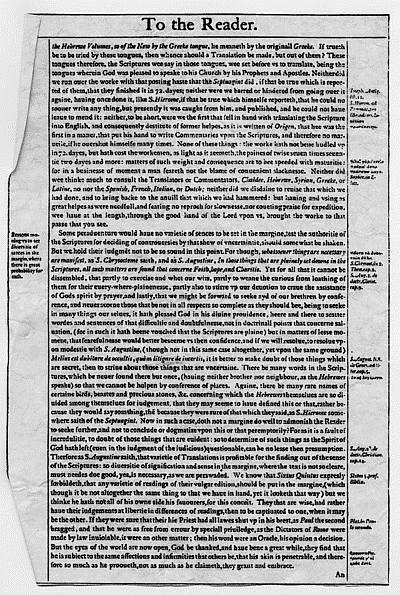
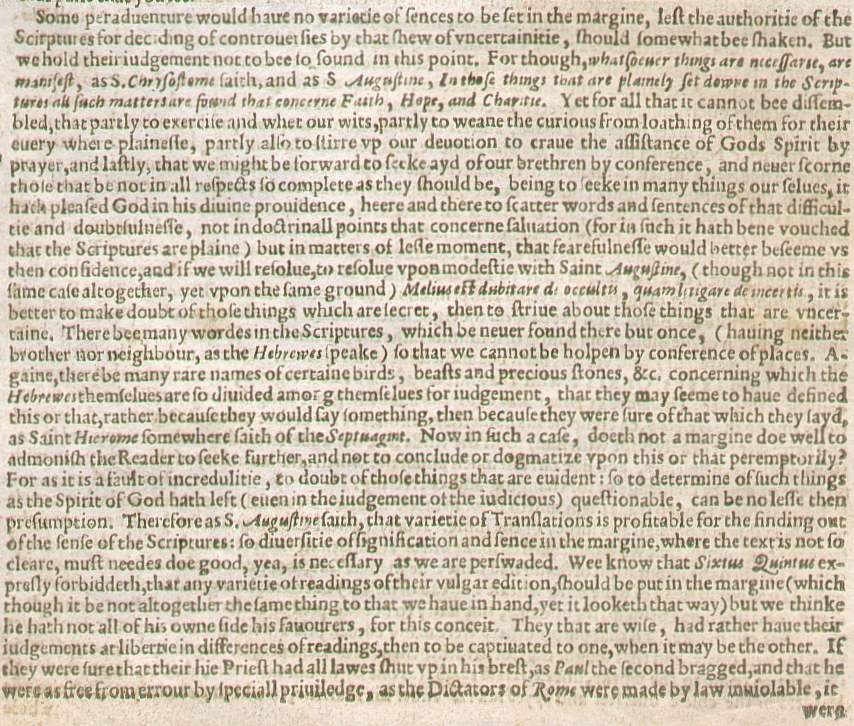
The translators never called there version a "infallible translation" as a mater of fact they acknowledged the need for correction of translations.
"Yet before we end, we must answer a third cavil and objection of theirs against us, for altering and amending our Translations so oft; wherein truly they deal hardly, and strangely with us. For to whomever was it imputed for a fault (by such as were wise) to go over that which he had done, and to amend it where he saw cause?" (emphasis added) [ From the "THE TRANSLATORS TO THE READER]
"But the difference that appeareth between our Translations, and our often correcting of them, is the thing that we are specially charged with; let us see therefore whether they themselves be without fault this way, (if it be to be counted a fault, to correct) and whether they be fit men to throw stones at us: O tandem maior parcas insane minori: they that are less sound themselves, out not to object infirmities to others. [Horat.]" (emphasis added) [From the "THE TRANSLATORS TO THE READER]
The KJV translators also included variant readings in the margins, indicating their uncertainty concerning the correct reading. The original 1611 edition contained 4,223 marginal notes giving a more literal translation and another 2,738 alternative readings that in the opinion of the translators were "not very less probable than those in the text." As the Protestant scholar Edward Hills pointed out "As the marginal notes indicate, the King James translators did not regard their work as perfect or inspired, but they did consider it to be a trustworthy reproduction of God's holy Word." (emphasis added) [The King James Version Defended pg. 216]
We must remember that these Margin Notes explaining "the Greek or Hebrew words" were one of the Fifteen general rules were set forth in advance By King James himself for the guidance of his translators of his version of the Bible:"6 No marginal notes at all to be affixed, but only for the explanation of the Hebrew or Greek words, which cannot without some circumlocution, so briefly and fitly be expressed in the text." [As found in "The Church History Of Britain" by Thomas Fuller, Oxford, M.DCCC.XLV]
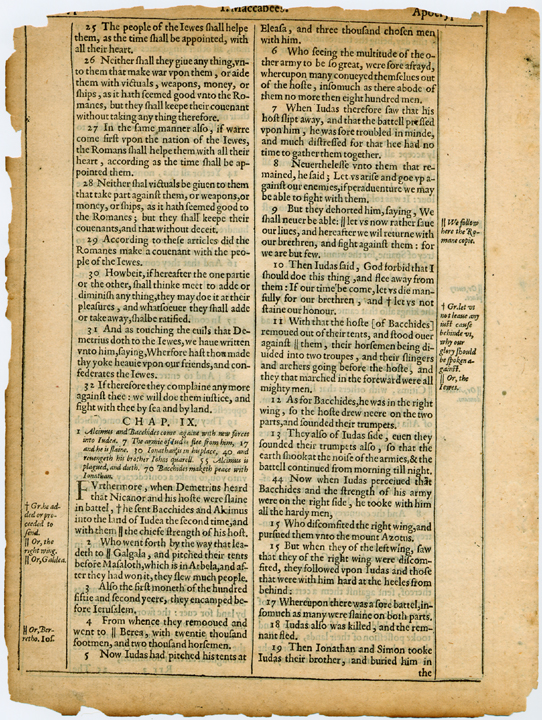 This Leaf is from the 1612 printing of the King James Version "Apocrypha" First book of the Maccabees.
9:2 Says "to Galgala" the foot note says "or Galilea"
9:4 Says "went to Berea" the foot note say "or, Berretho"
9:9 The margin note says "we follow here the Roman copie" this is the Catholic Latin vulgate.
This page a leaf is part of my collection from the 1612 printing by Robert Barker, the King’s Printer, London of the King James Version
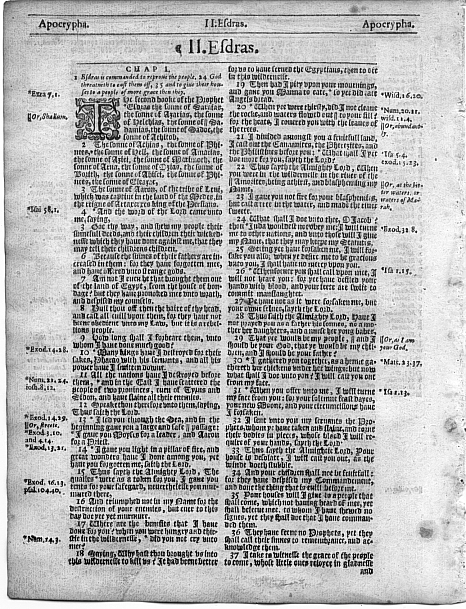 This
Next Leaf also is part of my collection from the 1625 King James Version Printed by
Richard Norton and John Bill The "printers to the Kings moft excellent
Majestie". This printing has become fondly know among collectors a the "Last
Edition" because of the year of its Printing. This was The LAST edition
published During the reign of King James the first of England.
This leaf is from the "Apocrypha" book of fist Esdres This is a very fine example of the confusion
found in the early King James Versions. Here, we find that from verse 9:19 to 9:31 [A
total of 12 verse] the translators put a incredible 41 optional renderings of the
words in the margin notes. Verses 9:43 and 9:44 together have a total of four possible
translations listed in the margins.
We also find this same translation confusion as to the proper meaning in the new Testament. This Leaf is from the 1615 printing of the King James Version [by Robert Barker, the King’s Printer, London] Second book of Peter.
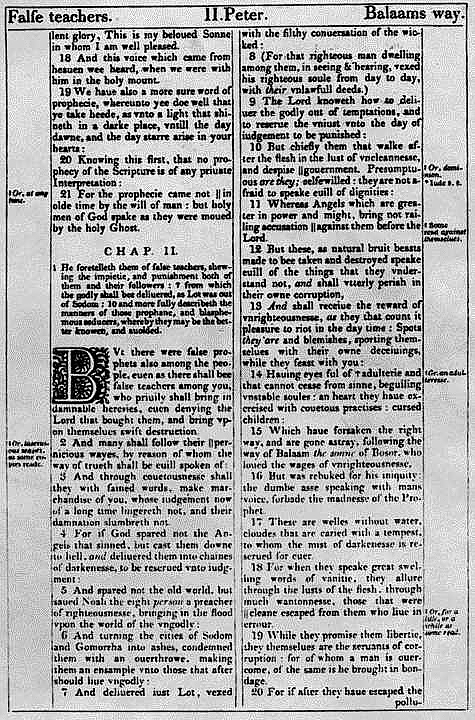 10:21 Says "in
olde time" the foot note says "or at any time"
11:2 Says "pernicious wayes" the foot note says "or lasciusous ways"
11:10 Says "government" the foot note says "or dominion"
11:11 Says "against them" the foot note says "or against themselves"
11:14 Says "adulterie" the foot note says "or adutteresse"
11:18 Says "were cleane" the foot note says "or for a litle, or a while" (NOTE: This verse has three possible translations)
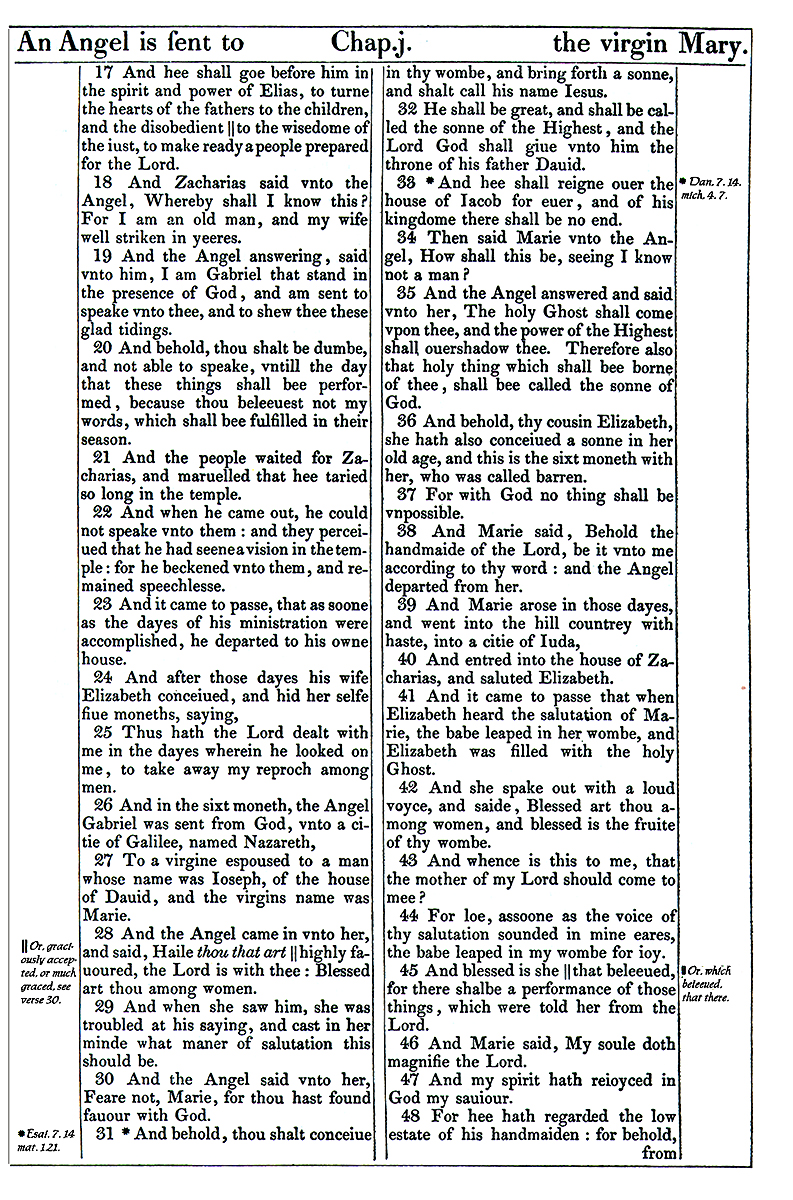 This
Next Scan is from the Thomas Nelson reprint of the 1611 King James
Version of the Bible. This Scan is from the Gospel of Luke.
1:28 Also has three possible translations the Text says "Highly Fauoured [favoured]" while the Margin notes "or graciously accepted, or Much Graced"
When reading this we should remember the translators own words on the subject of Margin-Notes:
"Doth not a margin do well to admonish the Reader to seek further, and not to conclude or dogmatize upon this or that peremptorily?...variety of Translations is profitable for the finding out of the sense of the Scriptures: so diversity of signification and sense in the margin, where the text is no so clear, must needs do good, yea, is necessary, as we are persuaded." (emphasis added) [From the "THE TRANSLATORS TO THE READER]
Here is a Small listing of some of the other "alternative readings" found in the Margins of the 1611:
Verse Reference: Actual KJV Text: KJV Translators' Note How The Original
Languages Might be Read:Gen 11:3 "they said to one another" "a man said to his neighbor" Exo 18:16 "one and another" "a man and his fellow" Lev 22:12 "a stranger" "a man a stranger" Num 22:11 "I shall be able to overcome them" "I shall prevail in fighting against him" Num 26:54 "give the more inheritance" "multiply his inheritance" Num 26:54 "give the less inheritance" "diminish his inheritance" Num 33:54 "give the more inheritance" "multiply his inheritance" Num 33:54 "give the less inheritance" "diminish his inheritance" Deut 3:18 "all that are meet for the war" "all that are sons of power" Deut 32:5 "They have corrupted themselves" "He hath corrupted to himself" 1 Sam 10:11 "one to another" "a man to his neighbor" 1 Sam 11:7 "with one consent" "as one man" 1 Sam 26:16 "ye are worthy to die" "ye are the sons of death" 1 Sam 30:22 "those" "men" 1 Sam 31:3 "archers" "shooters, men with bows" 2 Sam 2:7 "be ye valiant" "be ye the sons of valour" 2 Sam 13:28 "valiant" "sons of valour" 2 Sam 22:45 "strangers" "sons of the stranger" 1 Chron 12:29 "kindred" "brethren" 1 Chron 16:19 "few" "men of number" 2 Chron 2:17 "the strangers" "the men the strangers" Ezra 4:1 "children of the captivity" "sons of the transportation" Job 19:19 "my inward friends" "the men of my secret" Psa 12:7 "them" "him" Psa 18:14 "the strangers" "the sons of the strangers" Psa 29:1 "ye mighty" "ye sons of the mighty" Psa 41:9 "mine own familiar friend" "the man of my peace" Psa 119:24 "my counsellors" "men of my counsel" Psa 140:11 "an evil speaker" "a man of tongue" Prov 3:31 "the oppressor" "a man of violence" Prov 11:13 "A tale-bearer" "He that walketh being a talebearer" Prov 22:7 "lender" "man that lendeth" Prov 28:24 "a destroyer" "a man destroying" Prov 29:10 "The bloodthirsty" "The men of blood" Prov 31:5 "any of the afflicted" "all the sons of the afflicted" Prov 31:8 "such as are appointed to destruction" "such as are the sons of destruction" Ecc 2:7 "servants born in my house" "sons of my house" Isa 12:6 "inhabitant" "inhabitress" Isa 13:8 "one at another" "every man at his neighbor" Isa 22:17 "mighty captivity" "the captivity of a man" Isa 44:11 "they" "the men" Isa 44:12 "they" "the men" Isa 44:12 "them" "the men" Jer 10:17 "inhabitant" "inhabitress" Jer 13:14 "one against another" "a man against his brother" Jer 20:10 "all my familiars" "every man of my peace" Jer 21:13 "inhabitant" "inhabitress" Jer 22:23 "inhabitant" "inhabitress" Jer 26:23 "common people" "sons of the people" Jer 38:22 "friends" "men of thy peace" Jer 48:19 "inhabitant" "inhabitress" Dan 10:21 "none that holdeth" "none that strengtheneth himself" Joel 3:6 "Grecians" "sons of the Grecians" 2 Pet 2:14 "adultery" "adulteress"