
Were the Translators of the 1611King's Bible themselves KJV Onlyists?
The Answer is "NO"

The very translators of the 1611 King's Bible in there preface ["To the Reader"] openly reject the theory held by today's KJV Onlyists, that the King James Version is the only true "word of God"
"Now to the latter we answer; that we do not deny, nay we affirm and avow, that the very meanest translation of the Bible in English, .... containeth the word of God, nay, is the word of God."
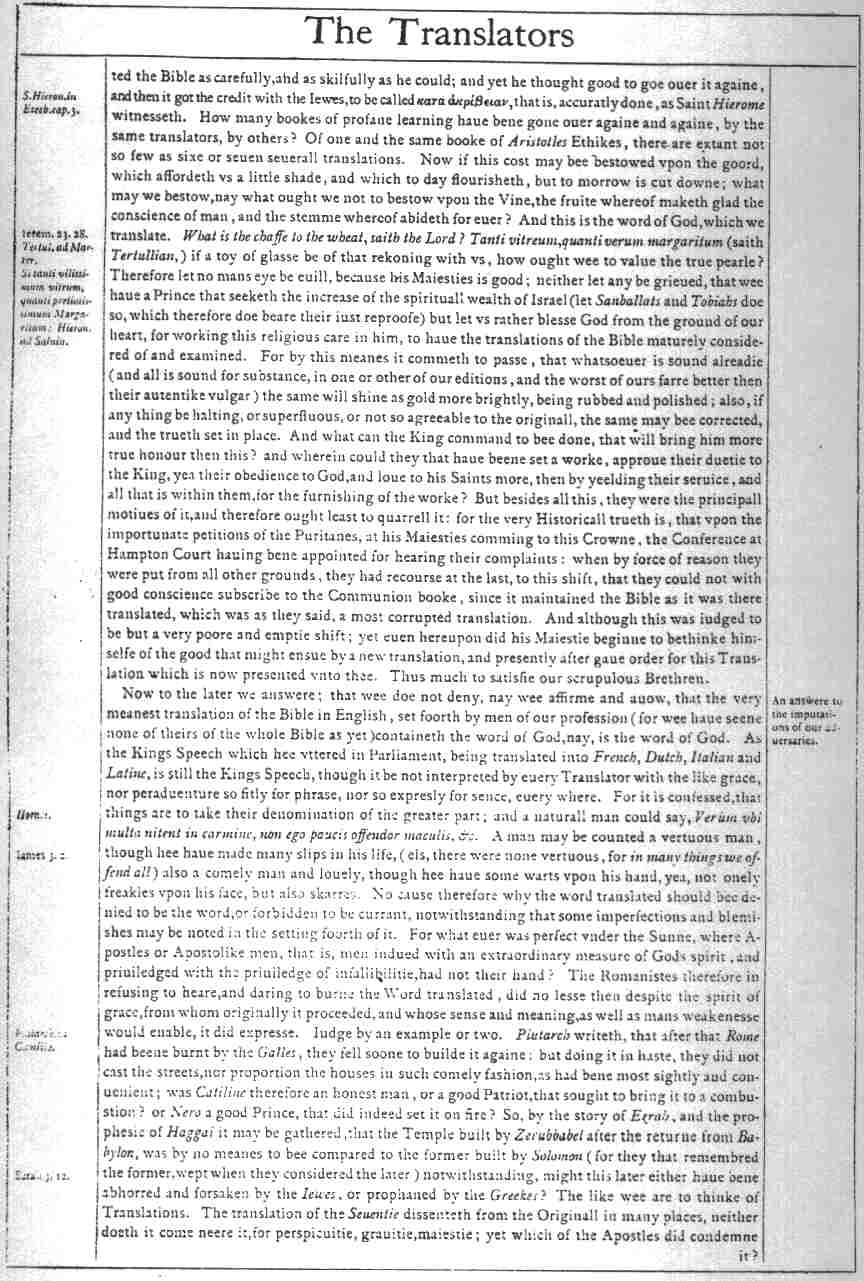
The 1611 translation comity held that any translation even if it should have "some imperfections and blemishes" should not be denied as "the word of God", or forbidden to be used:
"No cause therefore why the word translated should be denied to be the word, or forbidden to be current, notwithstanding that some imperfections and blemishes may be noted in the setting forth of it."
The Translators of the 1611 KJV stated in the preface that they felt older the English versions already in existence before their translation were "good" and that "variations of translations is profitable" for finding out the true sense of the scriptures. The Truth is, the Translators of the King's Bible didn't trust there own version as being the "Perfect" translation. For many Years after the completion of the translation, most of them chose to use other older translations [such as the Geneva, and Bishops Bible ].


"It was some time before men such as Miles Smith, Lancelot Andrewes, and others quoted from the Bible on which they had worked so diligently"(King James History, 1982, Pg. 23)
One reason for there lack of trust in there own translation was the influence of the Church of England on the work. The finished work of the KJV translators did not satisfy The Anglican Archbishop Richard Bancroft [King James I had selected oversee the project] . The Archbishop had to make some changes in the translation before it was even published. Paine noted that Miles Smith, final Editor of the KJV with Thomas Bilson, "protested that after he and Bilson had finished, Bishop Bancroft made fourteen more changes" (MEN BEHIND THE KJV, p. 128).
The reason for these fourteen changes were made was to support Episcopalian church government views of the Church of England. The changes were also in direct contravention of Puritan beliefs of some of the translators.The Changes were also in violation of the original rules set up for the translation of the KJV. These fourteen changes were made even though some of the KJV translators expressed there opposition that these changes were wrong.
Another reason for the translators hesitancy to use the KJV is found in The original Preface to the King James Version were the translators themselves admitted there were many Hebrew and Greek words (lexicons) and whole sentences They did not understand, They were forced to GUESS there meanings.
The KJV translators also included variant readings in the margins, indicating their uncertainty concerning the correct reading. The original 1611 edition contained 4,223 marginal notes giving a more literal translation and another 2,738 alternative readings that in the opinion of the translators were "not very less probable than those in the text." As the Protestant scholar Edward Hills pointed out "As the marginal notes indicate, the King James translators did not regard their work as perfect or inspired, but they did consider it to be a trustworthy reproduction of God's holy Word." [The King James Version Defended pg. 216]
Eighteen years after the original translation was published Dr. Samuel Ward and John Bois, [both of who had worked on the original translation of the King James Version] felt the need to go back and do a significant revision of the King's Bible in a attempt to correct the many errors of the 1611 edition. This major revision was printed at Cambridge in 1629 AD.