
Was it "Wine" or "Grape Juice" at the last Supper?

In recent times there has been a move among certain Protestant groups to argue that Christ did not us a form of fermented wine at the last supper, rather they claim he used a form of nonalcoholic "Grape Juice". The scholars tell us that no unfermented wine is now know in Palestine, and there is no evidence of its use at any time:
"No unfermented wine is now know in Palestine, and there is no evidence of its use at any time."----("Peloubet’s Bible Dictionary", Edited by F. N. Peloubet, D.D., Copyright 1969, Page.738)
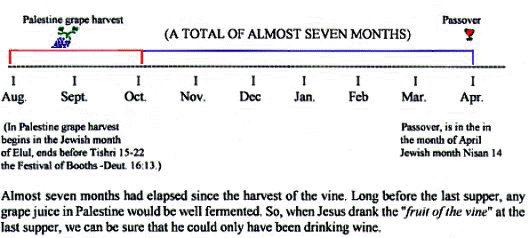
Even on the vine, the juice within the grapes is becoming wine because of the yeast and microbial activity at work in the grapes. This activity continues during and after the pressing of the grapes and extraction of the juice. Consequently, pure (i.e., non-alcoholic) grape juice was an impossibility until 1869, when Mister Welch succeeded in applying the process of pasteurization to freshly squeezed must. The "fruit of the vine" used by Christ at the Passover Feast could not have been grape juice, because of time considerations. The Palestine grape harvest begins in the Jewish month of Elul (August-September). The harvest is over before Tishri 15-21 (September-October), the Festival of Booths - Deuteronomy 16:13. Because the last supper was on Passover, at Nisan 14 (April), seven months had elapsed since the harvest of the vine.
Second, we know from the historic documents of the time that it was wine used at the Lord's Supper, many of the Early Christians also attest to the fact that Christ used wine at the last supper. The Early Church farther Tertullian Gives a wonderful explanation as to why our lord used wine at the last supper:
"He likewise, when mentioning the cup and making the new testament to be sealed 'in His blood,' affirms the reality of His body. For no blood can belong to a body which is not a body of flesh. If any sort of body were presented to our view, which is not one of flesh, not being fleshly, it would not possess blood. Thus, from the evidence of the flesh, we get a proof of the body, and a proof of the flesh from the evidence of the blood. In order, however, that you may discover how anciently wine is used as a figure for blood, turn to Isaiah, who asks, 'Who is this that cometh from Edom, from Bosor with garments dyed in red, so glorious in His apparel, in the greatness of his might? Why are thy garments red, and thy raiment as his who cometh from the treading of the full winepress?' The prophetic Spirit contemplates the Lord as if He were already on His way to His passion, clad in His fleshly nature; and as He was to suffer therein, He represents the bleeding condition of His flesh under the metaphor of garments dyed in red, as if reddened in the treading and crushing process of the wine-press, from which the laborers descend reddened with the wine-juice, like men stained in blood. Much more clearly still does the book of Genesis foretell this, when (in the blessing of Judah, out of whose tribe Christ was to come according to the flesh) it even then delineated Christ in the person of that patriarch, saying, 'He washed His garments in wine, and His clothes in the blood of grapes'--in His garments and clothes the prophecy pointed out his flesh, and His blood in the wine. Thus did He now consecrate His blood in wine, who then (by the patriarch) used the figure of wine to describe His blood." [Against Marcion,40(A.D. 212),in ANF,III:418-419]
The scholars tell us that in the many writings we have from the first and second centuries the term "Fruit of the vine" was common expression employed by both the Jews and Greeks as a synonym of wine which was capable of producing intoxication. This is supported by many statements from antiquity such as the one by the first century Jewish historian Flavius Josephus who said:
" for he let him know that God bestows the fruit of the vine upon men for good; which wine is poured out to him, and is the pledge of fidelity and mutual confidence among men; and puts an end to their quarrels " (Antiq. ii 5,2)
The Jewish Tractate Berakoth has this to say on the subject of "Fruit of the vine" and wine:
"What blessings are said over fruit? Over fruit of the tree one says, who Createst the fruit of the tree, except for wine, over which one says, who Createst the fruit of the vine." (Mishnah, Berakoth vi. 1)

Some Modern Protestant English translations of the sacred Scriptures such as:
- Christian Workers Edition
- Contemporary English Bible
- Dratmouth Version
- Good New Bible Living Bible
- Living Bible Paraphrased
- The Laymen’s Bible
- Modern Readers Bible
Simple say "Wine" instead of "Fruit of the vine".
Third, we know from the scriptures that it was wine from the way the Lord's Supper was celebrated in St. Paul's day. St. Paul wrote to the Corinthians, blasting them about abusing the bread and wine used in the Lord's Supper. "Therefore when you come together in one place, it is not to eat the Lord’s Supper. For in eating, each one takes his own supper ahead of others; and one is hungry and another is drunk." (1 Corinthians 11:20,21)
St. Paul went on to say, "Therefore whoever eats this bread or drinks this cup of the Lord in an unworthy manner will be guilty of the body and blood of the Lord. But let a man examine himself, and so let him eat of the bread and drink of the cup." (1 Corinthians 11:27,28)
Lastly, most scholars seem to agree that at the time Christ, wine (in a Alcoholic form) was a standard part of the Passover ritual among Jews in Judea, as the bellow listing shows this:
The Question of the Greek word "genematos" (The "Fruit [Gr. genematos] of the Vine")
The Question of the Greek word "oinos", (the wine used at the wedding feast)
a listing of a few other church fathers supporting the use of wine
Please sign our Guest book!
This page has helped
People find the truth since November 1999