
Apocrypha in the 1611 KJV and the "Geneva" Argument
The arguments refuted in this article were originally found on the "J.S. Bach's Ornament Table" a site set up to support and uphold the KJV.

Many ardent followers of the King James Version today attempt to negate the presence of "Apocrypha" in the original 1611 King James Version. They argue that the translators did not hold the "Apocrypha" Books as Scripture to prove this point they use the 1560 Geneva Bible. There argument goes something like this:
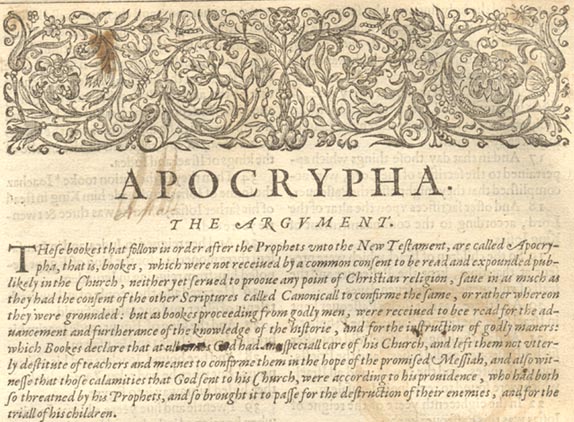
"The Some of the earlier [pre1611] English Bibles such as the Geneva had a disclaimer stating that the Apocrypha books were not inspired... the Geneva Bible of 1560 even preface the section with a special advisory...The Geneva Bible's prefatory notice deserves to be cited at length:
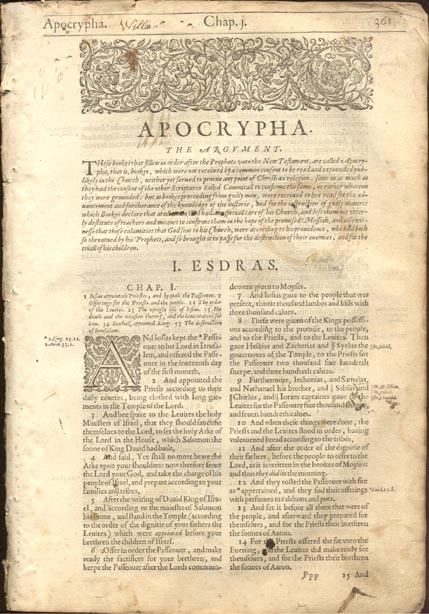
A close up or the "prefatory advisory notice" from the 1607 Geneva Bible, printed by Robert Barker in London 1607 A scan of the complete page. "These bokes that follow in order after the Prophetes vnto the Newe testament, are called Apocrypha, that is bokes, which were not receiued by a cõmune consent to be red and expounded publikely in the Church, nether yet serued to proue any point of Christian religion, saue in asmuche as they had the consent of the other Scriptures called Canonical to confirme the same, or rather whereon they were grounded: but as bokes proceding from godlie men, were receiued to be red for the aduancement and furtherance of the knowledge of the historie, & for the instruction of godlie maners: which bokes declare that at all times God had an especial care of his Church and left them not vtterly destitute of teachers and meanes to confirme them in the hope of the promised Messiáh, and also witnesse that those calamities that God sent to his Church, were according to his prouidence, who had bothe so threatened by his Prophetes, and so broght it to passe for the destruction of their enemies, and for the tryal of his children"It is true that the Geneva Bible showed open hostility twards these books, but we must not forget one VERY important point, the "Geneva" Bible was rejected by the Church of England (who translated the KJV ). The Anglican translators of the 1611 KJV in there preface also attacked and openly denounced this other Protestant translation for leaving the traditional Ecclesiastical words:
"Lastly, we have on the one side avoided the scrupulosity of the Puritans, who leave the old Ecclesiastical words, and betake them to other, as when they put WASHING for BAPTISM, and CONGREGATION instead of CHURCH:" [The original preface to the 1611 King James Version called "To The Reader"]
It is for this resin the pseudo-erudite English King James himself made the assertion that the Geneva version was, to his thinking "The worst that had so far appeared" (English Versions of The Bible, 1952 pg 229)
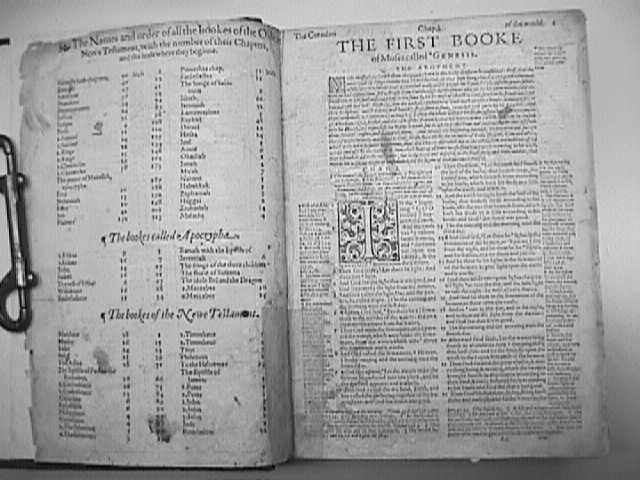
This is the table of contents from the 1577 Geneva Bible Printed by CHRISTOPHER BARKER, containing the "Apocrypha" Books. One of the reasons for the creation of this translation (the KJV) was to compete And battle against with it. At point's Possession of one of these Puritan "Geneva" Bibles in Anglican England at the time meant almost certain death. So weather or not there was a "disclaimer" in the Puritan "Geneva" DOES NOT have any bearing on what the translators of the KJV did or thought
"Even Some 1599 editions of the Geneva Bible were published without the Apocrypha."
In 1615, Archbishop Gorge Abbott, a High Commission Court member and one of the original translators of the 1611 KJV, "forbade anyone to issue a Bible without the Apocrypha on pain of one year's imprisonment" (Moorman, Forever Settled, p. 183). This order was likely aimed at the Geneva Bible with its 1599 edition printed without the Apocrypha.
"The first edition Geneva even Had marginal notes that criticize the text of the Apocrypha"
The Geneva had extensive marginal notes run to approximately 300,000 words, or one third the length of the text of the Bible itself! It was these marginal notes that were also the reason for its eventual demise. These strongly Protestant [Calvinistic] notes so infuriated King James that he considered Them "partial, untrue, seditious, and savouring of dangerous and traitorous conceits." and made its ownership a felony. James I was particularly worried about marginal notes such as the one in Exodus 1:9 indicated that the Hebrew midwives were correct in disobeying the Egyptian king's orders, [King James felt This undermined the theory of divine right of kings] and a note for 2 Chronicles 15:16 said that King Asa should have had his mother executed and not merely deposed for the crime of worshipping an idol."...it is supposed that James's suspicious mind thought that this might react unfavourably upon the memory of his own mother, Mary Queen of Scots." [Bruce, History of the Bible in English, p. 97] Consequently, King James eventually introduced the King James Version, which drew largely from the Geneva Bible (minus the marginal notes that had enraged him). The King James Version of the Bible grew out of the king's distaste for these brief but potent doctrinal commentaries. He considered the marginal notes to be a political threat to his kingdom. It was because of there rejection of James's theory of the "Divine right as king", That King came out openly condemning the Puritan Religion and it' s Bible:
"That Bishops ought to be in the Church, I ever maintained it as an Apostolic institution and so the ordinance of God, contrary to the Puritans, ... And as I ever maintained the state of Bishops and the Ecclesiastical Hierarchy for order sake, so was I ever an enemy to the confused anarchy or parity of the Puritans, [From A Premonition to All Most Mighty Monarchs, Kings, Free Princes, and States of Christendom Works, ed. James Montague, Bp. of Winchester (1616), pp. 301-308.]
It was during the reign of King James I (1566-1625), that England adopted harsh measures against the puritans which forced many of them [the Pilgrims] to flea England (1608), in order to escape religious persecution, they ended up in The Netherlands. The Pilgrims soon left the Netherlands and sailed for the new world , they arrived at Plymouth Rock aboard the Mayflower establishing the colony of Massachusetts in 1620[five years before the death of King James]. The Pilgrims brought with them there Geneva translation.
The irony is that even though openly condemning this Puritan Bible, until the version that was to bear his name was translated, King James I of England often used the Geneva. James I later tried to disclaim any knowledge of the Geneva Bible, though he quoted the Geneva Bible in his own writings. As a Professor Eadie reported it:
"his virtual disclaimer of all knowledge up to a late period of the Genevan notes and version was simply a bold, unblushing falsehood, a clumsy attempt to sever himself and his earlier Scottish beliefs and usages that he might win favor with his English churchmen."

Please sign our Guest book!
This page has helped
People find the truth since November 1999