The Evolution of a Heretical Bible,
"The King James Version"
"For we are not as many, which corrupt the word of God:" [2 Corinthians 2:17] Note: Tyndale's [1534] and Cranmer's [1539] said "which chop and change the word of God" a very accurate history of the King James Version.
A strange and new doctrine concerning the King James Bible is held by some today. It is said that the KJV is an absolutely "infallible" translation that "perfectly preserves the word of God in English" from 1611 to the present. In this insistence on absolute perfection for "every word" of the translation, it is common to hear some argue that the KJV has not undergone any significant "revision or change" since 1611. The Truth be told, from the very start the "Authorized Version" has gone through constant change, in order to correct the over 400 errors found in the first edition, and the countless other ones that in time worked there way into the KJV.
THE BEGINNING OF OUR STORY:In the summer of 1603, King James I was on his way to London to receive the English crown. During this time, he was presented with a list of grievances by those clergy with Puritan convictions. The King held a conference "for hearing and for determining of things pretended to be amiss in the church." The Puritan president of Corpus Christi College, John Reynolds moved his Majesty, that there might be a new translation of the Bible, because "those which were allowed in the reigns of Henry the eighth, and Edward the sixth, were corrupt and not answerable to the truth of the Original." [A Brief History of English Bible Translations by Dr. Laurence M. Vance.]. Dr. Reynolds, motion was opposed by the majority of the conference attendees. However, the King decided to proceed with the project anyway.
THE CREATION OF THE AUTHORIZED VERSION:
The "Translation" Committee of the King James Version was set up in a very specific structure it was composed of six panels of translators (47 men in all), two panels met respectively in Westminster, Cambridge and Oxford. Three panels were responsible for the Old Testament, two for the New Testament, and one One of the Cambridge Companies specifically for the "Apocrypha" Books, this last group composed of seven members was led by Dr. Bois. although the King nominated the translators to the number of fifty-four acutely only 47 actually took part in the work which, however--officially at least--they were in no hurry to begin; for, although named in 1604 and with all the preliminaries arranged before the end of that year, they did not begin their work till 1607.
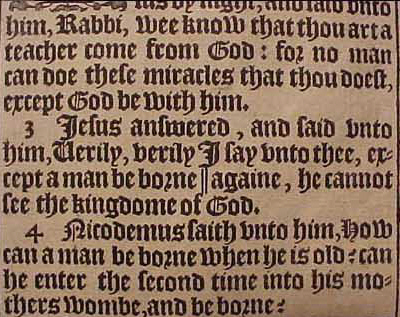
CAN YOU READ THIS?
This is a close up of John 3:3-4 and the Gothic type and old English spelling used in the original 1611 King James Version. The differences between the one commonly used today and the 1611 are obvious.
It has been shown that there were places were the translators of the 1611 even altered the word of God in order to please King James. One [of many possible] such example of this is I Cor. xiii:5 the translators added the word "easily".
"The English version [the KJV] here has the adverb 'easily,' which is not in the original. it is said that the translators inserted that word to save the Christian character of King James, who had a very high temper" [Translation of the New Testament by Rev. W.B. Godbey 1910 pg. 7]
you see this addition I Cor. 13:5 softens that which Christ made hard, and smoothes what God made rough; thus letting down God's standard of Christianity to the level of human feebleness.
Another example of this catering to the King's faults is found in 1Cor 6:9-10 were two different Greek words: malakos [homosexuals] and arsenokoites.[sodomites] were softened in there rendering by the 1611 translation comity, the KJV reads "effeminate... abusers of themselves with mankind". The translators did not wish to offend the King about his sexual preference.
When the translation and multiple revisions were done. the manuscript went to Archbishop Richard Bancroft for approval. In their preface to the King James Version, the Translators referred to Bancroft as the "chief overseer and task-master under his Majesty, to whom were not only we, but also our whole Church, much bound". Thus, Archbishop Bancroft was known for his determination to make everyone conform to the views of the State Church, the Church of England. He harassed and persecuted the Catholics, Puritans and other Non-conformists, including Baptists.
The finished work of the KJV translators did not satisfy Bancroft. This Archbishop had to make some changes in the translation before it was even published. Paine noted that Miles Smith, final Editor of the KJV with Thomas Bilson, "protested that after he and Bilson had finished, Bishop Bancroft made fourteen more changes" (Men Behind the KJV, p. 128).
Henry Jessey, a Baptist pastor in the early 1600's, also complained that Bancroft, "who was supervisor of the present translation, altered it in fourteen places to make it speak the language of prelacy" (Williams, Common English Version, p. 53). "Prelacy" refers to a Anglican system of church government by Prelates such as Archbishops and Bishops set over more than one local church.
After receiving it's approval, Bishop Belson and Miles Smith Delivered a hand written copy of the Bible to Robert Baker, the King’s Printer [who up until 1631 had exclusive Printing rights to this Bible], whose shop was in the Churchyard of St Paul’s.
There were three separate printings of the King’s Bible in the first year [1611]. these there printings are divided in to two groups, the "He Bible" and "She Bible". This is in reference to a error found in the last phrase of Ruth iii: 15. It should read "and she went into the city" but in the uncorrected first issue it reads "and he went into the city". The Protestant scholar Dr. Reagan's tells us that there were about 100 textual differences between the 1611 "He Bible" and the 1611 "She Bible":
The two original printings of the Authorized Version demonstrate the difficulty of printing in 1611 without making mistakes....Both were printed in the same year: 1611. The same printers did both jobs. Most likely, both editions were printed on the same printing press. Yet, in a strict comparison of the two editions, approximately 100 textual differences can be found. [The Answer Book, A Helpbook for Christians]
Most scholars agree, that the quality of the translation of some of the books of the 1611 KJV were poorly done.
The Protestant scholar Woolsey, D. D., LL.D., thus summarizes some of the defects in the 1611 KJV:"It is generally agreed that the Pentateuch, historical books, and prophets were well done, Job and the Psalms were not so well done, the epistles were also poorly done." (English Versions of the Bible, 1952, pg. 319)
"Our translators of the seventeenth century, in a great many instances, misunderstood the sense. To make this as evident as it may be made we should need to write a volume .... The main deficiency in our translation proceeds from want of exact knowledge of the Hebrew and Greek languages. Not only is the sense wholly misapprehended in a number of instances—as could scarcely fail of being the case—but a perception of the finer rules of grammar and interpretation was wanting. In the use of the article, of the tenses and modes of verbs, and of participles, and in a great variety of other instances," [The Revised New Testament and History of Revision, prepared under the direction of Professor Isaac H. Hall, LL.B.; Ph. D. printed in Philadelphia: Hubbard Brothers; Atlanta: C.R. Blackall & Co.; New York: A.L. Bancroft & Co., 1881]
The Fact is The original 1611 "Authorized Version" [as it came to be called] was so badly translated that it had to go through several revisions.
"More than 400 errors in the first edition of the King James Bible were corrected in a subsequent edition two years later." [NEIL LIGHTFOOT, How We Got the Bible pg. 59]
The Protestant scholar McGrath wrote:
"The annual 'privilege' enjoyed by the King's printer [Robert Barker] was brought at a considerable price, and had to recouped somehow. Cost savings introduced in the later phase of Barker's career included the reduction of the number of proofreaders used to check the text for errors. It is known that the four proofreaders employed by Barker in the 1630's were so fed up with the constant pressure to reduce their wages--or get rid of them altogether--that they appealed to the then-archbishop of Canterbury, William Laud, to intervene on their behalf" (In The Beginning: The Story of The King James Bible, P. 214).
This eventually lead to Baker loosing the right to print the King's Bible. One of the first errors entered the text as early as 1611, where, at Matthew 26:36, some AV. Bibles had "Then cometh Judas," when it should read "Then cometh Jesus." Other intriguing errors included...the deletion of "no" from "no more sea" at Revelation 21:1, the unrighteous inheriting the kingdom at 1 Corinthians 6:9, "printers have persecuted" rather than "princes have persecuted" at Psalm 119:161, the use of "sin on more" rather than "sin no more" at John 5:14, the "parable of the Vinegar" rather than "Vineyard" at Luke 20, Phillip denying Jesus rather than Peter at Luke 22:34, the use of "lions" instead of "loins" at 1 Kings 8:19, the use of "the fishes shall stand" rather than "fishers" at Ezekiel 47:10, the switching of "wife" for "life" at Luke 14:26, and the switching of "camels" and "damsels" with reference to Rebekah at Genesis 24:61. One original misprints to survive all of the revisions is the famous "strain (straine) at the gnat" in Matthew 23:24 (for "strain out a gnat"), which has so endeared itself to users of the King James that no modern publisher has the temerity to set it right.
Several times The Anglicans themselves burned Copies of the King James Version because of errors found in then. A example of this was the 1631 printing sometimes know as the "Wicked Bible" because of a error made by the Printer Robert Barker. The word "not" was left out of the 7th commandment say it said "Thou shalt commit adultery". England's King Charles I [a Anglican] was not amused by the mistake. He ordered the Bibles recalled and destroyed, took away Barker's license to print Bibles and fined him 300 pounds([a lifetimes wages in those days]. Barker was out of business. By order of the King almost 1000 Bibles was put to the torch, only 11 of this printing are left today. Over the years these type of printing problems and errors had a disastrous "snow ball" effect on the King James Version, as the Collier’s Encyclopedia explains:
"During the 17th and 18th centuries the text of the King James Version gradually became corrupted through mis-prints, despite a curious restriction of the right to print it. This right was held by the Royal printers, and the universities of Oxford and Cambridge the only exceptions." [Collier’s Encyclopedia 1967, Vol. 4, Pg. 130]
EARLY PROTESTANT OPPOSITION TO THE KJV:
Even from the very start many renowned Protestant scholars came out in opposition the Authorized version and to its inaccuracies, In the petition presented to king James by numbers of the Protestant clergy, page 75, they complain that
"the book of Psalms alone, differs from the Hebrew in at least two hundred places." (A Letter to a Protestant Friend on the Holy Scriptures, by Demetrius Gallitzin, pp. 58 - 72. Published 1819.)
In 1612 Dr. Hugh Broughton said in a critique addressed to the house of Lords:
"The late Bible (The 1611 King James version)... bred in me sadness that will grieve me while I breathe, it is so ill done... to his Majesty that I had rather be rent in pieces with wild horses, then any such translation by my consent should be urged upon the poor churches......the new edition crosseth me. I require it to be Burnt"(The Bible Through the Ages copyright 1996 p. 318)
Mr. Broughton, also wrote an epistle to the lords of the council, that
Another example is Dr. John Burges, moderate Puritan divine (1563-1635) who in his "Apology," sect. 6 excuses himself for not subscribing to the King's translation."the English translation perverts the text of the old testament in eight hundred and forty-eight places; and causes millions of souls to run to eternal flames." (A Letter to a Protestant Friend on the Holy Scriptures, by Demetrius Gallitzin, pp. 58 - 72. Published 1819.)
"How shall I approve," says he, "under my hand, a translation which has many omissions, many additions, which sometimes obscureth, sometimes perverteth the sense, being, sometimes senseless, sometimes contrary."
The Protestant ministers of the diocese of Lincoln affirm, that
"the English translation take's away from, and adds to, the text, and that, sometimes to the changing or obscuring the meaning of the Holy Ghost; a translation "which is absurd and senseless," &c. (See the Abridgment which the ministers of Lincoln delivered to his majesty, page 11.)
Mr. Carlisle, a Protestant divine, asserts that the
"English translators have depraved the sense of scripture, obscured the truth, and deceived the ignorant: that they shew themselves to love darkness more than light, falsehood more than truth." (See p. 116, 117 &c. of Christ's descending into hell.)
EARLY CHANGES AND REVISIONS OF THE KJV TEXT:
It is true that some of the errors of the 1611 edition were corrected in the 1613 printing. The variations between the 1611 and 1613 are about 375 in number, [exclusive of the apocrypha]. It is not known whether the variations of 1613 were printed under the supervision of the translators, and it probably cannot now be known. what we do know is the 1613 printing although correcting some of the 1611's faults it introduced many "new" errors.
"That the edition of 1611, although prepared with very great care, was not free from typographical errors; and that, while most of these were corrected in the editions of 1613, others in much greater number were nevertheless then introduced" (From The American Bible Society, Thirty-Sixth Report 1852)
1. MANIFEST ERRORS OF THE 1611 EDITION 1611 1613 and present copies Exo38:11 hoops of the pillars hooks of the pillars Lev 4:35 shall burnt them shall burn them Lev 13:56 the plaine be the plague be Lev 17:14 Ye shall not eat Ye shall eat Jer 5:24 rain...the later rain...the latter Jer 22:3 deliver the spoiler deliver the spoiled Jer 50:29 hath done unto her hath done, do unto her Ez 6:8 that he may have that ye may have Ez 24:7 poured it upon poured it not upon Hos 6:5 shewed them by the prophets hewed them by the prophets 2. MANIFEST ERRORS OF THE 1613 EDITION 1611 and present copies 1613 Gen 42:31 we said unto him we said unto them Lev 7:25 the fat of the beast the fast of the beast Lev 19:10 shalt not glean shalt glean Lev 26:24 also walk contrary also wake contrary Deut 19:5 slippeth from the helve slippeth from the helme 1 Kings 3:15 and offered peace offerings Omitted
1 Kings 20:3 even the goodliest even thy goodliest 2 Kings 22:3 eighteenth year of eighteenth were of 2 chron 6:10 in the room of David in the throne of David Job 29:3 I walked through darkness I shined through darkness Isaiah 59:7 shed innocent blood shed blood Hos 13:3 smoke out of the chimney smoke out the chimney Matt 13:8 some sixty fold Omitted
1 Cor 2:8 would confirm your love would continue your love 1 Cor 11:17 I praise you not, that I praise you that 3. OTHER VARIATIONS FROM THE READING OF 1611 1611 and present copies 1613 Gen 2:24 and shall cleav and cleave Gen 12:14 she was very fair she was fair Gen 27:44 fury turn away fury pass away Lev 26:40 the iniquity the iniquities Judges 16:30 upon all the people upon the people Isaiah 7:3 Ahaz, thou, and shear-jashub Ahaz, and Shear-jashub Isaiah 49:2 mouth like a sharp sword mouth a sharp sword John 5:3 a great multitude a great company Rev 2:18 feet are like fine brass feet are like brass Rev 5:4 no man was found worthy no man was worthy
The above is from From The American Bible Society, Thirty-Sixth Report 1852 The Minutes of the Report On Versions
Even the Translators of the King's Bible didn't trust there own version. For many Years after the completion of the translation, many of them chose to use other older translations [such as the Geneva, and Bishops Bible ].
"It was some time before men such as Miles Smith, Lancelot Andrewes, and others quoted from the Bible on which they had worked so diligently" (King James History, 1982, Pg 23)
It is also important to note that the fourteen Bible quotes found in the preface of the 1611 are not even KJV, they are direct citations the Geneva Bible.
"The title page of the Authorized Version announces that it is 'appointed to be read in churches', which is precisely right....The aim of this version, stated in the 1611 preface, 'The Translators to the Reader', was 'to make a good one better'. that this refers to the Geneva Bible_ though for political reasons it could not be stated is clear from the fact that whenever in that long preface the Bible is quoted (fourteen times) the authors do not do so from their own translation, nor from the Bishops' but from Geneva." (From David Daniell's preface to the modern spelling edition of the 1534 "Tyndale's New Testament", Copyright 1995, Page xiii)
This should not come as a surprise when one considers that in The original Preface to the King James Version of the translators themselves admitted there were many Hebrew and Greek words (lexicons) and whole sentences They did not understand, They were forced to GUESS there meanings.
The KJV translators also included variant readings in the margins, indicating their uncertainty concerning the correct reading. The original 1611 edition contained 4,223 marginal notes giving a more literal translation and another 2,738 alternative readings that in the opinion of the translators were "not very less probable than those in the text." As the Protestant scholar Edward Hills pointed out "As the marginal notes indicate, the King James translators did not regard their work as perfect or inspired, but they did consider it to be a trustworthy reproduction of God's holy Word." [The King James Version Defended pg. 216]
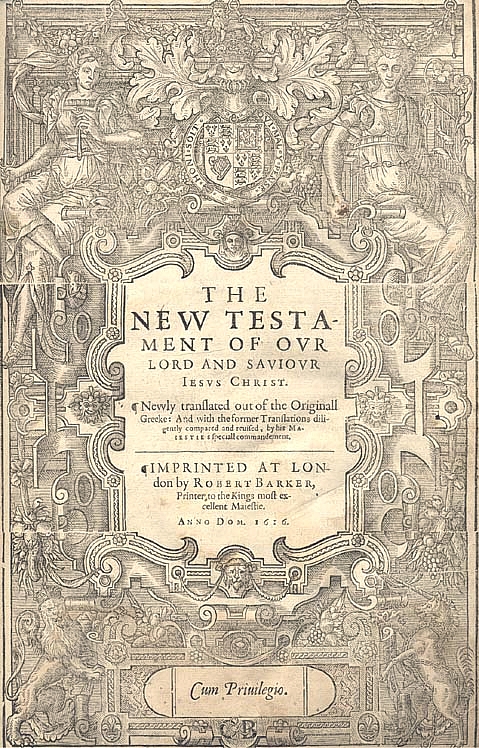
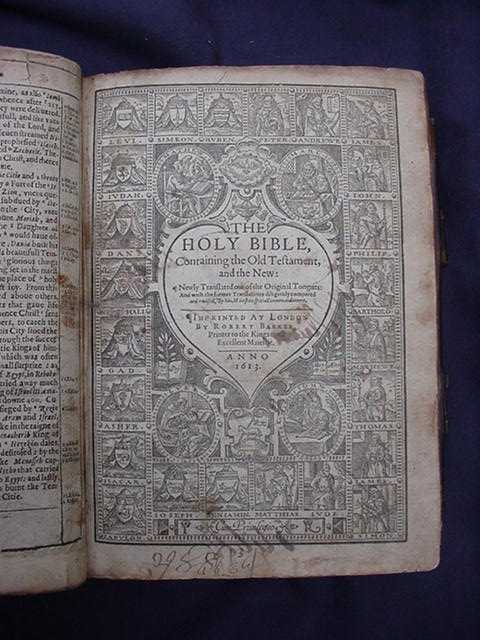
There have been many revisions since the 1611 was published, in a attempt to correct all the errors. Some Revisions were made as early as 1612; and in the 1613 edition. In 1616 an edition improved the reading "approved to death" (I Cor.4:9) to "appointed to death". Also in 1616 there was a edition of the KJV Imprinted at London by Robert Barker, that was only the New Testament [it omitted the entire Old Testament and "Apocrypha" ], it Consisted of 108 pages. Click here to see a scan of the Title page from this NT edition.
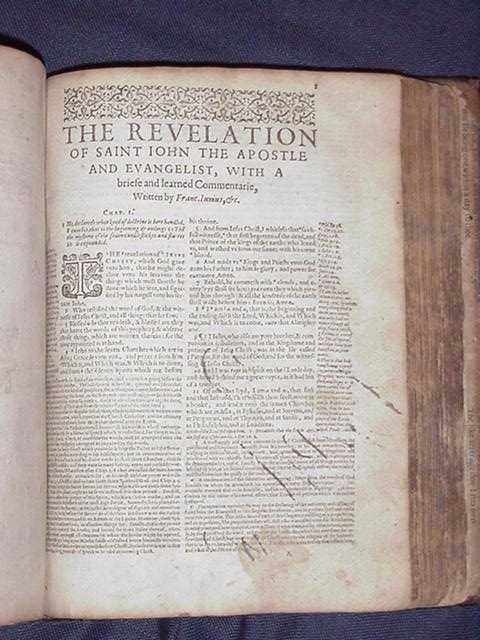
I recently had the opportunity to examine a 1613 edition of the King James Version (printed in London by Robert Barker) which was bound with 'The Revelation of Saint John ... with a briefe and learned Commentarie, Written by Franc. Junius". These are the same commentaries of Rev. found in the the Geneva Bible. Although it most unusual to find this bound up with an early KJV, some did have them.
In 1617 a edition was "Imprinted" at London by Robert Barker containing the Psalms with the annotations of Henry Ainsworth.
In 1622 a New Testament edition of the KJV was Imprinted at London by Bonham Norton and John Bill, what is so unique about this Bible is that it is in a single column format instead of the usual two columns that Bibles printed in at the time. [click here to see a digital photo from this very rear 1622 Bible ]
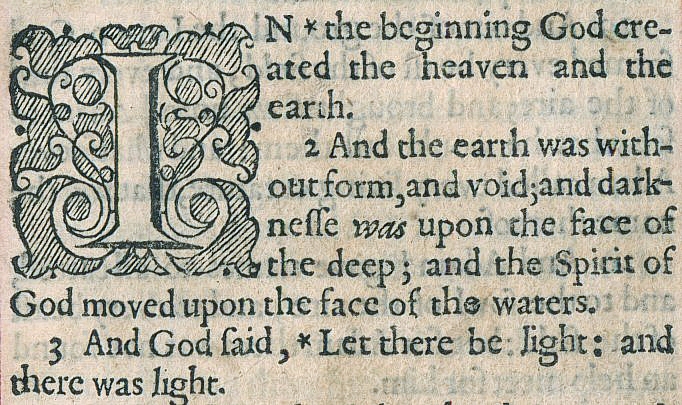
This image is from the 1630 Cambridge printing of the KJV. It may be the best preserved copy of he 1629 revision of the King James Bible. This edition has corrected hundreds of errors that occurred in the 1611 version A more recently printed King James Bible differs from the above original text. The recent printings replace darkneffe with darkness, faid with said, Also, deep; becomes deep. (the semicolon is replaced by a period). Here we find four veriations in the first three verses of Genesis.
The first major revision was done By Dr. Samuel Ward and John Bois, [both of who had worked on the original translation of the King James Version]. It was a attempt to correct the many errors of the King James Version, This first major revision was the 1629 edition of the Bible printed in Cambridge. This revision was completed just eighteen years after the translation.
But still there were problems with the text of the King James Version, and more revisions were needed:
"There were frequent calls for a new translation. A bill to this effect was introduced in Parliament. A committee was appointed to oversee such a revision, but Parliament adjourned before any work could Begin. In 1657 still another committee of Parliament was appointed, but once more no general revision was attempted" (King James History, 1982, Pg. 23)
The four most famous Revisions were released:
There have also been many other minor revisions made to the Kings Bible some of them were in 1644, 1664, 1701, 1744, and 1850. In the nineteenth century, professor Goodspeed has estimated that close to one hundred revisions, most of them the work of one individual or a small group , and mostly of the New Testament, were published between 1611 and 1881.
- The 1629 Revision
- The 1638 Revision [by the command of King Charles I. ]
- The 1762 Revision
- The 1769 Revision
In 1659 The Protestant William Kilburne released a tract in which he stated that when he compared six different editions of the KJV that were published in the 1650s he found about 20,000 errors had crept into them.
The King's Bible was to go through many changes, A unique KJV was Printed in Amsterdam by Stephen Swart in 1633. What makes this edition of the KJV so very different was that it contained the foot and margin Notes from the Geneva Bible. It was these marginal notes that were also the reason for its eventual demise of the Geneva. These strongly Protestant [Calvinistic] notes so infuriated King James that he considered Them "partial, untrue, seditious, and savouring of dangerous and traitorous conceits."
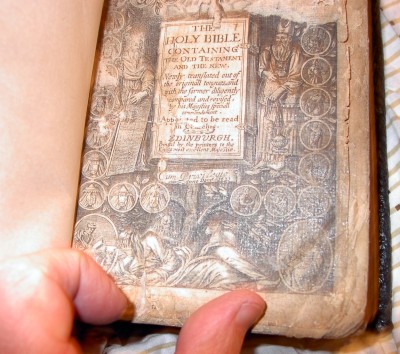
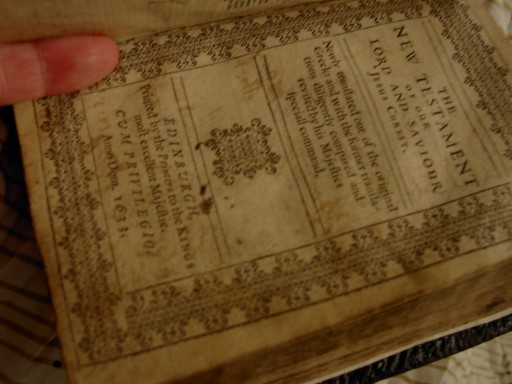
Also in 1633 the first time the KJV was printed in Scotland in Edinburgh, It is thought that publication of this bible is linked to the Coronation of King Charles 1st in Edinburgh that year. Click here and here to see two special digital picture of opening pages from this rare Scottish edition of the King's Bible.
In 1642 Civil war broke out in England, [some call it the "Puritan Revolution"]. During the war Bible printing in England Ceased, but the desire for the Scriptures continued, and many poorly executed, error-filled versions were imported from Holland. In Parliament these Bibles were labeled "corrupt and Dangerous to Religion... and should be burned" (The History of the King James Bible © 1974 p. 162)
Another edition of King James's Bible was printed in octavo at Amsterdam, in 1664, with a preface by John Canne, a leader of the English Brownists. His purpose was to make Scripture the interpreter of Scripture, by the addition of important marginal references "so far as the margin could contain." In England In 1666 appeared the first edition of the Authorized Version from which the "Apocrypha" were omitted, though the vast majority of future editions [until 1890] kept these books. More Changes were made to the King's Bible "many parallel texts" were added by Dr. Scattergood into the 1678 Cambridge edition. Two years later, 1680, an edition was issued at Oxford, with the insertion of Usher's Chronology. In 1685 Richard Baxters made A Paraphrased version of the KJV New Testament, with notes, doctrinal and practical, it was printed in London by Simmons.
THE CHANGES MADE IN THE EIGHTEENTH CENTURY:
The revision made by Dr. Lloyd in 1701 was also disfigured by many errors; and these errors were increased to such an extent, that in 1724 the Church of England passed a ruling that all editors employed by the various approved Printers to work on the KJV, were to be first approved of by the archbishop of Canterbury and the bishop of London.
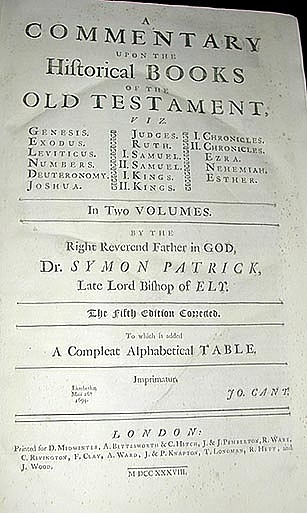
Between 1700 and 1703 we find that some editions of the KJV were printed to included John Foxe’s book of martyrs Known as the "Acts and Monuments". This book [Foxes] has been disproved many times as a pack of lies. In 1731 another revision of the King James Version was published by Dr. Symon Patrick, the late lord Bishop of ELT. This new revision referred to it self simply as "Corrected".
In 1745 William Whiston published a revision of the KJV, Ten years later [1755] another revision was made by John Wesley. Many efforts were made by the publishers of the KJV to promulgate there work, some editions such as the 1755 edition printed by Thomas Baskett were offered as low as "Six shillings unbound".
Dr. Benjamin Blayney, whose 1769 edition best represents the current KJV, said concerning his revision that :
For years afterwards many printings based on Blayney's 1769 revision echoed similar statements on there very Title pages. Many times these printings give us a slightly more detailed account of what specific types of "errors" were corrected by Blayney in 1769, errors such as "seeming contradictions" and "mis-translations". A good example of this is the 1785 King James Version British Family Bible [Printed in London for Alex Hogg & Co.]"many errors that were found in former editions have been corrected, and the text reformed to such a standard of purity, as, it is presumed, is not to be met with in any other edition hitherto extant" [Scrivener, pg. 238,].
"All the difficult and obscure passages are clearly explained, the seeming contradictions reconciled, the mis-translations corrected, former errors rectified"
Another wonderful example of this is the 1790 printing of the KJV by J. Cooke of London, which said:
"In which the most difficult passages are rendered clear and familiar; and seeming contradictions removed; The Mistranslations rectified,"
The editors of the 1769 revision deleated the 113 references to the Apocrypha in the margins of the Old and New Testaments of the King James version as printed in 1611.
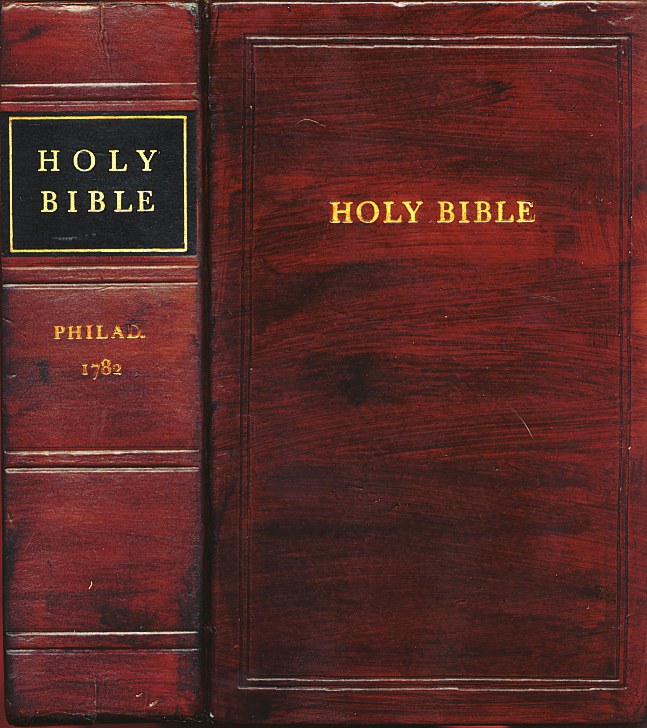
The 1782 Aitken's edition of the Bible . This Bible is Part of the webmaster's collection
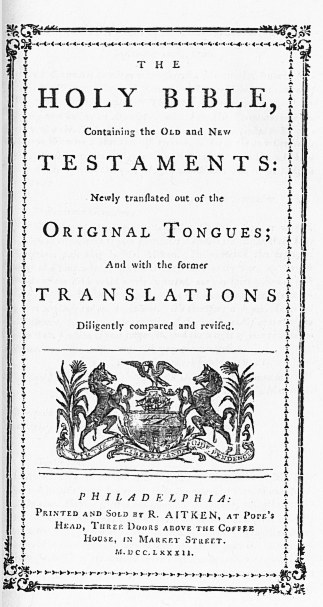
The Title Page of The 1782 Aitken's edition of the Bible.
The first King James Bible to be published in Americas was a new Testament versions printed in 1777 by Robert Aitken, it was not until 1782 that the first complete American edition of the King James Bible. Aitken's KJV Bible was the only Bible ever to be sanctioned by the American Congress.
In 1775 we Find the title page of the "The History of the New Testament" written by the Protestant Thomas Stackhouse [the Late Vicar of Beenham in Berkshire] printed in London, is a very Interesting statement. The Rev. Stackhouse says that his Book explains the:
"difficult texts, rectifying mif-tranflations, and reconciling feeming contradictions." [of the King James Version]
THE REVISIONS OF THE NINETEENTH CENTURY:
In 1811 the self styled "Immaculate Bible" was printed, it was called thus because of the printers [Sir David Hunter Blair and J. Bruce] claim that it more nearly reached perfection than any hitherto printed. This revision fell very short of it's claim's.
In 1824 we find that the King James version was being printed in a whorl wind of confusion and text differences:
"Perceiving the different European copies, even those printed at the universities of Oxford, Cambridge, and Edinburgh, often varied, and some times in the use of important words the publisher deemed it an object of the first magnitude to ascertain if possible, which text was the most correct" [from the preface to the 1824 Stereotyped for Collins & Co. by B & J. Collins. Boston Published by C. Ewer & T Bedlington we find yet another revision of the King James Bible]
Even Noah Webster America's first grammarian and founding father of American education, realized the shabby scholarship of this 1611 edition of the Bible, and took it upon himself to [try to] correct the errors found in it. In 1833 Noah Webster, who had mastered 20 languages including Hebrew and Greek, published a revised version the King's Bible "with amendments to the language". This version is what is known as The Webster Bible.
By the middle of the nineteenth century, Many Protestant had become fedup with the errors of the King James Version and began to call for a New translation of the Bible.
"(By) the mid-1800's, scholars and religious leaders were calling for fresh translations of the Bible. Scholars had more accurate knowledge of the original Hebrew and Greek Biblical texts and so uncovered many errors in the (12th century Greek) texts used by the (1611) King James. Scholars also gained more knowledge of other ancient Near Eastern languages, which added to their understanding of the Biblical languages. In addition, the English language itself had changed greatly over the years." (The World book Encyclopedia 1999)
A very able Committee of the American Bible Society, spent some three years in a diligent and laborious comparison of recent copies of the best edition of the American Bible Society, and of the four leading British editions, namely, those of London, Oxford, Cambridge, and Edinburgh, and also of the original edition of 1611. The number of variations in the text of these six copies was found to be twenty-four thousand.
"The Committee on Versions[1851-56] of the American Bible Society found twenty-four thousand variations in six different editions of the authorized Version." (Our Sixty-six Sacred Books 1946, Pg. 24)
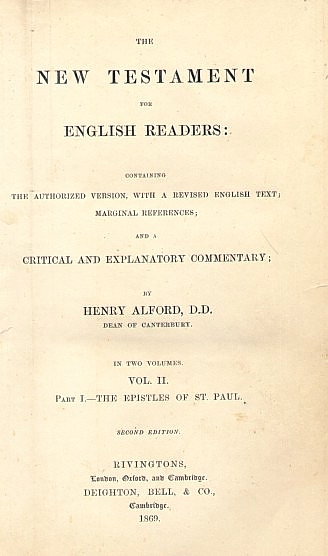
A simple examination of older Bibles would reveal it is was not uncommon in the nineteenth century for editions of the King James Version to acknowledge and advertise the fact that they were not the original 1611 KJV but rather a revision of it. These were some times printed in a sided by side format, one side the 1611, the other side the modern KJV text. A nice example of this is the 1869 English printing of the New Testament.
"The Authorized Version, with A revised English text" (The New Testament for English Readers. Printed in 1869 at London, Oxford and Cambridge. By Deighton, Bell, & Co)
In 1870 William Smith finished the work on his dictionary of the Bible, this Bible Dictionary was soon to become a part of many printings of the King James Version. By 1879 the number of notes in the KJV had multiplied some to the point that some editions [such as the printed by The Richardson Co. of Boston] advertised "100,000 marginal references and readings".
In 1884, Dr. F. H. A. Scrivener, perhaps the greatest authority on the history of the "Authorized Version" (1611 KJV), aptly said concerning the many changes to the King James Version:
"Most readers will be aware that numberless and not inconsiderable departures from the original or standard edition of the Authorized Translation as published in 1611, are to be found in the modern [KJV] Bibles which issue from the press by thousands every year. Some of these differences must be imputed to oversight and negligence, from which no work of man can be entirely free; but much the greater part of them are deliberate changes, introduced silently and without authority by men whose very names are often unknown."
In 1880 the American Bible Society voted remove the "Apocrypha" Books from the King James Version. These 14 Books [There are 155,683 words in over 5,700 verses in 168 Chapters] of the Apocrypha had been part of the King’s bible since 1611. The "Apocrypha" was officially removed from the English printings of the KJV by the Archbishop of Canterbury in 1885 leaving only 66 books.
In 1870. English parliament asks bishops of the Church of England to form a committee for the revision of the King James version. Work was begun on the Revised Vesion of the Bible, this was the first -- and remains the only -- officially authorised revision of the King James Version.
"The King James Version has grave defects. By the middle of the nineteenth century, the development of Biblical studies and the discovery of many manuscripts more ancient than those upon which the King James Version was based, made it manifest that these defects are so many and so serious as to call for revision of the English translation. the task was undertaken, by the Church of England, in 1870. The English Revised Version was published in 1881-1885" (from the Preface to the, Revised Standard Version, published by Nelson )
The work was entrusted to some fifty scholars from various denominations in Britain; American scholars were invited to co-operate, by corrrespondence. The revisers were charged with introducing alterations only if they were required in order to be faithful to the original text. In the New Testament alone more than 30,000 changes were made, over five thousand of them on the basis of a better Greek text. The Revised Version was published in 1885; the Apocrypha came out in 1895. The American Standard Edition, based on the Revised Version, was published in 1901.
THE KJV THROUGH THE TWENTIETH CENTURY AND TODAY:
In 1901 another change to the King James Version occurred, Dr. Klopsch printed the first "Red Letter Edition" [of the KJV]. In Dr. Klopsch's edition had the words of Christ in "key" verse printed in red color letters rather than the standard black color. The basic "Red Letter Edition" today has all the words of Christ in printed in red color letters. In 1909 a new revision of the King James Version was published by Dr. C. I. Scofield the opening page says "Authorized King James Version....Such words Changed in the text as will help the Reader", this edition was revised in 1917 by Dr. Scofield.
Even today there are differences between the KJV published by Oxford, Cambridge, and Nelson publishers, for example:
Oxford, Cambridge, and some Nelson printings have "an hungered" (Matt. 4:2); other Nelson and Zondervan printings have "an hungered";and the American Bible Society printing has "a hungered." The marginal readings and chapter headings of the 1611 edition are often not printed in current printings. why do so many variations exist within the various current editions of the KJV printed by different publishers?
At Jeremiah 34:16, the Oxford KJV has "whom he: while the Cambridge KJV has "whom ye."
One Oxford edition of the KJV has "fleeth" at Nahum 3:16 while a Cambridge edition has "flieth."
At 2 Chronicles 33:19, the Oxford KJV has "sins" while the Cambridge KJV has "sin."
At Nahum 3:16, the Oxford edition has "fleeth" while the Cambridge has "flieth."
The Companion Bible edition of the KJV has "LORD" in at least 133 places where most KJV editions have "Lord."
A present edition of the KJV published by the American Bible Society has many variations or differences when compared to other KJV editions. This ABS edition has "sneezings" (Job 41:18), "rearward" (Jos. 6:9), "since" (Ezek. 35:6), "thoroughly" (2 Tim. 3:17), and "hoisted" (Acts 27:40). The ABS edition of the KJV has "Elijah" (Matt. 16:14), "Hosea" (Rom. 9:25), "Beor" (2 Pet. 2:15), "Uzziah" (Matt. 1:9), "Hezekiah" (Matt. 1:10), etc. There are MANY more differences in the ABS edition.
(For more on this see The English Bible from KJV to NIV: A History and Evaluation by Jack P. Lewis, published by Baker, 1981).