
The Apocryphal Books
This is a refutation of a deceitful Protestant article by the same name written by Baptist named David Cloud. This article is typical of the trash was found at the militant Anti-Catholic BibleBelievers.net and the Way of Life websites.
EZCODE CENTER START
[Mr. Cloud] The word apocrypha is derived from the Greek abscondita, which historically identified writings which had an obscure origin or which were heretical. In the Talmud the Jewish rabbis used this word to describe works which were not canonical Scripture.
Right from the start we find that Mr. Cloud shows his ignorance of the topic. Among the Jew’s the term "Apocrypha" was not necessarily a denial of sacred inspiration of a writing, nor was it necessarily claim that the work was "heretical". The 1905 Jewish Encyclopedia Defines the word Apocrypha as:
The history of the earlier usage of the word is obscure. It is probable that the adjective abscondita "hidden away, kept secret," as applied to books, was first used of writings which were kept from the public by their possessors because they contained a mysterious or esoteric wisdom too profound or too sacred to be communicated to any but the initiated.
Dr. Guthrie BD, MTH, PHD [a Protestant scholar and Lecturer in new Testament, at the London Bible College] tells us:
The Greek term [Apocrypha] means ‘‘hidden’’ and was applied to books which were kept from the public eye and allowed to be read only by a privileged circle . Far from being an opprobrious term, therefore, it connotes the special value of the books so described. It seems to have been so applied to the works of the Jewish seers who were especially active between the 2nd century BC and the 1st century AD. These writings were issued under the name of ancient heroes and prophets of Israel and were kept hidden until those days; even so, they were not for the public but for those worthy to read them.
The Oxford Cambridge edition of the, Revised English Bible, in its preface to the "Apocrypha" tells us:
"THE term `Apocrypha', a Greek word meaning `hidden (things)', was early used in different senses. It was applied to writings which were regarded as so important and precious that they must be hidden from the general public and preserved for initiates, the inner circle of believers."
[Mr. Cloud]
The term has come to be applied particularly to the 15 books added to the Roman Catholic Bible but ordinarily rejected by non-Catholics.
It must be remembered the these Books are not only accepted by the Roman Catholic Church but also the Orthodox, this amounts to the VAST MAJORITY of Christianity.
[Mr. Cloud]
The Council of Trent was an attempt by the Catholic Church to counteract the Protestant Reformation with its battle cry of "faith alone" and "Scripture alone." By adding the Apocrypha to the canon of Scripture, the Catholic Church, in effect, rendered the rest of the Bible impotent.
Here again Mr. Cloud fall in to a common misconception, The Council of Trent did not "add" these books, they simply reaffirmed there place among the scripture. This books had been generally held by Christians as canonical for over a thousand years before Trent made its deceleration.
[Mr. Cloud] It is important that God's people understand why the Apocryphal books (also called the Deuterocanonical Books) are rejected from the canon of inspired Scripture. Because of ecumenical activities involving the Roman Catholic Church, there is an increasing tendency for publishers to include the Apocryphal writings with the Bible. This is being done by the United Bible Societies in many languages. By 1981, for example, the American Bible Society had published over 500,000 copies of the Today's English Version with the Apocryphal books included. In the mid-1980s I visited the Bible Society book depot in Calcutta, India, and was shown massive stacks of Revised Standard Version Bibles containing the Apocrypha. These had been published by the American Bible Society and shipped to India for distribution. The 1992-93 American Bible Society catalog of Scripture Resources lists at least nine different Bibles containing the Apocrypha. .
Here Mr. Cloud shows a severe ignorance of the history of the Protestant Bible, the existence of the "Apocrypha" books in the Protestant Bible is NOT a new thing brought on by any "ecumenical activities" involving the Catholic Church. Just as these books the Protestants call the "Apocrypha" Books were in Martin Luther's Translation and all of the Earlier Protestant English Translations of the Bible which Predated the 1611 KJV.
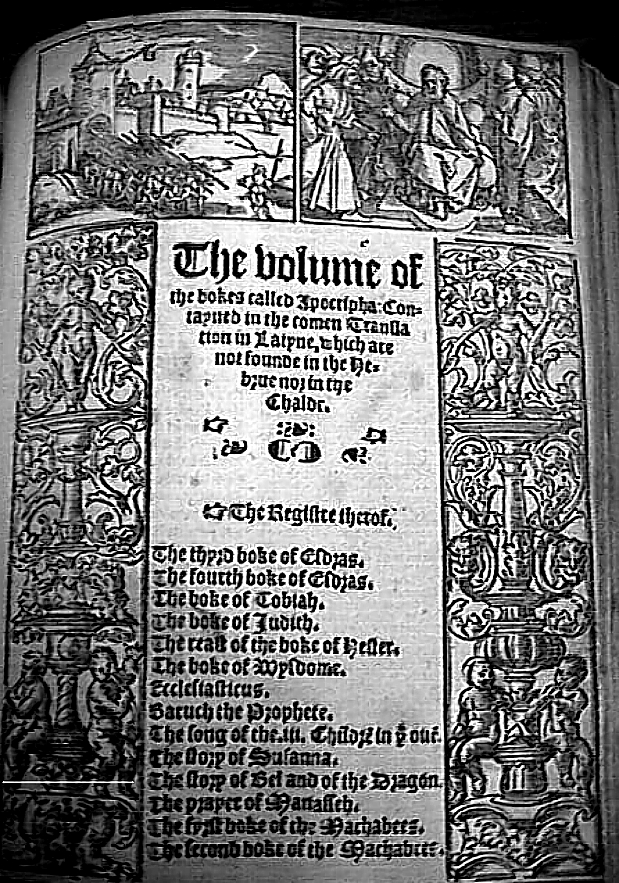 |
| This Scan is the highly ornate title page to the "Apocrypha" books from a 1549 Matthew Bible, printed in London by Jhon Daye |
The truth is, the history of the the "Apocrypha", in the Christian Bible is a long one. They appear in all of the ancient Greek LXX Bible (the Septuagint) of the early Church. the "Apocrypha" were also in the ancient Eastern Aramaic translations ancient Eastern Aramaic translation (called the Peshitta Bible) and the early Latin Bible, before and after Jerome's work of revising it. They passed naturally, as we have seen, into the early German translation of the Latin Bible, made in Bohemia in the fourteenth century, and also into the English translation made by Wyclif and his helpers, in 1382-88.
Coverdale's translation, (in very the first printed English Bible) imprinted in 1534 contained the books called "Apocrypha". And thereafter all the great historic English Bibles followed the same procedure, making these books a separate group, and putting them after the Old Testament-the Thomas Matthew Bible of 1537, the Taverner of 1539, the Great Bible of 1539, the Geneva of 1560, the Bishops' of 1568, the Catholic Douay Old Testament of 1610, and the King James 1611.
Throughout the following centuries we find that in the KJV the Deuterocanonical books have appeared and disappeared in a apparent whirlwind of apparent confession, all depending on the whims of the individual printers. In 1880 the The American Bible Society voted to remove the books they called "Apocrypha" from there Bibles, many printers simply ignored this decision. As Mr. Cloud points out, even the The American Bible Society has since returned to printing there book among many of its Bibles.
Even Today you still can still if you wish purchase the King James Version complete with the Apocrypha, this is again a small list of a few that can be found at Amazon .com:
The Bible: Authorized King James Version with Apocrypha: Published by Oxford University Press; ISBN: 0192835254 (Pub. Date: July 1998)
KJV Standard Reference Edition With Apocrypha: Published by Cambridge Univ Pr (Bibles); ISBN: 0521509467; Slipcase edition (Pub. Date: August 1997)
1611 Edition: a reprint of the 1611 KJV With Apocrypha, Published by Nelson Bible; ISBN: 0840700415; Reissue edition (Pub. Date: June 1, 1982)
King James Version Lectern Edition: Published by Cambridge Univ Pr (Bibles); ISBN: 0521508169; (Pub. Date: March 1998)
The Dake Annotated Reference Bible, Standard Edition: King James Version With Apocrypha, Published by Dake Publishing ISBN: 1558290699 (Pub. Date: April 1996)
We also know that the other Protestant translation have also included these books, for example the 1885 Revised Version, 1961 Dratmouth Bible1970 The New English Bible and the 1989 The Revised English Bible.
[Mr. Cloud]
They are not included in the original Hebrew O.T. preserved by the Jews. Rom. 3:1-2 states that God used the Jews to preserve His Word; therefore, we know that He guided them in the rejection of the Apocryphal books from the canon of Scripture.
To Begin with, Archeology has proven that The Septuagint [The LXX] which contained the "Apocrypha" books had gained a a certain amount of acceptance among the First century Jews of Judea. Portions of the LXX were found in Judea among the Dead Sea Scrolls... which dated to before 70 A.D. Some examples are those found in Cave 4, 119LXXLev. 120papLXX Lev. 121LXXNum. 122LXXDuet. And then there is Q9 [a unidentified Greek LXX text], found in Cave Nine.
In addition to these fragments, is the Greek papyrus fragment found in Cave 7, LXXExod. Qumran cave 7 has also produced many smaller Greek [LXX] fragments, the identifications of which are still debated or unclassified. Dr Emanuel Tov suggests the following identifications for some of these First century B.C. Greek fragments:
7Q4 Numbers 14.23-24
7Q5 Exodus 36.10-11; Numbers 22.38
7Q6.1 Psalm 34.28; Proverbs 7.12-13
7Q6.2 Isaiah 18.2
7Q8 Zechariah 8.8; Isaiah 1.29-30; Psalm 18.14-15; Daniel 2.43; Qohelet 6.3
Among these portions of the LXX were found partial scrolls of what some term the "Apocrypha" books:
4Q478 [Tobit] 4Q383 7QLXXEpJer. [Epistle Jeremiah] to list a few.
It is important to note that in the caves of the Qumran [the "Dead sea scrolls" findings] was found copy [scroll 2QSir] a of the book of Ecclesiasticus (The Wisdom of ben Sira) in the Hebrew . Also A fragment
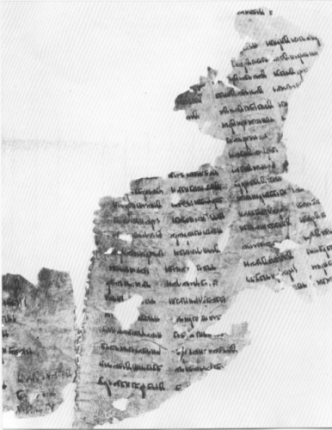 |
| This is a picture is a fragment of the Ecclesiasticus scroll, found in Hebrew language, discovered by Yigael Yadin in the ruins of Masada in the 1960's. |
[scroll 4Q551] The Story of Susanna [ch. 13 of the book of Dan.] in the Hebrew. And in cave four of the Qumran. fragments of the "apocrypha" book of Tobit were found in Cave four. These fragments of the book of Tobit are in Aramaic [scrolls 4Q196-9] as well as Hebrew [scroll 4Q200].
It should be noted that the Qumran caves are not the only place in Judea were some of the "Apocrypha" books have been found. Another example is the copy of the book of Ecclesiasticus (The Wisdom of ben Sira) in the Hebrew was also found in the ruins of Masada. This scroll fragment dates from the early first century BC.
The second reason this argument fails to hold water is because there was NO standardized "Hebrew" Old testament canon until about 90 AD, about thirty years after St. Paul wrote his epistle to the Romans
"The Hebrew Canon of the majority of today's Jews is the Canon that was settled upon by a group of Rabbis meeting in Jamnia [Javneh] in 90 AD. (The Books of The Bible 1997 p.102)
This is born out by the fact that even some OT Books that Mr. Cloud holds a canonical were disputed among the first century Jews of Judea. A good example of this is the book of Esther.
The book of Esther is missing from the collection of manuscripts unearthed in the caves above the banks of the Dead Sea. The absence of Esther from the twenty or so scrolls found among the ruins of Masada and the hideouts used by the rebels of the Bar Kokhba revolt does not raise much of a question, but the absence of Esther from more than 200 biblical scrolls from the caves at Qumran is a bit more curious.
Some evidence that has come to light just recently reveals that the absence of Esther was purposeful rather than accidental. The Qumran calendar texts not generally known before 1991 chart festivals and holy days on the community's 364 day year. The feast of Purim, which has its beginnings in the story of Esther, is missing. As a result, the real question now becomes: Why was Esther rejected?
Several answers might be suggested. First, the mere fact that the story concerns the marriage of Esther a Jew to a Persian king was likely repugnant to the first centuries conservative Jew’s sensibilities. Second, the book itself makes no mention of God whatsoever. Finally, the emphasis on retaliation evident in the final chapters of Esther (chapters 7_9) is contrary to the teachings of the Dead Sea Scrolls: "To no man shall I return evil for evil; I shall pursue a man only for good; for with God resides the judgment of all the living, and he shall pay each man his recompense" (1 QS 10:17_18). Any one of these factors would have provided good reason to reject the book of Esther.
Third, we know that Jewish canon of Javneh was not [and is still not] accepted by all of the Jew:
"Jews in many parts of the Roman Empire ( such as Alexandria and Ethiopia ) refused to accept Javneh's ( 90A.D.) claim of authority" (The Books of The Bible 1997 p.102)
[Mr. Cloud]
They were not received as inspired Scripture by the churches during the first four centuries after Christ.
First of all any credible scholar will tell you that here again Mr. Cloud is wrong,
"They are all, except The Second Book of Esdras, in the Greek version of the Old Testament made for the Greek speaking Jews in Egypt and known as the Septuagint. Gentile converts to Christianity overwhelmingly outnumbered those of Jewish origin, and so the Bible in Greek the international language with the extra books included in it, came to be adopted as the Bible of the early Church, and many early Christian writers quote them as scripture." [The Oxford Cambridge edition of the, Revised English Bible with the Apocrypha, pg. III ]
Secondly, This argument provided by Mr. Cloud is self defeating, for there are many canonical books, which Protestants holds as "inspired Scripture", which were disputed in the church during the first four centuries after Christ, some examples are:
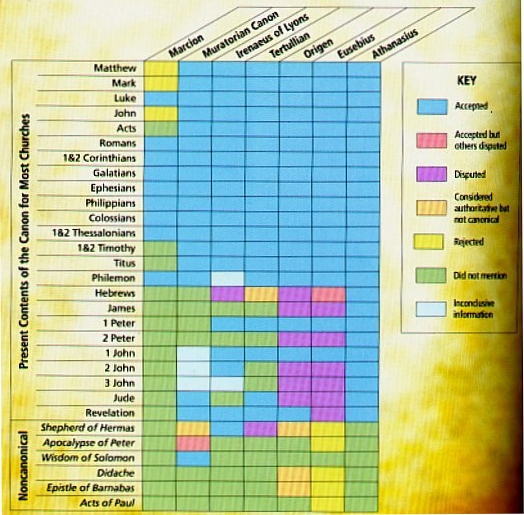
: Irenaeus of Lyons lists it as disputed. Tertullian this epistle as not canonical . Both Origen and the forth century historian Eusebius puts this epistle among the Antilegomena or contested writings. (Hist. eccl., III, 25, 3)Hebrews
The Epistle of James:
In the first centuries of the Church the authenticity of the Epistle was doubted by some, It is wanting in the Muratorian Canon, and because of the silence of several of the Western Churches regarding it, the forth century Christian historian Eusebius classes it amongst the Antilegomena or contested writings (Hist. eccl., III, 25, 3); St. Jerome gives the like information (De vir. ill., ii), but adds that with time its authenticity became universally admitted.Second Peter
: In the first two centuries there is not in the Apostolic Fathers and other ecclesiastical writers, if we except Theophilus of Antioch (180), a single quotation properly so called from this Epistle. In the Western Church there is not explicit testimony in favour of the canonicity and Apostolicity of this Epistle until the middle of the fourth century. Tertullian and Cyprian do not mention it. The forth century Christian historian Eusebius classes it amongst the Antilegomena or contested writings (Hist. eccl., III, 25, 3)Second John
: Tertullian does not list this epistle in the sacred canon. Both Origen and the forth century Christian historian Eusebius puts this epistle among the Antilegomena or contested writings.(Hist. eccl., III, 25, 3)Third John:
Tertullian does not list this epistle in the sacred canon. Both Origen and the forth century historian Eusebius puts this epistle among the Antilegomena or contested writings. (Hist. eccl., III, 25, 3)The Epistle of Jude
: Tertullian does not list this epistle in the sacred canon. Both Origen and the forth century historian Eusebius puts this epistle among the Antilegomena or contested writings. (Hist. eccl., III, 25, 3)The Apocalypse
[or the book of Revelations]: the forth century historian Eusebius the tells us "The Apocalypse is by some accepted among the canonical books but by others rejected" (Hist. Eccl., III, 25, 4). St. Cyril of Jerusalem does not name it among the canonical books (Catech. IV, 33-36); nor does it occur on the list of the Synod of Laodicea, or on that of Gregory of Nazianzus.So we see that if we use Mr. Cloud’s standard for qualifying the canon of the scriptures, we will have to reject far more than Just the the books he calls "Apocrypha". It was not until 367 St. Athanasius of Alexandria published for the first time the definitive list, including all twenty-seven books of the New Testament that we know today. These are the ones, he said; "let no one add to them or take anything away from them." Athanasius's canon was not immediately accepted by many. It was this cannon that was adopted by Pope St. Damasus I in the "Decretal of Gelasius" in 382, and it was confirmed by every subsequent council that took up the question. Finally, in 419, the Second Council of Carthage again confirmed the canon, and this time Pope Boniface promulgated it officially. The New Testament as we know it today was born.
Meanwhile, in the deserts around Bethlehem, St. Jerome was doing a standard Latin edition of the books in this canon. His version, the Vulgate, is still the Church's standard Latin Bible; it was this version that the Catholic Church took into northern and eastern Europe during the great age of monastic missions.
[Mr. Cloud] They were not written in the Hebrew language, which was alone used by the inspired historians and prophets of the OT.
I would like to ask Mr. Cloud upon what does he base his assumption that any books of the Old Testament that are not written in Hebrew are not canonical? If he presumes to base his assumption upon a Bible verse, then I must ask him to provide this verse (or verses if there be more than one), that says that any book of the Old Testament which was not written in Hebrew is not canonical.
As we have already seen Ecclesiasticus (The Wisdom of ben Sira), Susanna [ch. 13 of the book of Dan.] and Tobit were found in the Hebrew among the first century Qumran scrolls. but these books are just the beginning, the Truth be told, the majority of the "Apocrypha" books have now been found in the Hebrew Language. Follow this link for more information.
[Mr. Cloud] They do not claim to be the inspired Word of God. Unlike the inspired Scriptures, the Apocryphal books contain no statements such as "thus saith the Lord" or "these are the words of God."
Is it necessary for the author of a book to lay a claim to inspiration in order for the book to be inspired? If this is so, then let our opponent prove this point through the Sacred Scriptures - which he claims to hold as his sole written doctrinal authority. Furthermore, a claim of inspiration is not proof of anything for or against the book. For even the Koran claims to be inspired -- and I don’t know of any Christian who would want to include that in the Bible on that claim.
Mr. Cloud can't show us where the authors of many of the books of the Old Testament claimed inspiration. A good example is the book of Esther [as found in the Protestant Bibles] which does not even mention God, let alone any claim of his inspiration.
[Mr. Cloud] They contain teachings contrary to the biblical books. II Maccabees teaches praying to the dead and making offerings to atone for the sins of the dead. Consider this quote from II Maccabees 12:43-45: "He also took up a collection ... and sent it to Jerusalem to provide for a sin offering. ... For if he were not expecting that those who had fallen asleep would arise again, it would have been superfluous and foolish to pray for the dead ... Therefore he made atonement for the dead, that they might be delivered from their sin." The Bible, though, says there is only one mediator between God and men, the man Christ Jesus (1 Ti. 2:5-6). Also Heb. 10:10-14 says believers have been perfected forever through Christ's one sacrifice. Thus, the dead in Christ need no human, earthly prayers or offerings. At death the lost go immediately to a place of torment; thus there is no purpose in praying for them (Lk. 16:22-23). II Maccabees also contains the heresy that deceased saints are interceding in heaven for those on earth (15:11-14).
Here Mr. Cloud is resorting to faulty circular logic in his "arguments." He says, basically, in order for a book to be Canonical and Biblical, all the doctrines that it teaches must be reconcilable with what is taught elsewhere in the Bible... but how does he know that the books he is referring to are canonical? How does he know that any of the books in the Bible are canonical? Especially if he uses his above-given "reason" as a determining factor.
The danger of circular logic, is that it is not founded on the pillar of evidence or truth. The same arguments are to be made against the other books of the Bible. "No, the other books of the Bible are not true because they do not match what Maccabees says." The point is, where is the starting point? There is no pillar of truth to sit on. The same argument can be used against the other books of the Bible. For example, in Joshua 2:4-6 the woman lied in order to save the lives of some scouts which Joshua sent out to find out the "lay of the land." And when Joshua’s army took over the city, all the houses of everyone but the woman were burned. The woman was rewarded for her actions! Whereas we see in Exodus 20:16 that lying is forbidden! Does that mean that we should discard Exodus? Or Joshua? According to the circular logic of Mr. Cloud, we must discard one or the other. Which one is it to be?
The point is, when an ignorant person (with no exterior source of truth to appeal to) attempts to build up his own religion through reading a book, there are bound to be misunderstandings. For example, in the above-given case concerning the book of Joshua. At first glance, they look contradictory. But upon further though/reading, it becomes apparent that the woman was not being rewarded for lying, but for saving the life of the two scouts. Period. Hence, it wasn’t contradicting the book of Exodus at all. The same applies to the book of Maccabees. The anonymous authors’ alleged "contradictions" are nothing more than the products of - already blatant (19) - ignorance and circular logic.
Furthermore, I ask the reader to note that the Mr. Cloud is rejecting the Deuterocanonical books on his own private interpretation of the remainder of Scripture. In his opinion, the Deuterocanonical books contradict the rest of the Bible. In his opinion, the Deuterocanonical books are apocryphal, and non-canonical. In his opinion, what they teach is false. What we have here, is not fact... it is merely fallible human opinion. Which one is not obligated to accept and abide by - despite the opinion of the anonymous author to the contrary -, and which are not guaranteed to be without error.
[Mr. Cloud] In quality and style, the Apocryphal books are not on the level of Bible writings. Even a hurried reading of the Apocryphal books reveals the fact that here we are touching the uninspired writings of men apart from divine inspiration. These writings are not "God breathed," as 2 Tim. 3:16 says all Scripture is. There is not in the Apocryphal books the supernatural depth and breadth of thought, the rich complexity yet simplicity of language, which goes beyond mere writings of men.
Now, Mr. Cloud does not wish us to judge these books with regard to the truth of the narration, but with regard to the style and manner of writing. If we read the New Testament we will find were St. Paul said in 2 Corinthians 11:6:
"For though I be rude [I.E. crude] in speech, yet not in knowledge; but in all things, we have been made manifest to you."
So we see style and manner of writing are not sufficient for denial of inspiration, other wise we need to disregard second Corinthians as well - in fact, we should discard all of his Epistles for, as he said, he is crude in speech.
Secondly, Mr Cloud seems to ignore great influence the "Apocrypha" has been over the centuries. Not only have these books inspired homilies, meditations, and liturgical forms, but poets, dramatists, composers, and artists have drawn freely upon them for subject matter. Common proverbs and familiar names are derived from their pages. Even the discovery of the New World was due in part to the influence of a passage in 2 Esdras upon Christopher Columbus. Follow This link for more information .
Third, there are many Protestant scholars who would disagree with Mr. Cloud as to the quality of the "Apocrypha" Books. As the esteemed Protestant scholar Edger J. Goodspeed says about these books:
"Great values reside in the Apocrypha: the Prayer of Manasseh is a notable piece of liturgy; I Maccabees is of great historical value for its story of Judaism in the second century before Christ, the heroic days of Judas Maccabeus and his brothers, when Pharisaism had its rise. The additions to Esther impart a religious color to that romantic story; Judith, Susanna, and Tobit while fascinating pieces of fiction, were meant by their writers to teach important lessons to their contemporaries. Wisdom and Ecclesiasticus are among the masterpieces of the Jewish sages... (the Apocrypha are) important as forming a very necessary link between the Old Testament and the New; and if we had no Old Testament at all, the Apocrypha would still be indispensable to the student of the New Testament, of which it forms the prelude and background... they form an indispensable part of the historic Christian Bible, as it was known in the ancient Greek and Latin churches, in the Reformation and the Renaissance, and in all Authorized English Bibles, Catholic and Protestant." (From the preface to the "American Translation" of the Bible, (C) 1939, printed by the University of Chicago Press )
[Mr. Cloud] The Apocryphal writings are not quoted by the Lord Jesus or the Apostles, while every part of the O.T. Scriptures are quoted. This is a very important point. Though some claim to find allusions to the Apocrypha in certain N.T. passages (Mt. 7:12; 27:43-54; Rom. 9:21; Eph. 6:13-17; Heb. 1:3; Jam. 1:6,19; 5:6), this is not a proven fact. While it is possible that the N.T. writers were familiar with the Apocrypha, it is plain that they did not directly quote from these books. The supposed allusions to the Apocrypha in the N.T. could just as easily be allusions to other O.T. histories or to facts given directly by revelation. We must remember that the N.T. Scriptures are not the product of man, but of God.
First we must ask Mr. Cloud, were is this requirement [that a book must be quoted from in the New Testament ] found in the sacred scriptures? or is this a man made stipulation? They can provide no answer.
Second, If the Mr. Cloud’s position that being quoted by the New Testament writers was acknowledgment of the statues of being scripture is true, than what about the "The Assumption of Moses" [Jude Vs.9] and the "Prophecy of Enoch" [Jude, Vss 14,15 ], are they Sacred scripture? Both are late writings and both are considered "Apocrypha", yet both are quoted by he New Testament writer St. Jude. But we find that no one [Jew or Christian] has ever claimed them as Scripture.
Third, even if what Mr. Cloud said is true - which I do not admit -, it really doesn't prove a thing. For there are fifteen Old Testament books from the Hebrew canon are not quoted at all in the new testament:
Joshua, Judges, Ruth, 2 Kings, 1 & 2 Chronicles, Ezra, Nehemiah, Esther, Ecclesiastes, Song of Solomon, Lamentations, Obadiah, Nahum, and Zephaniah.
If this were truly a requirement for the canonicity of the books of the Old Testament, then we have fifteen more books that we have to throw out - bringing the total up to twenty-two (counting the Deuterocanonicals). We also need to add two new books to the Canon "The Assumption of Moses" and the "Prophecy of Enoch".
[Mr. Cloud] The Apocryphal books were rejected from the canon of Scripture by the early church leaders. "It is a significant fact that the best of the early Fathers adopted the Hebrew canon as giving the authoritative Scriptures of the O.T." (Analytical, p. 1083).
This objection is in essence the same as his objection number two, since we have already addressed it we will move on to the next point.
[Mr. Cloud] The book of Tobit contains many false things. First, there is the account of a supposed high and good angel of God who lies and teaches the use of magic! In Tobit 5:4 we are told that the angel's name is "Raphael," but later he lies to Tobit, claiming to be "Azarias the son of the great Ananias, one of your relatives" (Tobit 5:12).
Let us look at this accusation that the angle lied about his name. A study of the scriptures show that apparitions of angles are not to be examined by the ordinary rules of life. For example they even take the sacred name of God without scruple, as they act in his name [Gen. 31:11]. The Angle Raphael did not lie, for if the angle took the physical form of Azarias; he might therefore might call himself by the name of the man he personated. It is also important to note that the name the Angle chose to use "Azarias" in the Hebrew, means "the help of God"; and Ananias, "The grace of God"
[Mr. Cloud] This angel professes to be "one of the seven holy angels who present the prayers of the saints and enter into the presence of the glory of the Holy One" (Tobit 12:15).
This is not a unreasonable statement, for do we not read in Rev. 8:3-4:
"[An] angel came and stood at the altar [in heaven] with a golden censer; and he was given much incense to mingle with the prayers of all the saints upon the golden altar before the throne; and the smoke of the incense rose with the prayers of the saints from the hand of the angel before God"
[Mr. Cloud] Yet he not only lies about his name, but teaches magic. "Then the angel said to him, `Cut open the fish and take the heart and liver and gall and put them away safely.' ... Then the young man said to the angel, `Brother Azarias, of what use is the liver and heart and gall of the fish?' He replied, `As for the heart and the liver, if a demon or evil spirit gives trouble to any one, you make a smoke from these before the man or woman, and that person will never be troubled again. and as for the gall, anoint with it a man who has white films in his eyes, and he will be cured'" (Tobit 6:4,6-8). The Bible clearly condemns magical practices such as this (consider De. 18:10-12; Le. 19:26,31; Je. 27:9; Mal. 3:5).
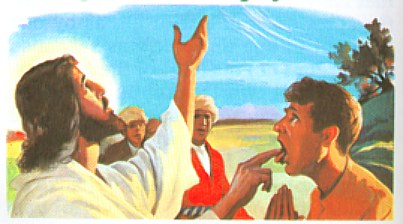 |
The idea of placing the heart of a fish upon the coals the fire so that the smoke would rise up and drive the demons away from the possessed, at first glance, to the uneducated person this may indeed seem like "magic". Let us closely examine this charge of "Magic". First, I ask if it pleases God to give a piece of its fish heart a power against those proud demonic spirits than who is to criticize this action? God sometimes makes use of things as remedies which have, naturally, a different effect; as when Christ put clay on the eyes of the blind man. (John. ix.) The things which the angel Raphael ordered were salutary, by God’s appointment. They could not act directly upon a spirit: but they might upon the person troubled by one, as Saul was relieved by music. The smoke was a sign of the devil’s expulsion and of the efficacy of prayer; or rather, God subjected the proud spirits to such weak elements.
Second The use of "smoke to fend off evil was not foreign to the Jew's loyal to God. A study of the Old Testament would Jews thought the smoke made from compound of sweet guns and spices [called incense] to have purifying effect in times of plague (Nuns. I6:17, ).
[Mr. Cloud] Second, the false doctrine of salvation through works is taught in the book of Tobit. "For almsgiving delivers from death, and it will purge away every sin" (Tobit 12:9). "So now, my children, consider what almsgiving accomplishes and how righteousness delivers" (Tobit 14:11). These false teachings must be contrasted with Lev. 17:11, which says "it is the blood that maketh an atonement for the soul," and with Tit. 3:5 which says, "Not by works of righteousness which we have done, but according to his mercy he saved us, by the washing of regeneration, and renewing of the Holy Spirit."
Again we ask the reader to note that the Mr. Cloud is rejecting the Deuterocanonical books on his own private interpretation of the remainder of Scripture. In his opinion, the Deuterocanonical books contradict the rest of the Bible. In his opinion, the Deuterocanonical books are apocryphal, and non-canonical. In his opinion, what they teach is false. What we have here, is not fact... it is merely fallible human opinion.
Because Mr. Cloud believes that the verses in this ONE book [ Tobit ] do not correspond with personal position of "Faith alone", he wishes us to reject all FIFTEEN books. This is were Mr. Cloud's hypocrisy becomes openly evident. The question we must ask is, are there not other biblical books that Mr. Cloud holds as "Canonical" that agree with Tobit and teach that works are a essential part of our salvation? the Answer is "Yes". The Epistle of James tells us:
"So faith also, if it have not works, is dead in itself. But some man will say: Thou hast faith, and I have works. Shew me thy faith without works; and I will shew thee, by works, my faith. Thou believest that there is one God. Thou dost well: the devils also believe and tremble. But wilt thou know, O vain man, that faith without works is dead? Was not Abraham our father justified by works, offering up Isaac his son upon the altar? Seest thou that faith did cooperate with his works and by works faith was made perfect? And the scripture was fulfilled, saying: Abraham believed God, and it was reputed to him to justice, and he was called the friend of God. Do you see that by works a man is justified, and not by faith only? For even as the body without the spirit is dead: so also faith without works is dead." James.2:17-26.
St. Paul Tells us:
"Though I speak with the tongues of men and of angels . . and though I have all faith, so that I could remove mountains . . . and have not charity, it profiteth me nothing." (I Cor. 13, 1-3)
[Mr. Cloud] Third, Tobit taught that help is only to be given to the deserving. "Place your bread on the grave of the righteous, but give none to sinners" (Tobit 4:17). Contrariwise, in Ex. 23:4-5 God taught even in O.T. times that His people were to do good to their enemies and not only toward the righteous.
This is a sad argument, based on faulty reasoning, in this verse Tobit is not even referring to "their enemies" but "Sinners". the fundamental difference is a "enemy" is some one who us, were as A "sinner" is someone who offends God, so Mr. Cloud's argument does not apply.
[Mr. Cloud] The book of Judith contains the account of how a supposedly godly widow destroyed one of Nebuchadnezzar's generals through deceit and sexual offers.
There is no evidence in among the pages of book of Judith that warrant the accusation that she made any form of "sexual offers". When we read Chapter twelve we note that all of the "sexual offers" were made by Gen. Holofernes. Judith pretends to be pleased by his obviously dishonorable intentions toward her. Her real thoughts are paraphrased in the Anglo-Saxon poem as follows :
"...the Saviour's handmade then/
Gloried, intently mindful how she might/
Take from the hateful one most easily/
His life...."
Do we not read in Genesis chapter 26, how Rebekah and Jacob deceived Abraham in to blessing Jacob and not Esau [the first born]? Does not St Paul [Rom 9:12] tell us this deception was God's will? Does this mean Jacob was not a godly man. are we now to through out the book of Genesis as well?
[Mr. Cloud] It is also important to note that Judith's counsel regarding resisting Nebuchadnezzar was contrary to that given by God's prophet Jeremiah (Jer. 38:1-4). God warned the Israelites to submit to Nebuchadnezzar rather than to resist, because the Babylonian captivity and destruction of Israel was a judgment from God upon the Jew's rebellion and idolatry.
The problem here is obvious, we are discussing two different Kings named Nebuchanezzar.
- Jeremiah : that king is Nebuchanezzar of the Babylonians reigning in Babylon. (Jer. 38:3)
- Judith: that king is Nebuchanezzar of the Assyrians reigning in Nineveh. (Jud. 1:1)
If Mr. Cloud had bothered to honestly read the text of these books he would have seen this fact.
[Mr. Cloud] The King James Bible and the Apocrypha, It is true that early editions of the KJV (as well as many other Reformation Bibles, including the German Luther Bible) contained the Apocrypha, but these books were included for historical reference only, not as additions to the canon of Scripture.
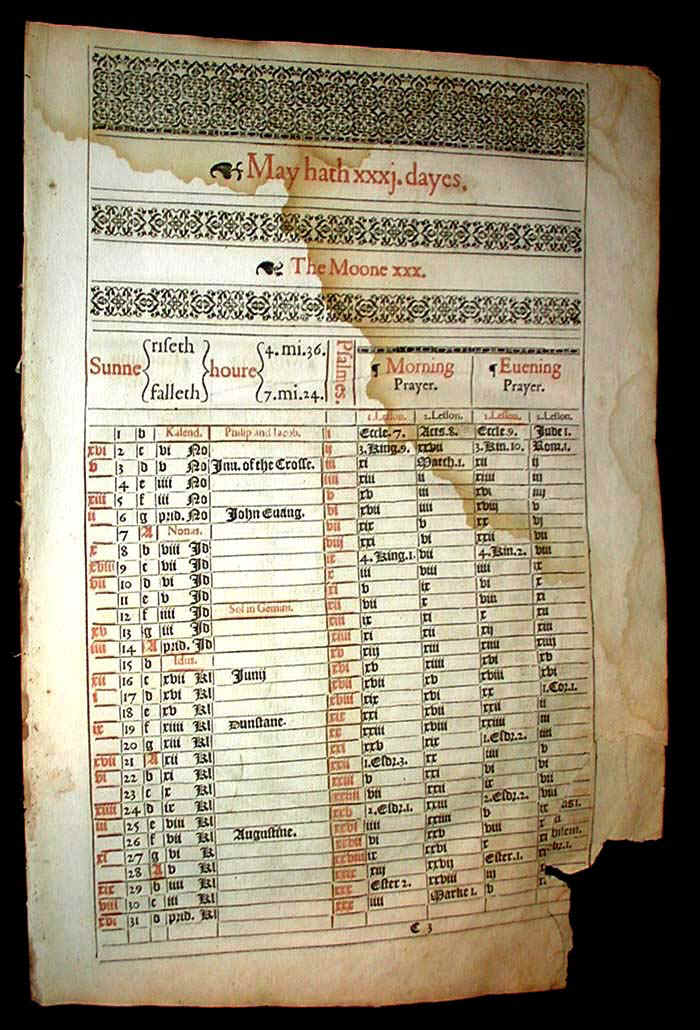
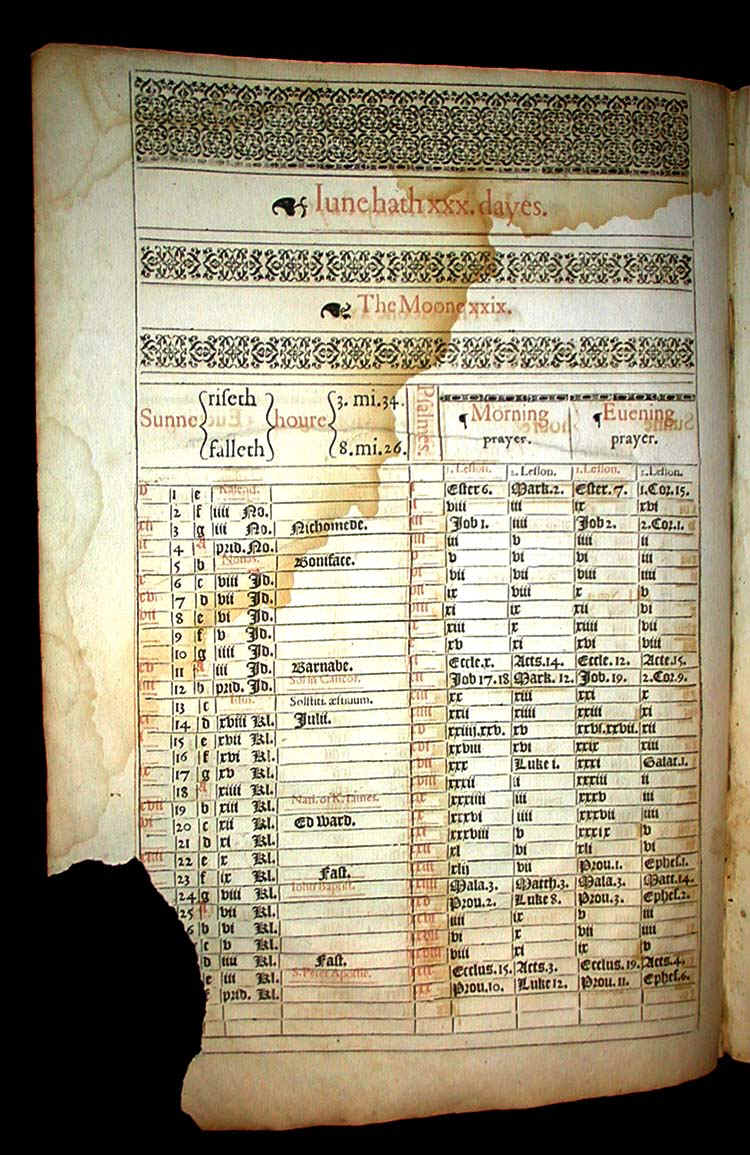
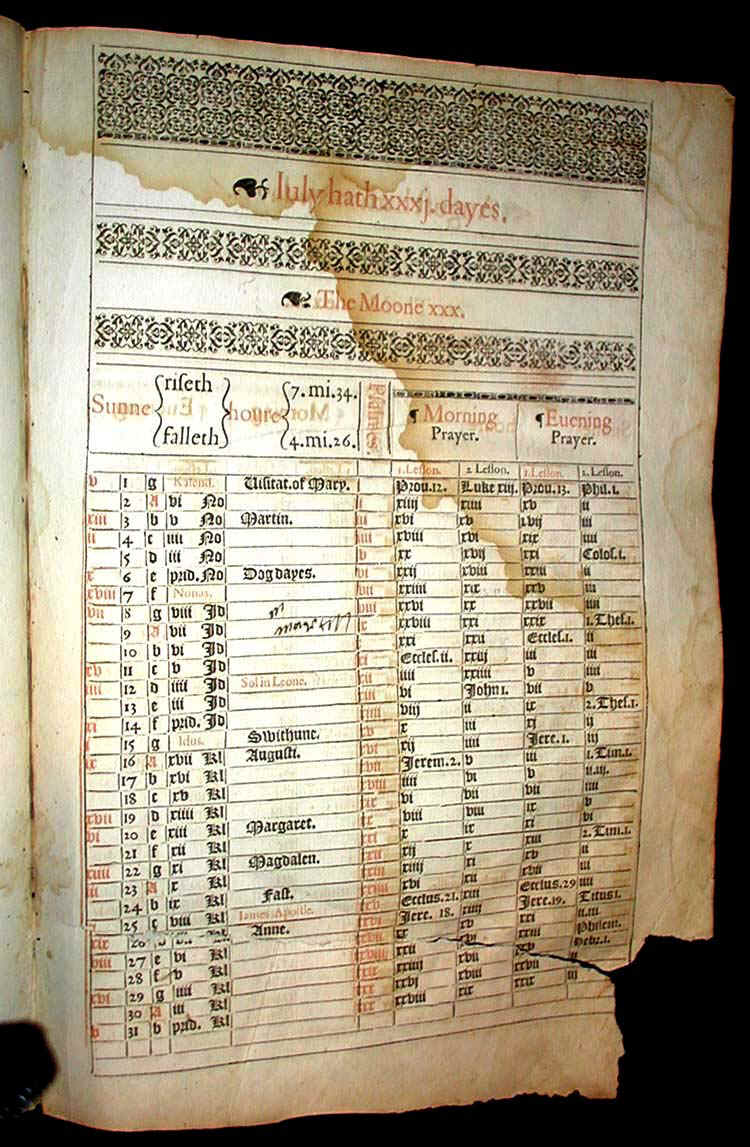
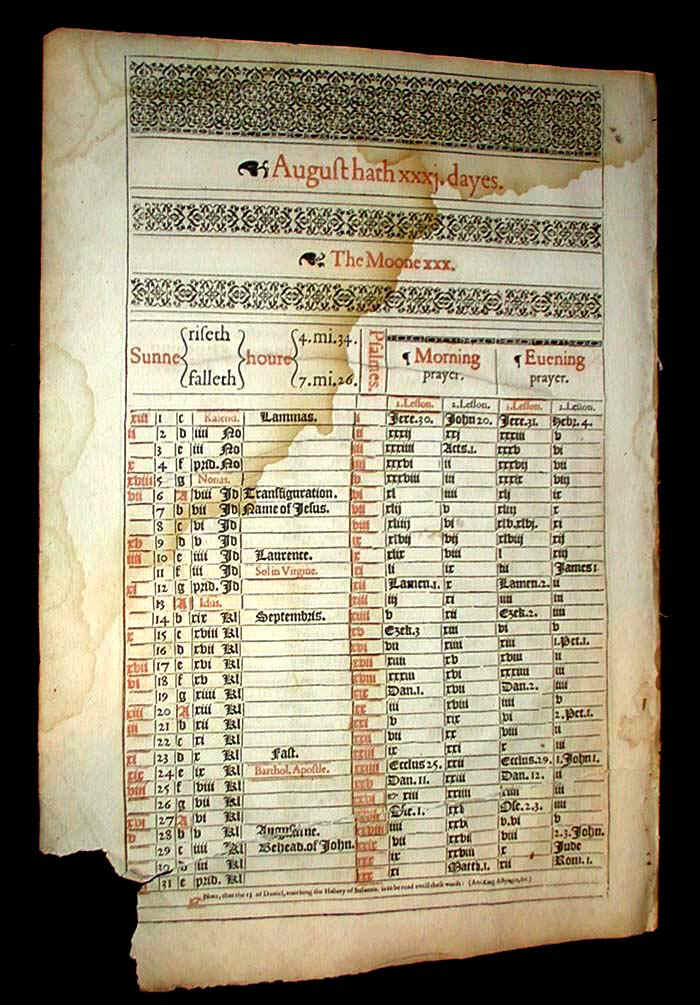
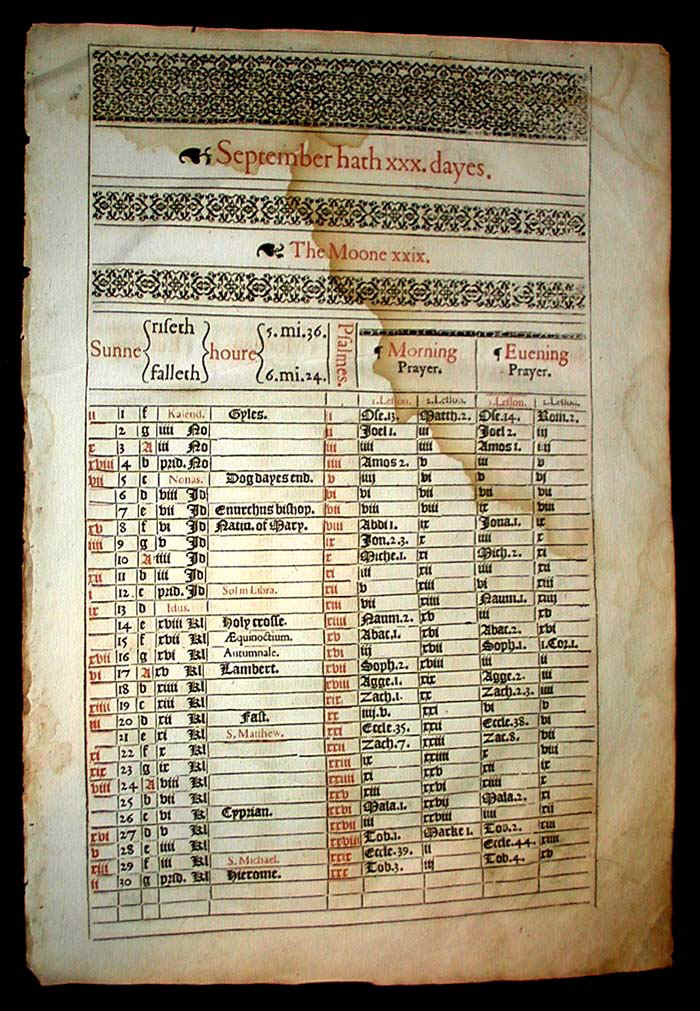
First it is important to note that it is true that these books do have historical value, but this was not the reason for there being placed in the 1611 KJV. Here again Mr. Cloud show his ignorance of the topic, the original 1611 KJV had a calendar for each month of the year. Bellow are scans of the 1613 KJV calendars for the months of:
| May | June | July | August | September | October |
 |
 |
 |
 |
 |
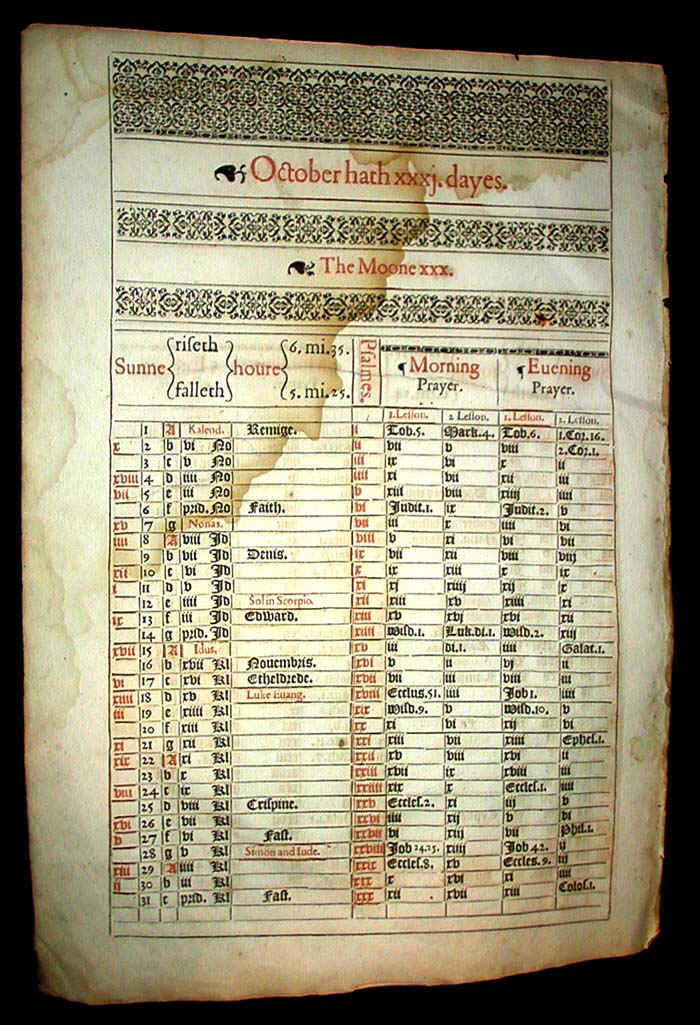 |
All of these leafs were printed by Robert Barker at London, England in 1613. The page size is A HUGE 11" X 16" these are Original leafs from the true Second Folio of the King James Bible. Black and red Letter English language text arraigned in double columns in "Gothic print type".
These calendars contained [shown in the scan above] contained such things as a schedule of Scripture readings for morning and evening prayer which includes passages from the "Apocrypha":
2 Esdras May 27-29;
Judith, Oct. 6-13;
Wisdom, Jan. 25; Feb.3; Feb. 24; Oct. 14-17; Nov. 1;
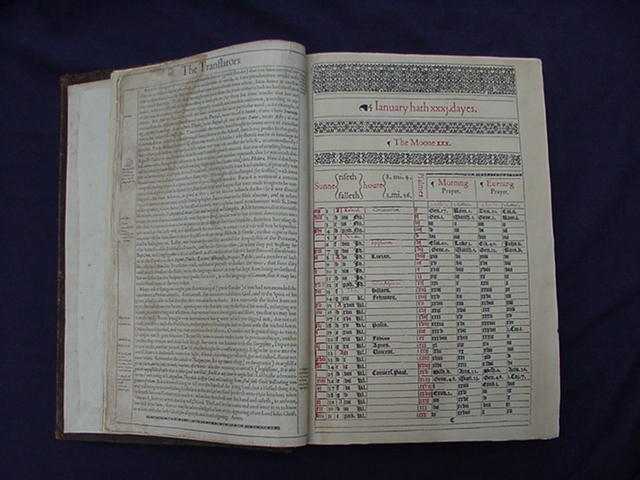
The 1611 KJV encourages rather than discourages the use of the Apocrypha in devotional reading and public worship, which is strange if the "Apocrypha" is not considered in some way inspired and authoritative Scripture. Clearly, the original translators of the 1611 King James Version held the Deuterocanonical books as authoritative or Scriptural, and worthy of public prayer and worship. It is also important to note the occasions of the use of these "Apocrypha" books in the calendars.
We observe the creators of the Kings Bible chose to use the book of "Ecclesiasticus" and "Wisedome" for Public prayer on the special holy days and for many of the days in honor of the Apostles of Christ, some examples are:
Jan. 25 is the holy-day in honor of the "Conuerf [conversion] of Paul" the book of "Wisedome" was chosen
Feb. 2 is the holy-day in honor of "Purification of Mary" the book of "Wisedome" was chosen
Feb. 24 is the holy-day in honor of "S. Matthias" the book of "Ecclesiasticus" was chosen
Jun. 29 is the holy-day in honor of "S. Peter Apostle" the book of "Ecclesiasticus" was chosen
July 25 is the holy-day in honor of "S. James Apostle" the book of "Ecclesiasticus" was chosen
Aug. 24 is the holy-day in honor of "S. Barthol. Apostle" the book of "Wisedome" was chosen
Oct. 18 is the holy-day in honor of "S. Luke. Apostle" the book of "Wisedome" was chosen
Nov. 1 is the holy-day in honor of "All Saints" the book of "Wisedome" was chosen
[Mr. Cloud] Alexander McClure, a biographer of the KJV translators, says: "...the Apocryphal books in those times were more read and accounted of than now, though by no means placed on a level with the canonical books of Scripture" (McClure, Translators Revived, p. 185).
If this were so than why did the translators of the 1611 KJV hold that eleven times Christ and the Apostles referred to or quoted from the "Apocrypha" books. The translators cross-referenced these eleven New Testament passages with the Apocrypha.
| Mat 6:7 | Ecclesiasticus 7:14 |
| Mat 23:37 | 2 Esdras 1:30 |
| Mat 27:43 | Wisdom 2:15-16 |
| Luke 6:31 | Tobit 4:15 |
| Luke 14:13 | Tobit 4:7 |
| John 10:22 | 1 Maccabees 4:59 |
| Rom 9:21 | Wisdom 15:7 |
| Rom 11:34 | Wisdom 9:13 |
| 2 Cor 9:7 | Ecclesiasticus 35:9 |
| Heb 1:3 | Wisdom 7:26 |
| Heb 11:35 | 2 Maccabees 7:7 |
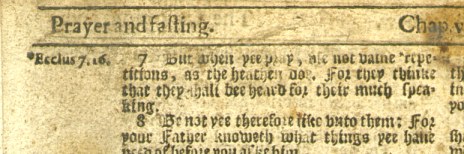
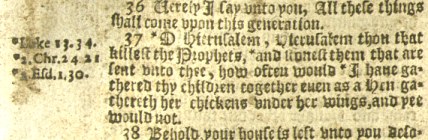
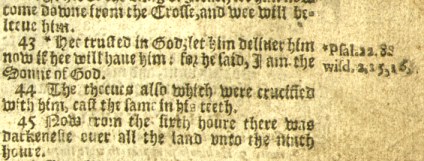
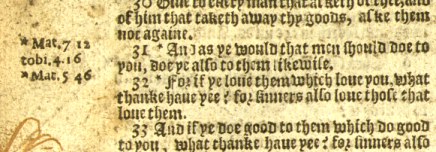
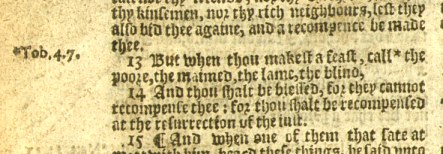
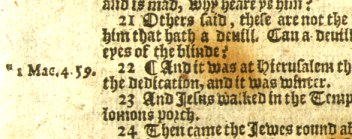
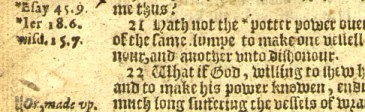

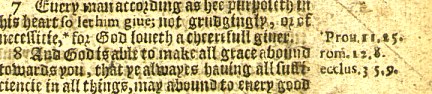
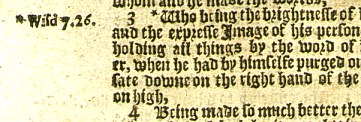
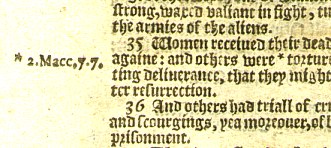
The above links are to images taken from the 1625 King James Version, Printed by Bonham Norton and John Bill The "printers to the Kings moft excellent Majestie". This Bible is part of my collection.
If we look over the pages "Apocrypha" books in 1611 King James Version we find over 840 times the translators cross-referenced these books to those of the "ligament" canon. This is a clear sign that these books were held as Sripture by the translators. We find in the general rules set forth By King James himself for the translation of this Bible that these cross-referencing were only allowed for "one Scripture to another" :
"7. Such Quotations of Places to be marginally set down as shall serve for the fit Reference of one Scripture to another." [As found in "The Church History Of Britain" by Thomas Fuller, Oxford, M.DCCC.XLV]
And last, we know for a fact, that the translators held these books as sacred and wish them to be part of there Bible, by the measures they took to keep part of the KJV. In 1615, the Anglican Archbishop [George] Abbott, a High Commission Court member and one of the original translator of the King James Version, "forbade anyone to issue a Bible without the Apocrypha on pain of one year's imprisonment" (Moorman, Forever Settled, p. 183).
[Mr. Cloud] He [Alexander McClure] then lists seven reasons assigned by the KJV translators for rejecting the Apocrypha as inspired.
Not so, in his 1858 book the "Translators Revived", Alexander McClure assigns the reasons that he believed were why the 1611 translators might have rejected these books. This listing has been answered by Catholics many times, follow this link to see a one such refutation.
[Mr. Cloud] The Thirty-nine Articles of the Church of England clearly states that the Apocrypha have no scriptural authority. "...[the Church of England] doth not apply to them to establish any doctrine."
Actually, the text does not say they held these books as no having scriptural authority. What it say's is that they do "not use "to them to establish any doctrine." in other words they held them to have no doctrinal authority, the difference is obvious. This fact is born out in that the 1611 KJV encourages the use of the Apocrypha in devotional reading and public worship.
[Mr. Cloud] The Westminster Confession says, "The books commonly called Apocrypha, not being of divine inspiration, are no part of the canon of the Scripture; and therefore are of no authority in the Church of God, nor to be any otherwise approved, or made use of, than other human writings."
Here again Mr. Cloud shows his ignorance, the two main reasons why the Westminster Confession does not apply the 1611 King James Version are:
- The Westminster Confession was put together by The 121 English Puritan ministers, It affirmed a strong Calvinistic position. Whereas the KJV was translated by the Anglican Church.
- The Westminster Confession of Faith was completed in 1646 this was thirty-five years after the KJV was translated.
[Mr. Cloud] Luther included a note on the Apocrypha which stated, "These are books not to be held in equal esteem with those of Holy Scripture..."
In the first place as we have already shown the 1611 KJV was translated by the Anglican church not the Lutherans.
Second, so what if Luther did not hold the Apocrypha books with high regard, for Luther also rejected several books of the new testament as well. If we look at Luther's German translation of the Bible, he took Hebrew, James, Jude and Revelation and placed them at the end of the New Testament. He categorized them as inferior to the rest of the Bible. The book of James which contradicts Luther's principle of Justification by Faith Alone. James 2:24 says "See how a person is justified by works and not by faith alone." Rather than change his theology, Luther just denied that, James the Apostle, was the author of James and removed it from his canon.
For more on this Visit : Did The 16th Century the Protestant "Reformers" Reject Parts of The New Testament?:
[Mr. Cloud] It is important to note that in the early King James Bibles the Apocryphal books were placed between the Old and New Testaments rather than intermingled within the O.T. itself as is done in Catholic Bibles. In the Jerusalem Bible (a Catholic Bible), for example, Tobit, Judith, and the Maccabees follow Nehemiah; the Book of Wisdom and Ecclesiasticus follow Ecclesiastes; Baruch follows Lamentations; etc.
First, Mr. Cloud seems to have fallen in to a common
misconception, the truth is in the early
King James Bibles the Apocryphal books were NOT placed between the Old and New
Testaments, they was placed at the end
of the Old Testament. 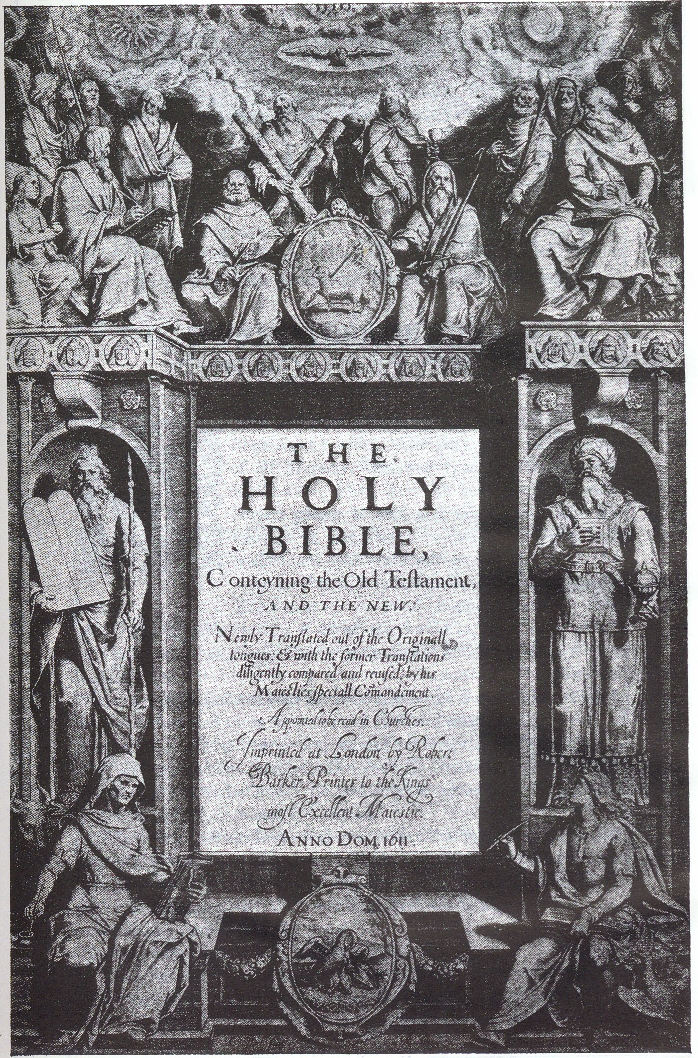 If we examine this scan of the beautify engraved title page of the
1611 KJV we see it Simply say " The Holy Bible, Conteyning the Old testament,
and the New" with no designation separating the "Books called Apocrypha"
from the Old Testament. The creators of the 1611 KJV went to great lengths to form a
separation between the Old and New testament even placing a special elaborately engraved
title page marking the beginning of the New testament. Yet they placed NO SUCH distinction
between the end of the Old Testament and the "Apocrypha". Again this show
acceptance of these Books as part of the Old Testament.
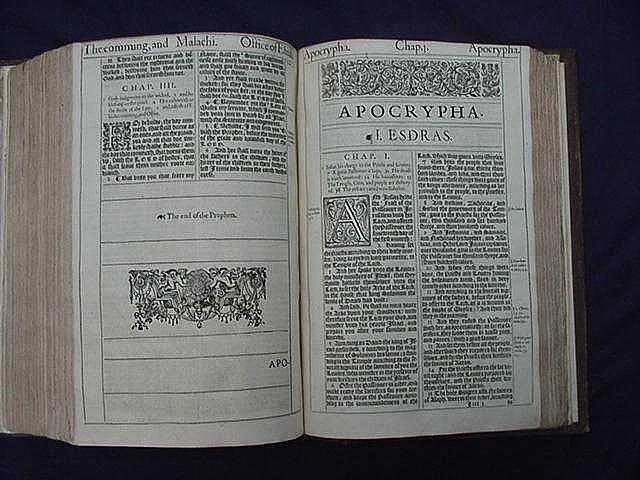
Another example of this is at the wording found at the bottom of the last page of the book of Malachi, [which most Protestants today consider the end of the Old Testament], just before the beginning of the First Esdras, we find the words "The end of the Prophets". As we can see the translators did not designate this as the end of the Old Testament [which they could have], they simply called it the end of the books of the Prophets, a grouping of books of the Old Testament. Click on the following link to see a photo of this point, the image is from a original 1611 printing of the King James Version printed by Robert Barker: Click here to see the image.
Second, the order of the sacred books of the Bible proves nothing, it is not a admission or denial of anything, nor does it determine the importance of any book. God never set forth any specific order of books for us to follow, a simple examination of the Jewish OT in comparison to that used in the Protestant Bible shows this:
The Jewish Bible (or Tanak) contains twenty-four books in three sections: the Torah, the Prophets, and the Writings.
The Protestant Old Testament contains the same books as the Tanak, but in four sections and in a different order: the Pentateuch, the Historical Books, the Poetical Books, and the Prophets. In addition, the Protestant canon contains thirty-nine books, not twenty-four, because it counts separately several books that comprise single books in the Jewish Bible. For example, the one Book of the Twelve Minor Prophets in the Jewish canon becomes the twelve books of the Minor Prophets in the Protestant Bible.